Foggia, Puglia
Fave e cicorie
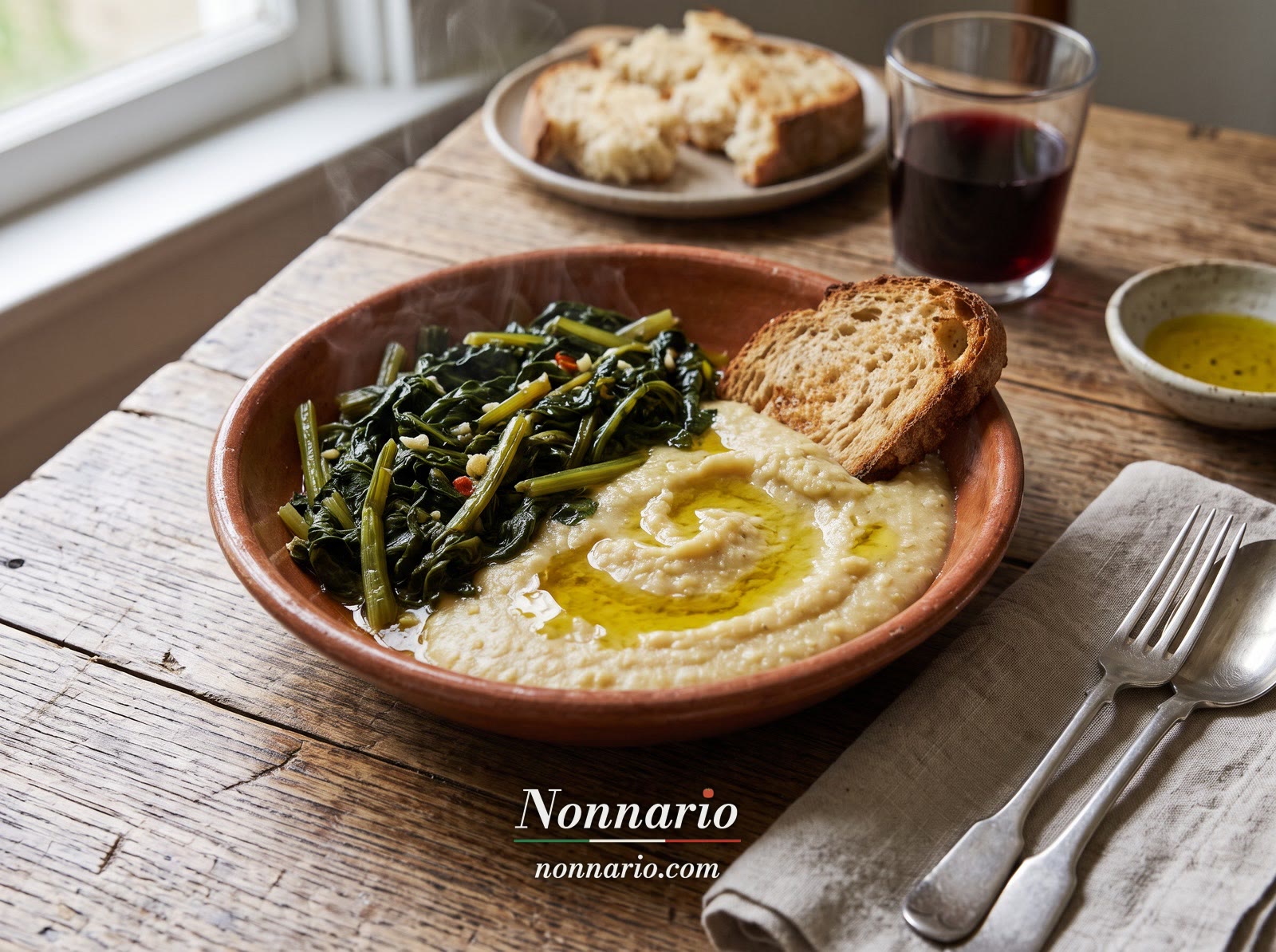
Purée of dried broad beans with boiled wild chicory and raw olive oil
Apulia's purée of dried skinned broad beans, soaked overnight and cooked slowly for hours until they fall apart, beaten with olive oil and served on boiled wild chicory with more raw oil poured over.
- Course
- ContorniSide Dishes
- Serves
- 4
- Hands-on
- 21 min
- Cooking
- 3 h 15 min
- Plan
- 2 days
The video and the photos of every step are also gathered on a separate page.
In breve
In short
Also called 'ncapriata, fave bianche e cicorie, fave e cicoria, fae e foje, fae nette e foje, fae janche e cicore, favi e fogghi, fae e fogghie, broad beans and chicory and fava bean purée with chicory.
- Vegetarian
- Vegan
- Gluten-free
- Dried broad beans, skinned, soaked at least 12 hours, then cooked about 3 hours over low heat until they fall into a purée.
- The purée is beaten with a wooden spoon while olive oil is drizzled in: dense and soft, but still a little grainy.
- Chicory, wild where possible, boiled apart in lightly salted water until tender, then laid as a bed under the purée.
- Only four ingredients: broad beans, chicory, extra virgin olive oil and salt, with more raw oil poured over each plate.
La provenienza
Where this recipe comes from
Fave e cicorie is a purée of dried broad beans, skinned and cooked slowly, traditionally in an earthenware pot, the pignatta, and served with wild greens boiled apart and dressed with raw olive oil. In dialect it has many names: fae e foje, fae nette e foje, favi e fogghi, 'ncapriata. It is made across the whole of Apulia, all year round, and has been on Italy's national list of traditional food products since 2006; it is a fixture of restaurants, trattorias and farm restaurants, and has festivals of its own, at Montemesola near Taranto and in the Gargano. Its origin is described as very old: the broad bean gave substance to the frugal Apulian table, and the dish of beans and chicory became part of the region's food identity. By one account the name 'ncapriata comes from a Greek dish called kapiridia.
There is no official recipe. We compared 10 sources and publish the most widely recognised version, as it is made in the Daunia, the province of Foggia: dried beans soaked for at least 12 hours and cooked for about 3 hours in lightly salted water over low heat, beaten into a purée with olive oil, and served on a bed of chicory boiled apart, with raw oil over the top. Most of the recipes agree on dried skinned beans, a long soak and slow cooking until the beans collapse when stirred, with the chicory boiled apart and raw extra virgin olive oil. They differ on how long the beans soak and cook, on a potato in the purée, on bay leaves in the pot and on blending rather than beating. It is served as a vegetable dish, and is also eaten as a meal on its own. The amounts of oil, the water level and the time for the chicory are this page's own.
- Provenance
- A regional tradition documented in cookbooks and local practice, with no single official text.
- Defined by
- Apulian tradition
- Reference
- Compared across 10 sources, listed below; this page publishes the most widely recognised version.
- Sources
- Accademia Italiana della Cucina: ‘Fave e cicorie’ as made in the Daunia, its recipe collection (Italian)
- University of Bari, with funding from the Regione Puglia: PAT Puglia, the atlas of Apulia's traditional food products, ‘Fave bianche e cicorie’ (Italian)
- GialloZafferano: its recipe of fave bianche e cicorie, as republished by PAT Puglia (University of Bari) in ‘Il dolce e l’amaro di Puglia’ (Italian)
- University of Bari, PAT Puglia: ‘Capriata’, the version of Gravina in Puglia (Italian)
- University of Bari, PAT Puglia: ‘Fave novelle e cicorie’, with fresh broad beans (Italian)
- Ministry of Agriculture (MASAF): the national list of traditional agri-food products, 25th revision, 2025 (Italian)
- Gambero Rosso: ‘Fave e cicoria’, its recipe (archived copy of 14 October 2025) (Italian)
- Dissapore, online food magazine: ‘Fave e cicoria’, 2023 (Italian)
- Istituto Superiore di Sanità (ISS), Italy's national public health institute: ‘Favismo’, on its ISSalute portal, 2022 (Italian)
- USDA Food Safety and Inspection Service: Leftovers and Food Safety (archived copy of 29 May 2025)
Ingredienti
Ingredients
The original recipe serves 4
For the purée
For the chicory
To serve
Equipment
- A large bowl for soaking the beans
- A heavy-based pot of about 3 l with a lid, or an earthenware pot (pignatta) on a flame diffuser
- A large pot of about 5 l for the chicory, and a colander
- A wooden spoon, a skimmer or slotted spoon and a sharp knife
- A kettle of boiling water for topping up the beans
- Four soup plates, warmed
Preparazione
Method
Scaled to 4 servings: the amounts in the steps follow. Pot and pan sizes and cooking times are still for the original 4.
Two days, with little work on the first. The evening before: put the beans to soak (12 hours). On the day, about 3 1/2 hours, nearly all of it unattended: the beans cook for about 3 hours. Put the chicory water on and clean the chicory about 40 minutes before the beans are done, so it comes out of the pot as the purée is beaten. The purée can also be made the day before: in the fridge within 2 hours of cooking, and eaten within 3 days of cooking.
- 21 minhands-on
- 3 h 15 mincooking
- 2 daysfrom start to table
The evening before: soak the beans
-
Rest 12 h
Put the 300 g of skinned dried broad beans in a sieve and rinse them under cold running water, picking out any dark beans, bits of skin or grit. Tip them into the bowl, cover them with plenty of cold water, at least three times their volume, and leave them for at least 12 hours, overnight.
Check The beans have swollen and soaked up much of the water; break one in half: it is pale and moist right through.
Tip Our guide: if the room is warm, soak them in the fridge.
Tip Our guide, for safety: people with G6PD deficiency (favism) should not eat broad beans. Two substances found only in broad beans, vicine and convicine, can destroy their red blood cells, with symptoms from a few hours to 1–3 days after eating them.
The beans: about 3 hours
-
Hands-on 2 min
Drain the beans, throw away the soaking water and rinse them well under cold running water.
-
Cooking 10–15 minHeat medium
Put the beans in the heavy-based pot and pour in fresh cold water to cover them by about 2 cm. Salt it lightly, about 5 g per litre. Bring it slowly to the boil over medium heat; as it comes up, a grey foam rises: lift it off with the skimmer.
Check The water is just boiling and the foam has been skimmed away.
Tip Our guide: in an earthenware pot, put a flame diffuser under it and bring it up gently, never over a high flame.
-
Cooking 2 hHeat lowest
Turn the heat to its lowest so the surface barely trembles, put the lid on slightly ajar and leave the beans to cook for 2 hours without stirring. Look at them every half hour: whenever the beans are no longer covered, pour in a little boiling water from the kettle.
Check After 2 hours the beans are very soft and starting to break up, with a little cloudy water still around them.
Tip Our guide: add only as much water as you need to keep them just covered; too much water makes a runny purée.
-
Cooking 1 hHeat lowest
Keep cooking over the lowest heat for about 1 hour more, now stirring every 10 minutes with the wooden spoon and scraping the bottom, and stop adding water. The beans collapse and thicken as the water is taken up.
Check Stirred with the wooden spoon, the beans break up easily into a coarse purée, and no loose water is left at the bottom of the pot.
Tip Stir right to the bottom: the thick purée catches easily, and a scorched taste runs through the whole pot.
Tip Our guide: if the purée is still loose at the end, take the lid off for the last 15 minutes; if it is dry and sticks before the beans have collapsed, add a few spoonfuls of boiling water.
The chicory
Start about 40 minutes before the beans are done, so the chicory is ready as the purée is beaten.
-
Hands-on 1 min
Bring about 3 l of water to the boil in the large pot, covered, over high heat, and salt it lightly, about 5 g per litre. It takes 15–20 minutes, while you clean the chicory.
-
Hands-on 10–15 min
With the knife, cut off the hard pale base that holds each head of the 400 g of chicory together, and pull away any yellow, damaged or tough outer leaves. Wash the leaves in a bowl of cold water, lifting them out so the soil stays behind, and repeat with fresh water two or three times.
Check The last water stays clear, with no grit at the bottom of the bowl.
Tip Our guide: wild chicory often carries soil in the base of its leaves; wash it until no grit is left.
-
Cooking 5–10 minHeat high
Drop the chicory into the boiling salted water, push it under with the wooden spoon and stir it now and then. Boil it for 5–10 minutes, uncovered, until the stems are tender.
Check The tip of a knife goes easily into the thickest stem, and the leaves are tender but still hold their shape.
Tip Our guide: small, tender leaves are done in about 5 minutes; thicker wild stems need the full 10.
-
Hands-on 2 min
Drain the chicory in the colander, press it lightly with the back of the wooden spoon to let out some of the water, and keep it warm in the pot, off the heat, with the lid on.
Check No water runs from the chicory when you tilt the colander.
Purée and serve
-
Hands-on 3–5 min
Take the pot of beans off the heat. Beat them hard with the wooden spoon while you pour in the 3 tablespoons of olive oil in a thin stream, a little at a time, working the purée against the side of the pot until all the oil is taken up.
Check A dense, soft purée that holds its shape on the spoon, glossy with oil, still a little grainy.
Tip Our guide: if it is too stiff, beat in a spoonful of boiling water; if it is too loose, put it back over the lowest heat for a few minutes, stirring all the time.
-
Hands-on 1 min
Taste the purée and add a little salt if it needs it, beating it in.
Check Pleasantly salted: the sweetness of the beans comes through, not flat.
-
Hands-on 2 min
Lay a bed of chicory in each warm soup plate and spoon the hot purée onto it. Pour about a tablespoon of raw olive oil over each plate, using the 4 tablespoons, and serve at once.
Check Every plate has its green bed, the purée on top, and the raw oil running over both.
Tip It is eaten with toasted country bread.
Tip Leftovers: into the fridge within 2 hours, in shallow covered containers, and eaten within 3 days of cooking. Reheat the purée in a pan with a spoonful of water, stirring, and the chicory in a covered pan, until both are steaming hot all through (at least 75 °C).
The essentials, for cooks who know the dish. Switch to Detailed for quantities, temperatures, times and checks at every step.
Press “I’m here” on the step you are on, and again when it is done.Tap the pin on the step you are on, and the tick when it is done. Timers keep running while you scroll.
Da sapere
Good to know
- WhenQuando
- Made all year round; in summer, with frozen greens. Source
- KeepingConservazione
- Boiled chicory and bean purée both keep in the fridge in a covered container. If you mean to keep some of the purée, leave it a little looser: it dries out slightly as it rests. Source
- VariantsVarianti
- With potato: In some parts of Apulia a boiled potato is worked into the purée to make it looser. Source
- Worked together: Elsewhere the beans and the chicory are worked together before they are served. Source
- With olio santo: Dressed with olio santo, olive oil in which hot chillies have been left to infuse. Source
- Capriata: The version of Gravina in Puglia: the beans soaked for an hour and cooked to a soft cream with sliced onion, bay leaves, two whole garlic cloves, salt and oil; the boiled wild chicory goes into oil fried with garlic and chilli, then the purée joins it to take the flavour. Source
- Fave novelle e cicorie: In late winter and spring: fresh broad beans, too big to eat raw, boiled in salted water until their skins wrinkle, with chicory boiled apart, dressed with olive oil. Source
Errori comuni
Common mistakes
- Cutting the soak short: the beans need at least 12 hours in cold water.
- Cooking the beans fast: over a brisk heat they catch on the bottom before they fall apart. Keep the heat at its lowest.
- Letting the pot run dry in the first 2 hours: top up with a little boiling water whenever the beans show.
- Pouring in the oil all at once: drizzle it in a thin stream while you beat, so the purée takes it up.
- Overcooking the chicory, or leaving it wet: drain it as soon as the stems are tender and press out some of the water, so it does not run into the purée.
Fuori dall'Italia
Cooking it outside Italy
- Fave secche decorticate are dried broad (fava) beans already skinned, pale cream rather than brown; they are often sold split, as split or peeled fava beans.
- Wild chicory (Cichorium intybus) is a bitter green gathered in the fields; cultivated chicory such as catalogna can take its place.
- Other wild greens are served with it too, alone or mixed with the chicory: bristly oxtongue (aspraggine) and sow thistle (grespino).
From nonnario.com/recipes/fave-e-cicorie/, where you will find its sources, its story and the step photos. Sources checked in November 2026.