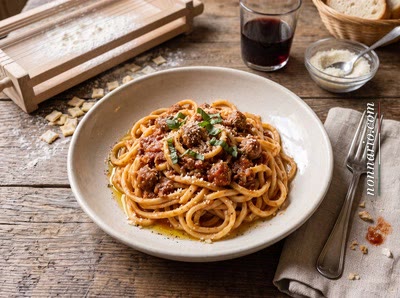
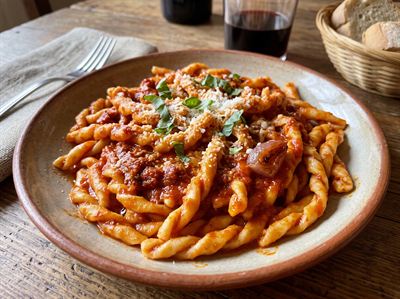
Bari, Puglia
Tiella barese
Bari's baked rice, potatoes and mussels
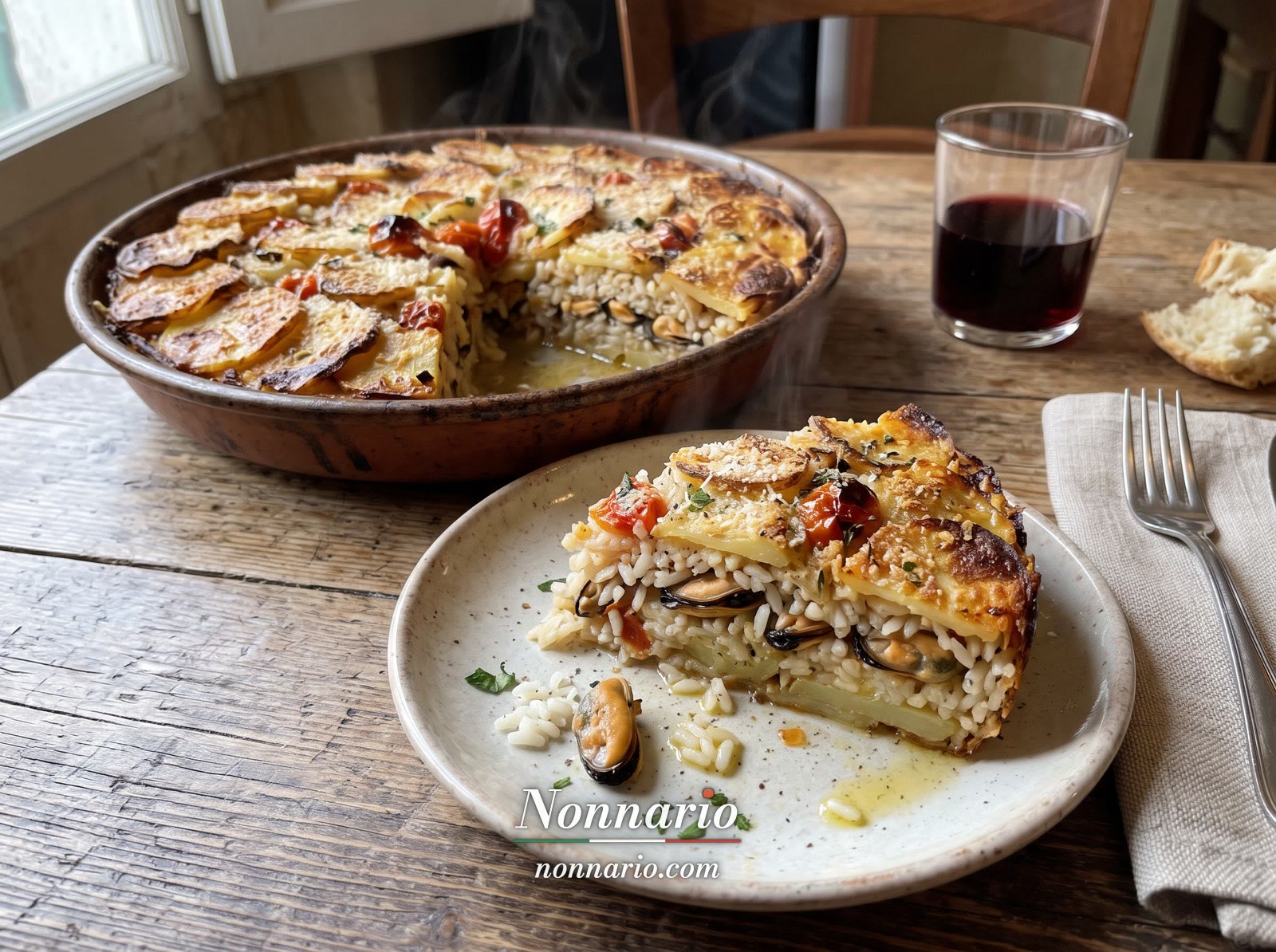
Raw rice, sliced potatoes and mussels opened raw on the half shell, layered in one dish with onion, small tomatoes, pecorino, garlic and parsley, covered with water and baked until the rice is cooked: Bari's tiella, on Italy's list of traditional food products for Puglia since 2017.
- Course
- Primi & RisottiPasta & Rice
- Serves
- 6
- Hands-on
- 1 h 25 min
- Cooking
- 50 min
- Resting
- 10 min+
In breve
In short
Also called riso, patate e cozze, patate, riso e cozze, tiella di riso, patate e cozze, tiella di riso e cozze, teglia al forno con patate, riso e cozze, tièdde and baked rice, potatoes and mussels.
- Gluten-free
- Raw rice, potatoes and mussels on the half shell, with onion, small tomatoes, pecorino, garlic, parsley, olive oil and salt.
- The mussels are opened raw with a small knife and left on one half shell; their liquid is filtered and goes into the water.
- Onion, tomato and pecorino at the bottom, then potato, washed raw rice, the mussels, tomato, and potato on top.
- Plenty of olive oil and 750 g of cold water poured over, then baked at 180 °C until the rice is cooked.
- Only live mussels go in, and the dish bakes until the centre reaches 90 °C; served hot or warm.
La provenienza
Where this recipe comes from
Tiella, tièdde in the dialect of Bari, is the name of the pan and of the way of cooking in it: rice, potatoes and mussels laid in layers in an earthenware dish and baked. The dish is made all over Puglia and is Bari's own; it has been on Italy's national list of traditional agri-food products for Puglia since 2017, as teglia al forno con patate, riso e cozze. In print, Gosetti della Salda's Le ricette regionali italiane gives a tiella di riso e cozze in 1967, Giovanni Panza's La checine de nononne a tiedde 'o furne de rise, patane e cozze in 1982, and Luigi Sada's La cucina della terra di Bari a tièdde o furne de rise, patate e ccozze in 1991; a local monthly of Noci described patate e cozze, sometimes with rice, in 1980. Its origins are not documented. The usual theory ties it to Spanish paella, but no document supports it, and the dish as it is made today cannot be older than the spread of potatoes in Puglia, in the second half of the eighteenth century; its earliest versions, it is said, had no mussels at all. The classic cookbooks call it riso, patate e cozze; patate, riso e cozze, the order of the layers, has caught on more recently.
There is no official recipe. We compared four serious recipes and publish the most widely recognised version, with its quantities and method from one of them, the recipe of 1967 that Puglia's own listing reproduces. Most of them agree on what matters: raw rice, sliced potatoes below and on top, mussels opened raw with a knife and left on the half shell, onion, tomato, pecorino, garlic and parsley, water poured in, and a moderate oven until the rice is cooked. They differ on whether the rice goes over or under the mussels, on how many mussels, on pecorino in one layer or in all of them, on black pepper, which many add, and on courgettes. Ours are the handling of the live mussels, their liquid filtered and counted in the water, the amounts the recipe leaves to the cook (pecorino, parsley, oil and salt), the size of the dish, the baking time and a last check that the centre has reached 90 °C, a heat that Italian public-health guidance gives for ridding bivalves of gut viruses.
- Provenance
- A regional tradition documented in cookbooks and local practice, with no single official text.
- Defined by
- Apulian tradition
- Reference
- Compared across 8 sources, listed below; this page publishes the most widely recognised version.
- Sources
- University of Bari Aldo Moro (DiSAAT), with funding from the Puglia Region: PAT Puglia, the atlas of Puglia's traditional agri-food products, product sheet for teglia al forno con patate, riso e cozze, with a recipe for 6 reproduced from a 1967 cookbook (Italian)
- Accademia Italiana della Cucina: tiella alla barese, from its recipe collection, for 4 (Italian)
- GialloZafferano: tiella barese (riso patate e cozze), its house recipe, for 6 (Italian)
- La Cucina Italiana: tiella di riso, patate e cozze and where to eat it in Bari, an article by Stefania Leo with a Bari restaurant's recipe for 4, 2026 (Italian)
- Gambero Rosso: the tiella of Bari and where to eat it, an article by Valentina Marino, 2023 (Italian)
- Istituto Zooprofilattico Sperimentale delle Venezie: Molluschi bivalvi, frutti del nostro mare, a public-health leaflet on buying, keeping and cooking bivalves, 2nd edition 2020 (Italian)
- US Food and Drug Administration: Selecting and Serving Fresh and Frozen Seafood Safely, on buying, storing and cooking live mussels
- USDA Food Safety and Inspection Service: Leftovers and Food Safety, on cooling, keeping and reheating cooked food (archived copy)
Ingredienti
Ingredients
The original recipe serves 6
For the layers
Equipment
- An ovenproof dish for 6, round and about 28 cm across or about 30 cm by 20 cm, at least 6 cm deep, ideally terracotta or ceramic
- A small, sharp, short-bladed knife and a folded cloth, for opening the mussels
- A stiff brush or a steel scourer
- A bowl to catch the mussel liquid, a fine sieve lined with muslin (cheesecloth) or a double sheet of kitchen paper, and a jug
- A sieve for washing the rice, and a mandoline if you have one
- A kitchen scale
- A probe thermometer, and a fridge thermometer to be sure the fridge is at 4 °C or below
- Aluminium foil and a clean tea towel
Preparazione
Method
Scaled to 6 servings: the amounts in the steps follow. Pot and pan sizes and cooking times are still for the original 6.
Allow 2¼–2¾ hours. Prepare the garlic and parsley, onions, tomatoes, rice and potatoes first, while the oven heats; only then take the mussels out of the fridge, clean and open them, which takes about 35 minutes, and layer the dish straight away. It bakes for about an hour and rests for 10–15 minutes. Buy the mussels no more than 2 days ahead and keep them in the fridge until you open them.
- 1 h 25 minhands-on
- 50 mincooking
- 10 minresting, at least
Buying and keeping the mussels
The quantities and the method follow one recipe whole. The handling of the mussels, their liquid, the amounts the recipe leaves to the cook, the sizes, times, checks and tips marked ‘Our guide’ are ours, after the public food-safety guidance listed in the sources.
-
Hands-on 5 min
Buy 500 g of live mussels, about 20–25 medium ones, from a fishmonger or a supermarket, in a sealed net or tray with its label, or loose from a labelled pack. Buy them no more than 2 days before you cook them.
Check The shells are closed and whole, they smell lightly of the sea, and the label gives the dispatch centre and the packing date.
Tip Our guide: leave mussels that are sitting in water at the counter, or that have no label: live bivalves must never be kept in water for sale, and a seller of loose ones keeps the label of the pack they came from, so ask to see it.
Tip Our guide: in Italy mussels may not be sold under 5 cm long. Italian mussels are on sale from April to October; in winter most are Atlantic ones.
-
Hands-on 2 min
At home, put the mussels straight into the fridge, at 4 °C or below, in their net or in an open bowl covered with a damp cloth, until you open them.
Check The fridge thermometer reads 4 °C or below and the mussels are in the fridge within a few minutes of coming home.
Tip Our guide: never close them in a sealed bag or leave them in a bowl of tap water: live mussels need air, and fresh water kills them.
Tip Our guide: on a hot day, carry them home in a cool bag; perishable food should never be out of the fridge for more than 2 hours (1 hour above 32 °C).
Preparing the layers
Prepare everything else first and open the mussels last, so they are out of the fridge for as short a time as possible.
-
Hands-on 2 minTemp 180 °C
Heat the oven to 180 °C, conventional (top and bottom heat), with a shelf in the middle.
Check The oven has reached 180 °C before the dish goes in; it takes about 15–20 minutes, while you prepare the rest.
Tip Our guide: with a fan oven, set it to about 160 °C.
-
Hands-on 4 min
Peel the 2 cloves of garlic. Pick the leaves from the 20 g of parsley, a large handful, and chop them finely together with the garlic. Divide the mixture into two equal heaps.
Check A fine green mixture with no large pieces of garlic, in two equal heaps.
-
Hands-on 5 min
Peel the 2 large onions and slice them into thin rings, about 3 mm.
Check A heap of thin, even rings.
-
Hands-on 4 min
Wash the 500 g of small tomatoes, pull off any stalks and break them into pieces, halving or quartering them with a knife. Divide them into two equal parts of about 250 g, keeping their juice.
Check Two equal piles of tomato pieces, with their juice.
-
Hands-on 3 min
Put the 300 g of rice in a sieve and rinse it under cold running water, stirring it with your hand, until the water runs almost clear. Leave it to drain.
Check The water running through is almost clear, and the rice is drained.
Tip Our guide: use an Italian rice for risotto, such as Arborio or Roma, never parboiled rice.
-
Hands-on 8 min
Peel the 500 g of potatoes and slice them 4 mm–5 mm thick, all the same, with a mandoline or a sharp knife. Keep the slices in a bowl of cold water until you layer them.
Check Even slices, none thicker than 5 mm.
Tip Our guide: slices of the same thickness cook in the same time; thick ones are still hard when the rice is done.
-
Hands-on 1 min
Brush the bottom and sides of the dish with 1 tablespoon of the 80 ml of olive oil. Keep the rest for the top.
Check A thin film of oil over the whole inside of the dish.
Opening the mussels raw
-
Hands-on 3 min
Take the mussels out of the fridge and go through them one by one. Throw away any with a cracked or broken shell. Tap any open mussel against the worktop or another mussel: if it does not close within about a minute, throw it away.
Check Only whole mussels are left, all of them closed or closing when tapped.
Tip Our guide: a mussel that stays open when tapped is dead and must not be eaten.
-
Hands-on 8–10 min
Scrub each shell under cold running water with the brush or scourer, scraping off any barnacles. Then pull off the beard, the tuft of threads that sticks out between the shells, with a firm tug towards the pointed end.
Check Clean, dark shells with no threads sticking out.
Tip Our guide: pull the beards off only now, just before opening: it harms the mussel.
Tip Our guide: never leave mussels to soak in tap water.
-
Hands-on 20–25 min
Hold a mussel in the folded cloth over the bowl, its flat, straight side towards you. Slide the tip of the knife between the shells near the pointed end and run it along the flat side to the other end, cutting the muscle that holds them shut. Open the shells, scrape the mussel off the empty half with the tip of the knife so it stays whole on the other half, and throw the empty half away. Lay it on a plate, mussel upwards, and open the rest in the same way, letting all their liquid run into the bowl.
Check Every mussel lies whole on its half shell, and the bowl holds their liquid.
Tip Our guide: a live mussel holds its shells shut, resists the knife and has clear liquid inside. Throw away any that gapes and falls open, is dry inside or smells unpleasant.
Tip Our guide: keep the cloth between your hand and the shell: the knife can slip. If you are slow, put the plate of opened mussels in the fridge, covered, as you go.
Tip Our guide: wash your hands, the knife and the sink with soap and warm water after handling the raw mussels.
-
Hands-on 3 min
Pour the mussel liquid slowly through the sieve lined with muslin or kitchen paper into the jug, standing on the scale, leaving any grit at the bottom of the bowl. Add cold water until the jug holds 750 g in all.
Check The jug holds 750 g of clear liquid, with no sand at the bottom.
Tip Our guide: the liquid is salty and tastes of the sea; counting it in the water keeps the liquid in the dish as the recipe gives it.
Building the tiella
Work straight on: the opened mussels go into the oven as soon as the dish is layered. Drain the potato slices well before you start.
-
Hands-on 3 min
Spread all the onion rings over the bottom of the greased dish. Scatter over half the garlic and parsley, then half the tomatoes and the 30 g of grated pecorino. Season with the salt, about 6 g, a level teaspoon.
Check The bottom is covered with onion, dotted with tomato, green flecks and cheese.
Tip Our guide: salt only lightly: the mussel liquid is salty, and this is the only salt in the dish.
-
Hands-on 2 min
Lay half the potato slices over the onions in an even, overlapping layer.
Check No onion shows through the potatoes.
-
Hands-on 1 min
Scatter the washed rice evenly over the potatoes.
Check An even layer of rice right to the edges.
-
Hands-on 3 min
Set the mussels on the rice side by side, mussel upwards, then scatter over the rest of the garlic and parsley and the rest of the tomatoes.
Check The mussels cover the rice in one layer, with tomato and green flecks between them.
-
Hands-on 2 min
Cover everything with the rest of the potato slices, overlapping, so that no mussel and no rice shows.
Check A complete roof of potato.
-
Hands-on 2 min
Pour the rest of the olive oil over the top. Then pour the 750 g of mussel liquid and water slowly in at the edge of the dish, all the way round.
Check The liquid comes up to about the top layer of potato, or just over it; whatever the level, the 750 g stays as it is.
Tip Our guide: pouring at the edge keeps the oil and the seasoning on top.
Tip Our guide: in a dish much larger than the one under Equipment (about 28 cm across, or 30 cm by 20 cm) the liquid stays well below the top layer; cover the dish loosely with foil for the first half hour of baking so the top does not dry out.
Baking and resting
-
Cooking 50 min to 1 h 10 minTemp 180 °C
Put the dish on the middle shelf of the oven at 180 °C and bake it until the rice is cooked, about an hour.
Check From about halfway the liquid bubbles at the edges, then in the centre: look between the potato slices in the middle and note the time when it first bubbles there, as the last check needs at least 10 minutes of it. After 50 minutes lift a slice of potato in the centre with a fork and taste a few grains of rice: tender right through. The liquid is almost all taken up, and the potatoes are tender to the point of a knife and golden on top.
Tip Our guide: if the top browns well before the rice is done, cover the dish loosely with foil; if it looks dry before the rice is tender, pour a little hot water in at the edge.
Tip Our guide: if the top is still pale when the rice is done, a few minutes under a hot grill will colour it.
-
Hands-on 2 min
Before you take the dish out, push a probe thermometer into the centre, among the mussels, and lift a slice of potato to look at one.
Check The thermometer reads at least 90 °C, the liquid has been bubbling in the centre for at least 10 minutes, and the mussels are firm and opaque. If not, give it 10 minutes more and check again.
Tip Our guide: this check is ours, for safety. Eating raw mussels has caused outbreaks of hepatitis A in southern Italy, in Puglia in 2004 among them, and Italian public-health guidance holds that 90 °C for 10 minutes rids bivalves of gut viruses such as hepatitis A and norovirus. A tiella baked until its rice is cooked is well past that; the thermometer proves it.
Tip Our guide: lemon or vinegar does not make undercooked mussels safe.
-
Rest 10–15 min
Take the dish out of the oven, cover it with a clean tea towel and leave it to rest for 10–15 minutes.
Check The bubbling has stopped and the tiella holds together when you cut into it.
Tip Our guide: it is served hot or warm. Serve it within 2 hours of taking it out of the oven, and put any left over into the fridge within that time.
-
Hands-on 2 min
Serve it from the dish at the table, cutting down through all the layers, so each plate has potato, rice and mussels in their half shells.
Check Each portion shows its layers, moist inside and golden on top.
Tip Our guide: put a bowl on the table for the shells.
The essentials, for cooks who know the dish. Switch to Detailed for quantities, temperatures, times and checks at every step.
Press “I’m here” on the step you are on, and again when it is done.Tap the pin on the step you are on, and the tick when it is done. Timers keep running while you scroll.
Da sapere
Good to know
- WhenQuando
- Made all year round, and in Bari a Sunday dish; its ingredients, mussels included, are at their best in summer. Source
- KeepingConservazione
- Leftovers go into the fridge in a shallow closed container within 2 hours of baking and keep for a day. Reheat only what you will eat, covered, until piping hot right through (75 °C); eat it warm within 2 hours, and throw away anything left rather than putting it back in the fridge. Source
- VariantsVarianti
- With courgettes: A bed of chopped onion softened in oil on the bottom of the dish, then a layer of raw courgettes in thin rounds, before the first layer of potatoes. Source
- With the rice over the mussels: The mussels laid on the first layer of potatoes, flesh upwards, and the rice spread over them so that some falls into the open shells; pecorino in every layer, and the mussel liquid and lightly salted water poured in at the edge until they just reach the top layer of potatoes. Source
- With boiled rice and shelled mussels: The rice boiled al dente first, and the mussels opened in a pan over the heat with a chopped clove of garlic, then shelled and their liquid filtered; potatoes, rice and thin slices of onion layered with pecorino, parsley and pepper, potatoes on top, then oil, the mussel liquid and the rice's cooking water poured over, breadcrumbs if you like, and about 45 minutes at 180 °C. No salt is needed. Source
Errori comuni
Common mistakes
- Using a mussel that is broken, open and does not close when tapped, or falls open with no resistance under the knife: throw it away.
- Keeping mussels in tap water or in a sealed bag: keep them in the fridge under a damp cloth.
- Opening the mussels first and leaving them out while you prepare the rest: open them last and layer the dish at once.
- Throwing away the mussel liquid: filter it and count it in the 750 g of water.
- Thick or uneven potato slices: they are still hard when the rice is done.
- Pouring the water over the top: pour it in at the edge so the top keeps its oil.
- Taking it out because the top looks done: the rice must be tender and the centre at 90 °C.
- Salting heavily: the mussel liquid is salty.
Fuori dall'Italia
Cooking it outside Italy
- Cozze are mussels; the ones farmed in Italy are Mediterranean mussels. The recipe needs live mussels in the shell, opened raw.
- Small Apulian tomatoes can be replaced by cherry tomatoes.
- Use an Italian rice for risotto, such as Arborio or Roma; never parboiled rice.
- Pecorino Romano, or another aged pecorino for grating, is the cheese to use.
From nonnario.com/recipes/tiella-barese/, where you will find its sources, its story and the step photos. Sources checked in November 2026.