Bari, Puglia
Focaccia barese
Bari's soft focaccia with cherry tomatoes and olives
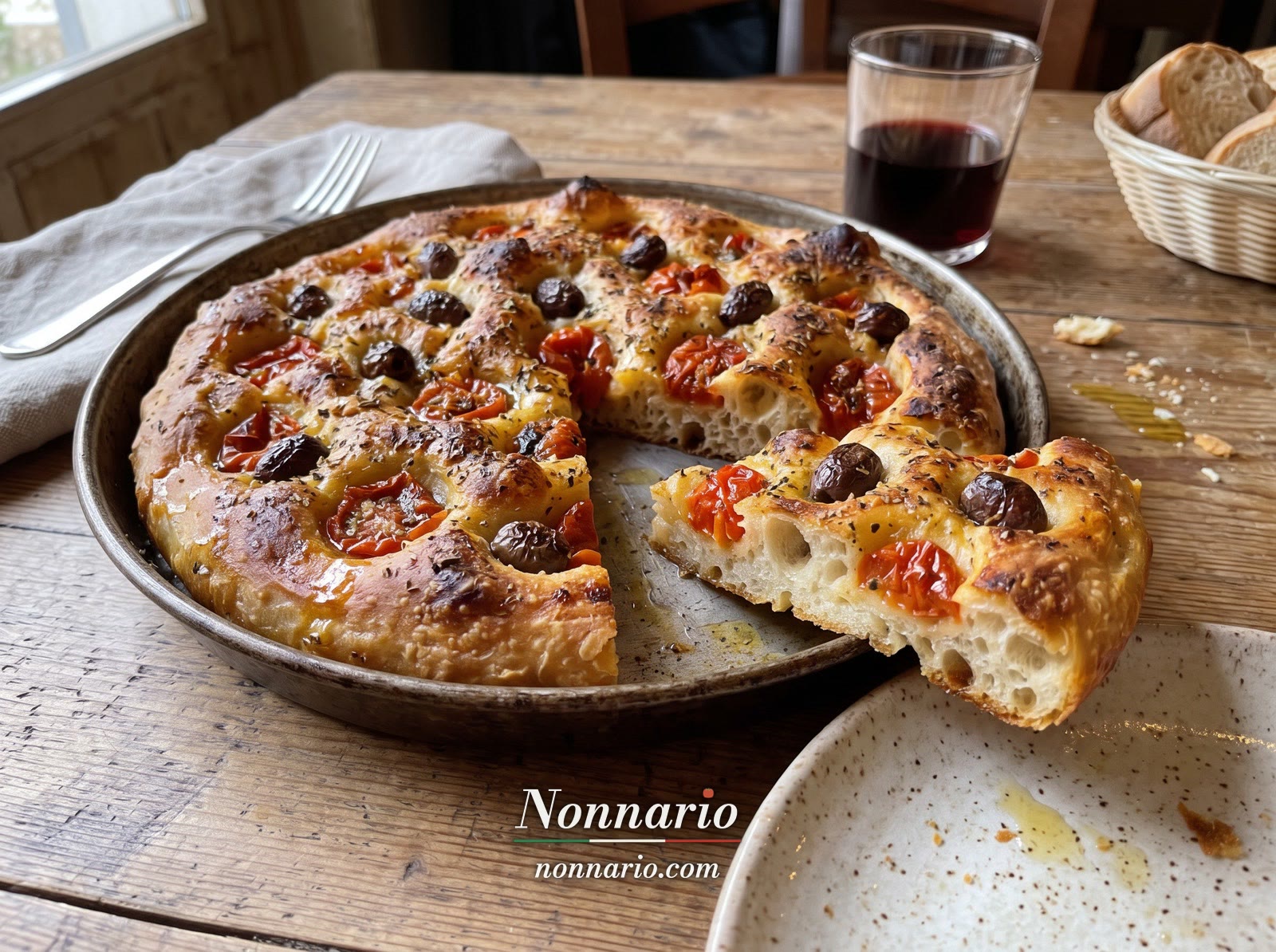
Bari's round focaccia of durum wheat semolina and soft wheat flour with a boiled potato in the dough, risen slowly with lievito madre and baked very hot under cherry tomatoes, olives and oregano; on Italy's list of traditional food products since 2012.
- Course
- Pizze e PaniPizza & Bread
- Serves
- 4
- Hands-on
- 1 h 24 min
- Cooking
- 40 min
- Resting
- 12 h 20 min+
The video and the photos of every step are also gathered on a separate page.
In breve
In short
Also called fcazz, fecàzze, focaccia di Bari and Bari focaccia.
- Vegetarian
- Vegan
- Re-milled durum wheat semolina and type 0 flour, a boiled potato, lievito madre, salt, water and olive oil.
- Topped with cherry tomatoes broken by hand and laid cut side down, Bari olives in brine, a pinch of salt, dried oregano and oil.
- The balls of dough rise uncovered for 8–12 hours, until a light skin forms and a fingertip dent springs back.
- Pressed out in a well-oiled round tin 32 cm across, topped and baked at once in the hottest oven, ideally 270 °C, for 20–25 minutes.
- Crisp on the base and edges, soft inside, about 1 cm–1.5 cm high.
La provenienza
Where this recipe comes from
Focaccia is Bari's everyday food: bought from the bakeries from first light, eaten in the street in place of lunch or dinner, taken to school wrapped in oiled paper, to the beach and to football matches watched with friends, where it comes with mortadella. Eaten in the street it calls for care, since a tomato can fall at every bite. The usual account places its birth in Altamura or Laterza, as a variant of the area's durum wheat bread: before the loaves went in, a piece of raw bread dough was stretched in a tin, left a little, topped and baked in the fierce first heat of the wood oven, before it settled to the temperature for bread. Another story says it was made to test the heat of the oven and to feed restless children while their mothers baked bread and baked pasta in the public ovens. Its name comes from the Latin focus, the hearth. It has been on Italy's national list of traditional agri-food products (PAT) for Puglia since 2012, made in the provinces of Bari, Barletta-Andria-Trani and Taranto all year round; a consortium of Bari bakers founded in 2010 promotes it, and an EU PGI has been proposed.
There is no official recipe, and every baker has a secret. We compared eight sources and publish the most widely recognised version: a dough of re-milled durum wheat semolina and type 0 flour with a boiled potato, raised with lievito madre over 8–12 hours with the balls left uncovered, then pressed out in a round oiled tin and baked at once, as hot as the oven goes. They agree that it is round, crisp outside and soft inside, and topped with fresh tomatoes, oil, salt and oregano. They differ on the rest: some use semolina alone or soft wheat flour alone, some leave out the potato or the olives, and many raise it with brewer's yeast and give it a second rise under its topping. The recipe asks for a starter refreshed at least 4 hours before; this page gives the refreshment its quantities. Its dough weighs about 1.2 kg, but it makes two focacce from balls of about 400 g, one to a 32 cm tin, so about 400 g of dough is left over.
- Provenance
- A regional tradition documented in cookbooks and local practice, with no single official text.
- Defined by
- Apulian tradition
- Reference
- Compared across 8 sources, listed below; this page publishes the most widely recognised version.
- Sources
- University of Bari Aldo Moro (DiSAAT), for the Puglia Region: PAT Puglia, the atlas of Puglia's traditional agri-food products, product sheet for focaccia barese (Italian)
- University of Bari Aldo Moro (DiSAAT), for the Puglia Region: PAT Puglia, the traditional recipe of focaccia barese, as given by the president of the Consorzio della Focaccia Barese, reproduced from the article below (Italian)
- Camin Vattin: focaccia barese, the recipe of the Bari baker Giovanni Di Serio, text by Sandro Romano, 2017 (archived copy of 25 July 2024) (Italian)
- Sky TG24: focaccia barese, the recipe explained by the gastronome Sandro Romano, 2023 (Italian)
- Il Cucchiaio d'Argento: focaccia barese, its recipe (Italian)
- Gambero Rosso: focaccia barese and where to eat it in Bari, by Annalisa Zordan, 2023 (Italian)
- Il Fatto Alimentare: whether focaccia barese may be made without tomato, a legal answer by Dario Dongo, 2022 (Italian)
- USDA Food Safety and Inspection Service: Leftovers and Food Safety (archived copy of 29 May 2025)
Ingredienti
Ingredients
Makes two round focacce, 32 cm across, baked one at a time: 4 servings
To refresh the lievito madre (our guide)
For the dough
To top two focacce
Equipment
- Kitchen scale and a thermometer
- A lidded container for the lievito madre
- A stand mixer with a dough hook, or a large bowl to knead by hand
- A potato ricer
- A worktop that is not wood (marble, steel or laminate): oil stains wood for good
- A tray or dish of about 20 cm × 30 cm for the rise, and a pastry brush
- Two round tins 32 cm across, aluminium if you can, or one used in turn
- A baking stone, if you have one
- A thin spatula, to look under the base
Preparazione
Method
Start the day before. In the afternoon refresh your lievito madre and leave it for at least 4 hours, until doubled; boil the potato towards the end. In the evening make the dough (about 40 minutes with the shaping) and leave the two balls to rise overnight, uncovered, 8–12 hours: about 8 in a kitchen above 20 °C, up to 12 between 15 °C and 20 °C. Next day switch the oven on at least 40 minutes before the rise ends, then press out, top and bake the focacce one at a time, about 30 minutes each. You need an active sourdough starter: if you have none, a bakery that bakes with lievito madre will often sell you a piece, which you refresh in the same way.
- 1 h 24 minhands-on
- 40 mincooking
- 12 h 20 minresting, at least
The lievito madre
The dough takes 200 g of lievito madre in one piece, a firm starter refreshed at least 4 hours before. Refresh your own; if you have none, a bakery that bakes with lievito madre will often sell you a piece to refresh.
-
Hands-on 5 min
Knead 100 g of your active starter with 100 g of type 0 flour and 50 ml of water into a smooth, firm ball. Put it in a lidded container and mark its level on the side.
Check A smooth, firm ball, with its level marked.
Tip Our guide: half as much water as flour makes a firm starter, the kind the dough is written for. A liquid starter turns firm after a refreshment or two like this one.
-
Rest 4–5 hTemp 26 °C
Leave it, covered, at about 26 °C for at least 4 hours, until it has doubled. Of its 250 g, 200 g go into the dough; keep the rest for your next bake.
Check At least 4 hours have passed, and it stands at twice its mark, domed and full of small holes inside, smelling pleasantly sour.
Tip Our guide: if it takes much longer, the starter is weak: refresh it again the same way before you go on.
The potato
-
Cooking 20–25 minHeat medium-high
Lower one small potato of about 100 g, whole and unpeeled, into a small pan of boiling water and boil it until tender.
Check A thin knife slides into the centre with no resistance.
Tip Our guide: start it towards the end of the starter's rise, so it has time to cool.
-
Rest 20–30 min
Drain the potato, peel it while warm and press it through a potato ricer onto a plate. Spread it out and leave it until it is at room temperature.
Check Cool to the touch all through, with no lumps; peeled, it weighs a little under 100 g.
Tip Our guide: a warm potato would heat the dough and hurry the starter, so let it cool completely.
The dough
-
Hands-on 5 minTemp 20 °C
Weigh the dough ingredients. Bring the water to room temperature; if your kitchen is warm, use it very cold instead.
Check The water reads about 20 °C, or comes straight from the fridge in a warm kitchen.
Tip Our guide: a kitchen is warm, for this dough, above about 25 °C.
-
Hands-on 2 min
Put the 300 g of type 0 flour and the 200 g of semola into the bowl of the stand mixer, or into a large bowl if you knead by hand. Add the riced potato, the 10 g of salt and the 200 g of lievito madre in one piece.
Check Everything in the bowl, the starter still in one piece.
-
Hands-on 5 min
Pour in a little of the water and start the mixer with the dough hook at low speed. Add the rest of the 300 g of water in a thin stream as it mixes, then, last of all, the 50 ml of oil. Mix like this for the first 5 minutes.
Check No dry flour left; a soft, shaggy dough that has taken in the oil.
Tip Our guide: if the dough still feels stiff once the water is in, add up to 50 g more, a little at a time.
Tip The oil makes the focaccia supple and gives it its crisp crust.
-
Hands-on 15 min
Turn the mixer up a speed and knead for 15 minutes more, until the dough comes cleanly away from the bowl and is completely smooth and elastic.
Check It comes away from the sides of the bowl, is smooth and elastic, and begins to pop and crackle as it fills with bubbles in the hook.
Tip If it struggles to come away from the bowl, sprinkle a pinch of flour round the edges of the bowl. No more than that: too much flour hardens the dough.
Tip Our guide: by hand, knead for about 20–25 minutes, stretching the dough away from you and folding it back, until you reach the same smooth, elastic dough; it is soft and sticky at first.
Two balls and the long rise
-
Hands-on 5 min
Lift the dough off the hook. Oil the worktop, put the dough on it and turn it over so it is oiled on both sides. Work it only as much as it takes to make two balls of about 400 g each.
Check Two smooth, oiled balls of about 400 g each.
Tip Use a worktop that is not wood: the oil leaves a stain that will not come out.
Tip Our guide: the quantities make about 1.2 kg of dough, so about 400 g is left over once the two balls are made. The recipe makes two focacce and does not use it.
-
Hands-on 2 min
Brush a medium tray with oil and set the two balls in it close together.
Check The balls sit almost touching.
Tip Keep the tray small enough for the balls to be close: side by side, they rise better.
Tip Our guide: a tray or dish of about 20 cm × 30 cm.
-
Rest 8–12 hTemp 15 °C–24 °C
Leave the balls at room temperature, uncovered, for 8–12 hours: about 8 hours in a room above 20 °C, up to 12 between 15 °C and 20 °C.
Check They have risen and grown a light skin on top. Press the surface gently with a finger: the dough springs back to its shape. If it does not spring back, or the ball has slumped, it has collapsed.
Tip Do not cover them: the light crust that forms on top is part of the method.
Pressing out, topping and baking
Press out, top and bake one focaccia at a time, straight into the oven with no second rise; the other ball waits in its tray.
-
Hands-on 2 minTemp 250 °C–270 °C
At least 40 minutes before the rise ends, put a baking stone, if you have one, on the lowest shelf and switch the oven on at full power, static or fan: ideally 270 °C, or as high as it goes, usually 250 °C.
Check The oven has been on at full power for at least 40 minutes when the first focaccia goes in.
Tip Our guide: without a stone, the tin goes on a rack in the lowest position.
-
Hands-on 3 min
Oil a 32 cm round tin all over with your hands or the brush. Lay one ball in the centre, turn it over so it is oiled on both sides, and press it out with your fingertips until it covers the whole tin.
Check An even layer of dough reaching the rim all round, dimpled by your fingers.
Tip Our guide: about 2 tablespoons of oil in the tin.
Tip Press gently, from the centre outwards: some cooks warn against squeezing out the gas of the long rise.
-
Hands-on 3 min
Break 200 g of cherry tomatoes in half with your hands over the focaccia, so their juice and seeds run onto the dough, and lay them cut side down until the whole surface is covered. Add 10 olives, oil it again, and finish with a pinch of salt and dried oregano.
Check Tomatoes cover the whole surface, cut side down, with the olives among them, glistening with oil.
Tip Our guide: 1–2 tablespoons of oil over the top.
-
Cooking 20–25 minTemp 250 °C–270 °CHeat maximum, lowest shelf
Put the tin straight onto the hot stone, or the lowest shelf, and bake for 20–25 minutes.
Check Lift an edge with a thin spatula: the base is golden-brown and crisp. The edges are browned, the tomatoes soft and wrinkled, and the focaccia is about 1 cm–1.5 cm high.
Tip Our guide: in an oven that stops at 250 °C, it usually needs the full 25 minutes.
-
Hands-on 35 min
Make and bake the second focaccia the same way, with the rest of the tomatoes and olives.
Check As the first: crisp, golden base, browned edges, about 1 cm–1.5 cm high.
Tip Our guide: give the oven 5–10 minutes to come back to full heat. If you use one tin in turn, let it cool enough to handle before you oil it again.
Tip Our guide: the waiting ball goes on rising a little while the first bakes; that does no harm.
-
Hands-on 2 min
Turn each focaccia out of its tin and cut it into wedges. Eat it hot, warm or cold.
Check The base stays crisp and the inside soft.
Tip Our guide: what is not eaten the same day goes into the fridge, covered, within 2 hours of baking, and keeps for 3 days from boiling the potato, the day before included; eat it cold, or reheat it in a hot oven until it reaches 75 °C in the centre.
The essentials, for cooks who know the dish. Switch to Detailed for quantities, temperatures, times and checks at every step.
Press “I’m here” on the step you are on, and again when it is done.Tap the pin on the step you are on, and the tick when it is done. Timers keep running while you scroll.
Da sapere
Good to know
- WhenQuando
- It is made all year round, and eaten in place of lunch or dinner or at any other time of day. Source
- KeepingConservazione
- Leftovers go into the fridge, covered, within 2 hours of baking. Eat them within 3 days of boiling the potato, the day before included, cold or reheated in the oven until hot right through, 75 °C in the centre. Source
Errori comuni
Common mistakes
- Covering the balls while they rise: they rise uncovered and grow a light skin.
- Cutting the rise short: it takes 8–12 hours by the room's temperature; a fingertip dent must spring back.
- Adding too much flour while kneading: it hardens the dough. A pinch round the edges of the bowl is enough.
- Laying the tomatoes skin side down: they go cut side down, so their juice soaks into the dough.
- A lukewarm oven: the focaccia bakes as hot as the oven goes, ideally 270 °C, on the lowest shelf.
- Oiling a wooden worktop: the oil stains it for good.
Fuori dall'Italia
Cooking it outside Italy
- Type 0 flour is Italian soft wheat flour; plain (all-purpose) flour is the nearest elsewhere.
- Look for semola rimacinata di grano duro, sold in English as re-milled durum wheat semolina: it is fine, like flour, unlike the coarse semolina sold for puddings.
- Olive baresane are Bari's olives in brine; elsewhere use any small olives in brine, drained.
- Any cherry tomatoes will do; the ciliegino is the usual Italian kind.
- Most home ovens stop at 250 °C; that is enough. A baking stone on the lowest shelf helps the base to crisp.
From nonnario.com/recipes/focaccia-barese/, where you will find its sources, its story and the step photos. Sources checked in November 2026.