Campobasso, Molise
Calcioni
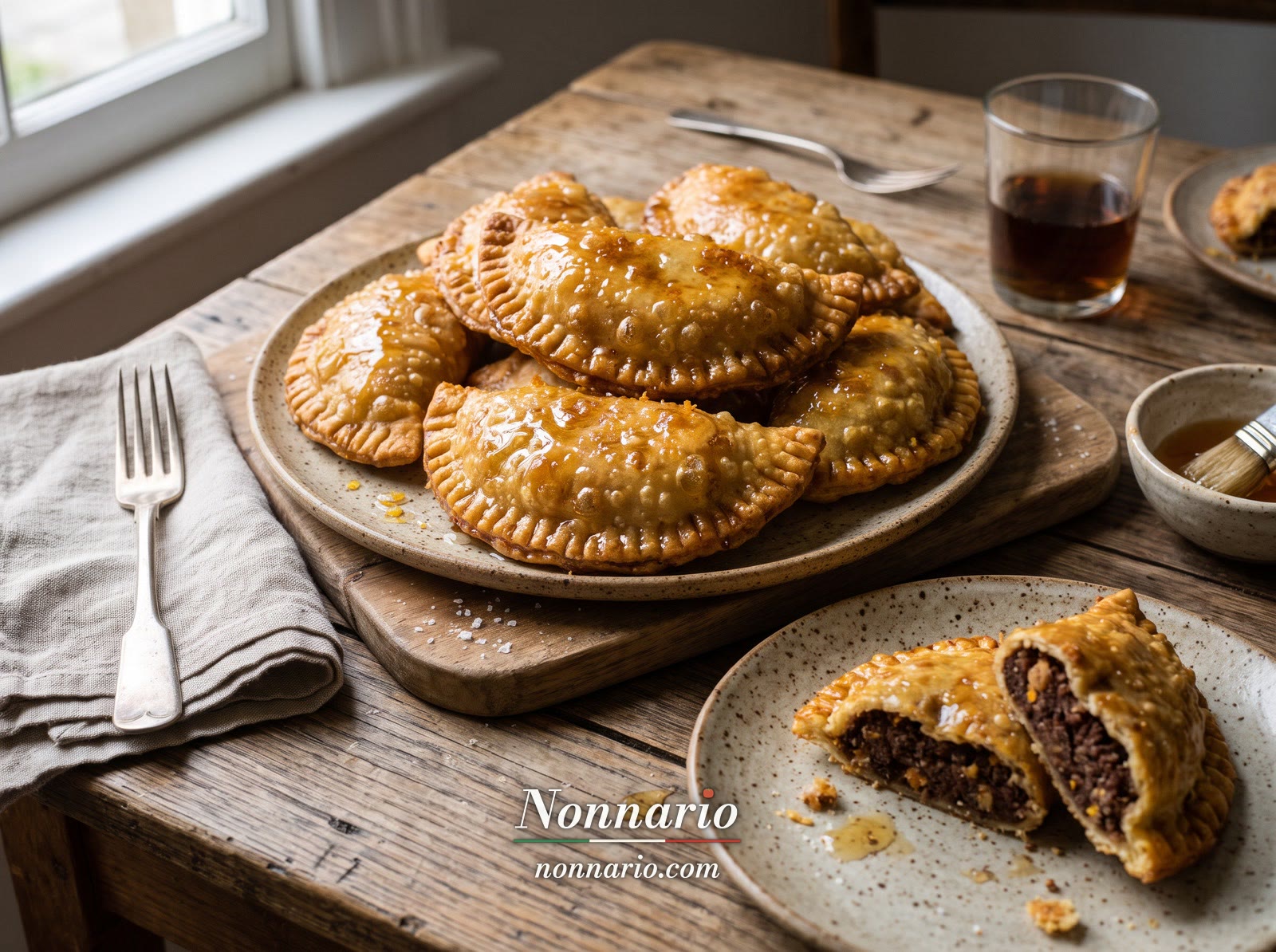
Molise sweet ravioli filled with chickpeas, cocoa and spices, fried and brushed with honey
The sweet ravioli of Molise for Christmas and Carnival: a filling of chickpeas, cocoa, cloves, cinnamon, candied citron and cognac sealed between two sheets of dough, fried, brushed with warm honey and dusted with icing sugar.
- Course
- DolciDesserts
- Serves
- 6
- Hands-on
- 1 h 51 min
- Cooking
- 1 h 30 min
- Plan
- 2 days
The video and the photos of every step are also gathered on a separate page.
In breve
In short
Also called cauciune, cauciuni and calciuni.
- Dried chickpeas, soaked 12 hours, boiled 1½ hours and sieved, then mixed with unsweetened cocoa, crushed cloves, cinnamon, candied citron and cognac.
- No sugar in the filling: the sweetness comes from the honey brushed on after frying and the icing sugar.
- A firm dough of sifted flour, two eggs and an extra white, a little sugar and white vermouth, with no fat, rested 30 minutes.
- Heaps of filling on one sheet, covered with a second, sealed round each heap and cut into ravioli with a fluted wheel.
- Fried a few at a time (on this page at 170 °C) until evenly golden, then brushed with honey melted in a bain-marie.
La provenienza
Where this recipe comes from
Calcioni, also called cauciune, cauciuni or calciuni, are the sweet fried ravioli of Molise: small parcels of pastry around a dark filling, most often of chickpeas and cocoa. They are made for Christmas, when they are counted among the classics of the Molise table, and for Carnival, in Campobasso and elsewhere, and they are traditionally given as presents. Molise shares them with neighbouring Abruzzo. In some villages of the province of Campobasso, such as Riccia, Casacalenda and Guardialfiera, ravioli of chickpeas and honey called caveciuni are among the sweets of the tables laid for San Giuseppe on 19 March.
There is no official recipe. We compared nine sources and publish the most widely recognised version. They agree on a sweet pastry wrapped round a thick filling and fried; those that describe the finish use sugar or honey. Most fill them with chickpeas, boiled and sieved; others use boiled chestnuts. The filling may be sweetened with honey or sugar or not at all, and is flavoured with cocoa or chocolate, cloves and cinnamon, vanilla, almonds, candied citron, rum, cognac or other liqueurs. The dough may be made with lard, with oil or with no fat at all; some cut half-moons from discs, others cut ravioli from two sheets laid one over the other; and the finish is warm honey or icing sugar. This version fills them with chickpeas, cocoa, cloves, cinnamon, candied citron and cognac, with no sugar in the filling; the dough is flour, eggs and an extra white, a little sugar and white vermouth, with no fat; the filling is set in heaps on one sheet, covered with a second and cut into ravioli, which are fried, brushed with warm honey and dusted with icing sugar if you like. The recipe it follows gives no frying temperature, sheet thickness or ravioli size, and no amount for the honey, the oil or the icing sugar: those are ours, marked as such. The keeping advice follows food-safety guidance.
- Provenance
- A regional tradition documented in cookbooks and local practice, with no single official text.
- Defined by
- Molisan tradition
- Reference
- Compared across 9 sources, listed below; this page publishes the most widely recognised version.
- Sources
- Accademia Italiana della Cucina, recipe collection: cauciune di castagne, Molise (Italian)
- Donna Moderna: cauciuni, sweet ravioli with a chickpea filling, 2019, archived copy (Italian)
- LaPresse news agency: Christmas dishes region by region, from Coldiretti, 2014 (Italian)
- Dissapore: Molise cooking, 20 typical dishes, 2021 (Italian)
- Linkiesta Gastronomika: Carnival food traditions of southern Italy, 2023 (Italian)
- Fine Dining Lovers: 10 typical foods from Molise, 2016
- La Voce di New York: Christmas in southern Italy, 2015 (Italian)
- Gambero Rosso: the San Giuseppe tables of Molise, 2026, archived copy (Italian)
- USDA Food Safety and Inspection Service: Leftovers and Food Safety (archived copy of 29 May 2025)
Ingredienti
Ingredients
The original recipe serves 6
For the filling
For the dough
To fry and finish
Equipment
- Kitchen scale and a measuring jug
- A large bowl for soaking, a large pan and a colander, for the chickpeas
- A sieve and a bowl, for the filling; a mortar and pestle for the cloves and cinnamon; a small knife
- A large pastry board or worktop, a fine sieve for the flour, a rolling pin and cling film
- A fluted pastry wheel, or a pasta cutter
- A heavy pan about 20 cm across and at least 10 cm deep, a kitchen thermometer that reads to at least 200 °C, a slotted spoon and a lid that fits the pan
- A tray lined with kitchen paper
- A second tray and a clean cloth, for the finished ravioli
- A small heatproof bowl set over a small pan of simmering water, and a pastry brush, for the honey; a small fine sieve for the icing sugar
Preparazione
Method
Scaled to 6 servings: the amounts in the steps follow. Pot and pan sizes and cooking times are still for the original 6.
Start the evening before: the chickpeas soak for 12 hours. The next day allow about 4 hours. The chickpeas boil for 1½ hours; then make the dough, which rests 30 minutes while you sieve the chickpeas and mix the filling. Rolling, filling and cutting the ravioli takes about 30 minutes, heating the oil and frying them about 35, and the honey and icing sugar about 10.
- 1 h 51 minhands-on
- 1 h 30 mincooking
- 2 daysfrom start to table
The night before: soak the chickpeas
-
Rest 12 h
Put the 300 g of dried chickpeas in the large bowl, cover them with plenty of cold water and leave them to soak for 12 hours.
Check The chickpeas have swollen to about twice their size and are smooth, with no wrinkles.
Tip Our guide: use about three times their volume of water, as they absorb a great deal. In a warm kitchen, soak them in the fridge.
The chickpeas
-
Hands-on 2 min
Drain the chickpeas in the colander.
Check No soaking water left on them.
Tip Our guide: throw the soaking water away and rinse them briefly under the tap.
-
Cooking 1 h 30 minTemp 100 °CHeat high to boil, then medium-low
Bring a large pan of lightly salted water to the boil, add the chickpeas and boil them for 1½ hours.
Check A chickpea squeezed between your fingers crushes easily, soft right through with no chalky centre.
Tip Our guide: about 3 l of water with a teaspoon of salt, enough to keep them well covered; keep it at a steady simmer, half covered, and top up with boiling water if the level drops below the chickpeas. If they are not soft at 1½ hours, give them 15 minutes more and test again.
-
Hands-on 2 min
Drain the chickpeas again and set them aside.
Check Well drained, with no water pooling under them.
Tip Our guide: sieve them while still warm (see the filling): they pass through much more easily.
The dough
-
Hands-on 3 min
Sift the 300 g of flour onto the pastry board and make a well in the centre.
Check A ring of flour with a hollow in the middle large enough to hold the eggs.
Tip Our guide: separate the third egg first and keep only its white for the dough.
-
Hands-on 2 min
Break the 2 eggs into the well, add the egg white, the 40 g of sugar and the 40 ml of vermouth.
Check Everything in the well, none of it running out over the flour.
Tip Our guide: beat them together lightly with a fork inside the well before you draw in the flour.
-
Hands-on 8–10 min
Draw in the flour and knead until the dough is firm and even.
Check No dry flour left on the board; a firm, smooth ball, even in colour, that does not stick to your hands.
Tip Our guide: about 8–10 minutes. The dough is meant to be firm: add no water unless it will not come together at all, and then only a few drops.
-
Rest 30 min
Gather the dough into a ball, wrap it in cling film and leave it to rest for 30 minutes in a cool place. Make the filling meanwhile.
Check The dough is relaxed: pressed with a finger, it holds the mark and does not spring back.
The filling
-
Hands-on 15 min
Press the boiled chickpeas through the sieve into a bowl.
Check A fine, even purée in the bowl and only the skins left in the sieve.
Tip Our guide: press a ladleful at a time with the back of a spoon or a scraper, and scrape the purée off the underside of the sieve as you go.
-
Hands-on 5 min
Crush the 4 cloves and crumble the cinnamon stick. Cut the 20 g of candied citron into small pieces.
Check The cloves and cinnamon reduced to small crumbs, with no large splinters; the citron in small dice.
Tip Our guide: pound the cloves and the broken-up cinnamon together in the mortar until they are coarsely ground; whole splinters of cinnamon are unpleasant to bite on. Dice the citron about 3 mm.
-
Hands-on 5 min
Mix the chickpea purée with the 100 g of cocoa, the crushed cloves, the crumbled cinnamon, the citron and the 80 ml of cognac, carefully, until all is well blended.
Check A smooth, even, dark brown paste with no streaks of cocoa; a spoonful holds its shape.
Tip Our guide: the filling has no sugar and tastes bitter on its own; the honey brushed on after frying sweetens the ravioli.
The ravioli
-
Hands-on 8 min
Roll the dough out with the rolling pin into a sheet that is not too thin.
Check An even sheet about 2 mm thick, with no holes.
Tip Our guide: on a lightly floured board, about 2 mm, roughly 40 cm × 50 cm; thin enough to cook through in the oil, thick enough not to tear over the filling. On a small board, work in two rounds with half the dough each time.
-
Hands-on 1 min
Divide the sheet into two halves.
Check Two sheets of about the same size.
Tip Our guide: cut it straight across with the knife or the wheel.
-
Hands-on 5 min
Spread the filling over one of the two halves in small heaps.
Check Rows of even heaps, evenly spaced, with clear dough all round each one.
Tip Our guide: heaps of about 30 g, a heaped tablespoon, about 6 cm apart from centre to centre and 3 cm in from the edges. The filling makes about 24.
-
Hands-on 7 min
Cover with the other half of the dough and press the dough down round each heap to seal it.
Check Each heap is enclosed on every side, with no air trapped inside and no gap in the seal.
Tip Our guide: lay the top sheet loosely, then press with your fingertips from the top of each heap outwards, pushing the air out before you seal the sides. An open seam lets the filling out into the oil, where it burns and makes the oil spit.
-
Hands-on 5 min
Cut out the ravioli between the heaps with the fluted pastry wheel or the pasta cutter.
Check Separate ravioli of about 6 cm, each with a sealed border of about 1 cm all round.
Tip Our guide: press the cut edges together once more with your fingers. Lay the ravioli on a lightly floured tray, not touching, and cover them with a cloth while the oil heats.
Frying and finishing
-
Hands-on 10 minTemp 170 °CHeat medium-high, then adjust to hold the temperature
Heat the oil in the deep pan until it reaches the right temperature for frying.
Check The thermometer reads 170 °C, and the oil is not smoking.
Tip Our guide: 170 °C, about 5 cm of oil in a pan 20 cm across and at least 10 cm deep, so it is no more than half full. Hotter browns the outside before the dough is cooked; cooler makes them greasy.
Tip Never leave hot oil unattended. Keep the pan no more than half full and a lid within reach, lower the ravioli in with the slotted spoon, never put water on burning oil, turn the heat off if it smokes, and let the oil cool completely before moving the pan.
-
Hands-on 20–25 minTemp 165 °C–175 °C
Lower the calcioni into the oil a few at a time and fry them until they are evenly golden.
Check Golden all over, the edges included. Break one from the first batch: the pastry is cooked and dry right through, with no pale, doughy layer at the border.
Tip Our guide: 4 or 5 at a time, for 2–3 minutes, turning them once. Keep the oil between 165 °C and 175 °C, and let it come back to 170 °C before the next batch. Too many at once cool the oil and the calcioni turn greasy.
-
Hands-on 1 min
Lift each batch out with the slotted spoon and drain it on the tray lined with kitchen paper.
Check No oil dripping, and the paper under them no longer wet with it.
Tip Our guide: lay them in one layer, not piled up, so they stay crisp. When the last batch is out, turn off the heat under the oil.
-
Hands-on 5 min
Put the 120 g of honey in the small heatproof bowl over the pan of simmering water and let it melt.
Check The honey is runny and drips easily off the brush.
Tip Our guide: the water should only simmer, and the bowl should not touch it; about 5 minutes.
-
Hands-on 5 min
Brush the calcioni with the melted honey.
Check Every calcione glistens with an even coat of honey.
Tip Our guide: brush them while they are still warm, so the honey spreads thinly.
-
Hands-on 2 min
Dust the calcioni with icing sugar through the small sieve, as much as you like, and serve.
Check A light veil of sugar over the honey.
Tip Our guide: the icing sugar is optional; about 20 g dusts the whole batch.
The essentials, for cooks who know the dish. Switch to Detailed for quantities, temperatures, times and checks at every step.
Press “I’m here” on the step you are on, and again when it is done.Tap the pin on the step you are on, and the tick when it is done. Timers keep running while you scroll.
Da sapere
Good to know
- WhenQuando
- For Christmas and Carnival, when they are made and given as presents. Source
- KeepingConservazione
- In the fridge within 2 hours of frying, in an airtight container, and eaten within 3 days of boiling the chickpeas. Out of the fridge at most 2 hours when served, then back in the fridge or thrown away, never out again. Source
- VariantsVarianti
- With chestnuts: For fifteen: a filling of 500 g of boiled chestnuts, peeled and sieved, mixed with 150 g of sugar, 100 g of unsweetened cocoa, 100 g of honey and a sachet of vanillin. The dough: 400 g of type 00 flour in a well, with 3 eggs beaten in it with 150 g of sugar, a pinch of salt and 150 g of lard softened at room temperature, kneaded smooth and rested about half an hour wrapped in a tea towel. It is rolled out thin and cut into discs with a cup; each takes a spoonful of filling and is folded over, the edges pressed shut with a fork or a crimper. When all are made, they are fried in plenty of smoking-hot oil (our guide for safety: about 170 °C, never smoking, in a pan no more than half full, as in the method), drained on kitchen paper, dusted with icing sugar and arranged on a tray. Source
Errori comuni
Common mistakes
- Cutting the soak or the boil short: the chickpeas stay hard and will not pass through the sieve into a smooth filling.
- Expecting a sweet filling: this version has no sugar in it; the honey brushed on after frying sweetens the ravioli.
- Rolling the sheet thin: it tears over the heaps of filling.
- Leaving air or gaps round the heaps: the ravioli burst or leak in the oil, which spits.
- Crowding the pan: the oil cools and the calcioni come out greasy.
- Frying in smoking oil: the outside burns before the pastry is cooked through, and the oil can catch fire.
Fuori dall'Italia
Cooking it outside Italy
- Dried chickpeas are also sold as garbanzo beans.
- Plain flour is all-purpose flour in the US.
- Candied citron (cedro candito) is sold in Italian delis and online, often in large pieces: dice it yourself.
- White vermouth is the pale, sweet Italian kind, labelled bianco.
- Icing sugar is powdered or confectioners' sugar.
From nonnario.com/recipes/calcioni/, where you will find its sources, its story and the step photos. Sources checked in November 2026.