San Martino in Pensilis, Molise
Pampanella
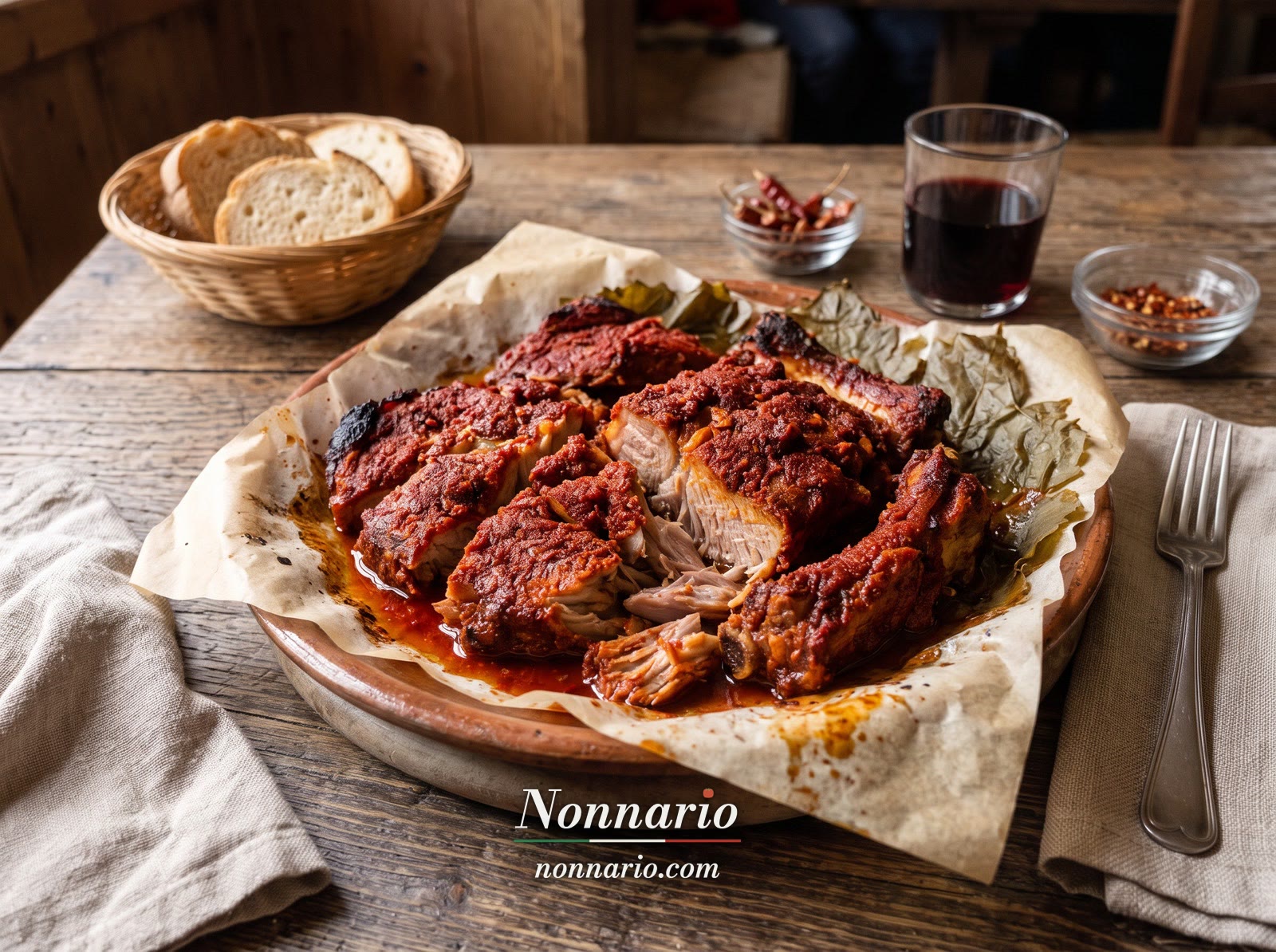
Molise roast pork with sweet and hot red pepper
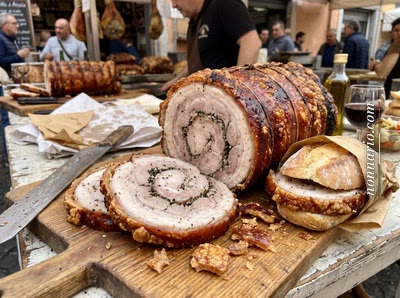
Bone-in pork from San Martino in Pensilis, cut into thick slices held by the rind, coated in dried sweet and hot red pepper with garlic and salt, roasted under damp straw paper and sprinkled with vinegar; the town's De.Co. since 2009.
- Course
- SecondiMain Courses
- Serves
- 8
- Hands-on
- 44 min
- Cooking
- 2 h 30 min
- Resting
- 5 h 10 min+
The video and the photos of every step are also gathered on a separate page.
In breve
In short
Also called pampanella molisana, Pampanella di San Martino in Pensilis and carne di maiale cotta alla pampanella.
- Only pork, dried sweet and hot red pepper, fresh garlic, salt and vinegar.
- Bone-in pork with its rind, cut into thick slices that stay joined by the rind.
- Both sides of every slice coated evenly and generously with the seasoning, packed tight in the tray.
- Roasted for about two hours under damp straw paper, finished uncovered, then sprinkled with vinegar out of the oven.
- Done when the meat is soft and moist and starts to come away from the bone; deep red outside.
La provenienza
Where this recipe comes from
Pampanella is pork heavily seasoned with sweet and hot red pepper and garlic, roasted until soft and deep red. It is known across Molise but made almost only in San Martino in Pensilis, a town of about five thousand people inland from Termoli; at the big festivals of the Basso Molise the pampanella makers still all come from the town. Its origins are hard to trace. It probably takes its name from the vine leaves, the pampini, it was once cooked in, and it is thought to go back to shepherds and the seasonal droving of flocks: it is still known in some villages of the Gargano. A book of more than two centuries ago, La Fisica Appula, describes an old way of cooking it in the ground. It became so costly that few could afford it; in the nineteenth century some barons ate it at lunch and at dinner, but never in front of guests, because it was not thought refined enough. Early in the twentieth century its price fell and it became festival food. A poem by a man of the town praises it and holds San Martino the only place that knows all its secrets.
Pampanella is on Italy's list of traditional food products for Molise. In 2002 the Comune di San Martino in Pensilis created its De.Co., the municipal designation of origin, and in 2009 it opened a register for the pampanella and approved its production rules. They allow only Italian sweet and hot red pepper, fresh Italian garlic, salt, Italian vinegar and pork from pigs of 70 to 90 kg, raised without GM feed, which the producers undertook to source from animals raised in Molise, Abruzzo or Campania. They set out the method: meat rested at least two days below 4 °C, cut and laid in steel trays, sprinkled with salt and finely chopped garlic, then the two peppers, left to rest if the producer wishes, covered with waxed paper and slightly damp straw paper, put into an oven heated beforehand to about 300 °C for about two hours, and sprinkled with vinegar once it is out of the oven. The quantities and the order of the additions are left to each producer, so the quantities and the home method here come from a published recipe as made in San Martino in Pensilis, for eight. It roasts at 200 °C under damp straw paper alone, then uncovered for a short finish: its quantities and times were written for that heat, most home ovens do not reach 300 °C, and waxed paper is not made for an oven. The vinegar goes on as the town's rules say, at the end, out of the oven. A few things are ours: the five-hour rest is in the fridge, and a probe checks that the thickest slice reaches at least 71 °C.
- Provenance
- A reference recipe set by a protection consortium or by the town the dish is named after.
- Defined by
- Comune di San Martino in Pensilis
- Reference
- De.Co. (Denominazione Comunale) production rules for the Pampanella di San Martino in Pensilis, for the ingredients and the method; quantities and home method from the Accademia Italiana della Cucina's recipe as made in San Martino in Pensilis, 2009
- Sources
- Comune di San Martino in Pensilis: the De.Co. of the pampanella and its production rules, 2009 (Italian, PDF; copy hosted by the producers' committee)
- Accademia Italiana della Cucina: pampanella as made in San Martino in Pensilis, from its recipe collection (Italian)
- Ministero dell'agricoltura, della sovranità alimentare e delle foreste (MASAF), Italy's Ministry of Agriculture: national list of traditional food products, 25th revision, 2025 (Italian)
- Turismo.it: pampanella, its history and a recipe, 2019 (Italian)
- USDA Food Safety and Inspection Service: Leftovers and Food Safety
Ingredienti
Ingredients
The original recipe serves 8
Equipment
- A long tray or board, for seasoning the slices
- A steel roasting tray that holds all the meat in one layer with no gaps (for 3 kg, about 40 cm by 30 cm)
- A sheet of straw paper (carta paglia) large enough to cover the tray
- Kitchen scale, sharp knife and board for the garlic, and a bowl for the seasoning
- Disposable kitchen gloves, for spreading the chilli by hand
- A heatproof bowl, for the liquid and fat poured off the tray
- Probe thermometer and oven gloves
- A heavy knife or cleaver, to cut through the rind between the slices
Preparazione
Method
Scaled to 8 servings: the amounts in the steps follow. Pot and pan sizes and cooking times are still for the original 8.
About 8½ hours, most of it waiting: buy pork that has rested at least two days in the cold, and have the butcher slice it. About 30 minutes to make the seasoning and coat the meat, then 5 hours in the fridge under straw paper. Turn the oven on 20 minutes before the rest ends; the meat roasts for about 2 hours covered and 10–20 minutes uncovered, is sprinkled with vinegar as it comes out, then rests for 10 minutes before it is cut.
- 44 minhands-on
- 2 h 30 mincooking
- 5 h 10 minresting, at least
The meat and the seasoning
-
Temp 0 °C–4 °COfficial text
The pork is cut only after resting for at least two days at around 0 °C, and below 4 °C.
Check The butcher confirms how long the piece has rested, and it is still cold when you get it home.
Tip You need one whole piece of 3 kg, capocollo or loin, with the bone and the rind.
Tip Our guide: ask the butcher how long it has been kept in the cold room. At home keep it in the coldest part of the fridge, below 4 °C, until you start.
-
Hands-on 5 min
Have the butcher cut the whole piece into fairly thick slices, without cutting through the rind: the rind must keep the slices joined.
Check The slices open out like the pages of a book, all still held together by the rind.
Tip Our guide: slices about 3 cm thick, cut between the bones on a loin, down to the rind but not through it.
Tip A large piece is the point: the fat, the bones, the cartilage and the rind all add to the flavour as it cooks, so the dish is worth making for many.
-
Hands-on 10 min
Peel the 5 garlic cloves and chop them very finely. In a bowl, mix the 75 g of fine salt with the garlic, the 25 g of hot chilli and the 75 g of sweet paprika.
Check An even, deep red mixture, with no clumps of garlic or streaks of salt.
Tip Our guide: chop the garlic almost to a paste, so it spreads with the pepper and does not fall off in pieces.
-
Hands-on 15 min
Lay the meat in a long tray. Wearing gloves, spread the mixture with your hands over both sides of every slice, opening them apart as you go, until each is covered evenly and generously.
Check No bare meat anywhere: every face of every slice is coated an even red, the coating sticking to the meat.
Tip Our guide: use all of the mixture. An even coat that clings to the meat is what the town's De.Co. rules call a good pampanella.
Tip Gloves matter: the hot chilli stays on your skin for hours, and it burns if you touch your eyes.
-
Hands-on 3 min
Move the seasoned meat into a tray that holds all of it, with no gaps between one piece and the next.
Check The meat fills the tray in one tight layer, close up against the sides.
Tip Our guide: a steel tray, as the town's producers use, about 40 cm by 30 cm for 3 kg. If there are gaps, push the pieces together or use a smaller tray: the meat stays moister packed tight.
-
Rest 5 h
Cover the meat with a sheet of straw paper and leave it for about 5 hours to take the flavour, in the fridge.
Check After the rest the coating looks darker and moist, and the meat smells strongly of garlic and pepper.
Tip Our guide: in the fridge, not on the worktop. Raw meat must not stand out for more than 2 hours, and five hours is far longer. It can go into the oven straight from the fridge.
Roasting
-
Cooking 20 minTemp 200 °C
About 20 minutes before the rest ends, heat the oven to 200 °C, conventional (top and bottom) heat, with a shelf in the middle.
Check The oven has reached 200 °C and its light has gone off, or an oven thermometer reads 200 °C.
-
Hands-on 2 min
Lift off the straw paper, wet it, and lay it back over the meat.
Check The paper is damp all over but not dripping, and covers all the meat.
Tip Our guide: hold it briefly under the cold tap and shake it. Tuck the edges just inside the tray so that none hangs over the sides towards the oven walls.
Tip The damp paper keeps the pepper from scorching and turning black in the long roast.
-
Cooking 2 hTemp 200 °CHeat conventional (top and bottom)
Put the tray in the oven and roast at 200 °C for about 2 hours.
Check Liquid and melted fat have gathered in the tray, and a knife slides into the meat easily.
Tip Our guide: look through the door after an hour. If the paper has dried out and is browning at the edges, take the tray out, sprinkle the paper with a little water and put it back.
-
Hands-on 3 min
Take the tray out of the oven. Remove and discard the paper, then carefully pour off the liquid and the fat.
Check Only the meat is left in the tray.
Tip Our guide: tilt the tray and hold the meat back with a spatula as you pour into a heatproof bowl; never pour hot fat into the sink.
-
Cooking 10–20 minTemp 200 °C
Return the tray, uncovered, to the oven at 200 °C to finish cooking.
Check The meat is soft and moist and starts to come away from the bone, the outside a deep red; a probe in the thickest slice, away from the bone, reads at least 71 °C.
Tip Our guide: 10–20 minutes. Check after 10; if the meat still holds to the bone or the probe reads less than 71 °C, give it 5 minutes more and check again.
-
Hands-on 1 minOfficial text
When it is cooked, take the tray out of the oven and sprinkle the meat with vinegar.
Check The whole surface is lightly and evenly wet with vinegar.
Tip Our guide: about 3 tablespoons, sprinkled with your fingers or a spoon over the whole surface.
Serving
-
Rest 10 min
Leave the meat in its tray for 10 minutes before cutting it.
Tip Our guide: out of the oven, uncovered. The juices settle and the slices are easier to cut cleanly.
-
Hands-on 5 min
Cut through the rind between the slices and serve them hot, straight from the tray, or let them cool and serve them at room temperature, within 2 hours of leaving the oven.
Check Each slice is red all over, moist inside, with its piece of rind.
Tip Many in San Martino eat it as soon as it comes out of the oven, when its aromas are strongest; others prefer it cooled.
Tip Cooled meat is eaten, or put in the fridge, within 2 hours of leaving the oven. Whatever is not eaten: cut it into smaller pieces and put it in the fridge in shallow covered containers, and eat it within 3 days. Reheat it covered in the oven until it reaches 75 °C at the centre.
The essentials, for cooks who know the dish. Switch to Detailed for quantities, temperatures, times and checks at every step.
Press “I’m here” on the step you are on, and again when it is done.Tap the pin on the step you are on, and the tick when it is done. Timers keep running while you scroll.
Da sapere
Good to know
- WhenQuando
- Usually sold at village festivals, markets and fairs, and always to be had from the producers of San Martino in Pensilis. Source
- KeepingConservazione
- Many prefer to eat it as soon as it comes out of the oven, for its aromas; others are happy to let it cool. Source
- VariantsVarianti
- Loin with its ribs, at a lower heat: A whole pork loin with its ribs, cut into pieces without cutting through the bones, coated with salt, chopped garlic and plenty of sweet and hot pepper, covered with damp straw paper and roasted at 180 °C for about two hours. Ten minutes before it is done, the paper, water and fat are removed, the meat is sprinkled with vinegar and goes back in the oven to finish. Source
- Rested longer, in a hotter oven: The seasoned meat left for 5–6 hours, then laid in the tray under straw paper soaked in water, so the pepper does not turn black, and roasted in an oven heated to 270 °C for about two hours, with a sprinkling of white vinegar at the end. Source
Errori comuni
Common mistakes
- Cutting through the rind: the slices must stay joined by it, which holds the meat together as it cooks.
- Seasoning thinly or on one side only: both sides of every slice are covered evenly and generously.
- Leaving gaps in the tray: the meat goes in one tight layer, with no space between the pieces.
- Putting the paper on dry for the roast: it is wetted first, so the pepper does not scorch.
- Leaving the meat out for its 5-hour rest: it rests in the fridge.
- Taking it out too soon: it is ready only when it is soft and moist and starts to come away from the bone.
Fuori dall'Italia
Cooking it outside Italy
- Peperoncino dolce is what English calls sweet paprika: use a plain, unsmoked one. For peperoncino piccante use pure dried hot chilli, ground or crushed, not a chilli powder blend with cumin or garlic.
- Ask for pork collar or neck (capocollo) or a bone-in loin, both with the rind (skin) left on, in one piece of 3 kg. Outside Italy the town's rule on where the pigs are raised cannot apply: choose good, well-chilled pork with a little fat.
- Straw paper (carta paglia) is the coarse yellow paper Italian butchers wrap meat in; ask an Italian delicatessen. Our guide: unwaxed, unbleached butcher paper, wetted the same way and kept damp, is the nearest thing. Never waxed paper in a 200 °C oven.
From nonnario.com/recipes/pampanella/, where you will find its sources, its story and the step photos. Sources checked in November 2026.