Vasto, Abruzzo
Brodetto alla vastese
Vasto's fish stew in a terracotta pot
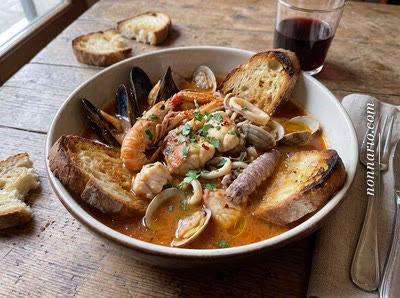
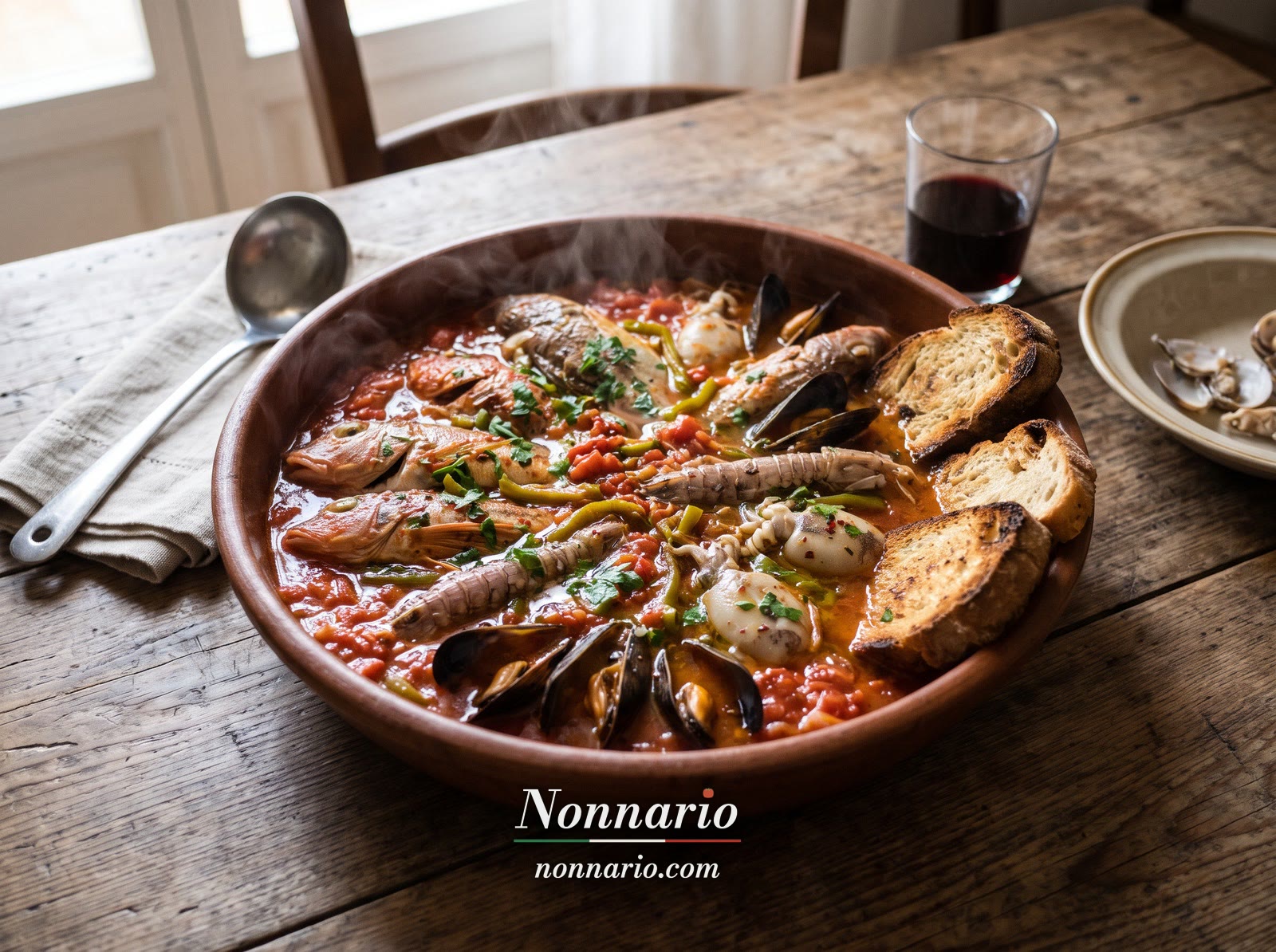
Mixed Adriatic fish, squid, mantis shrimp, mussels and clams laid one kind at a time over small tomatoes, sweet pepper, garlic, parsley and oil in a wide terracotta pot, cooked with the lid on and never stirred: Vasto's brodetto, whose recipe the Accademia Italiana della Cucina deposited with a notary in 2019.
- Course
- SecondiMain Courses
- Serves
- 4
- Hands-on
- 1 h 28 min
- Cooking
- 28 min
The video and the photos of every step are also gathered on a separate page.
In breve
In short
Also called lu vrudàtte, lu vrudatte a la uastareule, lu vrudátte a la uaštaréule, brodetto di pesce alla vastese, brodetto vastese and Vasto fish stew.
- Gluten-free
- Mixed Adriatic fish, whole with their heads, with squid, mantis shrimp, mussels and clams: 2.5 kg of fish in all.
- No soffritto: oil, a little water, sweet red pepper, garlic, parsley, basil and salt go into the cold terracotta pot together.
- Small tomatoes go in once it boils, then the fish one kind at a time, the firmest first and the most delicate last.
- 15–20 minutes with the lid on and never stirred: the pot is lifted by its handles and swirled so the fish swim in the sauce.
- Fresh hot red chilli broken over at the end, and served still bubbling in its pot.
La provenienza
Where this recipe comes from
Lu vrudàtte, in the dialect of Vasto, is the fish stew of this town on the Abruzzo coast. It was born, it is said, of barter: on the Costa Contina, the old path from the harbour up to the town's market square, fishermen carrying the catch in wicker baskets met market gardeners coming the other way and swapped fish for vegetables, and the scafetta, the basket of small mixed fish a fisherman could keep for himself, went into the pot with tomato, pepper, garlic and parsley. Its history is placed in the nineteenth century, and its recipe as it is made today in the last decades of the 1800s, when Vasto's mezzotempo tomato, a local variety that ripens in mid-season, was first planted. By 2012 the town's tourism office, with the historians Pino Jubatti and Luigi Murolo, had drawn up a disciplinare for the dish, recognised by the Chamber of Commerce of Chieti. In July 2015, when the Accademia Italiana della Cucina founded its Vasto delegation, it presented its updated recipe book, the Expo 2015 edition, which printed the full text of the brodetto for the first time; in 2019 the Accademia, on its Vasto delegation's proposal, deposited the recipe with a notary in Lanciano, as the one most faithful to the customs handed down; the Mayor of Vasto signed the disciplinare with the Accademia's officers.
The deed itself is not published. This page follows the recipe the Accademia publishes in its own collection, whose ingredients are the ones the Abruzzo Region lists for the deposited recipe; whether its quantities and method are the deed's cannot be checked. Other published versions of the town's recipe differ in the details (a green pepper instead of a red one, under a kilo of fish for four instead of two and a half, basil or none, a little water or none), so no step here is marked as official. They agree on what makes the dish: a wide, low terracotta pot, no soffritto, the base put in cold all together, the fish added one kind at a time from the firmest to the most delicate, the lid kept on and the stew never stirred, only swirled by lifting the pot by its handles. Ours are the weight of each group of fish, the place of the mussels and clams (in with the first fish, so they cook the whole time), the amounts of water, oil and herbs the recipe leaves loose, the heat, and a last check that the thickest fish has reached 63 °C, the temperature US food-safety guidance gives for fish.
- Provenance
- An official recipe filed with an Italian Chamber of Commerce or a notary by a recognised culinary body.
- Defined by
- Accademia Italiana della Cucina, Vasto delegation
- Reference
- Recipe deposited with a notary in Lanciano in 2019; the deed is not published, so the page follows the recipe the Accademia publishes in its own collection, whose ingredients match the Abruzzo Region's account of the deposit (the deed's quantities and method could not be compared)
- Sources
- Accademia Italiana della Cucina: brodetto alla vastese, from its recipe collection, for 4 (Italian)
- Accademia Italiana della Cucina, press review: an Abruzzo news site's report of 14 June 2019 on the deposit of the recipe with a notary in Lanciano (Italian, PDF)
- Accademia Italiana della Cucina, press review: Vastoweb on the founding of the Vasto delegation and the brodetto in the Accademia's updated recipe book, 10 July 2015 (Italian, PDF)
- Regione Abruzzo, its tourism portal: the ‘via del Brodetto’ in Vasto, with the 2019 deposit and its ingredients (Italian)
- Regione Abruzzo, its tourism portal: brodetto alla vastese in the Wall Street Journal (Italian)
- Agrodolce, food magazine: traditional specialities, brodetto alla vastese, its disciplinare and a recipe of its own, by Alessandro Olivieri, 2017 (Italian)
- Agrodolce, food magazine: how brodetto di pesce alla vastese is made, by Manuela Chimera, 2024 (Italian)
- Zonalocale, a Vasto news site: a press release by Nicola Del Prete, former councillor for tourism, on keeping to the brodetto's disciplinare, 20 November 2012 (Italian)
- Scatti di Gusto, food magazine: brodetto di pesce alla vastese, a Vasto restaurant's recipe, by Guido Ferraro, 2026 (Italian)
- Brodetto & Contorni, the Vasto festival of Slow Food Abruzzo e Molise: brodetto alla vastese, its history and a recipe for 4 (archived copy, Italian)
- Istituto Zooprofilattico Sperimentale delle Venezie: Molluschi bivalvi, frutti del nostro mare, a public-health leaflet on buying, keeping and cooking bivalves, 2nd edition 2020 (Italian)
- US Food and Drug Administration: Selecting and Serving Fresh and Frozen Seafood Safely, on buying fish and live shellfish and cooking them
- USDA Food Safety and Inspection Service: Safe Minimum Internal Temperature Chart, fish and shellfish at 145 °F (archived copy)
- USDA Food Safety and Inspection Service: Leftovers and Food Safety, on cooling, keeping and reheating cooked food (archived copy)
Ingredienti
Ingredients
The original recipe serves 4
The fish and shellfish
For the base
Equipment
- A wide, low terracotta pot (tijella) with two handles and a lid, about 36 cm–40 cm across and 7 cm–8 cm deep, for four; or two of about 30 cm, with everything shared between them
- A heat diffuser, for terracotta on an electric hob, or on gas if the pot's maker asks for one
- Oven gloves, for lifting the hot pot by its handles
- A fish scaler or the back of a knife, fish scissors and a sharp knife
- A stiff brush for the mussels, and a colander
- Three plates or trays, one for each group of fish
- A probe thermometer, and a fridge thermometer
- A fish slice and a wide spoon for serving, and a bowl for heads, shells and bones
Preparazione
Method
Scaled to 4 servings: the amounts in the steps follow. Pot and pan sizes and cooking times are still for the original 4.
Allow 2–2½ hours: about 1¼ hours to clean the fish and shellfish and prepare the base, then about 50 minutes at the stove. Buy the fish and shellfish on the day you cook them and keep them in the fridge at 4 °C or below; once cleaned, put the fish back in the fridge on three plates, in the order they go into the pot. The stew goes to the table as soon as it is done, still bubbling in its pot.
- 1 h 28 minhands-on
- 28 mincooking
Buying and keeping the fish and shellfish
The quantities and the method follow the Accademia's published recipe whole. The weight of each group of fish, the place of the mussels and clams, the water, the sizes, heat levels, times, checks and tips marked ‘Our guide’ are ours, after the public food-safety guidance listed in the sources.
-
Hands-on 5 min
Buy 2.5 kg of mixed Adriatic fish, whole, in the three groups listed: 300 g of mantis shrimp, 400 g of gurnard and 300 g of small squid for the first group, 800 g of firm-fleshed fish for the middle and 700 g of delicate fish for the last. Buy 300 g of live mussels and 300 g of live clams, each in a sealed net with its label.
Check The fish have bright eyes, red gills and firm flesh, and smell fresh and mild; the mussel and clam shells are closed and whole, and their labels give the packing date.
Tip Our guide: fish that smells fishy, sour or of ammonia is not fresh: leave it. Ask the fishmonger which fish came in that morning, and build the groups from those.
Tip Our guide: leave shellfish that is sitting in water at the counter or has no label. In Italy mussels may not be sold under 5 cm long, nor clams under 2.5 cm.
Tip Our guide: the recipe asks for many kinds. If one is missing, make up its weight with another of the same group.
-
Hands-on 2 min
At home, put the fish straight into the fridge, at 4 °C or below, on a plate, covered, on the bottom shelf. Put the mussels and clams in an open bowl covered with a damp cloth, in the fridge too.
Check The fridge thermometer reads 4 °C or below, and everything was in the fridge within a few minutes of coming home.
Tip Our guide: never shut live shellfish in a sealed bag or leave them in tap water: they need air, and fresh water kills them.
Tip Our guide: on a hot day carry everything home in a cool bag; fish and shellfish should never be out of the fridge for more than 2 hours, or 1 hour above 32 °C.
Cleaning the fish
The fish go into the pot whole, with their heads; only a fish too large for the pot is cut.
-
Hands-on 30–40 min
Clean the gurnard, the firm-fleshed fish and the delicate fish under cold running water, leaving them whole with their heads. Leave the small ray in its skin.
Check Every fish is scaled, empty and rinsed, with no gills and no blood along the backbone, and still has its head.
Tip Our guide: scrape off the scales from tail to head with a scaler or the back of a knife, slit the belly with scissors and pull out the guts, then cut out the gills, which make the sauce bitter. Rinse inside and out.
Tip Our guide: cut the tail of the monkfish across into 2 or 3 pieces through the bone, so it lies flat. The sole and scaldfish need only their guts and gills taken out; leave their skin on.
Tip Our guide: gurnard and scorpionfish have sharp spines on the back and gills: snip them off with scissors first, and hold the weever by the head, as its spines sting.
Tip Our guide: your fishmonger will scale and gut the fish if you ask; have the heads left on.
-
Hands-on 8–10 min
Clean the small squid and leave them whole.
Check No quill, beak, eyes or innards are left; the bodies are white and whole, with their tentacles beside them.
Tip Our guide: pull the head and innards out of the body, take out the clear quill, cut the tentacles off just in front of the eyes and squeeze out the beak from the middle of them. Rinse the body inside. With small cuttlefish, keep the ink sac out.
-
Hands-on 3 min
Rinse the mantis shrimp, and the crab if you have one, under cold running water, leaving them in their shells.
Check They are clean and whole, in their shells.
Tip Our guide: mantis shrimp have sharp spines along the tail and claws that can cut: hold them by the body.
-
Hands-on 3 min
Put the fish on three plates, by how long they take to cook: on the first the mantis shrimp, gurnard and squid; on the second the firm-fleshed fish (weever, scorpionfish or stargazer, ray, monkfish and crab); on the third the delicate fish (hake, grey mullet, sole, scaldfish and red mullet). Cover them and put them back in the fridge.
Check Three covered plates in the fridge, the firmest fish on the first.
Tip Our guide: wash your hands, the board and the knife with soap and warm water after handling raw fish.
The mussels and clams
-
Hands-on 3 min
Take the mussels and clams out of the fridge and go through them one by one. Throw away any with a cracked or broken shell. Tap any open one against the worktop: if it does not close within about a minute, throw it away.
Check Only whole shells are left, all of them closed or closing when tapped.
Tip Our guide: a mussel or clam that stays open when tapped is dead and must not be eaten.
-
Hands-on 8–10 min
Scrub each mussel under cold running water with the brush, scraping off any barnacles, and pull off its beard, the tuft of threads between the shells, with a firm tug. Rinse the clams in a colander in several changes of cold water, shaking them. Put both back in the fridge in their bowl, under the damp cloth.
Check Clean, dark mussel shells with no threads sticking out, and clams whose last rinsing water is clear, with no sand at the bottom of the bowl.
Tip Our guide: pull off the beards only now, shortly before cooking: it harms the mussel.
Tip Our guide: clams from a dispatch centre are usually clean. If one you open is gritty, soak them for an hour in cold water with 35 g of salt per litre, in the fridge, then rinse them again.
The base
-
Hands-on 2 min
Peel the 2 cloves of garlic and slice them thinly.
Check Thin, even slices, with no thick pieces.
-
Hands-on 4 min
Wash the sweet red pepper, cut out the stalk, seeds and white ribs, and cut the flesh into long strips about 5 mm wide.
Check A heap of long, thin strips, with no seeds left.
-
Hands-on 3 min
Pick the leaves from the 15 g of parsley and chop them. Pick the 10 leaves of basil and leave them whole.
Check Finely chopped parsley with no stalks, and whole basil leaves.
-
Hands-on 3 min
Wash the 500 g of small tomatoes, pull off any stalks and cut them in half. Wash the chilli and keep it aside for the end.
Check A bowl of halved tomatoes with their juice.
Tip Our guide: halving them is ours, so they give their juice to the sauce.
Cooking in the terracotta pot
From the moment the fish go in, nothing is stirred and nothing is turned: to move the fish, lift the pot by its handles with oven gloves and swirl it gently, so everything swims in the sauce.
-
Hands-on 2 min
Put the 250 ml of olive oil, the water, about 100 ml, the strips of pepper, the chopped parsley, the sliced garlic, the salt, about 6 g, and the basil leaves into the cold terracotta pot, all together.
Check The pot holds a shallow layer of oil and water with the pepper, garlic and herbs spread through it; nothing has been fried.
Tip Our guide: with two pots, share the oil, water and everything after it equally between them.
-
Cooking 10–14 minHeat medium
Set the pot on a medium heat, on its diffuser if you use one, and bring it to the boil. Let it boil for a few minutes.
Check The oil and water bubble all over the pot, and the pepper strips have begun to soften and the garlic to smell sweet, without colouring.
Tip Our guide: terracotta heats slowly, about 8–10 minutes to the boil, then 2–4 minutes at the boil. Never put a cold terracotta pot on a hot ring, or a hot one on a cold, wet surface: it can crack.
-
Cooking 3–4 minHeat medium
Add the halved tomatoes and let it come back to the boil.
Check The base bubbles again all over and the tomatoes have begun to soften and give their juice.
Tip Our guide: spread them evenly over the bottom, so the fish lie on a bed of tomato and pepper.
-
Hands-on 2–3 minHeat medium
Lay the mantis shrimp, the gurnard and the squid in the pot, one kind at a time, side by side in the sauce. Add the mussels and clams around them. Put the lid on.
Check The first group lies in one layer in the sauce, the shellfish tucked in between, and the sauce bubbles again under the lid.
Tip Our guide: the recipe does not say when the mussels and clams go in. They go in now, with the first fish, so they cook for the whole time: they open within a few minutes, and then stay at the boil for a further 15–20 minutes. Public-health guidance asks for 5 minutes of cooking after the shells open.
Tip Our guide: lay each fish in gently with your hand or a fish slice; do not drop it in, as the oil is hot.
-
Hands-on 2–3 minHeat medium
Lift the lid and lay the firm-fleshed fish over and between the first group, one kind at a time, the ray flat and the monkfish pieces in the gaps. Put the lid back on.
Check The second group is in, with as little overlapping as possible, and the sauce bubbles again around it.
Tip Our guide: wait until the sauce bubbles again before each group; it takes 2–3 minutes.
-
Hands-on 2 min
Lay the hake, grey mullet, sole, scaldfish and red mullet on top, one kind at a time, so they are not crushed.
Check All the fish are in the pot, the most delicate on top, and the sauce is bubbling up around them.
Tip Our guide: if the pot is too full for one layer, lay the delicate fish over the others rather than underneath; they cook in the steam under the lid.
-
Cooking 15–20 minHeat medium-low
Put the lid on and cook the brodetto for 15–20 minutes without stirring it at all. Now and then, lift the pot gently by its handles and swirl it in small, flat circles, so the fish move and swim in the sauce.
Check Steam escapes at the edge of the lid and the sauce bubbles steadily all the time; the fish have not stuck and have not broken.
Tip Our guide: keep it at a steady bubble: on a medium-low to medium heat, depending on your hob. Swirl the pot every 4–5 minutes, with oven gloves, keeping it level.
Tip Our guide: keep the lid on; lift it only for the check at the end.
-
Hands-on 2 min
Lift the lid and push a probe thermometer into the thickest fish, near the backbone but not touching it.
Check The thermometer reads at least 63 °C, the flesh is opaque all through and comes away from the bone easily, the mantis shrimp and squid are opaque and firm, and every mussel and clam is open. If not, put the lid back on for 3–5 minutes more and check again.
Tip Our guide: 63 °C is the temperature US food-safety guidance gives for fish and shellfish. The thickest fish is usually the gurnard or the largest of the middle group.
Tip Our guide: throw away any mussel or clam that is still shut.
-
Hands-on 1 min
Take the pot off the heat and break or snip the fresh red chilli over the top.
Check Pieces of red chilli are scattered over the fish.
Tip Our guide: for a milder stew, use only part of the chilli.
Tip Our guide: taste a spoonful of the sauce from the edge of the pot and, if it needs it, add a pinch of salt at the side, then swirl the pot once.
-
Hands-on 3 min
Bring the pot to the table at once, on a board or a folded cloth, and serve the brodetto while it is still bubbling, giving each plate a share of every kind of fish and shellfish with plenty of sauce.
Check Each plate has some of every fish, whole and unbroken, with sauce and open shells.
Tip Our guide: lift the fish out with a fish slice and a wide spoon so they stay whole, and put a bowl on the table for heads, shells and bones. Warn your guests that the fish keep their bones.
Tip Many serve slices of toasted bread on the side, for the sauce.
Tip Our guide: from the moment it comes off the heat, the brodetto may stand at room temperature for 2 hours at most (1 hour on a day above 32 °C). Put any leftovers in shallow containers in the fridge within that time.
The essentials, for cooks who know the dish. Switch to Detailed for quantities, temperatures, times and checks at every step.
Press “I’m here” on the step you are on, and again when it is done.Tap the pin on the step you are on, and the tick when it is done. Timers keep running while you scroll.
Da sapere
Good to know
- WhenQuando
- Vasto celebrates it every June, with themed menus, events, food stalls and tastings on the trabocchi, the old wooden fishing platforms along the coast. Source
- KeepingConservazione
- It is eaten at once, still bubbling. Leftovers go into the fridge in shallow, covered containers within 2 hours of cooking and keep for up to 3 days; reheat only what you will eat, covered, shaking the pan rather than stirring, until the sauce boils and the thickest piece reaches 75 °C. Source
- VariantsVarianti
- With a green pepper and prawns: About 900 grams of cleaned mixed fish, mussels and clams, a few live mantis shrimp, king prawns and scampi, 500 grams of fresh tomatoes broken up (the local mezzitempi if possible), two cloves of garlic, one sweet green pepper, parsley, oil and salt. The same cold start with water, the tomatoes, then the fish from the firmest to the most delicate, 15–20 minutes with the lid on and never stirred, fresh chilli at the end and toasted bread alongside. Source
- With less fish, at a brisk boil: For four, 900 grams in all of medium-sized hake, red mullet, sole, weever, gurnard, octopus or small cuttlefish, false conger (falso grongo), scorpionfish or stargazer, a small ray and a few mantis shrimp, with 500 grams of cherry or mezzitempi tomatoes, four cloves of garlic and a red pepper. Plenty of oil, very little water, the garlic, pepper, parsley and split tomatoes all go in cold together and come to the boil on a moderate flame; the fish go in one by one by hardness, ray and scorpionfish first, sole and hake last, and cook for 15 minutes at a brisk boil with the lid always on. At the table the lid is lifted with a flourish, to let out the scent. Source
- With pasta to follow: In some of the restaurants on the trabocchi at Vasto it is a meal in two parts: first the fish, then pasta cooked in the sauce left in the pot. Source
Errori comuni
Common mistakes
- Frying the garlic first: there is no soffritto, and everything for the base goes into the cold pot together.
- Adding vinegar or broth: the sauce is only oil, a little water, pepper, tomato, herbs and what the fish give.
- Putting all the fish in at once: the firmest go in first and the most delicate last, so all are done together.
- Stirring or turning the fish: lift the pot by its handles and swirl it instead, or the fish break up.
- Taking the lid off during the cooking: it stays on for the 15–20 minutes, until the check.
- Using a mussel or clam that is broken, or open and does not close when tapped; serving one that stays shut.
- Taking it off the heat before the thickest fish has reached 63 °C.
- Grabbing the hot handles with bare hands: use oven gloves.
Fuori dall'Italia
Cooking it outside Italy
- Merluzzo in the Adriatic is hake; triglie are red mullet, sogliole sole, cefalotto or muggine grey mullet, and suacia, also called cianchetta, is scaldfish, a small flatfish.
- Gallinella, also called testone, is gurnard; tracina or gragnoletto is weever, scorfano scorpionfish, lucerna stargazer, razza ray (occhialino is a small one) and pescatrice monkfish.
- Calamari are squid and seppioline small cuttlefish; cicale di mare, panocchie or pannocchie are mantis shrimp, and granchio is crab.
- Cozze are mussels, and vongole are clams, called cozza bianca in Vasto.
- If you cannot find a fresh chilli, a teaspoon of dried chilli flakes will do.
From nonnario.com/recipes/brodetto-alla-vastese/, where you will find its sources, its story and the step photos. Sources checked in November 2026.