Pescara, Abruzzo
Parrozzo
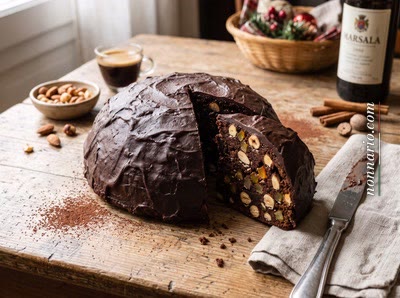
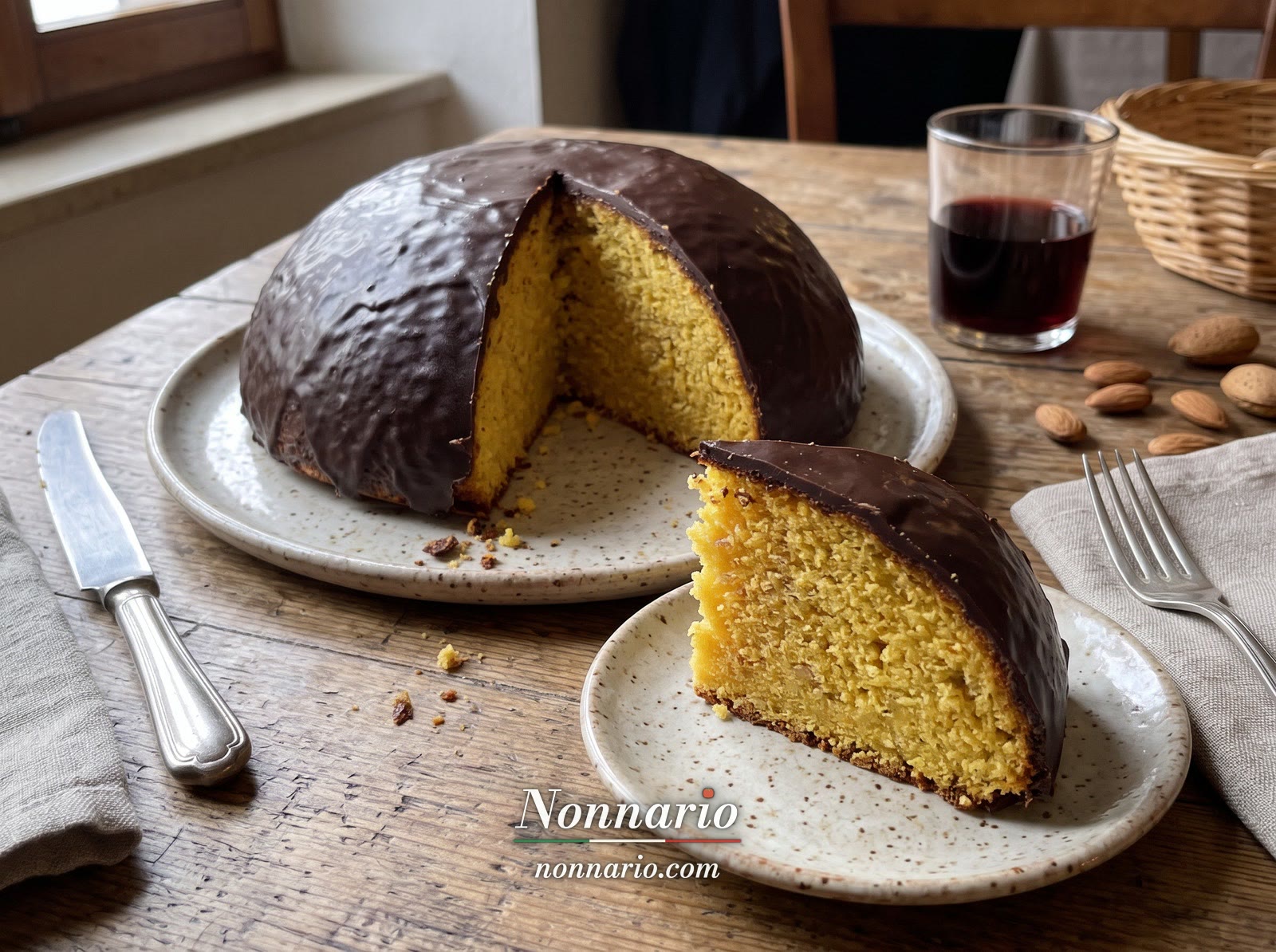
Pescara's dome-shaped almond and semolina cake covered in dark chocolate
Pescara's Christmas cake, created by a pastry maker in 1920 and named by Gabriele D'Annunzio: whisked eggs, sugar, chopped almonds with a few bitter ones and semolina, baked in a dome and covered in dark chocolate.
- Course
- DolciDesserts
- Serves
- 8
- Hands-on
- 47 min
- Cooking
- 1 h
- Resting
- 3 h 5 min+
The video and the photos of every step are also gathered on a separate page.
In breve
In short
Also called pan rozzo, parrozzo abruzzese and parrozzino.
- Vegetarian
- Eggs, sugar, finely chopped almonds with a few bitter ones, semolina and orange zest; no baking powder, as the whisked eggs alone make it rise.
- The yolks are whisked with the sugar until pale and foamy, the whites until stiff, then folded in a spoonful at a time.
- Baked in a hemispherical mould, so it keeps the dome of the pane rozzo, the cornmeal bread it was modelled on.
- Covered entirely in melted dark chocolate once cold: the dark coat stands for the scorched crust of bread from a wood-fired oven.
La provenienza
Where this recipe comes from
Parrozzo is the Christmas cake of Pescara. Abruzzo's farmers once baked for themselves a dome-shaped bread of cornmeal in wood-fired ovens, the pane rozzo or rough bread, while the white wheat bread was sold to the gentry. Luigi D'Amico, a Pescara pastry maker, turned it into a sweet in 1920 (regional accounts say only the start of the 20th century): he kept its dome by baking in a hemispherical mould, took the yellow of the corn from egg yolks with almonds, and covered it in dark chocolate for the scorched crust. Gabriele D'Annunzio, born in Pescara, gave it its name and wrote verses to it in dialect; in a letter of 1934 he told the pastry maker that his parrozzo was like the deepest stone of the Maiella turned into angels' bread. Others contributed too: the playwright Luigi Antonelli wrote a ‘Storia del Parrozzo’, Cesare De Titta the words of the ‘Canzone del Parrozzo’, set to music by Maestro Di Jorio, and the ceramist Armando Cermignani drew its box; some accounts give that title to D'Annunzio's own verses. The name was registered as a trademark in 1926, and it was still a registered trademark in 2023. In July 1927 D'Amico opened the Ritrovo del Parrozzo, a tea room in piazza Garibaldi, a few steps from the poet's birthplace. The Abruzzo Region lists parrozzo among its traditional food products, and describes it as dark outside and yellow within, tasting strongly of almond and chocolate with a hint of orange.
There is no official recipe: no deposited text and no De.Co. of Pescara, and the Region's description gives no quantities. We compared the serious sources and publish the most widely recognised version. They agree on eggs whisked with sugar, the whites whisked stiff and folded in last, ground almonds, semolina, citrus zest, a hemispherical mould, a moderate oven for 40 to 50 minutes, and a full coat of dark chocolate once the cake is cold. They differ on the bitter almonds (a few, or almond liqueur instead), on butter in the batter, which some cooks add and others leave out, on orange or lemon, and on what goes into the coating with the chocolate: butter, milk or oil. This version has six eggs, six bitter almonds and orange zest, with butter only in the coating. Ours are the blanched almonds, the times for whisking and cooling, the melting temperature of the chocolate and the hour for it to set; each step has a check to judge it by.
- Provenance
- A regional tradition documented in cookbooks and local practice, with no single official text.
- Defined by
- Abruzzese tradition
- Reference
- Compared across 6 sources, listed below; this page publishes the most widely recognised version.
- Sources
- Agrodolce: parrozzo, the Christmas cake of Abruzzo (Italian)
- Dissapore: parrozzo abruzzese, the cake D'Annunzio loved (Italian)
- Il Cucchiaio d'Argento: parrozzo (Italian)
- Abruzzo Region, its tourism site: the sweet history of parrozzo, as archived in October 2022 (Italian)
- Abruzzo Region, its agency for agricultural development (ARSSA): Atlas of the traditional products of Abruzzo, 2006, parrozzo on page 142 (Italian and English)
- Abruzzo Region: its list of traditional food products (PAT), parrozzo at no. 99 (Italian)
Ingredienti
Ingredients
Makes one parrozzo about 20 cm across, for 8: 8 servings
The batter
For the mould
The coating
Equipment
- Kitchen scale
- A hemispherical mould about 20 cm across, preferably aluminium
- Pastry brush, for buttering the mould
- Food processor or mini chopper, for the almonds
- Fine grater, for the orange zest
- Two large bowls, one perfectly clean and grease-free for the whites
- Electric whisk
- Flexible spatula
- Oven thermometer
- Wooden toothpick or thin skewer; a probe thermometer helps, for the cake and the chocolate
- Wire rack and a sheet of baking paper
- Heatproof bowl and a pan that holds it, for the bain-marie
- Palette knife or a second spatula, for spreading the chocolate
Preparazione
Method
About 4 hours 50 minutes from start to table, most of it waiting: 15 minutes for the oven to heat while you prepare the mould and chop the almonds, about 25 minutes to separate, whisk and fold the batter, about 50 in the oven, 2 hours for the cake to cool completely, about 20 minutes to melt, cool and pour the chocolate, and an hour for the coating to set. Bake it in the morning to serve it in the evening.
- 47 minhands-on
- 1 hcooking
- 3 h 5 minresting, at least
Before you start
-
Cooking 15 minTemp 170 °C
Heat the oven to 170 °C, static (top and bottom heat), with a shelf in the middle.
Check The oven has reached 170 °C: its light has gone off, or the oven thermometer reads it.
Tip The recipe asks for a preheated oven at 170 °C; static heat and the middle shelf are our guide. Home ovens drift, so trust the thermometer rather than the dial.
-
Hands-on 3 min
While the oven heats, brush the inside of the hemispherical mould with soft butter, then spoon in a little flour, turn the mould so it coats every part, and tap out the excess.
Check A thin, even white film all over the inside, with no bare patches and no loose flour in the bottom.
Tip Our guide: the curve is where the cake sticks, so brush the butter right up to the rim. The recipe says only that the mould is buttered and floured.
-
Hands-on 3 min
Put the 150 g of almonds and the 6 bitter almonds in the food processor with 2 tablespoons of the 200 g of sugar, and chop them finely in short pulses.
Check Like fine sand, with nothing bigger than a grain of rice; dry and loose, not oily or clumping.
Tip Our guide: pulse rather than run the motor, and stop as soon as it is fine. Run too long, the almonds warm and turn to an oily paste.
Tip Our guide: never use more than the 6 bitter almonds. They give the cake its bittersweet almond scent, but they contain a compound that releases cyanide, so a few flavour a whole cake and they are never eaten by the handful. Keep the rest of the packet away from children.
Tip Our guide: blanched almonds keep the crumb pale yellow; the recipe does not say whether they are peeled.
-
Hands-on 2 min
Grate the zest of the orange on the fine grater.
Check Only the orange skin, with none of the bitter white pith beneath it.
The batter
-
Hands-on 5 min
Separate the 6 eggs, the whites into the clean, grease-free bowl and the yolks into the other.
Check Not a trace of yolk in the whites.
Tip Our guide: crack each egg over a cup first and tip the white into the bowl only when it is clean: a speck of yolk, or any fat, and the whites will not whisk stiff.
-
Hands-on 3–5 min
Add the pinch of salt to the whites and whisk them with the electric whisk until stiff.
Check Stiff, glossy peaks that stand up when the whisk is lifted; the bowl can be tipped without the whites sliding.
Tip The cake has no baking powder: the whisked eggs are all that make it rise, so whisk the whites fully, and handle them gently from here on.
-
Hands-on 5–8 min
Whisk the yolks with the rest of the sugar until pale and foamy.
Check The mixture is much paler than when you started, light and foamy, and falls from the whisk in a thick ribbon.
Tip Our guide: use the same beaters without washing them. A little white on them does not hurt the yolks, while yolk on them would have stopped the whites rising; that is why the whites come first.
-
Hands-on 2 min
With the spatula, stir the orange zest, the chopped almonds and the 150 g of semolina into the yolks.
Check A thick, even batter, with no dry pockets of semolina or almonds.
-
Hands-on 5 min
Add the whites a spoonful at a time, folding each in gently with the spatula, lifting from the bottom of the bowl up over the top, until they are all in.
Check No white streaks left; the batter is light, airy and evenly coloured.
Tip Our guide: stir the first spoonful in more firmly, to loosen the thick batter; then fold the rest lightly, so the air you whisked in stays in.
Baking
-
Hands-on 2 min
Pour the batter into the mould and level the top gently with the spatula.
Check An even surface, and the batter into the oven straight away.
Tip Our guide: do not let the batter wait: the whites slowly lose their air.
Tip Our guide: a round-bottomed mould rocks on a flat shelf: stand it in a cake ring on a baking tray, or on a ring of crumpled foil, so it sits level.
-
Cooking 45–50 minTemp 170 °C
Bake at 170 °C for about 45–50 minutes, until it is well cooked and dry. Test it with a toothpick after the first 45 minutes and, if needed, bake it a little longer.
Check A toothpick pushed into the centre comes out dry; the top is golden and springs back when pressed lightly, and a probe in the centre reads about 95 °C.
Tip Our guide: do not open the oven in the first 40 minutes, or the whisked batter may fall.
Tip Our guide: if the toothpick comes out moist, give it 5 minutes more and test again.
-
Hands-on 2 min
Take the cake out of the oven, turn it out of the mould straight away and set it on the wire rack, dome up.
Check It comes out whole, with no crumb left in the mould.
Tip Our guide: if it holds, run a thin knife round the rim and tap the mould. Use oven gloves: the metal is hot.
-
Rest 2 h
Leave the cake on the rack until it is cold right through, about 2 hours.
Check The base and the top of the dome feel cool to the touch.
Tip Our guide: on a warm cake the chocolate stays soft and slides off.
The chocolate coating
-
Hands-on 8–10 minHeat low
Chop the 150 g of chocolate and put it in the heatproof bowl with the 20 g of butter. Set the bowl over a pan of barely simmering water, clear of the water, and stir until melted, no hotter than 45 °C.
Check Smooth and glossy, with no lumps, and no hotter than 45 °C.
Tip Our guide: 45 °C is enough to melt all of the cocoa butter; much hotter and the chocolate thickens and turns grainy. Keep water and steam out of the bowl: a drop makes chocolate seize.
Tip Our guide: the butter makes a soft, glossy coat, so the chocolate is not tempered.
-
Rest 5 min
Take the bowl off the pan and stir now and then for about 5 minutes, until the chocolate is about 35 °C.
Check Still runny, but it coats the back of a spoon thickly rather than running off it.
Tip Our guide: too hot, it runs off the dome and the coat is thin; it should still flow easily.
-
Hands-on 5 min
Slide the baking paper under the rack. Pour the chocolate over the top of the dome and help it down the sides with the spatula or palette knife until the whole cake is covered.
Check No cake shows anywhere, down to the base; the coat is even and glossy.
Tip Our guide: scrape what drips onto the paper back up onto any bare patch while it is still soft.
-
Rest 1 h
Leave the cake in a cool room, about 18 °C–20 °C, for about an hour, until the chocolate has set.
Check The coating is no longer tacky, and a light touch leaves no mark.
Tip Our guide: not in the fridge, where damp can dull and mark the chocolate.
-
Hands-on 2 min
Lift the cake onto a plate and cut it into 8 wedges with a sharp knife, its blade warmed in hot water and dried.
Check Cut, it is dark outside and yellow within: a fine, moist, almond crumb inside a thin shell of chocolate.
Tip Serve it with coffee or tea, or with a sweet wine or an orange liqueur.
The essentials, for cooks who know the dish. Switch to Detailed for quantities, temperatures, times and checks at every step.
Press “I’m here” on the step you are on, and again when it is done.Tap the pin on the step you are on, and the tick when it is done. Timers keep running while you scroll.
Da sapere
Good to know
- WhenQuando
- Christmas: it was first made only for the Christmas holidays. Source
- KeepingConservazione
- Out of the fridge, away from heat, for 5 to 7 days. Butter melted into the chocolate keeps the coating from drying out and keeps it supple. Source
- VariantsVarianti
- Without bitter almonds, with lemon: Leave out the bitter almonds and add 2 tablespoons of amaretto liqueur to the batter instead; use the zest of a lemon in place of the orange. Source
- With butter in the batter: For 6: 100 g each of almond flour, semolina and sugar, 4 eggs, a pinch of salt, the zest of a lemon and 80 g of melted butter stirred into the yolks with the almonds and semolina; baked in a buttered zuccotto mould dusted with almond flour, in a static oven at 180 °C for 40 minutes, cooled completely before it is turned out, then covered with 200 g of dark chocolate melted in a bain-marie with a drop of milk. The same batter makes 4 small parrozzi in individual moulds. Source
- With flour and honey: For 8: 140 g of yolks whisked with 180 g of sugar, 15 g of honey and, optionally, lemon zest; 50 g of toasted unpeeled almonds ground with 5 g of apricot kernels and mixed with 60 g of 00 flour and 40 g of semolina; 210 g of whites whisked stiff and folded in. Baked in a buttered and floured mould 21 cm across, in a fan oven at 170 °C for about 45 minutes, checked with a toothpick; once cold it rests overnight in the fridge, wrapped, and is then set on a rack and covered with 400 g of extra dark chocolate melted with 50 g of seed oil and left to cool a little, poured from a jug. Source
Errori comuni
Common mistakes
- Whisking the whites too little, or stirring them in hard: with no baking powder, the whisked eggs are all that lift the cake, and it comes out dense.
- Adding more bitter almonds than the six: they turn the cake bitter, and they are not safe in quantity.
- Opening the oven early: the whisked batter can fall.
- Coating the cake while it is still warm: the chocolate stays soft and slides off.
- Overheating the chocolate, or letting water or steam into it: it thickens, turns grainy and will not pour.
- Setting the coated cake in the fridge: damp dulls and marks the chocolate.
Fuori dall'Italia
Cooking it outside Italy
- Bitter almonds can be hard to find outside Italy. The recipe's own alternative is to leave them out and add 2 tablespoons of amaretto liqueur to the batter; bitter almond extract for baking, used as its label directs, also gives a similar flavour.
- Apricot kernels (armelline) can stand in for bitter almonds. Our guide: no more than 6, the same cap as for the bitter almonds, about 5 g, and never eaten raw or by the handful.
- Semolino is fine semolina, sold for puddings and cakes: not the coarse kind for pasta or bread. Without it, the recipe allows part plain flour and part durum-wheat semola, or plain flour with potato starch.
- Choose unwaxed oranges, since the zest goes into the batter.
- Plain flour (all-purpose in the US) is fine for dusting the mould.
From nonnario.com/recipes/parrozzo/, where you will find its sources, its story and the step photos. Sources checked in November 2026.