San Martino sulla Marrucina, Abruzzo
Maccheroni alla chitarra
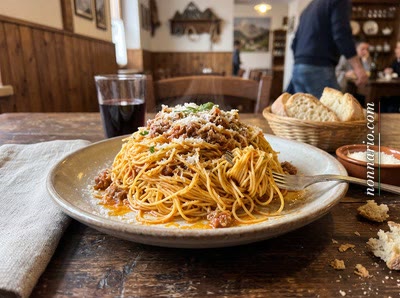
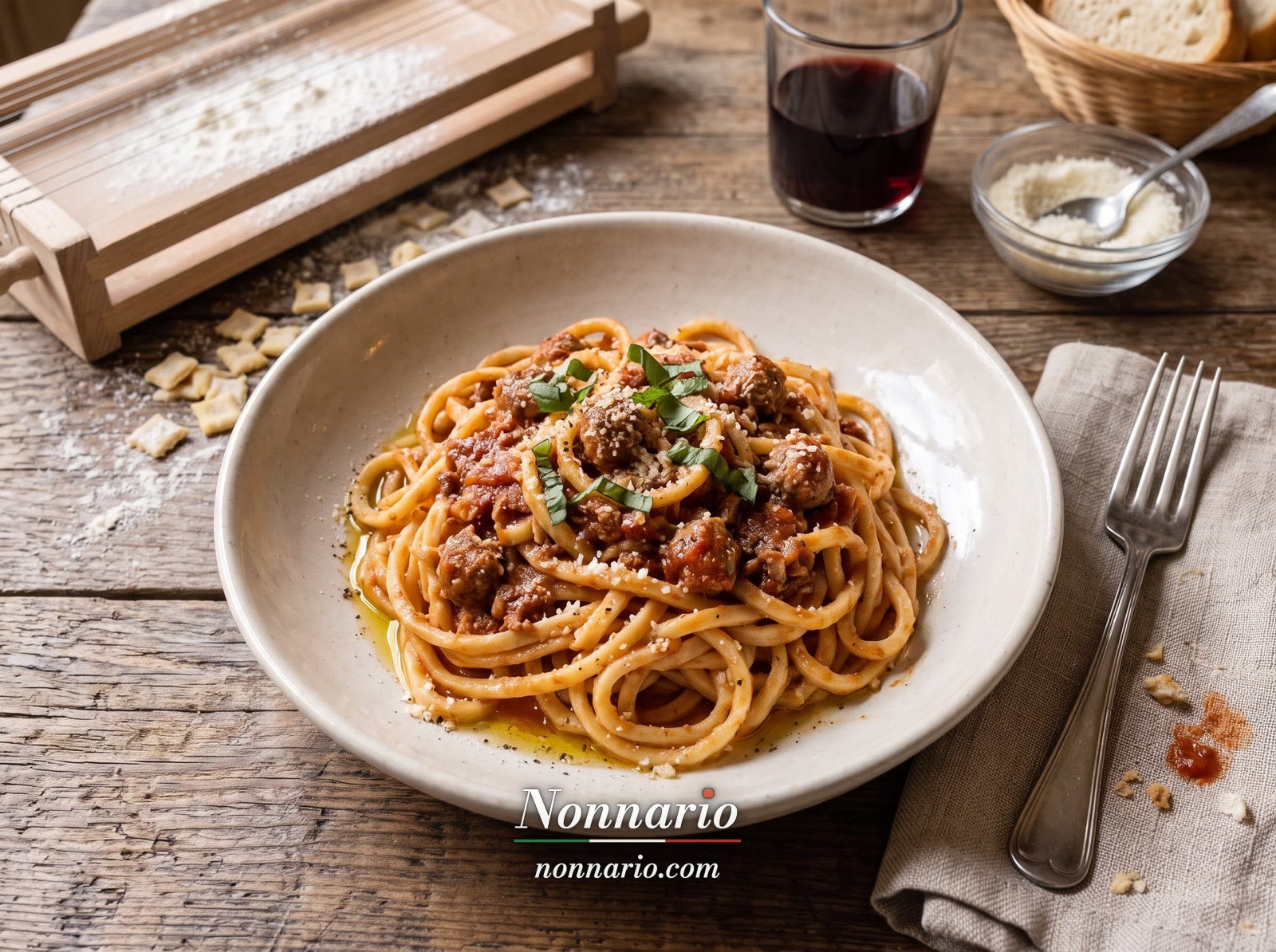
Abruzzo's square egg pasta cut on the chitarra, with a ragù of three meats
Abruzzo's egg pasta of flour and eggs, rolled into a sheet not too thin and pressed through the steel strings of the chitarra into square strands, served with a ragù of beef, lamb and pork in passata; a traditional agri-food product of the region.
- Course
- Primi & RisottiPasta & Rice
- Serves
- 6
- Hands-on
- 1 h 24 min
- Cooking
- 1 h 18 min
- Resting
- 33 min+
The video and the photos of every step are also gathered on a separate page.
In breve
In short
Also called spaghetti alla chitarra, pasta alla chitarra, maccheroni alla chitarra al ragù, guitar-cut pasta and chitarra pasta with three-meat ragù.
- Egg pasta of soft wheat flour and eggs, one egg to every 100 g of flour, kneaded until smooth and elastic.
- The sheet is rolled as thick as the strings are apart, 2 mm–3 mm, so that each strand comes out square.
- Cut by laying the sheet on the steel strings of the chitarra and pressing it through with a rolling pin, along its length.
- Here with a ragù of beef, lamb and lean pork, browned in olive oil, splashed with red wine and simmered in passata for about an hour.
- Finished with grated young pecorino, or Parmigiano, and chopped chilli.
La provenienza
Where this recipe comes from
Maccheroni alla chitarra are the first course par excellence on Abruzzo's tables: a fresh pasta of flour and eggs with a square section of 2–3 mm, thicker and narrower than fettuccine. They take their name from the tool that cuts them, a rectangular wooden frame strung with steel wires 2–3 mm apart (its other side, with wires 4–6 mm apart, cuts fettuccine). The sieve-makers of San Martino sulla Marrucina, in the province of Chieti, built the first one around 1860, after steel wire spread into Italy from Germany. It was first called the ‘carratore per pasta’, ‘lu carrature’ in dialect; under that name it appears among a bride's trousseau in a notarial deed of 1871 from Pescara, and only in the early twentieth century did it become the ‘chitarra’, for the sound its strings make. The dish is on Italy's national list of traditional agri-food products for Abruzzo.
There is no official recipe. We compared seven sources and publish the most widely recognised version. They agree on the pasta: flour and eggs, roughly one egg to every 100 g of flour, rolled into a sheet not too thin and pressed through the strings with the rolling pin; most cut the sheet into rectangles of about 60 by 20 cm. They differ on the sauce: some give a ragù of three meats, others the pallottine, tiny meatballs of the Teramo area, and some cooks combine the two. This page serves the ragù of beef, lamb and lean pork, browned, splashed with red wine and cooked about an hour in passata, with the meat left in. Two steps are ours: the dough rests in the fridge and is cooked the same day, because raw egg dough should spend no more than 2 hours at room temperature; and each sheet dries for a few minutes before cutting, so it does not stick in the strings.
- Provenance
- A regional tradition documented in cookbooks and local practice, with no single official text.
- Defined by
- Abruzzese tradition
- Reference
- Compared across 7 sources, listed below; this page publishes the most widely recognised version.
- Sources
- Accademia Italiana della Cucina: maccheroni alla chitarra, an Abruzzese recipe from its collection (Italian)
- Regione Abruzzo, its tourism portal: maccheroni alla chitarra and the history of the chitarra, from the atlas of Abruzzo's agri-food products (Italian)
- Regione Abruzzo: Italy's national list of traditional agri-food products, the Abruzzo entries (Italian, PDF)
- Italia.it, Italy's official tourism portal: the history of maccheroni alla chitarra (Italian)
- Discover Teramo, the tourism site of the B.I.M. Teramo consortium of mountain municipalities: chitarra alla teramana with pallottine (Italian)
- Unione Cuochi Abruzzesi, Ordine dei cavalieri dei maccheroni alla chitarra: its two base recipes of 2013 (archived copy, Italian)
- USDA Food Safety and Inspection Service: Leftovers and Food Safety (archived copy of 29 May 2025)
Ingredienti
Ingredients
The original recipe serves 6
For the maccheroni
For the ragù
To cook and serve
Equipment
- A chitarra for maccheroni, with steel strings 2 mm–3 mm apart
- Large wooden pastry board and a long rolling pin
- Kitchen scale, a ruler and a knife
- Cling film
- Tray dusted with semolina, for the cut maccheroni
- Heavy casserole about 26 cm across, with a lid, and a wooden spoon
- Large pot holding at least 8 l, and a colander or tongs
- Cheese grater
Preparazione
Method
Scaled to 6 servings: the amounts in the steps follow. Pot and pan sizes and cooking times are still for the original 6.
About 2 1/2–3 hours. Start the ragù: about 40 minutes of chopping and browning, then about an hour of simmering. As soon as the passata is in, make the dough (about 20 minutes) and rest it in the fridge for 30 minutes to an hour; then roll and cut it, one sheet at a time, while the ragù finishes and keeps warm. Put the pasta water on when you start cutting the second sheet. The maccheroni cook in 3–5 minutes, so the ragù must be ready before they go in. Count the raw dough's time out of the fridge from when the eggs are broken: no more than 2 hours in all before it is cooked. The ragù can also be made the day before: into the fridge within 2 hours of cooking, and back to the boil before you dress the pasta.
- 1 h 24 minhands-on
- 1 h 18 mincooking
- 33 minresting, at least
The ragù
-
Hands-on 15 min
Peel the onion and the carrot, trim the celery and chop all three finely. Trim any gristle from the beef, lamb and pork and cut each into pieces of about 1.5 cm.
Check The vegetables are in small, even pieces, and the meat in pieces of about the same size, so they cook evenly.
Tip Use one board and knife for the raw meat and wash them before you make the dough.
-
Hands-on 8–10 minHeat medium-low
Warm the 200 ml of olive oil in the casserole over a medium-low heat. Add the onion, carrot and celery and let them soften, stirring now and then.
Check Soft, shrunk and lightly golden, with no dark or burnt edges.
Tip Our guide: 8–10 minutes. If they start to catch, turn the heat down.
-
Hands-on 8–10 minHeat medium-high
Add the three meats, turn the heat up to medium-high and keep browning them, turning the pieces, until they are coloured all over.
Check Browned on every side, and the liquid the meat gives off has gone.
Tip Our guide: 8–10 minutes. Spread the pieces out: crowded, they stew instead of browning.
-
Hands-on 2–3 minHeat medium-high
Pour in the 150 ml of red wine and let it bubble until it has evaporated, scraping the bottom of the casserole with the wooden spoon.
Check Only a little liquid is left, and the sharp smell of wine has gone.
Tip Montepulciano d'Abruzzo, the region's own red wine, is the one to use.
-
Cooking 1 hHeat low: a gentle bubble, lid ajar
Add the 1 l of passata, stir and bring it to a gentle boil. Turn the heat down to low, set the lid ajar and cook for about an hour, stirring every 15 minutes or so.
Check The meat is tender when pressed with the spoon, the sauce is thick and dark red, and drops of oil gather on its surface.
Tip Our guide: if the meat is still firm after an hour, give it up to 20 minutes more; if the sauce catches on the bottom before then, add a few spoonfuls of hot water and turn the heat down.
Tip Make the dough as soon as the ragù is simmering.
-
Hands-on 2 min
Taste the ragù and add salt until it is properly seasoned. Keep it warm over the lowest heat, covered, until the pasta is cooked.
Check It tastes well seasoned, and is hot when the pasta goes in.
Tip Our guide: made ahead, the ragù goes into the fridge in shallow containers within 2 hours of cooking and keeps for 3 days; bring it back to the boil before you dress the pasta.
The maccheroni
-
Hands-on 5 min
Heap the 600 g of flour on the board and make a wide well in the middle. Break the 6 eggs into it, add a pinch of salt and beat them with a fork, drawing in the flour from the inside of the well little by little.
Check A rough, shaggy dough with all the flour taken up.
Tip Work with clean hands on a clean board, and do not taste the raw dough: raw eggs and flour can carry salmonella.
-
Hands-on 10–15 min
Knead the dough, pushing it away with the heel of your hand and folding it back, until it is smooth and elastic.
Check Smooth and elastic: it springs back slowly when pressed and no longer sticks to your hands or the board.
Tip Our guide: 10–15 minutes. If it stays crumbly, wet your hands and keep going; if it sticks, dust the board with a little flour.
Tip In Abruzzo the dough is traditionally worked for a long time, as long as 35–40 minutes.
-
Rest 30 min to 1 h
Wrap the dough in cling film and leave it in the fridge for 30 minutes to an hour.
Check Cool and firmer, with a smooth surface that has not dried out.
Tip Our guide: rest it in the fridge, not on the worktop. Raw egg dough should spend no more than 2 hours in all at room temperature, counted from when the eggs are broken, and the rolling and cutting take time.
-
Hands-on 8–10 min
Cut the dough into pieces of about 300 g, put back all but one in the fridge, wrapped, and roll it out with the rolling pin on a lightly floured board until it is as thick as the strings of your chitarra are apart, 2 mm–3 mm. Keep it a long strip, a little over 60 cm long: its width follows from the thickness.
Check Even all over, with no thinner patches or thicker edges; held against the strings, the edge of the sheet is as thick as the gap between two of them.
Tip The thickness comes first: as thick as the strings are apart, so each strand comes out square. Never roll thinner to make the sheet wider.
Tip Our guide: a batch for 6 makes three pieces of about 300 g.
-
Hands-on 2 min
With the knife and the ruler, trim the sheet into a rectangle about 60 cm long and as wide as the sheet neatly allows, up to 20 cm: about 20 cm wide with strings 2 mm apart, about 16 cm at 2.5 mm, about 13 cm at 3 mm. Wrap the trimmings and put them back in the fridge with the dough still to roll, and knead them into the next piece.
Check A rectangle with straight edges, about 60 cm long, and still as thick as the gap between the strings.
Tip Our guide: if your chitarra's strings are shorter than 60 cm, cut the rectangle to the length of the strings; it is then a little wider, up to 20 cm.
Tip Our guide: discard what you trim from the last sheet, rather than leave it out of the fridge.
-
Rest 3–5 min
Leave the sheet on the board for a few minutes, turning it once, so the surface dries slightly.
Check No longer tacky to the touch, but still supple: it bends without cracking.
Tip Our guide: a tacky sheet sticks in the strings; one left too long cracks instead of cutting. Roll the next piece while you wait.
-
Hands-on 20–30 min
Lay the sheet on the strings of the chitarra, its length along the strings. Press the rolling pin down on it and roll it firmly along the length of the sheet until the strings cut right through and the maccheroni drop onto the sloping board beneath. Run a finger across the strings to free the last ones, dust the maccheroni with semolina and lay them on the tray in loose nests. Roll, trim, dry and cut the other pieces the same way.
Check Long strands with a square section, all separate, and none stuck in the strings.
Tip Use the side of the chitarra with the strings 2 mm–3 mm apart; the other side, with wider strings, cuts fettuccine.
Tip Our guide: cook the maccheroni within 2 hours of breaking the eggs, counting only the time out of the fridge. If the ragù is not ready, put the tray in the fridge, loosely covered, and cook the nests straight from it.
Cooking and serving
-
Cooking 15–20 minHeat high
When you start cutting the second sheet, bring the 6 l of water to the boil in the large pot, covered, over a high heat, and add the 60 g of coarse salt.
Check The water is at a full rolling boil before the pasta goes in.
-
Cooking 3–5 minHeat high
Shake the semolina off the nests and drop them into the boiling water, stirring gently with a fork to separate the strands. Cook them for 3–5 minutes from when the water returns to the boil, tasting one after 2 minutes.
Check They have risen to the surface; a strand bitten in two is tender, with a firm bite and no raw white line at the centre.
Tip Our guide: before you drain them, set aside a cup of the cooking water.
-
Hands-on 2 min
Drain the maccheroni and toss them in a warm bowl with most of the ragù, adding a few spoonfuls of the cooking water if it needs loosening.
Check Every strand is coated, with no pool of water at the bottom.
Tip Keep back a few ladles of ragù, with pieces of meat, for the top.
-
Hands-on 2 min
Share the maccheroni between warm plates, spoon the rest of the ragù and the meat over them, scatter with grated pecorino dolce, or Parmigiano, and the chopped chilli, and serve at once.
Check Hot, glossy with sauce, with the cheese just melting.
Tip At the table in Abruzzo there is often a cruet of olio santo, extra virgin olive oil in which chillies have been steeped, for those who want more heat.
Tip Our guide: leftovers go into the fridge within 2 hours, in shallow containers, and keep for 3 days from cooking the ragù, the day ahead included; reheat them until steaming hot, 75 °C at the centre.
The essentials, for cooks who know the dish. Switch to Detailed for quantities, temperatures, times and checks at every step.
Press “I’m here” on the step you are on, and again when it is done.Tap the pin on the step you are on, and the tick when it is done. Timers keep running while you scroll.
Da sapere
Good to know
- VariantsVarianti
- Chitarra alla teramana, with pallottine: The dish of Teramo: tiny meatballs about half a centimetre across, of minced meat with a little salt, nutmeg, Parmigiano and egg, either poached in broth or water or fried, go into a tomato sauce made on a finely chopped soffritto of onion, celery and carrot about 20 minutes after the tomato; served with Parmigiano and a few drops of oil in which chopped chilli was fried. Source
- With ragù and polpettine: A ragù of veal brisket, pork ribs and lamb neck cooked for two hours in passata, then lifted out and the sauce blended smooth, with tiny fried veal meatballs, half a centimetre across, stirred into part of it; finished with pecorino. Source
- With a lamb ragù: Boned lamb shoulder seasoned with herbs, garlic and salt, rolled and tied, browned with its bones and cooked for at least two hours in passata; the sauce is blended and dresses the pasta, and the lamb is sliced and served beside it, with grated pecorino. Source
- With tomato and basil, mushrooms and truffles, or seafood: The pasta takes almost any dressing: besides the meat sauces, simple tomato and basil, mushrooms and truffles, or seafood. Source
Errori comuni
Common mistakes
- Rolling the sheet too thin: it should be as thick as the strings are apart, 2 mm–3 mm, or the strands come out flat instead of square.
- Cutting a sheet that is still tacky: it sticks in the strings. Let it dry for a few minutes first.
- Leaving the raw dough out: from the moment the eggs are broken it spends no more than 2 hours in all at room temperature before it is cooked.
- Boiling the ragù hard: it simmers gently, with the lid ajar, or it catches on the bottom.
- Overcooking: fresh maccheroni need only 3–5 minutes; drain them as soon as they float and are tender.
Fuori dall'Italia
Cooking it outside Italy
- Tipo 00 and tipo 0 are Italian soft wheat flours, sold abroad as Italian 00 flour.
- Passata is sieved tomato, sold in the US as strained tomatoes or tomato purée.
- Pecorino dolce is a young, mild sheep's milk cheese; the recipe allows Parmigiano Reggiano instead.
- Beef chuck is sold as chuck roast in the US, and lean pork leg as fresh ham.
- A chitarra is sold by Italian kitchen shops and online, sometimes as a pasta guitar: choose one with strings 2 mm–3 mm apart.
From nonnario.com/recipes/maccheroni-alla-chitarra/, where you will find its sources, its story and the step photos. Sources checked in November 2026.