Celle sul Rigo, Toscana
Pici all'aglione
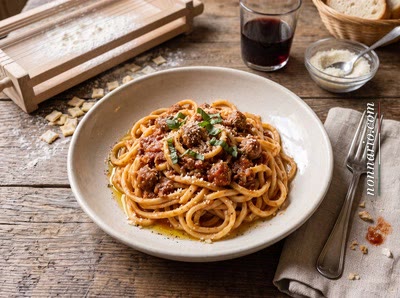
Southern Tuscany's hand-rolled pasta of flour and water, in a slow tomato sauce made on aglione, the Valdichiana's large, mild garlic
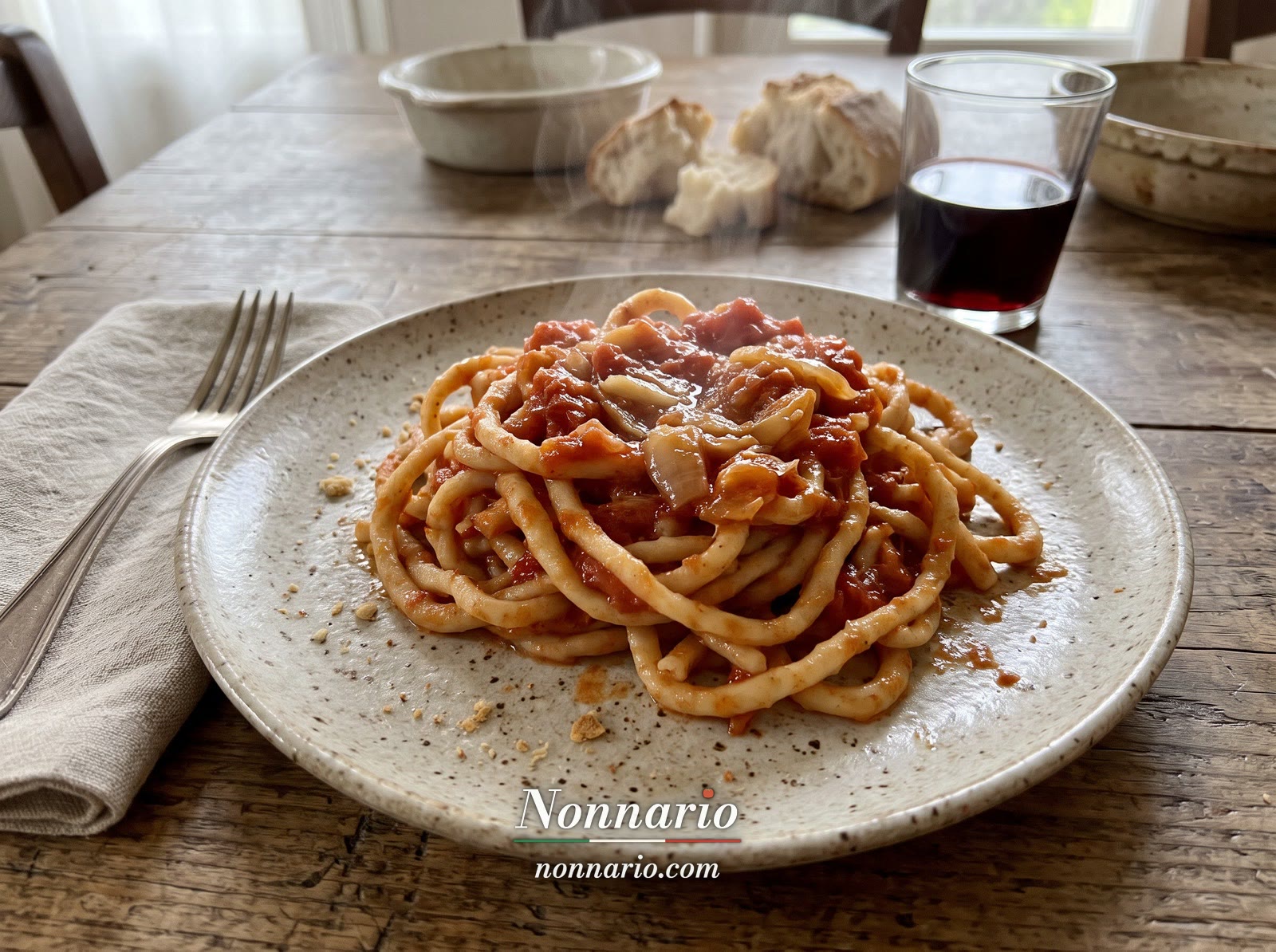
Thick pici rolled by hand from flour and water, with no egg, tossed in fresh tomato cooked slowly on aglione, the large, mild garlic of the Valdichiana, with olive oil and chilli; Italy has applied for EU protection of the garlic.
- Course
- Primi & RisottiPasta & Rice
- Serves
- 4
- Hands-on
- 1 h 36 min
- Cooking
- 57 min
- Resting
- 40 min+
The video and the photos of every step are also gathered on a separate page.
In breve
In short
Also called pici with garlic and pici with aglione.
- Vegetarian
- Pici: soft wheat flour, slightly warm water, a pinch of salt and a spoonful of olive oil, no egg, rolled by hand into strands a little thicker than spaghetti.
- Aglione, the large, mild garlic of the Valdichiana, crushed and cooked very gently in olive oil with chilli until it melts, never browned.
- Then peeled, seeded fresh tomatoes, cooked over a low heat until the sauce turns creamy.
- The freshly rolled pici cook in a few minutes, are tossed in the sauce and served hot with a dusting of pecorino toscano.
La provenienza
Where this recipe comes from
Pici are thick spaghetti rolled by hand from flour and water, with no egg, a pasta of southern Tuscany, of the Val d'Orcia and the Val di Chiana; Tuscany lists them among its traditional food products as pici or pinci. Their name is said to come from appiciare, the word for rolling the dough out by hand, and some say their history goes back to the Etruscans, though that rests on legend. Aglione is a giant garlic, Allium ampeloprasum var. holmense, grown across the Valdichiana on both sides of the border between Tuscany and Umbria: a bulb has one to eight white to cream cloves, its aroma is far gentler than garlic's, so that it is nicknamed the kissing garlic, and once cooked it tastes sweet and soft. In April 2026 Italy published the specification of the PGI it has applied for, which calls pici all'aglione a typical dish of the area. Pici are the heart of the Sagra dei Pici, usually held at the end of May in Celle sul Rigo, near San Casciano dei Bagni.
There is no official recipe for the dish. We compared the serious sources and publish the most widely recognised version: the aglione is cooked very gently in olive oil until it melts, tomato goes in, and many add chilli; some add white wine and basil, oregano and vinegar, or vegetable broth, some make it without tomato, and only some finish it with cheese. The pici are made of soft wheat flour, water and salt, often with a little oil. The dough and the shaping here follow one documented recipe for four, and the sauce and the finish another. What is ours is the size of the pici, about 3 to 4 mm thick and 30 cm long, their dusting of semolina, the kneading times, the time for blanching the tomatoes and the cooking times of the sauce.
- Provenance
- A regional tradition documented in cookbooks and local practice, with no single official text.
- Defined by
- Tuscan tradition
- Reference
- Compared across 10 sources, listed below; this page publishes the most widely recognised version.
- Sources
- Touring Club Italiano: pici all'aglione, a recipe of the Tuscan tradition, for four, 2017, updated 2023 (Italian)
- GialloZafferano, Mondadori's recipe site: pici all'aglione, its editorial recipe for four, 2012, updated 2024 (Italian)
- Accademia Italiana della Cucina, recipe collection: pici, Tuscany, for four (Italian)
- Visit Tuscany, the Region of Tuscany's official tourism site: the recipe for pici all'aglione by Giulia Scarpaleggia of Juls' Kitchen, a food blog, republished with her photos (Italian)
- Dissapore, food magazine: pici all'aglione, 2023, updated 2025 (Italian)
- Italy Segreta, a magazine about Italy: the pici all'aglione of the Osteria da Giovanna, near Arezzo, 2025 (Italian)
- QN Quotidiano Nazionale, its travel section Itinerari: pici all'aglione with breadcrumbs, for five, 2026 (Italian)
- Ministry of Agriculture (MASAF): the production specification of the PGI applied for, ‘Aglione della Valdichiana’, Gazzetta Ufficiale no. 94, 23 April 2026 (Italian)
- Ministry of Agriculture (MASAF): national list of traditional food products, 25th revision, 2025, Tuscany nos. 131 (aglione) and 399 (pici) (Italian)
- USDA Food Safety and Inspection Service: Leftovers and Food Safety (archived copy of 29 May 2025)
Ingredienti
Ingredients
The original recipe serves 4
For the pici
For the sauce
To serve
Equipment
- Mixing bowl and a wooden spoon
- Large wooden pastry board, and an upturned bowl to cover the dough
- Dough scraper or a knife
- One or two trays, dusted with semolina, for the pici
- Kitchen scale
- Medium pot of water for blanching the tomatoes, and a slotted spoon
- Wide pan, about 28 cm–30 cm across, for the sauce and then the pasta
- Large pot holding at least 6 l, and a colander
- Cheese grater
Preparazione
Method
Scaled to 4 servings: the amounts in the steps follow. Pot and pan sizes and cooking times are still for the original 4.
About 2–2½ hours from start to table, about half of it rolling the pici. Make the dough (about 30 minutes, a 10-minute rest included), then rest it for 30 minutes and start the sauce: it takes about an hour, mostly gentle simmering, and is ready while you roll the pici (60–80 minutes). Put the pasta water on about 15 minutes before the last pici are rolled; they cook in a few minutes and go straight into the sauce. Leftovers go into the fridge, in a shallow container, within 2 hours of cooking; warm them through until piping hot, 75 °C at the centre, before serving.
- 1 h 36 minhands-on
- 57 mincooking
- 40 minresting, at least
The dough
The dough and the shaping follow one documented recipe for four, and the sauce and the finish another; the size of the pici, the kneading times and the sauce's cooking times are our guide.
-
Hands-on 5 min
Put the 525 g of flour and a pinch of salt in the bowl. Stirring with the wooden spoon, start pouring in the 270 g of slightly warm water and the spoonful of olive oil, then add the rest of the water and stir until it has all been absorbed.
Check A rough, shaggy dough with no water left pooling in the bowl.
Tip Any soft wheat flour will do, but wholemeal flour takes up more water.
-
Hands-on 8–10 min
Turn the dough out onto the board and knead it hard: push it away from you with the heel of your hand, working from the wrist as if you were almost tearing it, fold it back and turn it, and carry on until you have a smooth ball.
Check Smooth and even, with no dry flour or sticky patches.
Tip Our guide: about 8–10 minutes.
-
Rest 10 min
Cover the ball with the upturned bowl and leave it for 10 minutes.
-
Hands-on 5 min
Work the dough again on the board for a few minutes, the same way.
Check Very smooth and supple; it springs back slowly when you press it with a finger.
Tip Our guide: about 5 minutes.
-
Rest 30 min
Cover it again with the bowl and leave it for 30 minutes. Start the sauce now.
Tip On a hot day, let the dough rest in the fridge for these 30 minutes.
The sauce (while the dough rests and the pici are rolled)
-
Cooking 8–10 min
Bring a medium pot of plenty of water to the boil.
-
Hands-on 1 min
Cut a small cross in the skin at the base of each tomato and lower them into the boiling water for 30–60 seconds. Lift them out with the slotted spoon.
Check The skin has split and curls back from the cross.
Tip Our guide: a short dip is enough; longer and the flesh starts to cook.
-
Hands-on 10 min
Peel off the skins, cut the tomatoes in half, scoop out the seeds and cut the flesh into small cubes.
Check Small cubes of tomato flesh, with no skin or seeds.
Tip Out of season, tomato passata will do instead of fresh tomatoes; our guide: about 500 g, and skip the blanching.
-
Hands-on 5 min
Peel the 6 cloves of aglione and crush them with the flat of a large knife or a garlic press. Chop the chilli finely.
Tip Our guide: take the seeds out of the chilli for less heat.
-
Cooking 10–15 minHeat low
Put the olive oil, the crushed aglione and the chilli in the wide pan over a low heat and let the aglione cook very gently, stirring now and then, until it softens and melts into the oil.
Check The aglione is soft and translucent and falls apart when you press it with the spoon; it has not coloured.
Tip Never let it brown: it should melt, not fry. If it starts to colour, take the pan off the heat for a moment.
Tip Our guide: 10–15 minutes.
-
Cooking 25–30 minHeat low
Add the diced tomatoes, season with salt and cook over a low heat, stirring now and then, until the sauce is creamy. Take the pan off the heat until the pici are ready.
Check The tomato has broken down into a thick, creamy sauce and the oil shows at the edges.
Tip Our guide: 25–30 minutes. If the sauce starts to catch before it is creamy, add a spoonful of water.
Shaping the pici
-
Hands-on 1 h to 1 h 20 min
Cut off a small piece of dough with the scraper or knife, and keep the rest covered with the bowl. Roll the piece on the bare board under your palms, pressing lightly and moving your hands outwards from the middle, until it is a long strand a little thicker than spaghetti: keep it fairly thin, because pici swell as they cook. Dust it with semolina and lay it on the tray, apart from the others. Carry on until the dough is used up.
Check Strands about 3 mm–4 mm across and about 30 cm long, round and a little irregular, none touching.
Tip Our guide: pieces of about 4 g, the size of a small hazelnut, give pici of about that size; the dough makes roughly 200.
Tip If a piece is too big to roll comfortably, cut it in half.
Tip Our guide: roll on the bare board, without flour, so the dough grips and rolls instead of sliding.
Tip For pieces of even size, roll a piece of dough out about 5 mm thick, cut it into strips 1 cm wide and roll those out instead.
Cooking and serving
-
Cooking 12–15 min
About 15 minutes before the last pici are rolled, bring about 5 l of water to the boil in the large pot and add about 50 g of coarse salt.
-
Cooking 2–3 min
Put the sauce back over a low heat. Shake the excess semolina off the pici and drop them into the fast-boiling water; stir once so they do not stick, and cook them for 2–3 minutes.
Check Bite one: cooked right through, with no floury core, but still with some bite.
Tip Our guide: start tasting at 2 minutes; thicker pici, rolled from strips about 5 mm thick, take 4–5 minutes.
-
Hands-on 2 minHeat low
Drain the pici al dente, keeping back a cup of the cooking water, tip them into the pan and toss them in the sauce for a minute or two so they take up its flavour. Serve hot, with a dusting of grated pecorino toscano.
Check Every strand is coated in the sauce.
Tip Our guide: if the sauce is too thick to coat the pici, loosen it with a spoonful of the cooking water.
The essentials, for cooks who know the dish. Switch to Detailed for quantities, temperatures, times and checks at every step.
Press “I’m here” on the step you are on, and again when it is done.Tap the pin on the step you are on, and the tick when it is done. Timers keep running while you scroll.
Da sapere
Good to know
- KeepingConservazione
- Best served as soon as they are made; otherwise they keep in the fridge for a day, warmed through before serving. Source
- VariantsVarianti
- With white wine, passata and basil: Grated aglione softened in olive oil over a low heat for a few minutes, a splash of white wine boiled off, then tomato passata, covered and cooked on a gentle heat for about 15 minutes; plenty of basil at the end, and no chilli. Source
- With oregano and vinegar: The aglione sliced thin, softened on a very low heat and mashed with a fork into a cream; diced fresh tomatoes and a spoonful of vinegar, covered and cooked over a low heat for about 20 minutes; fresh oregano at the end. Source
- Long-cooked, with broth and breadcrumbs: A whole head of aglione chopped to a paste and cooked gently in olive oil with vegetable broth until it melts, then peeled tomatoes crushed with a fork, salt, black pepper and chilli, simmered for about an hour; finished with crisp breadcrumbs. Source
- In bianco, with breadcrumbs: No tomato: the pici are tossed in olive oil heated with the aglione, thyme and chilli, with a little of their cooking water and a pinch of parmigiano, and scattered with breadcrumbs toasted golden in olive oil. Source
- With a third durum wheat flour: The pici made with 350 g of 00 flour and 170 g of durum wheat flour, 300 g of warm water, 20 g of olive oil and a pinch of salt, rested for about 30 minutes, rolled out and worked into long cords a little thicker than spaghetti, and cooked for about 18 minutes. Source
Errori comuni
Common mistakes
- Browning the aglione: it must melt slowly in the oil over a low heat.
- Rolling the pici too thick: they swell as they cook.
- Leaving the shaped pici in a heap: dust them with semolina and keep them apart, or they stick together.
- Overcooking them: freshly rolled pici cook in a few minutes; taste from 2 minutes.
Fuori dall'Italia
Cooking it outside Italy
- Aglione is not always easy to find, even in Italy; ordinary garlic will do instead. Our guide: ordinary garlic is much stronger, so use 3 or 4 cloves and cook them just as gently.
- Aglione is Allium ampeloprasum, called elephant garlic in English; the Valdichiana's is a local form of it.
- Tipo 1 is an Italian grade of soft wheat flour, a little less refined than tipo 0 and 00; plain (all-purpose) flour is soft wheat flour too.
- Pecorino toscano is a Tuscan sheep's milk cheese, protected in the EU as Pecorino Toscano PDO: buy a piece and grate it yourself.
From nonnario.com/recipes/pici-all-aglione/, where you will find its sources, its story and the step photos. Sources checked in November 2026.