Firenze, Toscana
Bistecca alla fiorentina
Florentine T-bone steak of young beef, grilled over charcoal and served rare
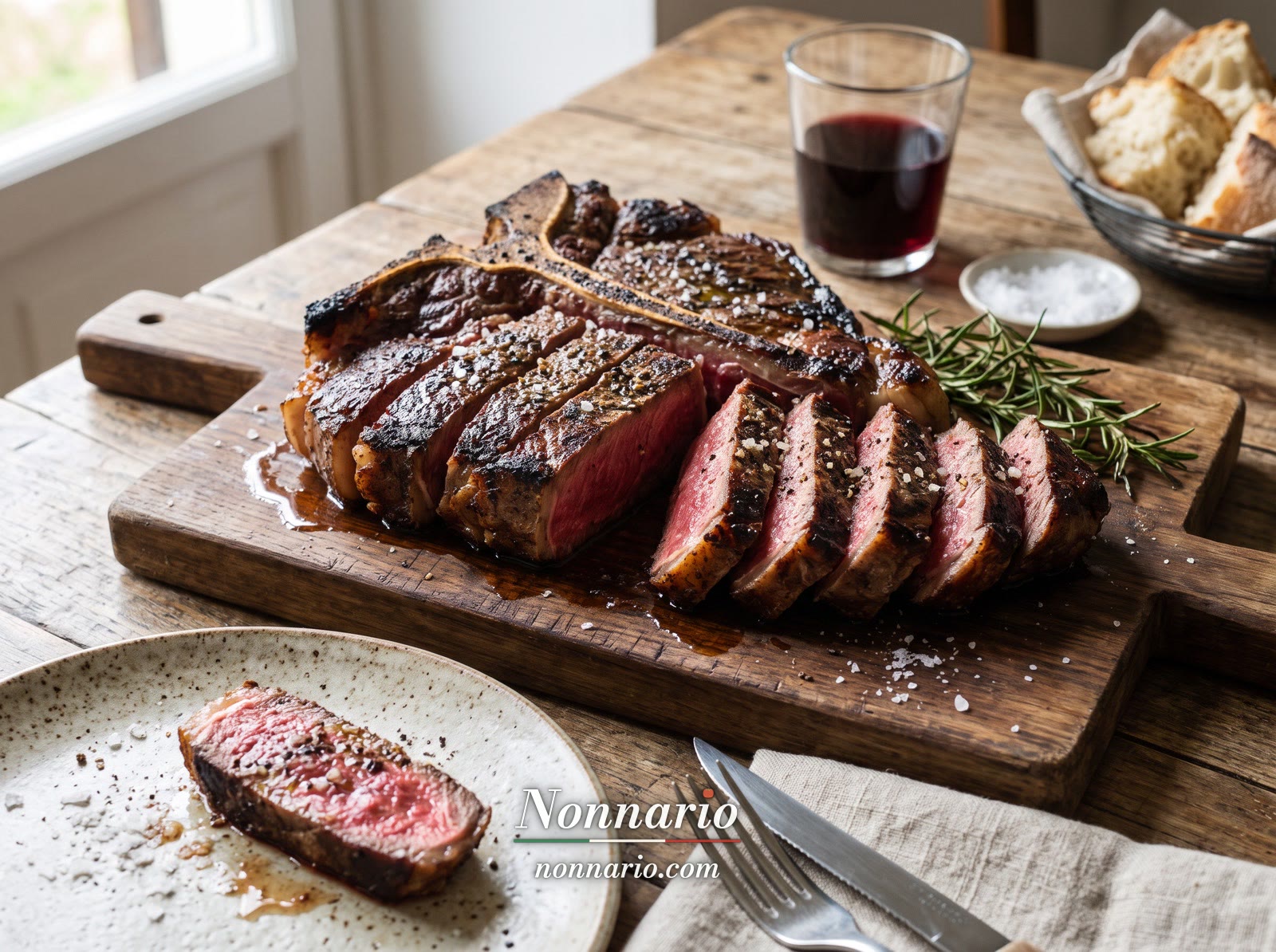
A thick T-bone steak of well-hung young beef, traditionally from Tuscan breeds such as Chianina, seared on both sides over glowing charcoal, served rare and salted only once it is cut, often with a drizzle of olive oil: Florence's bistecca, on Italy's list of traditional food products since 2020.
A request for EU recognition as a Traditional Speciality Guaranteed was presented in June 2025 and is still at the Italian stage; the level shown here may change when it is decided.
- Course
- SecondiMain Courses
- Serves
- 3
- Hands-on
- 44 min
- Cooking
- 41 min
- Resting
- 53 min+
The video and the photos of every step are also gathered on a separate page.
In breve
In short
Also called bistecca, fiorentina, la fiorentina, bistecca fiorentina, carbonata, Florentine steak, Florentine T-bone steak and T-bone steak Florentine style.
- Gluten-free
- A T-bone steak from the loin, fillet on one side of the bone and sirloin on the other, at least 4 cm thick and about 1 kg, well hung.
- At room temperature, never salted or oiled first, on a hot grill over glowing charcoal under a light ash, and never pierced.
- 3–5 minutes a side, turned once, and taken off very rare, at about 48 °C in the centre, then rested a few minutes on a board.
- US food-safety guidance gives 63 °C and a 3-minute rest for whole cuts of beef; the tradition serves it well below that, red inside.
- Salted only once it is cut, with flaky salt, black pepper and a drizzle of extra virgin olive oil, and eaten at once.
La provenienza
Where this recipe comes from
In Florence it is simply called bistecca, from the English beef-steak, as Florence's academy of the Italian language, the Crusca, recorded in 1750. One account, a likely story rather than a fact, ties it to Florentine bankers who lent money to the kings of England from the 14th century, and to the English aristocrats who came to Florence in the 18th century, when charcoal for cooking became common: a rare steak for foreign visitors. Others say it has been documented since the Renaissance, and link it to the feast of San Lorenzo. It went to the Italian pavilion of the Paris Universal Exhibition of 1889 as a Tuscan dish, and Pellegrino Artusi described it in his cookbook of 1891: a chop with its bone from the loin of young cattle, grilled over a fierce charcoal fire and salted and peppered only once cooked. At the end of 2020 the bistecca joined Italy's list of traditional food products. A committee coordinated by Accademia della Fiorentina, an association of Florentine butchers and scholars founded in 1991, drafted a specification for the dish and sent it to the Ministry of Agriculture, the first step of an application for an EU Traditional Speciality Guaranteed; in June 2025, with Confcommercio Toscana and PromoFirenze, the association formally presented the request. In November 2026 the EU register had no application for it. Some of the beef used is protected as Vitellone Bianco dell'Appennino Centrale, a PGI since 1998 for Chianina, Marchigiana and Romagnola cattle: it covers the meat, not the dish.
There is no official recipe: the draft specification is not registered, and neither the national list nor the Region's own sheet for the dish gives quantities or times. We compared the serious sources and publish the most widely recognised version. They agree on a thick steak with its bone, cut from the loin, brought to room temperature, put on a grill over charcoal embers under a light ash, turned without piercing it, browned outside and red inside, and never salted before it goes on the fire. Many finish it with a drizzle of extra virgin olive oil; others serve it with only salt and pepper, or leave the oil on the table for each diner. Ours are the fire and its safety, the height of the grate, the timings within the range, the way of cutting it, and keeping the steak out of the fridge well within 2 hours. The tradition takes the steak off rare, at about 48–50 °C in the centre; US food-safety guidance gives 63 °C for whole cuts of beef, followed by a rest of at least 3 minutes. The page gives both, so that you can choose.
- Provenance
- A regional tradition documented in cookbooks and local practice, with no single official text.
- Defined by
- Florentine tradition
- Reference
- Compared across 12 sources, listed below; this page publishes the most widely recognised version.
- Sources
- Cucchiaio d'Argento: bistecca alla fiorentina, a steak of 1 kg for 2–3, on the charcoal grill (Italian)
- Accademia Italiana della Cucina, recipe collection: bistecca alla fiorentina, Tuscany, for 2 or 3 (Italian)
- Consiglio regionale della Toscana (Tuscany's Regional Council): ‘Identità, buone pratiche e futuro della Bistecca alla Fiorentina’, proceedings of a 2023 conference promoted by the Accademia della Fiorentina, edited by Andrea Giuntini and Giovanni Brajon, 2024, with a summary of the draft specification for the dish (Italian, PDF)
- GialloZafferano: bistecca alla fiorentina, a recipe for 4 made for the site by the butcher Dario Cecchini, 2022 (Italian)
- La Cucina Italiana: bistecca alla fiorentina, two steaks for 4, 2020 (Italian)
- Visit Tuscany, the official tourism site promoted by the Region of Tuscany: the recipe of the bistecca alla fiorentina (Italian)
- Pellegrino Artusi: ‘La scienza in cucina e l'arte di mangiar bene’, recipe 556, bistecca alla fiorentina (Project Gutenberg, 25th edition, Italian)
- Ministry of Agriculture (MASAF): national list of traditional food products (PAT), 25th revision, 2025, sheet ‘Toscana’ (Italian)
- Gambero Rosso: the Fiorentina seeks an EU label, on the application for a Traditional Speciality Guaranteed, by Simona Sirianni, 2025 (Italian)
- Ministry of Agriculture (MASAF): production specification of the PGI ‘Vitellone Bianco dell'Appennino Centrale’ (Italian, PDF)
- Regione Toscana (ARSIA): ‘I Prodotti Agroalimentari della Toscana’, the traditional-product sheet for the bistecca alla fiorentina (Italian)
- USDA Food Safety and Inspection Service: Leftovers and Food Safety, on cooking steaks to a safe temperature, resting them and keeping leftovers (archived copy of 29 May 2025)
Ingredienti
Ingredients
Makes one bistecca of about 1 kg, for 2 or 3: 3 servings
For one steak
Equipment
- A charcoal barbecue or grill with a sturdy grate, ideally one whose height can be set, large enough to move the steak aside
- Lump charcoal, of oak or holm oak if you can find it, and a chimney starter or firelighters (never petrol or other accelerants)
- Long tongs or a wide metal spatula (never a fork), heat-resistant gloves and a wire grill brush
- A probe thermometer
- A tray, and kitchen paper
- A wooden board and a sharp knife with a plain, not serrated, edge
- Warm plates
- A bucket of water or a garden hose beside the barbecue
Preparazione
Method
About 2¼–2½ hours in all, nearly all of it waiting: 10 minutes to make the place safe, about 2 hours from fridge to table, and a quarter of an hour after the meal to put the fire out. The steak comes out of the fridge once the place is ready and sits for 50 minutes before you light the charcoal; the coals take 30–35 minutes to burn down to embers and the grate 5 minutes to heat, so the steak goes on the grill 95–100 minutes after leaving the fridge and is off it well within 2 hours. On a day above 32 °C, light the charcoal as soon as the steak is out, so that it goes on the grill within the hour. Grilling takes 7–12 minutes, resting and cutting about 10. One steak of about 1 kg serves 2 or 3; for more people, grill more steaks side by side, if the grill is large enough, and allow the same times. Choose a calm, dry day for the fire.
- 44 minhands-on
- 41 mincooking
- 53 minresting, at least
Before you start: the steak and the fire
There is no official recipe. This page follows the most widely recognised way: a thick steak at room temperature, seared on both sides over glowing charcoal, rare inside and salted only once cooked. The fire, the height of the grate, the timings within the range and the checks are ours, marked ‘Our guide’.
-
Hands-on 10 min
Set the barbecue on level, bare ground or paving, in the open, well away from buildings, dry grass, hedges, trees and anything else that burns, and never under a roof or an awning. Put a bucket of water or a hose beside it, and keep children and pets well back.
Check Nothing that can burn is near the barbecue, and water is at hand.
Tip Our guide: check the local rules on fires and barbecues before you start, and do not light it in a strong wind.
Tip Never use a barbecue indoors, or in a tent, garage or any closed space, lit or still warm: burning charcoal gives off carbon monoxide.
Tip Never leave the fire alone, from lighting it until it is out.
-
Hands-on 5 min
About 2 hours before you eat, take the steak out of the fridge and out of its wrapping, pat it dry all over with kitchen paper and lay it on a tray lined with kitchen paper. Do not wash it, salt it, oil it or season it.
Check The surface is dry to the touch all over, bone and fat included.
Tip Our guide: cover it loosely with a clean cloth and keep it somewhere cool, out of the sun. Keep its time out of the fridge well within 2 hours: the steps below put it on the grill 95–100 minutes after it comes out, and it is off the grill within 2 hours. On a day above 32 °C, where the limit is 1 hour, skip the 50-minute wait and light the charcoal as soon as the steak is out, so that it goes on the grill within the hour.
-
Rest 50 min
Leave the steak on its tray for 50 minutes, then light the fire (the next steps) while it goes on warming.
Check Pressed in the middle, the steak feels cool rather than cold.
-
Hands-on 5 min
Light a generous amount of lump charcoal, of oak or holm oak if you can find it, with a chimney starter or firelighters: enough for an even bed a good deal larger than the steak.
Check The charcoal has caught all through and is burning steadily.
Tip Our guide: never pour petrol, spirit or lighter fluid on the charcoal, least of all once it is alight.
-
Cooking 30–35 minHeat glowing embers, no flame
Spread the coals into an even bed and leave them to burn down until they glow red under a light veil of grey ash, with no flames.
Check Red coals under a thin grey ash, and no flames rising from them.
Tip The ash matters: fat that drips onto flaming coals catches fire and burns the meat.
-
Cooking 5 minHeat very hot
Set the grate over the embers and let it get thoroughly hot, then brush it clean with the wire brush.
Check You can hold your hand at the height of the grate for only 2–3 seconds.
Tip Our guide: about 10 cm–15 cm above the coals. If you can hold your hand there for longer, push the coals closer together or lower the grate; if you cannot hold it there at all, raise it a little.
Grilling
-
Cooking 3–5 minHeat very hot embers, no flame
Lay the steak on the hot grate over the embers and leave it for 3–5 minutes, according to its thickness, without moving or turning it, and look at it often.
Check The underside has a deep brown crust with dark grill marks, and the steak lifts cleanly off the grate.
Tip Our guide: about 3–4 minutes for a steak 4 cm thick, about 5 for one 5 cm thick.
Tip If the fat flares up, slide the steak aside for a few seconds until the flames die down, then put it back.
-
Cooking 3–5 minHeat very hot embers, no flame
Turn the steak over with the tongs or the spatula and grill the second side the same way, for the same time, without ever piercing it.
Check The second side has the same deep brown crust as the first.
Tip Never use a fork or a knife on it while it cooks: every hole lets out the juices.
-
Hands-on 1–2 min
If the steak is very thick, stand it upright on the grate on its bone for 1–2 minutes.
Check The bone is hot and the fat along the edge has browned.
Tip Our guide: do this for a steak 5 cm thick or more, steadying it with the tongs if it will not stand by itself. A thinner steak goes straight on to the next step.
Tip Some cooks also stand the steak on its bone beside the embers before the searing, to warm it gently.
-
Hands-on 1 minTemp 48 °C
Push a probe thermometer sideways into the thickest part of the sirloin, the larger side, as far as the centre and not touching the bone. Take the steak off the grill when it reads 48 °C for a very rare steak, the steak of tradition; at 52 °C–55 °C it is medium. Never let it go past 60 °C–65 °C.
Check The probe reads 48 °C for very rare, 52 °C–55 °C for medium, and the outside is browned all over.
Tip Our guide: US food-safety guidance (USDA FSIS) gives 63 °C at the centre for whole cuts of beef such as steaks, followed by a rest of at least 3 minutes. The rare steak of tradition comes off well below that, at about 48 °C–50 °C. If you prefer the US figure, keep grilling with the steak further from the heat (raise the grate or move it to the edge of the embers), turning it once more, until the probe reads 63 °C.
Tip If it is below the reading you want, give it another minute a side and check again.
Resting and serving
-
Rest 3–5 min
Lift the steak onto the wooden board and leave it for a few minutes, so that its juices settle. Warm the plates meanwhile.
Check The steak is still hot to the touch.
Tip Our guide: 3–5 minutes; a longer rest lets it cool.
-
Hands-on 5 min
With the sharp, plain-edged knife, cut the fillet and the sirloin away from the bone, slice each across into strips about 2 cm wide and lay them back around the bone.
Check Each slice is brown at the edge and red to pink inside, and the juice stays mostly in the meat.
Tip Our guide: a serrated knife tears the meat and lets out its juice; give the diners plain-edged knives too.
Tip Some cooks cut it at the table, in front of the diners, and lay the slices straight onto warm plates.
-
Hands-on 2 min
Dress the slices with a drizzle of extra virgin olive oil, flaky sea salt and freshly ground black pepper, and serve straight away on the warm plates, with the bone.
Check On the table while it is still hot.
Tip The salt goes on only now: salted before cooking, the steak dries out on the fire.
Tip Some cooks add no oil at all and serve it with only salt and pepper; others leave salt, pepper and oil on the table for each diner to add.
Tip It is eaten at once, and the slices are not reheated. Our guide: put anything left over into the fridge within 2 hours of cooking (1 hour on a day above 32 °C), in a shallow covered container, and eat it within 3 days, cold or reheated until it reaches 75 °C, which cooks it through.
-
Hands-on 15 min
When you have finished with the grill, close the barbecue's lid and vents if it has them; otherwise spread the coals with the tongs and drown them with water, stir and drown them again until no steam or hiss is left.
Check The ashes are cold to the back of your hand held just above them.
Tip Our guide: never tip warm ashes into a bin or a bag, and never leave the coals to burn out on their own: they can smoulder for hours.
The essentials, for cooks who know the dish. Switch to Detailed for quantities, temperatures, times and checks at every step.
Press “I’m here” on the step you are on, and again when it is done.Tap the pin on the step you are on, and the tick when it is done. Timers keep running while you scroll.
Da sapere
Good to know
- KeepingConservazione
- It is eaten as soon as it is cut, on warm plates; the slices are not reheated. Source
- VariantsVarianti
- Without oil: For 2 or 3, a steak of about 1 kg of well-hung young beef from the loin, 4 cm–5 cm thick, at room temperature and never washed. Set the grate 10 cm above embers of holm-oak or oak charcoal and let it get red-hot; only then lay the steak on it, unsalted and unpeppered, and leave it for 6 minutes. Turn it with a spatula, never piercing it, cook it for about 5 minutes more and salt it only at the end. Serve it on a wooden board or a very hot plate and wait a minute before eating it, with no oil or lemon, only a grinding of pepper. Source
- With a knob of butter: The version of 1891: a chop with its bone, a finger to a finger and a half thick, cut from the loin of young beef, put on the grill over a fierce charcoal fire just as it is, or at most washed and dried, turned several times, seasoned with salt and pepper only once cooked and sent to the table with a small knob of butter on top. It must not be overcooked: when it is cut, it should pour plenty of juice onto the plate. Source
- On a gas grill with lava stone: In recent years many cooks have replaced the embers with a grill heated by gas-fired lava stone, which still seals the meat and keeps its juices in; the steak is cooked, cut and served the same way. Source
Errori comuni
Common mistakes
- Salting it before it goes on the fire: the salt goes on only once it is cooked and cut.
- Putting it on the grill straight from the fridge, or leaving it out of the fridge for more than 2 hours.
- Grilling over flames instead of glowing embers under a light ash.
- Piercing it with a fork, or turning it again and again: turn it once, with tongs or a spatula.
- Oiling it before or during the cooking: the oil goes on only at the end.
- Leaving the barbecue alone while it burns, or tipping warm ashes into a bin.
Fuori dall'Italia
Cooking it outside Italy
- Ask the butcher for a T-bone or porterhouse steak cut from the loin, with both fillet and sirloin, at least 4 cm thick (about 1½ inches) and about 1 kg, from well-marbled beef dry-aged for about 20–30 days. Besides the Tuscan breeds, the draft rules for the dish allow Limousine and Charolaise, which are raised in many countries.
- With no charcoal grill, a gas grill heated as hot as it will go will do, as many cooks now use a grill heated by gas-fired lava stone; the steak still needs fierce heat and a single turn.
- Flaky sea salt such as Maldon is sold widely; fine sea salt will do.
From nonnario.com/recipes/bistecca-alla-fiorentina/, where you will find its sources, its story and the step photos. Sources checked in November 2026.