Firenze, Toscana
Pappa al pomodoro
Tuscan bread and tomato soup
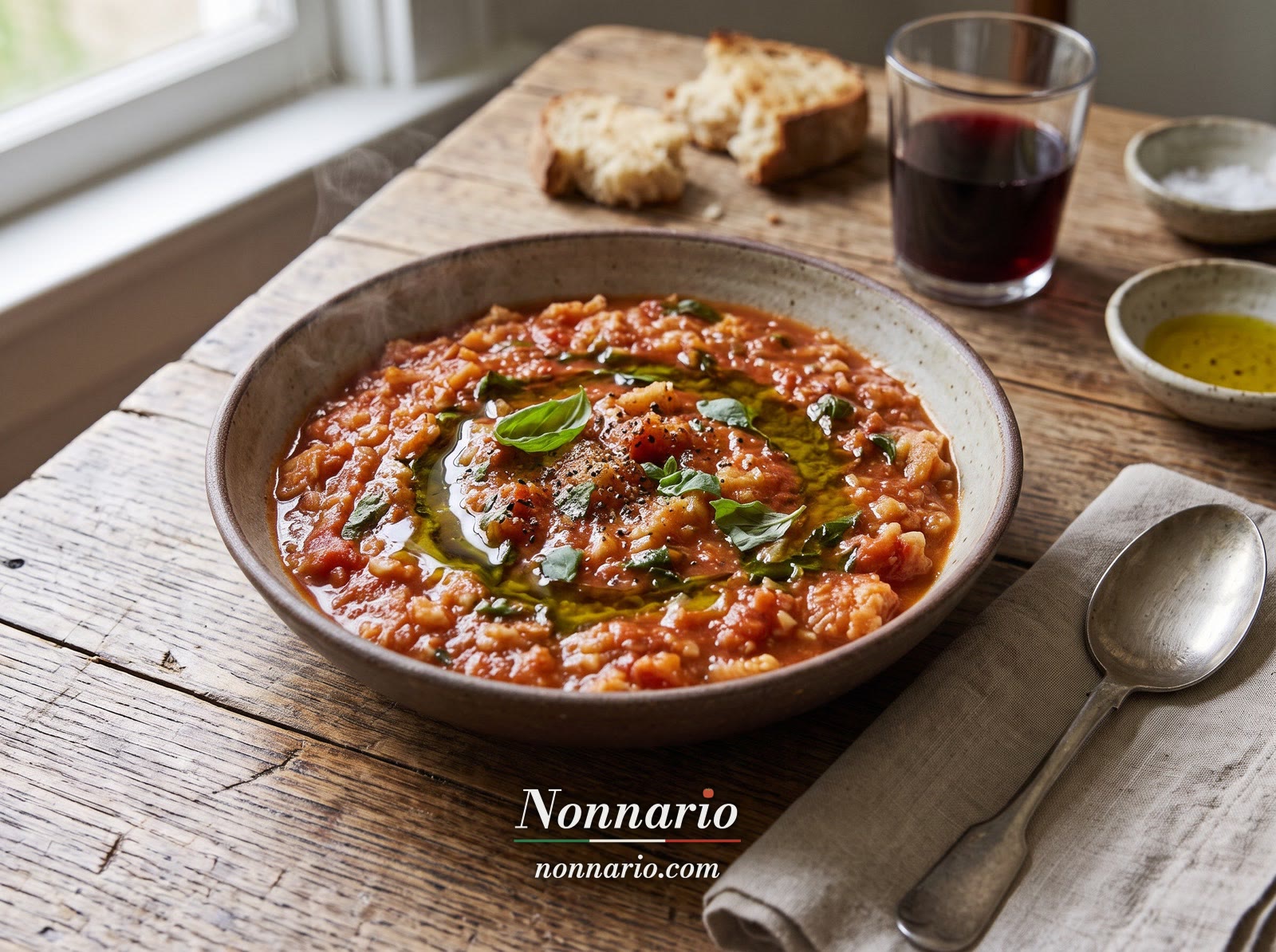
The thick Tuscan soup of stale bread cooked into tomatoes, garlic and basil with a glass of extra virgin olive oil, rested for an hour and eaten hot, warm or at room temperature.
- Course
- ZuppeSoups
- Serves
- 4
- Hands-on
- 30 min
- Cooking
- 20 min
- Resting
- 1 h+
The video and the photos of every step are also gathered on a separate page.
In breve
In short
Also called pappa col pomodoro, pappa al pomodoro toscana, Tuscan tomato and bread soup and Tuscan bread soup with tomato.
- Vegetarian
- Vegan
- Stale bread, in Tuscany the unsalted Tuscan loaf, with tomato, garlic, basil and a full glass of extra virgin olive oil.
- The halved garlic softened in the oil without browning, then the tomatoes cooked with basil for 20 minutes.
- The bread goes in covered with hot water or vegetable broth and is stirred until it falls apart into a thick pappa.
- Rested for about an hour, stirred again and finished with raw olive oil and fresh basil.
- Eaten hot, warm or at room temperature.
La provenienza
Where this recipe comes from
Pappa al pomodoro, or pappa col pomodoro, is the everyday food of Tuscan home cooking: a peasant dish made from what is left over, stale bread, tomato and olive oil, which changes from one area and one family to the next. The bread is Tuscany's own, made without salt, so that the dressing gives it its taste; leavened with sourdough, it keeps for days without going mouldy, which is why it is the bread of the stale-bread dishes, pappa col pomodoro, ribollita and panzanella among them. The dish became known all over Italy through Vamba's ‘Il giornalino di Gian Burrasca’, in which the boys of the Pierpaoli boarding school, tired of the usual soup, are at last given an excellent pappa col pomodoro; Rita Pavone sang its praises in ‘Il giornalino di Gian Burrasca’.
There is no official recipe. We compared eight sources and publish the most widely recognised version: halved garlic softened in plenty of olive oil, the tomatoes cooked with basil for twenty minutes, the stale bread covered with hot water or vegetable broth and stirred until it breaks down, an hour's rest, then raw oil and fresh basil. The sources agree on stale bread, tomato, garlic, basil and olive oil, on hot water or broth, and on cooking the bread until it is a pappa; they differ on onion instead of garlic, a little chilli or sugar, layering the bread with the tomato, and how long it cooks. Ours are the size of the glass of oil, the slices, the amount of water, the time and heat of each stage and the food-safety rules, since it is often eaten at room temperature: it is out of the fridge for 2 hours at most each time.
- Provenance
- A regional tradition documented in cookbooks and local practice, with no single official text.
- Defined by
- Tuscan tradition
- Reference
- Compared across 8 sources, listed below; this page publishes the most widely recognised version.
- Sources
- Accademia Italiana della Cucina, recipe collection: pappa al pomodoro, Tuscany, for four (Italian)
- Linkiesta, its food section Gastronomika: Viva la pappa col pomodoro, where to eat it and how to make it, by Daniela Guaiti, 17 June 2021 (Italian)
- GialloZafferano, Mondadori's recipe site: pappa col pomodoro, its editorial recipe for four, 2009, updated 2025 (Italian)
- La Cucina Italiana: pappa al pomodoro, the editors' recipe for six, 29 April 2015 (Italian)
- Visit Tuscany, the Region of Tuscany's official tourism site: the recipe for pappa al pomodoro, signed by Juls' Kitchen, a food blog (Italian)
- Scatti di Gusto: pappa al pomodoro, the original recipe with the seven veils and a simpler one, by Anna Maria D'Anna, 20 July 2020 (Italian)
- Qualigeo (Fondazione Qualivita), its database of protected foods: Pane Toscano DOP, product sheet (Italian)
- USDA Food Safety and Inspection Service: Leftovers and Food Safety (archived copy of 29 May 2025)
Ingredienti
Ingredients
The original recipe serves 4
Equipment
- Heavy pot of about 3 l, with a lid
- Saucepan or kettle, for the hot water or broth
- Bread knife and chopping board
- Wooden spoon and a ladle
- Shallow containers and a probe thermometer, for any leftovers
Preparazione
Method
Scaled to 4 servings: the amounts in the steps follow. Pot and pan sizes and cooking times are still for the original 4.
Just under 2 hours from start to table, of which about 50 minutes of work and cooking. Slice the bread and put the water on to heat (10 minutes), soften the garlic in the oil (2–3 minutes), cook the tomatoes with the basil for 20 minutes, then add the bread and the hot water and stir it into a pappa (13–18 minutes). It rests off the heat for about 1 hour and is served. From the moment it comes off the heat it may be out of the fridge for 2 hours at most, the resting hour included (1 hour in all on a day above 32 °C): put what is left in the fridge before then.
- 30 minhands-on
- 20 mincooking
- 1 hresting, at least
Get everything ready
-
Hands-on 5 min
Cut the 300 g of stale bread into thin slices, about 1 cm thick, leaving the crust on. Cut any large slices in half so they fit in the pot.
Check The slices are thin and roughly even, so they soften at the same pace.
Tip The bread should be firm and dry, a few days old: stale bread soaks up the liquid and breaks down into the pappa.
-
Hands-on 5 min
Peel the 3 garlic cloves and cut each in half lengthways. Pick a few basil leaves for the pot and keep some small ones for the end. Put about 750 ml of water or vegetable broth on to heat, and keep it hot, just below the boil.
Check The water or broth is steaming, with small bubbles at the edge.
Tip Our guide: about 750 ml for this much bread. The amount depends on how dry the bread is, so keep a little more hot.
The tomato
-
Hands-on 2–3 minHeat medium-low
Pour the 150 ml of olive oil into the pot and warm it over medium-low heat. Add the halved garlic and let it fry gently, stirring, for 2–3 minutes, without letting it colour more than a little.
Check The garlic sizzles gently and smells sweet; it is pale gold at most, never brown.
Tip If the garlic starts to brown, take the pot off the heat for a moment: browned garlic turns the pappa bitter.
-
Cooking 20 minHeat medium-low to medium
Add the 500 g of tomato pulp and a few basil leaves, then season with about 1 level teaspoon of salt and a few grinds of black pepper. Cook over moderate heat for 20 minutes, at a gentle bubble, stirring now and then.
Check The tomato has thickened a little and the oil shows in small red pools on the surface.
Tip Our guide: the salt is a starting point. The bread is unsalted, so taste again at the end.
The bread
-
Hands-on 3 min
Lay the bread slices in the tomato, pushing them down with the spoon, and pour in enough of the hot water or broth to cover everything.
Check All the bread is under the liquid.
Tip Cover the bread, no more: it is easier to add a little hot water later than to cook off too much.
-
Hands-on 10–15 minHeat low
Turn the heat to low and stir continuously with the wooden spoon, scraping the bottom and pressing the bread against the side of the pot, until it has broken up completely into a thick, even pappa, 10–15 minutes. If it gets too stiff, stir in a little more hot water.
Check No slices are left: the bread has dissolved into a dense, soft mass that falls slowly from the spoon, and the spoon leaves a trail across the bottom of the pot.
Tip Our guide: the time depends on the bread; with a dense, very dry loaf it can take longer. Keep stirring all the way, or the bread catches on the bottom.
Tip Taste it now and add salt and pepper if it needs them.
-
Rest 1 h
Take the pot off the heat, put the lid on and leave it to rest for about 1 hour.
Check The pappa has thickened further and the flavours have come together; it is warm, no longer hot.
Tip Our guide, for food safety: this hour counts towards the 2 hours it may stay out of the fridge after cooking. On a day above 32 °C the limit is 1 hour in all, so rest it about 30 minutes and put what is left in the fridge within the hour.
Serve
-
Hands-on 3 min
Stir the pappa well, ladle it into bowls and finish each with a drizzle of raw extra virgin olive oil and a few small fresh basil leaves.
Check A thick, soft pappa in each bowl, with a thread of green oil and fresh basil on top.
Tip It is eaten hot, warm or at room temperature. Our guide: for it hot, warm it gently for a few minutes, stirring, with a spoonful of hot water.
Tip Our guide, for food safety: serve it within 2 hours of its coming off the heat, the rest included, and put what is left in the fridge before then, in shallow containers.
-
Hands-on 2 min
Keep what is left covered in the fridge at 4 °C or below and eat it within 3 days of cooking. To eat it hot, loosen it with a little water or broth and bring it back to a rolling boil, stirring, at least 75 °C at the centre. To eat it cold or at room temperature, take it out at most 2 hours (1 hour above 32 °C), then put what is left straight back in the fridge, or throw it away; never set it out again.
Check In the fridge within 2 hours of cooking; reheated to a rolling boil, or out at most 2 hours when served cold.
Tip Our guide: 3 days is the safety limit; for its texture, eat it within a day.
The essentials, for cooks who know the dish. Switch to Detailed for quantities, temperatures, times and checks at every step.
Press “I’m here” on the step you are on, and again when it is done.Tap the pin on the step you are on, and the tick when it is done. Timers keep running while you scroll.
Da sapere
Good to know
- WhenQuando
- Made all year with tomato pulp or passata; it is also ideal in summer, warm or cold, made with fresh vine tomatoes. Source
- KeepingConservazione
- Keeps in the fridge for a day; each time, loosen it with water or broth. Freezing is not advised. Source
- VariantsVarianti
- With onion: The garlic replaced by a thinly sliced onion, browned very slowly in the oil. Source
- Pappa bugiarda: A beaten egg stirred in at the end, which blends into the pappa and gives it flavour and, above all, substance: a way of those who could afford it. Source
- The seven veils: The old way of telling it is done: the bread cooked slowly in about a litre of vegetable broth added a little at a time, and each time a skin forms on the surface it is broken with a wooden spoon and more broth stirred in, seven times in all, about 40 minutes. Source
- Layered and cooked for an hour: Fresh tomatoes peeled and passed through a food mill, layered in the pot with slices of stale Tuscan bread rubbed with garlic, dressed with oil, a pinch of sugar, salt, pepper, basil and a few ladles of hot broth, then cooked on the lowest heat for an hour, stirred now and then to break up the bread. Source
- From the Chianti, with chilli: Tinned peeled tomatoes cooked slowly in oil with garlic and dried chilli; the bread soaked in cold water for about 10 minutes, squeezed and crumbled in with a cup of hot water, cooked about 10 minutes, then basil and more oil off the heat and a rest of at least an hour; served hot or at room temperature. Source
Errori comuni
Common mistakes
- Browning the garlic: soften it gently in the oil, pale gold at most.
- Stopping stirring once the bread is in: it catches on the bottom and stays in lumps.
- Drowning the bread: cover it and no more, adding hot water only if it gets too stiff.
- Skipping the hour's rest: the pappa thickens and the flavours come together off the heat.
- Leaving it out too long: 2 hours at most after cooking, the rest included, and 2 hours at most when served again from the fridge; 1 hour each time on a day above 32 °C.
Fuori dall'Italia
Cooking it outside Italy
- Outside Tuscany, use a plain country loaf (pane casereccio) with a firm crumb, a few days old. Most such loaves are salted, so go easy on the salt and taste at the end (our guide).
- Polpa di pomodoro is chopped tomato in its juice, sold in the US as canned diced or crushed tomatoes; peeled tomatoes, passata or ripe fresh tomatoes can stand in for it.
- Look for ‘Pane Toscano DOP’ (PDO in English) on the label for the Tuscan loaf itself: it is made without salt.
From nonnario.com/recipes/pappa-al-pomodoro/, where you will find its sources, its story and the step photos. Sources checked in November 2026.