Teramo, Abruzzo
Scrippelle 'mbusse
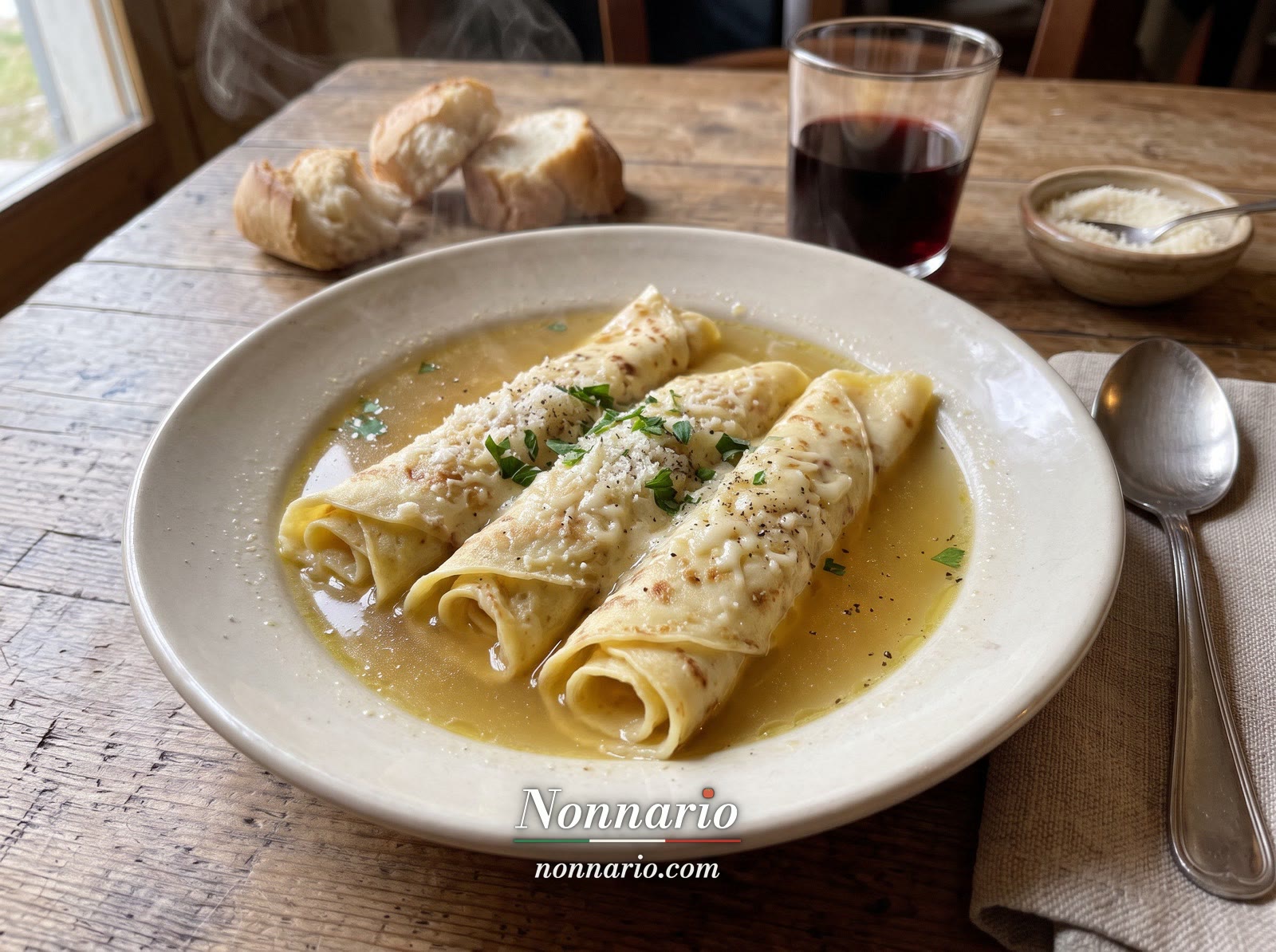
Teramo crêpes rolled with pecorino, in hot broth
Teramo's thin crêpes of eggs and flour, each sprinkled with grated pecorino, rolled up and covered with hot broth of beef, chicken and turkey; the scrippelle are a traditional agri-food product of Abruzzo.
- Course
- ZuppeSoups
- Serves
- 4
- Hands-on
- 1 h 10 min
- Cooking
- 3 h 35 min
- Resting
- 1 h 30 min+
The video and the photos of every step are also gathered on a separate page.
In breve
In short
Also called scrippelle mbusse, scrippelle 'mbrusse, screppelle 'mbusse, scrippelle teramane in brodo, crespelle in brodo and Teramo crêpes in broth.
- Scrippelle: thin crêpes of eggs beaten with salt and a spoonful of flour for each egg, into a rather liquid batter.
- Cooked one small ladle at a time in a small pan greased with olive oil.
- Each one sprinkled with grated young pecorino, rolled up and laid in a deep plate.
- Covered with hot broth of beef, chicken and turkey, simmered slowly for about three hours, with more pecorino on top.
- 'Mbusse means soaked, in dialect: the scrippelle are served in the broth.
La provenienza
Where this recipe comes from
Scrippelle 'mbusse are the flagship dish of Teramo's cooking: scrippelle, very thin crêpes of eggs and flour, rolled up with grated cheese and served 'mbusse, soaked, in hot broth. The scrippelle most likely came from French crêpes, reworked in the local kitchen. Legend has it that the soup was born by accident: a Teramo cook, Messer Enrico dei Castorani, helped the French cook of the officers' mess in the town, who served crêpes at table instead of the coarse corn and black bread of a time of famine; a tray of crêpes fell into a pot of hen broth, and he served the mixture in place of the minestra. It is a story, not a document. The method is recorded in Rino Faranda's book Gastronomia Teramana (Teramo, 1978), and the scrippelle, also called scrippelle teramane, are on Italy's national list of traditional agri-food products for Abruzzo. The same scrippelle are layered in place of pasta in the timballo of Teramo.
There is no official recipe. We compared seven sources and publish the most widely recognised version. They agree on the dish: thin crêpes of eggs and flour cooked a ladle at a time in a greased pan, each sprinkled with grated cheese, rolled up and covered with hot broth, with more cheese on top. They differ on the batter, which many thin with water and one with milk, on the cheese, pecorino or Parmigiano, and on the broth, of hen, or of beef with chicken or turkey. This page makes the batter with eggs, flour and salt alone, uses young pecorino, and simmers a broth of beef, chicken and turkey for about three hours. What is ours: how the kilo of meat is divided, a half-hour rest for the batter in the fridge, the size of the pan and the ladle, and a probe in the chicken to be sure it has reached 74 °C.
- Provenance
- A regional tradition documented in cookbooks and local practice, with no single official text.
- Defined by
- Teramo tradition
- Reference
- Compared across 7 sources, listed below; this page publishes the most widely recognised version.
- Sources
- Accademia Italiana della Cucina: scrippelle ’mbusse, an Abruzzese recipe from its collection (Italian)
- Regione Abruzzo, its tourism portal: scrippelle ’mbusse, their history, legend and batter, among its traditional recipes (Italian)
- Regione Abruzzo, its tourism portal: an alphabet of Abruzzo's foods, with scrippelle ’mbusse in hen broth (Italian)
- Regione Abruzzo: Italy's national list of traditional agri-food products, the Abruzzo entries (Italian, PDF)
- Discover Teramo, the tourism site of the B.I.M. Teramo consortium of mountain municipalities: scrippelle ’mbusse, a recipe for six (Italian)
- Dissapore: scrippelle ’mbusse, the Teramo recipe for crêpes in broth (Italian)
- USDA Food Safety and Inspection Service: Leftovers and Food Safety (archived copy of 29 May 2025)
Ingredienti
Ingredients
The original recipe serves 4
For the broth
For the scrippelle
To serve
Equipment
- Stockpot of 5 l–6 l, with a lid
- Skimmer, and a fine sieve
- Probe thermometer
- Bowl and a whisk
- Small non-stick frying pan, 18 cm–20 cm across, and a thin spatula
- Small ladle of about 30 ml
- Kitchen paper, for oiling the pan
- Fine grater
- Deep plates
- Shallow containers, if you make the broth ahead
Preparazione
Method
Scaled to 4 servings: the amounts in the steps follow. Pot and pan sizes and cooking times are still for the original 4.
About 4 hours, most of it unattended: 10 minutes to fill the pot, 30–40 minutes for the broth to come slowly to the boil and about three hours of slow simmering. Make the batter during the simmer and rest it in the fridge for 30 minutes; cook the scrippelle in the last half hour, about 25 minutes for twelve. Then strain the broth, bring 1.2 l back to the boil and serve at once. The broth can be made up to a day or two ahead: in the fridge within 2 hours of cooking, used within 3 days of cooking it, and brought back to a full boil before serving.
- 1 h 10 minhands-on
- 3 h 35 mincooking
- 1 h 30 minresting, at least
The broth
The broth simmers for about three hours; make the scrippelle during the last part of it.
-
Hands-on 10 min
Put the beef, the chicken and the turkey wing in the stockpot with the carrot, the celery in pieces and the parsley, and pour in 3 l of cold water.
Check The water covers the meat.
Tip Our guide: wash your hands, the board and the knife after handling the raw chicken and turkey.
-
Cooking 30–40 minHeat medium
Heat the pot over medium heat so that the water comes slowly to the boil, in 30–40 minutes. As it nears the boil, lift off the grey foam that rises with the skimmer, again and again.
Check The surface stays clean, with only small drops of fat.
Tip Our guide: starting the meat in cold water and heating it slowly lets the proteins rise as foam you can skim, for a clearer broth.
-
Cooking 3 hTemp 90 °C–95 °CHeat low, a bare simmer
Lower the heat until only a few small bubbles break the surface, set the lid ajar and let the broth cook slowly for about three hours, skimming now and then.
Check The chicken comes away from the bone, and a probe in the thickest piece of chicken reads at least 74 °C.
Tip Our guide: 90 °C–95 °C is a bare simmer. A rolling boil clouds the broth: if it boils hard, lower the heat or move the pot half off the burner.
-
Hands-on 10 min
Lift out the meat and the vegetables with the skimmer and pour the broth through a fine sieve into a clean pan. Taste it and add salt a little at a time until it is right.
Check The broth is clear and tastes well seasoned.
Tip Our guide: salt at the end, once the broth has reduced, so it is not over-salted.
Tip Our guide: whatever broth you will not serve now goes into shallow containers and the fridge within 2 hours of cooking, as in 'Cool the broth quickly and chill it'.
Tip Our guide: the meat is not part of this dish. Like the broth, it goes into the fridge within 2 hours of cooking if you keep it.
The scrippelle
Make the batter during the simmer and cook the scrippelle in its last half hour, so the broth and the scrippelle are ready together.
-
Hands-on 5 min
Beat the 6 eggs with a pinch of salt in a bowl. Whisk in the flour a spoonful at a time, until the batter is smooth and rather liquid.
Check No lumps; the batter runs off the whisk in a thin stream, like single cream.
Tip Adding the flour a spoonful at a time keeps lumps from forming.
-
Rest 30 minTemp 4 °C
Cover the bowl and put it in the fridge for 30 minutes.
Tip Our guide: the rest lets the flour absorb the egg and the bubbles settle, for smoother scrippelle. It holds raw egg, so it rests in the fridge, not on the worktop.
-
Hands-on 3 minHeat medium
Dip a folded piece of kitchen paper in a little olive oil and wipe it over the small pan, leaving only a thin film. Heat the pan over medium heat. Stir the batter once.
Check A drop of batter sizzles and sets at once.
Tip Our guide: a pan of 18 cm–20 cm. Wider pans make larger scrippelle, and fewer of them.
-
Hands-on 20–25 minHeat medium
Pour in a small ladle of batter, about 30 ml, and tilt the pan at once so it covers the bottom in a thin layer. Cook for about a minute, until the surface is dry and the edges lift and colour slightly. Free the edge all round with the tip of a knife, slide the spatula underneath and turn it with one quick movement; cook the other side for 20–30 seconds. Slide it onto a plate and cook the rest the same way, stacking them, and wipe the pan with the oiled paper every two or three.
Check Thin and supple, pale with light golden spots, with no wet egg left on either side. The batter makes about 12, three for each plate.
Tip Our guide: the first one is a test. If the batter will not spread, the pan is too hot; if it stays pale and sticks, it is not hot enough.
Tip Turning a scrippella before its edges lift tears it or folds it over on itself.
-
Keep the stack covered with a clean cloth until you serve. Serve them within 2 hours of cooking, or put them in the fridge.
Tip Our guide: cooked egg left out of the fridge for more than 2 hours must be thrown away.
To serve
-
Cooking 5–10 minHeat high
Bring 1.2 l of the strained broth to a full boil, about 300 ml for each plate. Warm the deep plates with hot water meanwhile.
Check It boils all over, not just at the edges.
-
Hands-on 5 min
Sprinkle each scrippella with grated pecorino, about a tablespoon, and roll it up loosely. Lay three in each warm deep plate, seam down.
Check The rolls hold their shape and the cheese is spread from end to end.
Tip Our guide: keep a quarter of the pecorino back for the top.
-
Hands-on 2 min
Ladle the boiling broth over the scrippelle until they are covered, sprinkle with the rest of the pecorino and serve at once.
Check The broth steams in the plate and the scrippelle are covered.
Tip Our guide: serve only as many as will be eaten. Scrippelle left in broth turn soft. Leftovers go into the fridge within 2 hours of cooking the scrippelle (the time they waited counts), or, for scrippelle made ahead, within 2 hours of taking them out of the fridge; brought back to the boil, they keep only to the end of the 3 days from cooking the broth.
If you make it ahead
-
Rest 1–2 hTemp 4 °C
Divide the strained broth into shallow containers and stand them in a sink of iced water, stirring now and then, so they go into the fridge within 2 hours of cooking. Keep them covered at 4 °C, and use the broth within 3 days of cooking it.
Check The broth is in the fridge no more than 2 hours after it came off the heat.
-
Hands-on 5 min
Stack the cooled scrippelle, wrap them and put them in the fridge within 2 hours of cooking; use them the next day. To keep them longer, freeze them laid open, one on another, in freezer bags, on the day they are cooked or at the latest after their day in the fridge. Thaw them in the fridge overnight.
Check They peel apart easily and smell fresh.
Tip Our guide: thaw them in the fridge, not on the worktop. Once thawed they have what is left of the 3 days counted from cooking them (the time in the freezer does not count), and they go into broth that is itself within its 3 days.
-
Hands-on 10 min
Before serving, bring the chilled broth back to a full boil, then fill, roll and serve the scrippelle as above.
Check It boils all over, not just at the edges.
The essentials, for cooks who know the dish. Switch to Detailed for quantities, temperatures, times and checks at every step.
Press “I’m here” on the step you are on, and again when it is done.Tap the pin on the step you are on, and the tick when it is done. Timers keep running while you scroll.
Da sapere
Good to know
- KeepingConservazione
- The cooked scrippelle can be made the day before and kept in the fridge, or frozen laid open, one on another, in freezer bags; fill and roll them only when you serve them. Source
- VariantsVarianti
- In hen broth: The scrippelle soaked in hen broth. Source
- With cinnamon: In hen broth, with a grating of cheese and a dusting of cinnamon. Source
- With water in the batter: The eggs and flour thinned with half a glass of water for each egg, cooked over low heat in a pan greased with lard or oil, into very thin scrippelle. Source
- With Parmigiano, in beef and turkey broth: For six: one egg a person and two level spoonfuls of flour for each egg, thinned with a glass of water (or milk) for each egg. The broth is 300 g–400 g each of beef brisket and shin, a beef knee bone, a turkey wing, parsley, celery, half an onion, a carrot and a Parmigiano rind, boiled about two hours and strained; the scrippelle are sprinkled with Parmigiano. Source
Errori comuni
Common mistakes
- Too much batter in the pan: the scrippelle come out thick. A small ladle, tilted at once, makes them thin.
- Too much oil, or a cold pan: they fry or stick. Wipe the pan with oiled paper and heat it well first.
- Turning them too soon: wait until the edges lift, or they tear.
- Boiling the broth hard: it turns cloudy. It should cook slowly, with only a few small bubbles.
- Pouring lukewarm broth over them: it should be boiling.
Fuori dall'Italia
Cooking it outside Italy
- Pecorino dolce is a young, mild sheep's milk cheese, sold by Italian delis; an aged, sharp pecorino is a different cheese.
- Tipo 00 is Italian soft wheat flour, sold abroad as Italian 00 flour; plain (all-purpose) flour works too.
- Beef for boiling: brisket, or shin (beef shank in the US).
- A crêpe pan of 18 cm–20 cm does the job of the small frying pan.
From nonnario.com/recipes/scrippelle-mbusse/, where you will find its sources, its story and the step photos. Sources checked in November 2026.