Cosenza, Calabria
Licurdia
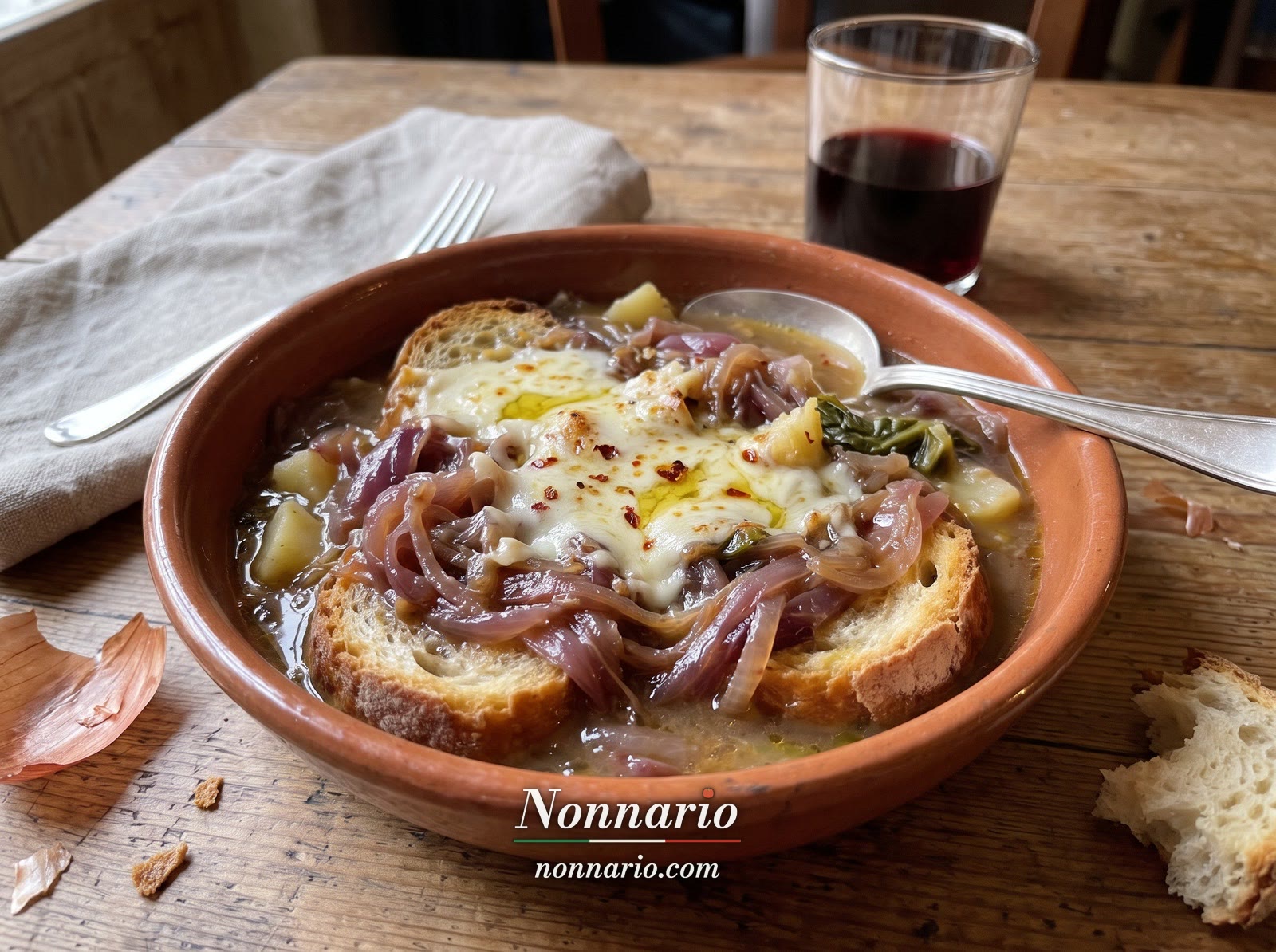
Calabrian onion soup over toasted bread
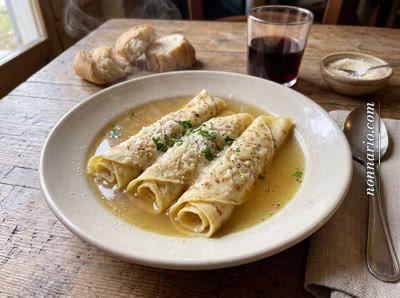
The onion soup of Calabria's poor kitchen: sweet Tropea red onions, an EU PGI since 2008, cooked for about an hour in water with a little lard, then poured boiling over toasted stale bread rubbed with chilli and finished with pecorino.
- Course
- ZuppeSoups
- Serves
- 4
- Hands-on
- 35 min
- Cooking
- 1 h
The video and the photos of every step are also gathered on a separate page.
In breve
In short
Also called licurdìa, zuppa di pane e cipolla, zuppa di cipolle alla calabrese, brodo con le cipolle, Tropea onion soup and Calabrian onion soup.
- Tropea red onions, 1 kg for four, cut small and cooked for about an hour in plain water with a little lard.
- Water, not meat broth: in the kitchen it comes from, broth was for the rich.
- Stale bread, sliced, toasted and rubbed with hot chilli, laid in the soup plates first.
- The onion broth poured over the bread still boiling, grated pecorino on top, served at once.
La provenienza
Where this recipe comes from
Licurdia, or licurdìa, is a soup of Calabria's poor, peasant kitchen: a handful of humble ingredients made into something nourishing. One account places it in the cooking of Cosenza and the towns around it; another calls it a dish of the Tropea area, on the Tyrrhenian coast, home of the sweet red onion that defines it. It is made with water, not meat broth, which in the times it comes from was a food for the rich. The onion is the Cipolla Rossa di Tropea Calabria, protected by the EU as a PGI since 2008 and grown on a long stretch of the Tyrrhenian coast across three provinces, Vibo Valentia, Catanzaro and Cosenza: from Nicotera in the south to the land between Amantea and Fiumefreddo Bruzio, where the province of Cosenza begins. It is sold as a spring onion, as a fresh onion and as a red-violet onion for keeping.
Licurdia has no official recipe. We compared eleven sources and publish the most widely recognised version: Tropea onions cooked for about an hour in water with a little lard, poured boiling over toasted stale bread rubbed with chilli, and finished with grated pecorino. Nearly all of them cook the onions soft in water, and all serve them with bread and chilli, most of them with pecorino too; the fat is lard or olive oil, and many versions add potatoes, carrots, chard, escarole or asparagus, depending on the place, or melt caciocavallo on the bread. The size of the pieces, the heat and the lid, the toasting, the salt beyond the first pinch and the rules for leftovers are ours, and say so where they appear.
- Provenance
- A regional tradition documented in cookbooks and local practice, with no single official text.
- Defined by
- Calabrian tradition
- Reference
- Compared across 11 sources, listed below; this page publishes the most widely recognised version.
- Sources
- Donna Moderna: licurdia, onion broth, a traditional Calabrian recipe for four, 1 December 2020 (archived copy of 19 July 2025; Italian)
- Accademia Italiana della Cucina, recipe collection: zuppa di pane e cipolla (licurdìa), Calabria, for four (Italian)
- Accademia Italiana della Cucina, recipe collection: zuppa di cipolle (minestra di cipuji frischi), Calabria, for four (Italian)
- La Cucina Italiana: licurdia, the Calabrian soup of onions and caciocavallo, by Paola Toia, 6 June 2023 (Italian)
- Cookaround (Mondadori Digital): licurdia, a typical Calabrian recipe for four (Italian)
- CalabriaMagnifica.it, a Calabrian online newspaper: licurdia, the soup of Tropea onions and Sila potatoes, by Annamaria Gnisci, 17 October 2021 (Italian)
- Resto al Sud, an online news magazine on southern Italy: a dish a week, the Calabrian licurdia, by Rosalia Bonfardino, 26 August 2016 (Italian)
- Il Giornale del Cibo, CIRFOOD's food magazine: zuppa di cipolle alla calabrese (licurdia), 2008 (Italian)
- Regione Calabria, Department of Agriculture: DOP IGP e PAT Regione Calabria, a brochure on the region's protected and traditional foods, with the Cipolla Rossa di Tropea Calabria PGI (Italian)
- Official Journal: Commission Regulation (EC) No 284/2008 of 27 March 2008, which registers Cipolla Rossa di Tropea Calabria as a PGI (Italian)
- USDA Food Safety and Inspection Service: Leftovers and Food Safety (archived copy of 29 May 2025)
Ingredienti
Ingredients
The original recipe serves 4
For the onion broth
To serve
Equipment
- Large saucepan of about 4 l, with a lid
- Chopping board and a sharp knife
- Wooden spoon and a ladle
- Kettle of boiling water, for topping up
- Grill, a dry frying pan or the oven, for the bread
- Grater, for the pecorino
- Four soup plates or deep bowls
- Shallow containers and a probe thermometer, for any leftover broth
Preparazione
Method
Scaled to 4 servings: the amounts in the steps follow. Pot and pan sizes and cooking times are still for the original 4.
About 1½ hours, most of it unattended. Peel and cut the onions (15 minutes), put them in the water with the lard and a pinch of salt, and let them cook over moderate heat for about an hour. Slice, toast and rub the bread with chilli during the last 15 minutes, so the broth goes over it still boiling. Serve at once.
- 35 minhands-on
- 1 hcooking
Prepare the onions
-
Hands-on 15 min
Rinse the 1 kg of onions, then peel them, trimming off the root and the top. Halve each one from top to root and cut it into small pieces, about 1.5 cm across.
Check All the onion is in small pieces of roughly the same size, with no papery skin left among them.
Tip Our guide: the size of the pieces is ours; small, even pieces soften together within the hour.
Cook the onion broth
-
Hands-on 1 minHeat medium-high
Pour about 2 l of water into the large saucepan and set it over medium-high heat.
Check The water is in the pot and the pot is on the heat.
-
Hands-on 2 min
Add the onions, the 30 g of lard and a pinch of salt to the water, and stir once so the onions are under the water.
Check The onions are in the water and the lard is in the pot, starting to melt.
-
Cooking 1 hHeat medium-high to the boil, then moderate
Let it come to the boil, then turn the heat down to moderate so the broth bubbles steadily but gently. Put the lid on, leaving a gap, and cook for about an hour from when the onions went in, stirring now and then. If the broth drops well below the level it started at, add a little boiling water from the kettle.
Check The onions are very soft, almost falling apart when pressed with the spoon against the side of the pot, and the lard has melted into a broth that still well covers them.
Tip Our guide: the lid left ajar, and the medium-high heat until it boils, are ours; the recipe gives only moderate heat for about an hour.
Tip Our guide: top up with boiling water, not cold, so the bubbling does not stop; licurdia is a broth, and it should stay one.
The bread, during the last 15 minutes of the broth
-
Hands-on 8–10 minTemp 200 °CHeat medium (pan) or a hot grill
About 15 minutes before the broth is ready, cut the 500 g of stale bread into slices about 1.5 cm thick. Toast them in batches under a hot grill or in a dry frying pan over medium heat for 2–3 minutes on each side, or in the oven at 200 °C for 8–10 minutes, turning them once.
Check Golden and crisp on both sides, with a rough surface that will catch the chilli.
Tip Our guide: the thickness and the toasting are ours; the recipe says only to slice and toast the bread.
-
Hands-on 3 min
Cut the chilli in half lengthways. While the toast is still warm, rub the cut side over one face of each slice. Share the slices between four soup plates or deep bowls.
Check One face of every slice has been rubbed with the chilli, and the bread is shared between the four plates.
Tip Rub lightly at first: how hot the soup ends up depends on the chilli and on how hard you rub.
Tip Wash your hands well after handling the chilli, and keep them away from your eyes.
Serve
-
Hands-on 1 min
When the hour is up, taste the broth and add salt if it needs it.
Check The broth is seasoned to your taste.
Tip Our guide: the recipe starts with only a pinch of salt; the pecorino adds more at the table, so salt with that in mind.
-
Hands-on 3 minHeat medium-high
Bring the broth back to the boil if it has stopped bubbling. Ladle it, with its onions, over the bread in the four plates, sharing it out evenly.
Check The broth is still boiling as it goes into the plates, and the bread is covered and starting to soften.
Tip Our guide: the broth meets the bread at the boil, so it reaches the table hot.
-
Hands-on 2 min
Sprinkle the 50 g of grated pecorino over the plates, an equal share on each, and serve straight away.
Check Every plate has its pecorino, and the soup goes to the table steaming.
Tip Leftovers: keep only the broth, never the soaked bread. Get it into the fridge in shallow containers within 2 hours of it coming off the heat, eat it within 3 days of cooking it, and bring it back to a rolling boil, at least 75 °C at the centre, before pouring it over freshly toasted bread.
The essentials, for cooks who know the dish. Switch to Detailed for quantities, temperatures, times and checks at every step.
Press “I’m here” on the step you are on, and again when it is done.Tap the pin on the step you are on, and the tick when it is done. Timers keep running while you scroll.
Da sapere
Good to know
- KeepingConservazione
- Served the moment the soup is poured over the bread. Source
- VariantsVarianti
- With carrots, potatoes and lettuce: For four: 200 g of carrots, 400 g of potatoes and 100 g of lettuce, chopped and boiled hard in 3 litres of salted water for three quarters of an hour, then passed through a sieve into an earthenware pot. 500 g of small onions, first boiled in a little water, are sliced roughly and fried in 100 g of lard, then go into the pot with their cooking liquid. The well-stirred soup is poured over 24 crostini of toasted bread dusted with dried chilli, and served at once. Source
- With potatoes and caciocavallo: Six sliced Tropea onions and two potatoes in chunks, cooked for about an hour in plenty of salted water over low heat with the lid on, with chilli flakes if you like. The soup goes over 200 g of bread cubes toasted in the oven or in a pan with oil, and four slices of caciocavallo, left a few minutes for the cheese to melt, then finished with raw olive oil, grated pecorino and more chilli. Carrots and chard are a common addition. Source
- With grated potato, in olive oil: 500 g of sliced Tropea onions stewed over low heat for about 15 minutes in 2 tablespoons of olive oil with a chilli and salt; then 200 g of Sila potatoes, peeled and grated, and 500 ml of water, simmered gently for 30 minutes and seasoned with salt and pepper. A slice of bread goes into each bowl, with plenty of pecorino. Source
- With other vegetables: Escarole, chard, asparagus or carrots join the onion, depending on the place, all cooked in water and lard to a soft cream and served with toasted bread, chilli and pecorino. Source
Errori comuni
Common mistakes
- Using meat broth: the traditional licurdia is made with water.
- Cutting the cooking short: the onions need about an hour, until they are very soft and almost falling apart.
- Letting the broth cool before it meets the bread: pour it over still boiling.
- Putting the pecorino in the pot: it goes over each plate at the end, an equal share on each.
Fuori dall'Italia
Cooking it outside Italy
- Look for ‘Cipolla Rossa di Tropea Calabria’ marked ‘IGP’ (PGI in English); it is sold as a spring onion (cipollotto), as a fresh onion and as a red-violet onion for keeping. Where you cannot find it, young fresh onions (cipolle novelle) are the alternative some cooks use.
- Strutto or sugna is rendered pork fat, sold as lard. Olive oil is the other fat some cooks use.
- Pecorino is a hard sheep’s-milk cheese, used grated; Pecorino Romano is one some cooks use.
From nonnario.com/recipes/licurdia/, where you will find its sources, its story and the step photos. Sources checked in November 2026.