San Giovanni in Fiore, Calabria
Pitta 'mpigliata
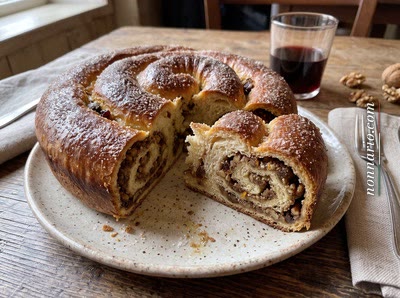
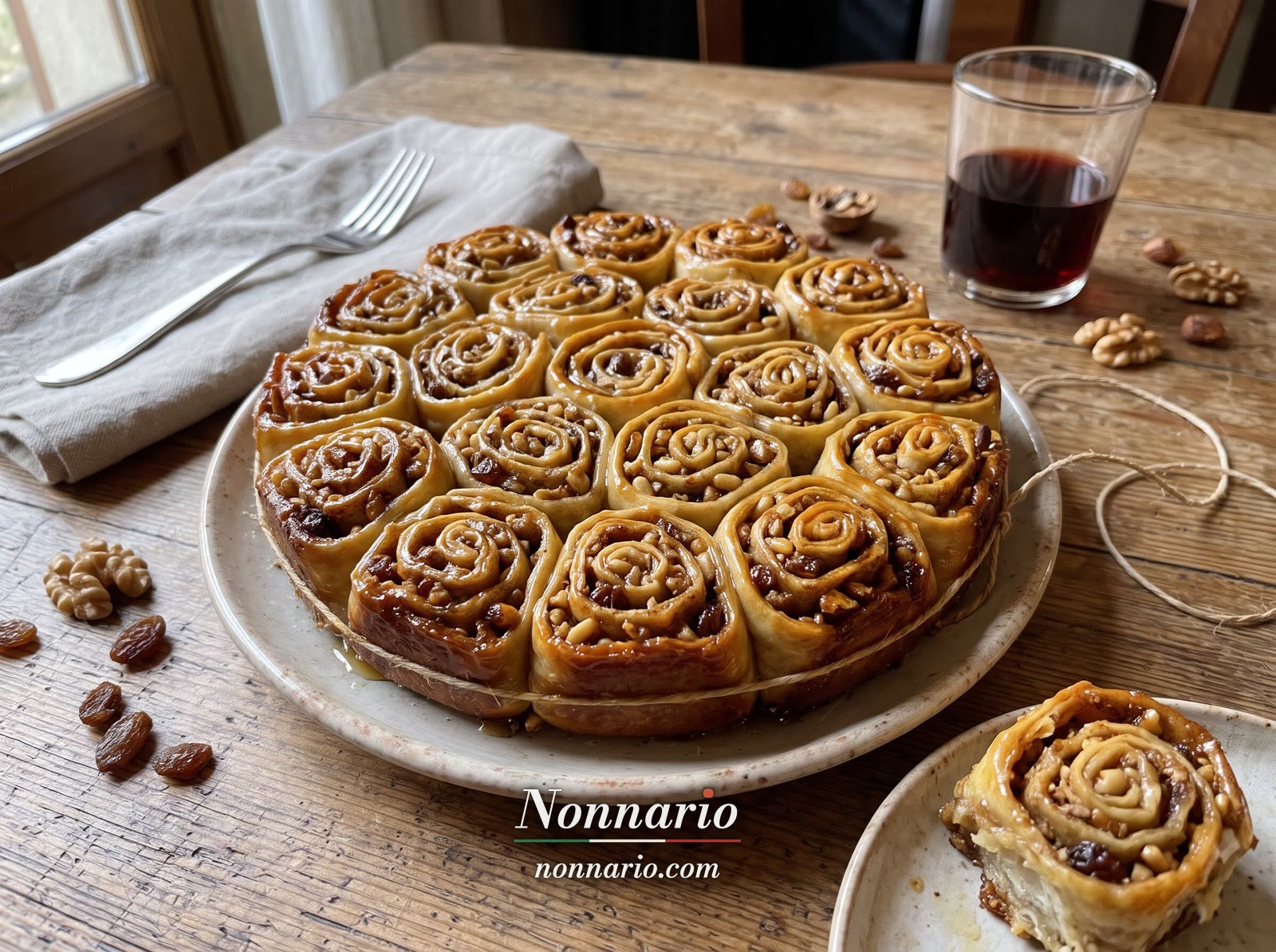
Calabrian rose pastry filled with walnuts, raisins and orange, finished with honey
The festive sweet of San Giovanni in Fiore in the Sila: thin strips of spiced pastry spread with walnuts, raisins and orange zest, rolled into roses, baked close together in a round tin and covered with honey while hot, one of Calabria's traditional food products.
- Course
- DolciDesserts
- Serves
- 6
- Hands-on
- 50 min
- Cooking
- 1 h
- Resting
- 5 h 40 min+
The video and the photos of every step are also gathered on a separate page.
In breve
In short
Also called pitta 'nchiusa, pitta mpigliata and pitta nchiusa.
- Vegetarian
- A thin dough of fine durum wheat semolina and a little soft flour, sugar, olive oil, sweet white wine, water, cinnamon and cloves, rested 30 minutes cold.
- The filling: coarsely chopped walnuts, raisins soaked in sweet white wine, sugar, grated orange zest, cinnamon and cloves.
- Strips of 60 cm × 7 cm, covered with filling, are rolled from both ends into joined roses and set side by side on a disc of dough in a 22 cm tin.
- Brushed with olive oil, baked at 180 °C for 45 minutes, covered with honey while hot, then left a few hours for the flavours to blend.
La provenienza
Where this recipe comes from
Pitta 'mpigliata, also called pitta 'nchiusa, comes from San Giovanni in Fiore, a large town in the Sila mountains in the province of Cosenza, and has spread across Calabria, above all around Cosenza and Catanzaro; around Catanzaro the name 'nchiusa goes with a flattened rose shape. Its origins are placed in the eighteenth century, when it was made for weddings and family feasts. Today it belongs to Christmas and Easter, and is eaten at other times of year too. In San Giovanni in Fiore the quarters of the town light bonfires, the focere, on Christmas night, a custom that may be weaker today than it once was; while the children spend the weeks before gathering wood for them, the pitta is made at home. It is on Italy's national list of traditional food products for Calabria, and it is made with some variations between the Sila and the Crotone area. It has had a festival of its own for some years, and in 2023 San Giovanni in Fiore hosted the first edition of a regional contest for home-made pitta 'mpigliata, held to compare recipes and techniques and to lay the ground for a production rule.
There is no official recipe. We compared eleven sources and publish the most widely recognised version. They agree on a dough most often made with olive oil and usually rolled thin; a sweetened filling of walnuts and raisins, with cinnamon in the dough or the filling; a base of dough in a round tin; and, in most, filled dough rolled into roses set close together on that base, and honey. They differ on the flour (durum wheat, soft wheat or both), on the liquids and flavourings (sweet wine, vermouth, orange juice, or liqueurs of anise, Strega or mandarin), on eggs, lard, almonds, pine nuts or dried figs, on where the honey goes, on the shape (one lays cords of dough in rings over a layer of filling instead of roses), and on the oven, from 160 to 200 °C. This version makes the dough with fine durum wheat semolina and a little soft flour, flavours the filling with sweet white wine and orange zest, and covers the pitta with honey as it comes out of the oven. The recipe it follows gives no amount for the honey or the oil brushed on top and does not say how the roses stand in the tin: those are ours, marked as such.
- Provenance
- A regional tradition documented in cookbooks and local practice, with no single official text.
- Defined by
- Tradition of San Giovanni in Fiore and the Sila
- Reference
- Compared across 11 sources, listed below; this page publishes the most widely recognised version.
- Sources
- Ministry of Agriculture (MASAF): national list of traditional food products, 25th revision, 2025, Calabria (Italian)
- Regione Calabria: PDO, PGI and traditional products of Calabria, a brochure (Italian)
- Cookist: pitta 'mpigliata, the recipe (Italian)
- Agrodolce: pitta 'nchiusa, 2019, archived copy (Italian)
- Linkiesta Gastronomika: Christmas in Calabria, pitta 'mpigliata, 2020 (Italian)
- Il Cucchiaio d'Argento: pitta 'nchiusa (Italian)
- Accademia Italiana della Cucina, recipe collection: pitta della Madonna as made in Crotone (Italian)
- Gambero Rosso: the many shapes of the Calabrian pitta, 2024, archived copy (Italian)
- Dissapore: 23 typical dishes of Calabria, 2022 (Italian)
- Regione Calabria, Calabria Straordinaria (the Region's tourism site): a tour of traditional Calabrian desserts
- ANSA news agency: pitta 'mpigliata, the first regional contest in the Sila, 2023 (Italian)
Ingredienti
Ingredients
Makes one pitta 22 cm across: 6 servings
For the dough
For the filling
To finish
Equipment
- Kitchen scale and measuring spoons
- A large bowl and a fork, for the dough; cling film
- A small bowl for the raisins, a bowl for the filling, a large knife and a fine grater for the orange zest
- Pastry board or worktop, rolling pin and a ruler at least 60 cm long (or a tape measure)
- A fluted pastry wheel, or a sharp knife
- A round tin 22 cm across (a springform is easiest), lined with baking paper
- Pastry brush
- An oven thermometer (optional)
- A small pan for the honey, and some foil
Preparazione
Method
About 7½ hours from start to table, most of it waiting, all on one day. The dough takes 10 minutes and rests 30 minutes in the fridge; make the filling meanwhile. Rolling, filling and shaping the roses takes about 30 minutes, the bake 45 minutes. Then the pitta is covered with honey, cools for about 2 hours and is best left a few hours more (about 3, by our reckoning) before it is cut, so the flavours blend. It keeps well, so it can be made a day or more ahead.
- 50 minhands-on
- 1 hcooking
- 5 h 40 minresting, at least
The dough
Make the dough first: it rests in the fridge for 30 minutes, time enough to make the filling.
-
Hands-on 3 min
Put the 130 g of semolina, the 25 g of flour, half a teaspoon of the spice mix, the 40 g of sugar, the 35 ml of olive oil, the 30 g of sweet white wine, the 30 ml of water and the pinch of salt in a large bowl. Mix everything together with a fork.
Check No dry flour left in the bowl: a rough, damp, crumbly mass.
Tip Our guide: the recipe lists the pinch of salt but never says when it goes in; it goes here, with the rest.
-
Hands-on 3–5 min
Tip the mixture onto the board and knead it well for a few minutes, until it comes together into a smooth, even ball.
Check Smooth and even in colour, with no cracks; it holds its shape and is soft enough to roll.
Tip Our guide: if it stays crumbly, wet your hands and knead again; add a few drops of water only if it still will not come together.
-
Rest 30 min
Wrap the dough in cling film and leave it in the fridge for 30 minutes. Make the filling meanwhile.
Check Slightly firmer and no longer sticky.
The filling
-
Rest 10 min
Put the 100 g of raisins in a small bowl, pour over the 20 ml of sweet white wine and leave them for 10 minutes.
Check The raisins are plump and soft.
Tip Our guide: stir them once or twice so they all take up the wine.
-
Hands-on 5 min
Chop the 200 g of walnuts coarsely with the large knife.
Check Coarse pieces, with no whole halves and no powder.
Tip Our guide: pieces about the size of a lentil or a pea spread easily and stay crunchy.
-
Hands-on 5 min
Put the walnuts in a bowl with the raisins and all their wine. Add the other half teaspoon of the spice mix, the 50 g of sugar and the finely grated zest of the orange, and mix well.
Check An even mixture, with the zest, sugar and spice spread all through it and no wine left pooling at the bottom.
Tip Our guide: grate only the coloured part of the peel; the white pith underneath is bitter.
Tip Our guide: divide the filling into four equal parts, about 90 g each, one for each strip.
Shaping the roses
-
Cooking 15 minTemp 180 °CHeat top and bottom heat, no fan
Switch the oven on to 180 °C, static (top and bottom heat), with a shelf in the middle, so it is hot when the pitta is ready.
Check An oven thermometer on the shelf reads 180 °C.
Tip Our guide: most ovens take about 15 minutes; shaping takes longer, so it will be ready in time.
-
Hands-on 2 min
Unwrap the dough and divide it into pieces of about 100 g: three pieces. Wrap one again and set it aside for the base.
Check Three pieces of about the same weight, one of them kept covered.
Tip Our guide: the dough weighs about 290 g in all, so each piece is just under 100 g. Keep the pieces you are not rolling under cling film so they do not dry out.
-
Hands-on 5 min
On a lightly floured board, roll one piece out with the rolling pin into a strip 60 cm long and 14 cm wide.
Check An even strip of the full size, the same thickness all over.
Tip Our guide: at this size the sheet is very thin, about 1 mm. Measure with the ruler: a smaller strip is too thick and the roses come out heavy.
-
Hands-on 1 min
Cut the strip in half along its length with the fluted pastry wheel, to make two strips 60 cm long and 7 cm wide.
Check Two strips of the same width, with clean edges.
-
Hands-on 3 min
Spread the filling over the two strips, covering the whole of each sheet.
Check Both strips covered from edge to edge, with no bare dough showing.
Tip Our guide: one of the four portions of filling for each strip; press it down lightly with your palm so it sticks to the dough and does not fall out as you roll.
-
Hands-on 3 min
Roll up each strip from both ends at once, towards the middle, so that the two little roses you make meet and join in the centre.
Check Two tight spirals joined in the middle, with the filling held inside the coils.
Tip Our guide: roll snugly but without pulling: the thin dough tears if it is stretched.
-
Hands-on 10 min
Roll, halve, fill and roll the second piece of dough in the same way, until the filling is finished. Keep the third piece, about 100 g, for the base.
Check Four double roses, and the reserved piece of dough still wrapped.
Assembling and baking
-
Hands-on 3 min
Roll the reserved dough out with the rolling pin into a disc big enough to cover the bottom of the 22 cm tin, already lined with baking paper, and lay it in the tin.
Check The bottom of the tin is covered by an even disc of dough.
-
Hands-on 3 min
Arrange all the roses on the base, one beside the other.
Check All the roses are in the tin, touching one another, spiral side up.
Tip Our guide: stand them upright, spiral side up, and group them together from the centre outwards, pressed gently against each other, so they hold each other up as they bake. They will not cover the whole base.
-
Hands-on 1 min
Brush the top of the pitta with a little olive oil, about a tablespoon.
Check A light, even sheen over all the roses.
Tip Our guide: the recipe says only a little oil; a tablespoon covers a 22 cm pitta.
-
Cooking 45 minTemp 180 °CHeat top and bottom heat, no fan
Bake the pitta at 180 °C for 45 minutes, until it is well golden.
Check Well golden all over, the dough dry and crisp at the edges of the roses.
Tip Our guide: look at it after 35 minutes; if the top is darkening fast, lay a sheet of foil loosely over it for the rest of the time.
-
Hands-on 3 min
Take the pitta out of the oven and, while it is still hot, brush or spoon the 100 g of honey all over it.
Check The whole surface glistens with honey.
Tip Our guide: the recipe asks only for plenty of honey; 100 g covers a 22 cm pitta. If your honey is thick, warm it for a few seconds in the small pan so it brushes on easily. Let some run down between the roses.
-
Rest 2 h
Leave the pitta to cool completely, in its tin, then lift it out on its paper.
Check Cold right through, even at the bottom, and the honey no longer runny.
Tip Our guide: cool it in the tin, about 2 hours; there the honey soaks in and the roses settle together.
-
Rest 3 h
You can eat it straight away, but it is better left a few hours before you serve it, so the flavours blend.
Check Each piece shows the spiral of thin pastry and walnut filling.
Tip Our guide: about 3 hours; the recipe says only a few hours. To serve, cut it into wedges or break off the roses.
Tip It makes a dessert for Christmas Day, or an afternoon treat with a hot herbal tea.
The essentials, for cooks who know the dish. Switch to Detailed for quantities, temperatures, times and checks at every step.
Press “I’m here” on the step you are on, and again when it is done.Tap the pin on the step you are on, and the tick when it is done. Timers keep running while you scroll.
Da sapere
Good to know
- WhenQuando
- Once made for weddings and family feasts; today it is the sweet of Christmas and Easter. Source
- KeepingConservazione
- At room temperature, covered with cling film or shut in an airtight container, for up to 2 weeks. It can be eaten as soon as it is cold, but is better after a few hours' rest. Source
- VariantsVarianti
- With honey in the dough and liqueurs in the filling: The filling: 500 g of walnuts in pieces and 500 g of sultanas with ground cloves, cinnamon, a spoonful each of Strega and anise liqueur, mandarin liqueur and 50 ml of orange juice, rested 3–4 hours. The dough: 500 g of flour, 100 g of sugar, 100 ml of olive oil, 100 ml of moscato, the rest of the orange juice, cloves, cinnamon, the liqueurs, salt and 100 g of honey. Each piece of dough is brushed with oil, sugar and cinnamon, spread with filling and rolled into a rose; baked at 170 °C for 40 minutes, brushed with 100 g of honey and baked 20 minutes more, then finished with the last of the honey, sugar and cinnamon. Source
- With eggs, pine nuts and dried figs: A dough of 500 g flour, 2 eggs, half a sachet of baking powder and salt, worked with a glass of olive oil, a glass of water and a spoonful each of mandarin, Strega and anise liqueur brought to the boil together. The filling: 250 g of chopped walnuts, 50 g of pine nuts, 150 g of raisins, 100 g of chopped dried figs and 250 g of honey. Half the dough lines an oiled tin and is brushed with oil, sugar and cinnamon; the other half, brushed with oil, sprinkled with sugar and cinnamon and spread with filling, is folded, cut into strips and rolled into small roses set on the base, with the edge folded over into a cord, and the top brushed with oil and sprinkled with sugar and cinnamon. Baked at 160 °C for about an hour. Source
- Pitta 'nchiusa with a layer of filling: For six: a dough of 250 g flour, 100 g sugar, aniseed, cinnamon, cloves, a spoonful of rum, 4 spoonfuls of oil and water. The filling, 150 g each of almonds and walnuts, 100 g each of raisins and pine nuts, bound with 50 g of honey, is spread over a disc of half the dough in a 20 cm–22 cm tin; the rest of the dough is cut into thin strips, rolled into cords and laid on top in rings. Baked at 190 °C for about 30 minutes. Source
- Pitta della Madonna, as in Crotone: For eight, with lard and egg: a soft dough of 750 g flour, 3 eggs, 3 spoonfuls of sugar, 12 of lard, grated lemon zest and salt, rolled into two sheets about 70 cm across. One sheet is brushed with oil or vino cotto and covered with 250 g of raisins, 300 g of walnuts, orange zest, cinnamon and 200 g of sugar; the other goes on top, and strips cut from both are rolled into rosettes, set on a base of dough in an oiled tin with its edge raised round them, sprinkled with sugar and baked at 200 °C. Made for the feast of the Madonna on 8 May. Source
Errori comuni
Common mistakes
- Rolling the strips smaller than 60 cm × 14 cm: the dough is then too thick for the roses.
- Leaving bare dough on the strips: the filling should cover the whole sheet.
- Waiting for the pitta to cool before the honey goes on: it goes on while the pitta is still hot.
- Cutting it straight away when there is time to wait: a few hours' rest lets the flavours blend.
Fuori dall'Italia
Cooking it outside Italy
- Semola rimacinata is durum wheat semolina milled a second time into a fine, pale yellow flour; it is sold as durum wheat flour or semola rimacinata. Coarse semolina for puddings is too gritty for this dough.
- Type 00 is a fine soft-wheat flour: plain flour (all-purpose in the US) is the nearest equivalent.
- The recipe asks for a sweet white wine without naming one. Some Calabrian towns use vermouth or Marsala instead.
- If you cannot buy ground cloves, grind whole cloves finely in a mortar or a spice grinder.
From nonnario.com/recipes/pitta-mpigliata/, where you will find its sources, its story and the step photos. Sources checked in November 2026.