Cividale del Friuli, Friuli-Venezia Giulia
Gubana
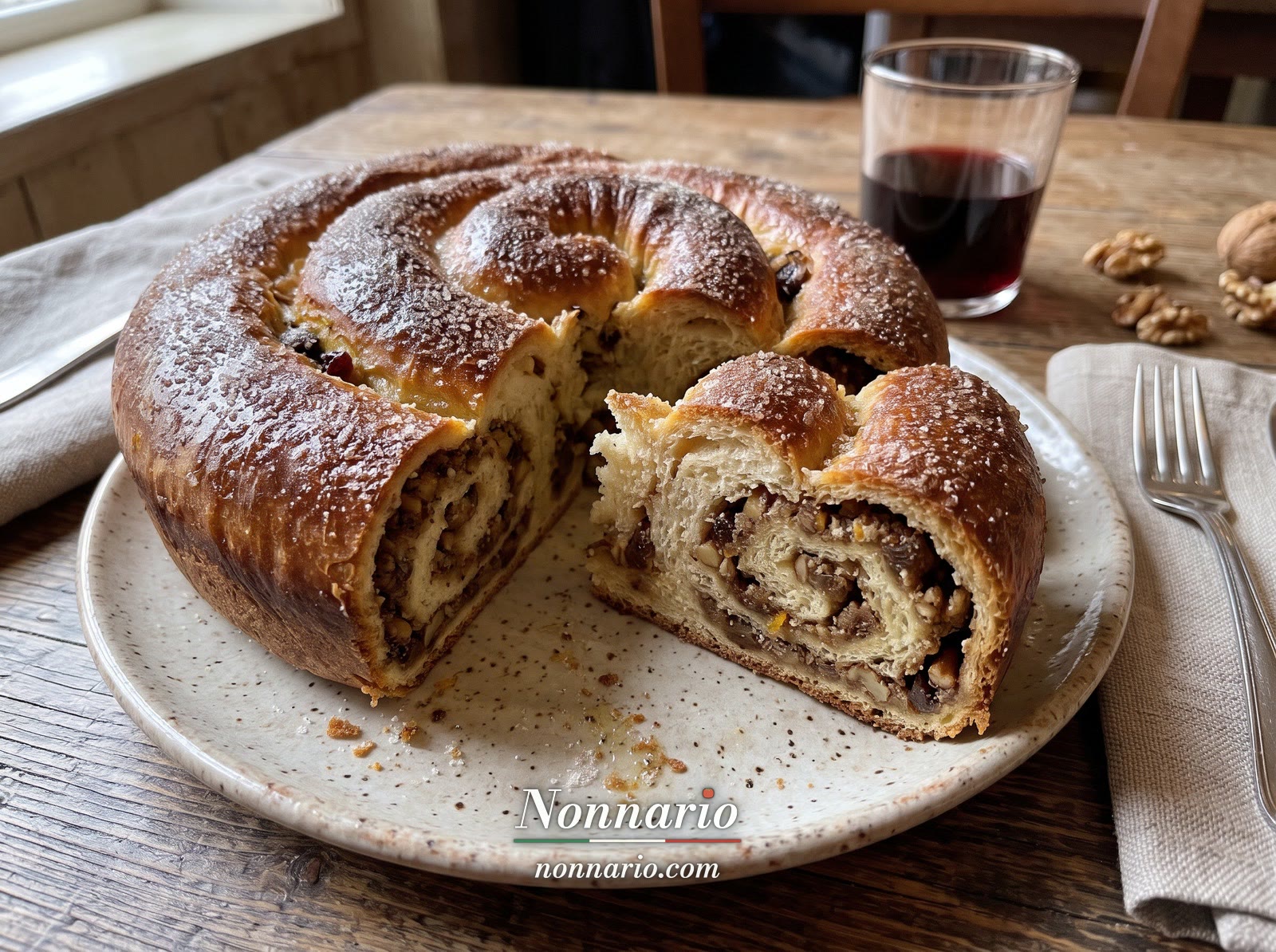
Spiral cake of the Natisone valleys, filled with walnuts and raisins
The feast cake of the Valli del Natisone and Cividale del Friuli: a soft yeast dough rolled round walnuts, raisins, pine nuts and amaretti moistened with plum grappa, coiled into a tight snail and baked in a round tin, one of the region's traditional food products.
- Course
- DolciDesserts
- Serves
- 6
- Hands-on
- 1 h 12 min
- Cooking
- 1 h 15 min
- Plan
- 2 days
The video and the photos of every step are also gathered on a separate page.
In breve
In short
Also called gubane, gubanza and gubana delle Valli del Natisone.
- Vegetarian
- A sweet yeast dough of flour, egg and yolk, milk, butter, sugar and honey, made in two stages: risen about an hour, then rested 30 minutes.
- The filling: walnuts, some caramelised, rum-soaked raisins, pine nuts browned in butter, amaretti and biscuits, sugar, lemon zest, vanilla and plum grappa.
- The filling rests at least a day and must be moist; the region's product sheet asks for at least 40% filling by raw weight.
- Rolled up like a strudel, stretched to 70 cm–80 cm and coiled into a compact snail in a buttered 20 cm round tin, then risen until doubled.
- Brushed with egg white, sprinkled with sugar and baked at 160 °C for about an hour.
La provenienza
Where this recipe comes from
Gubana is the feast cake of the Valli del Natisone, the valleys that link Cividale del Friuli with the valley of the Isonzo: a soft leavened dough wrapped round a rich filling of walnuts, raisins and pine nuts and coiled into a compact snail. The name most likely comes from the Slovene guba, a fold. Accounts of its history tie it to the banquet given in Cividale in 1409 for Pope Gregory XII, and to a contract of 1576 that priced a gubana at a lira of twenty soldi, a mason's pay for a full day; one account places the first written use of the name in a Gorizian poem of 1714, and the Touring Club's gastronomic guide of 1931 called it a renowned speciality of Friuli. In Friulian, plen come une gubane, as full as a gubana, is said of someone who has eaten their fill, and the word also stands for a stroke of great luck. It was baked above all for Easter and Christmas, and for the great moments of a life: at weddings it was a must, and a bride was expected to know how to make it; emigrants leaving to work abroad took one with them, and slices were handed out at village feasts such as San Donato's in Cividale. Gorizia makes a cousin wrapped in thin puff pastry, and the valleys' strucchi, small pastries boiled or fried, take a filling derived from it.
There is no official recipe. Gubana is on Italy's national list of traditional food products for Friuli Venezia Giulia, and the Region's product sheet, drawn up by its rural development agency on the evidence of the 1973 statute of the Consorzio per la tutela della Gubana delle Valli del Natisone, sets the frame: a filling of at least 40% of the raw weight, dried fruit at least 25% of the baked cake, required ingredients (wheat flour, sugar, raisins, eggs, butter, seed oil, walnuts, pine nuts, milk, salt, lemon and vanilla) and allowed ones (amaretti or biscuits, grappa and spirits such as slivovitz, cocoa, candied peel, honey, almonds, hazelnuts); a dough built up in stages, a coil in a round tin, a full rise and about an hour at 150–170 °C. How the dough is made it leaves to each bakery. We compared nine sources and publish the most widely recognised version. They agree on a sweet yeast dough rolled out around walnuts, raisins and pine nuts bound with sugar, citrus zest and a spirit, rolled up, coiled and risen again before baking; they differ on the spirit (rum, grappa, plum brandy or Marsala), on hazelnuts, almonds, biscuits, cocoa or egg in the filling, and on the dough, which one Natisone bakery builds up over three days. This version makes its dough in two stages and rests the filling for a day. The recipe it follows gives no amounts for the spirits, the butter dotted over the filling or the sugar on top, and does not say when the honey goes in: those are ours, marked as such. By our calculation the filling is about half the raw weight and the dried fruit just over a quarter of the baked cake, within the sheet's limits. One difference: the sheet lists seed oil among the required ingredients, and the recipe followed here has none in the dough; we have not added it, so as not to change a tested recipe.
- Provenance
- A regional tradition documented in cookbooks and local practice, with no single official text.
- Defined by
- Tradition of the Valli del Natisone
- Reference
- Compared across 9 sources, listed below; this page publishes the most widely recognised version.
- Sources
- Regione Autonoma Friuli Venezia Giulia, ERSA rural development agency: product sheet of the traditional food product gubana, archived copy of 2010 (Italian)
- Regione Autonoma Friuli Venezia Giulia, ERSA rural development agency: Il Cibario del Friuli Venezia Giulia, atlas of traditional products, 2017, feast sweets (Italian)
- Ministry of Agriculture (MASAF): national list of traditional food products, 25th revision, 2025, Friuli Venezia Giulia (Italian)
- Il Cucchiaio d'Argento: gubana (Italian)
- PromoTurismoFVG, the Region's tourism agency: the recipe for the gubana of the Valli del Natisone (Italian)
- GialloZafferano: gubana (Italian)
- Gambero Rosso: gubana, history, recipe and secrets of the Friulian feast cake, 2020, archived copy (Italian)
- Accademia Italiana della Cucina, recipe collection: gubana as made in Cividale (Italian)
- Accademia Italiana della Cucina, recipe collection: gubana as made in Gorizia, the Collio and the Carso (Italian)
Ingredienti
Ingredients
Makes one gubana 20 cm across, a little under 1 kg: 6 servings
For the filling, made a day ahead
For the dough
For shaping and baking
Equipment
- Kitchen scale and measuring spoons
- A small heavy-based pan for the caramel (a copper sugar pan if you have one), and a wooden spoon
- A marble slab, a tray or a sheet of baking paper, lightly oiled, for the caramelised walnuts
- A small frying pan, for the pine nuts
- A food mincer (the best tool for the walnuts) or a food processor, or a large knife
- Mixing bowls, cling film and a dough scraper
- A warm place that holds 26 °C–28 °C (a proving box, or the oven switched off with only its light on) and a thermometer to check it
- Rolling pin and a ruler
- A round tin 20 cm across, with sides at least 6 cm high, buttered
- Pastry brush
- Probe thermometer, a wooden skewer and some foil
- Wire rack and a sharp serrated knife
Preparazione
Method
Two days. Day 1, the filling (about 45 minutes): soak the raisins, caramelise some of the walnuts, brown the pine nuts, chop and mix everything, then leave it to rest in a cool place for at least a whole day. Day 2, about 7–8 hours from start to table, most of it waiting: the first dough (10 minutes) rises about an hour; the second (15 minutes) rests 30 minutes; shaping takes about 20 minutes; the coiled gubana rises in its tin for 1½–2½ hours, bakes for about an hour and then cools for at least 2 hours. You need a warm place that holds 26 °C–28 °C for the dough, and a cool one for the filling.
- 1 h 12 minhands-on
- 1 h 15 mincooking
- 2 daysfrom start to table
Day 1: the filling
Make the filling at least a day before you bake: it rests a whole day, so the flavours blend and the crumbs and fruit soften.
-
Hands-on 2 min
Put the 60 g of raisins in a small bowl and pour the 40 ml of rum over them. Leave them to soak while you prepare the rest, at least 30 minutes.
Check The raisins are just covered.
Tip Our guide: the recipe we follow gives no amount of rum; 40 ml covers 60 g of raisins in a small bowl.
-
Hands-on 3–5 minHeat medium
Oil the marble, tray or baking paper lightly. In the small heavy pan, put 30 g of the filling sugar with the tablespoon of water and a drop of vinegar, and cook without stirring until it turns to caramel.
Check The syrup has turned a clear, light amber and smells of caramel.
Tip Swirl the pan rather than stirring it, so the sugar does not crystallise.
Tip Take it off the heat as soon as it is light amber: it darkens fast, and dark caramel tastes bitter.
-
Hands-on 1 min
Tip 50 g of the walnuts into the caramel and stir quickly for a few seconds, just until they are coated. Take the pan off the heat at once and pour the walnuts onto the oiled surface, spreading them out.
Check Every piece is glazed and the walnuts lie in a single layer.
Tip Caramel burns skin badly: keep your fingers away from it until it has cooled.
-
Rest 15 min
Leave them until cold and set hard. Brown the pine nuts meanwhile.
Check Hard and brittle, and cold to the touch.
-
Hands-on 3–5 minHeat very low
Melt the 20 g of butter in the small frying pan, add the 30 g of pine nuts and cook them on the lowest heat, stirring, until golden. Take them off the heat and leave them to cool in their butter.
Check Evenly golden, with the butter foaming but not browned.
Tip Keep all the butter: it goes into the filling with the pine nuts.
-
Hands-on 10 min
Chop the 40 g of amaretti and the 30 g of dry biscuits finely. Then chop the caramelised walnuts together with the other 90 g of walnuts, ideally through a food mincer.
Check The biscuits are fine crumbs and the walnuts are a moist, fine grain with no whole pieces.
Tip With a food processor, use short pulses and stop before the walnuts turn to paste.
-
Hands-on 8 min
Drain the raisins and squeeze them well. In a large bowl, put the crumbs and walnuts, the raisins, the pine nuts with all their butter, the grated lemon zest, the pinch of salt, the vanillin, the cinnamon if you like it, the remaining 30 g of sugar and the finely chopped citron. Pour in the 30 ml of plum grappa and mix for a long time, until everything is well blended.
Check Squeezed in the hand, the filling holds together and feels moist; if it is still dry and crumbly, add more plum grappa a little at a time.
Tip Our guide: the recipe we follow says only to add as much spirit as the filling needs; 30 ml is a start, and a dry filling may take up to twice that.
-
Rest 24 h
Cover the bowl with cling film and leave the filling in a cool place for at least a whole day.
Check After a day the crumbs have softened and the filling is moist and even.
Tip Our guide: a cool place means below about 18 °C; in a warm kitchen use the fridge and take the filling out an hour before you shape the gubana, so it spreads easily.
Day 2: the dough, in two stages
-
Hands-on 5–8 min
Heap 170 g of the flour on the worktop or in a bowl and make a well in the middle. Crumble the 10 g of yeast into the 40 g of lukewarm milk and stir until dissolved, then pour it into the well with 1 teaspoon of the sugar, the egg, the 30 g of yolk and the 2 g of salt. Work it all together into a soft dough.
Check A soft, smooth dough with no dry flour left; it is meant to be soft and slightly sticky.
Tip Our guide: lukewarm is about 30 °C–35 °C, warm on the inside of your wrist; hotter milk weakens the yeast.
Tip A dough scraper helps gather it while it is soft.
-
Rest 1 hTemp 26 °C
Put the dough in a bowl, cover it with cling film and leave it in a warm place for about an hour.
Check Clearly risen and puffy, with small bubbles under the surface.
Tip Our guide: 26 °C–28 °C is warm enough; the oven with only its light on usually holds it, but check with a thermometer.
-
Hands-on 15 min
Work in the remaining 50 g of flour, the 60 g of soft butter a little at a time, the rest of the sugar and the 20 g of honey, adding each slowly. Then knead the dough energetically for about 15 minutes, by hand or in a stand mixer with the hook.
Check Smooth, glossy and elastic: it comes away from the bowl or the worktop and stretches without tearing.
Tip Our guide: the recipe we follow lists the honey but never says when it goes in; it goes here, with the other ingredients of the last stage, as the region's sheet has it.
Tip Add the next piece of butter only when the last has disappeared into the dough.
-
Rest 30 minTemp 26 °C
Shape the dough into a ball, put it back in the covered bowl and leave it in the warm place for 30 minutes. Take the filling out of the fridge now if it was there, and butter the tin.
Check Slightly puffed and soft, and easy to roll.
Shaping and the last rise
-
Hands-on 5 min
On a lightly floured worktop, roll the dough out into a rectangle of 20 cm × 30 cm, with one long side towards you.
Check An even sheet of the right size, the same thickness all over.
Tip Measure with the ruler: a sheet larger than this is too thin to hold the filling.
-
Hands-on 5 min
Spread the filling evenly over the whole sheet, pressing it down lightly, and dot it all over with the 30 g of soft butter in small pieces.
Check An even layer of filling from edge to edge, with butter scattered across it.
Tip Our guide: the recipe we follow asks for plenty of butter here without weighing it; 30 g is our amount.
-
Hands-on 5 min
Starting from the long side nearest you, roll the sheet up round the filling as you would a strudel, and finish with the seam underneath. Pinch the two ends closed. Then roll it gently back and forth under your palms, working from the middle outwards, until it is 70 cm–80 cm long.
Check An even rope 70 cm–80 cm long, sealed at both ends, with no filling showing.
Tip Stretch it gradually, in several passes: pulled hard, the dough splits and the filling escapes.
-
Hands-on 5 min
Lift the right-hand end of the roll and fold it inwards to make the centre of the snail, then wind the rest of the roll gently round it. Tuck the last end underneath, where it meets the first. Set the coil in the buttered tin.
Check A compact, round snail with no gaps between the coils, sitting flat in the tin.
Tip Wind it close but without pulling: the coils need room to rise into each other.
-
Rest 1 h 30 min to 2 h 30 minTemp 26 °C
Cover the tin loosely with cling film and leave it in the warm place until the gubana has doubled in size. Take it out of the oven if that is where it is rising, and heat the oven when it is nearly ready.
Check Doubled, the coils pressing into each other; a fingertip pressed gently into the dough leaves a dent that fills back slowly.
Tip Our guide: the recipe we follow gives no time; at 26 °C–28 °C it usually takes 1½–2½ hours. Go by the size, not the clock.
Baking and cooling
-
Cooking 15 minTemp 160 °CHeat top and bottom heat, no fan
Heat the oven to 160 °C, static (top and bottom heat), with a shelf in the lower middle.
Check An oven thermometer on the shelf reads 160 °C.
Tip Our guide: the region's sheet bakes gubana at about 150 °C–170 °C; the oven needs about 15 minutes to get there.
-
Hands-on 2 min
Beat the egg white lightly with a fork. Brush it over the whole surface of the gubana and sprinkle with the tablespoon of sugar.
Check An even, glistening coat, with sugar all over it.
Tip Brush gently, so as not to deflate the risen coils.
-
Cooking 1 hTemp 160 °C
Bake at 160 °C for about an hour.
Check Deep golden brown all over; a skewer pushed into the dough near the edge comes out dry, and a probe in the centre reads at least 92 °C.
Tip Our guide: check it after 50 minutes. If the top is darkening before the inside is done, lay a sheet of foil loosely over it.
-
Rest 2 h
Take the gubana out of the oven, leave it in the tin for 10 minutes, then turn it out onto the wire rack and leave it to cool completely.
Check Cool right through, even at the bottom.
Tip Our guide: 10 minutes in the tin lets it firm up enough to turn out without breaking.
Tip It is at its best the day after baking, once the flavours have blended.
-
Hands-on 3 min
Cut it into thin slices with the serrated knife and serve.
Check Each slice shows the spiral of dough and filling.
Tip In Friuli the slices are often moistened with a little plum grappa or slivovitz at the table.
The essentials, for cooks who know the dish. Switch to Detailed for quantities, temperatures, times and checks at every step.
Press “I’m here” on the step you are on, and again when it is done.Tap the pin on the step you are on, and the tick when it is done. Timers keep running while you scroll.
Da sapere
Good to know
- WhenQuando
- Above all at Easter and Christmas. It was also baked for the great moments of a life (birthdays, weddings, baptisms, first communions) and handed out in slices at the feast of a village's patron saint, such as San Donato's in Cividale. Source
- KeepingConservazione
- Covered under a glass cake dome at room temperature for 2–3 days. It can also be frozen raw, before its last rise, as long as none of its ingredients had been frozen before, or once baked. Source
- VariantsVarianti
- With hazelnuts and a filling soaked overnight: A single dough of 250 g type 00 flour and 50 g strong flour, a teaspoon of dried yeast, 2 tablespoons of grappa, 100 ml of milk, an egg, 40 g of soft butter, 2 tablespoons of sugar and a teaspoon of salt, risen 3 hours. The filling, mixed the evening before and kept overnight in the fridge: 70 g each of walnuts and raisins, 50 g each of toasted hazelnuts and toasted pine nuts, the grated zest of a lemon and an orange, 100 g of dry biscuits or amaretti and 60 ml of rum. Rolled into a disc about 5 mm thick, spread, rolled up tight and coiled on a lined tray, risen 2 hours, brushed with egg white and sugar, then baked at 200 °C for 15 minutes and at 180 °C for 15–20 more. Best the next day, moistened with a little plum grappa. Source
- With Marsala and whisked egg whites in the filling: For a 22 cm tin: a starter of 150 g flour, 3 g of dried yeast and 85 g of milk, left to double for about an hour, then a dough of 350 g flour, 90 g sugar, 170 g of egg, 75 g butter, 40 g milk, 15 g grappa, lemon zest and salt, risen about 3 hours. The filling: 250 g of walnuts, 120 g of pine nuts and 60 g of almonds, each finely ground, 140 g of raisins soaked in Marsala, 60 g of breadcrumbs toasted in 50 g butter, grappa, lemon and orange zest and 2 eggs, the whites whisked to stiff peaks. Rolled to about 50 cm × 60 cm, coiled into the tin, risen 30 minutes more, brushed with egg and sugar and baked at 170 °C for 60 minutes. Source
- In a butter pastry, with chocolate and figs: An unleavened version for eight: a pastry of 250 g flour, 250 g butter, 2 teaspoons of grappa or slivovitz and salt, rested at least half an hour in a cool place and rolled into a long, narrow strip a few millimetres thick. The filling, spread over the whole strip: 250 g of raisins soaked in grappa or slivovitz, 250 g of pounded walnuts, 100 g of pine nuts, 100 g of grated dark chocolate, 50 g each of almonds and hazelnuts, 100 g of sugar, chopped dried figs and 3 prunes, 4 or 5 crumbled amaretti, orange and lemon zest, an egg and a splash of sweet white wine. Rolled, coiled, brushed with yolk and baked on a buttered tray at 180 °C for 40–50 minutes; served cold. Source
- In puff pastry, as in Gorizia: A classic puff pastry of two doughs, one mostly butter and one of flour, water and salt, laid together and folded several times. The filling: walnuts, almonds, pine nuts and sultanas soaked in warm water, rum or Marsala, candied orange or citron, sugar or honey, aromas and spices, and if you like butter, hazelnuts, egg and crumbled dry biscuit, the nuts coarsely chopped. It is shaped into a sausage and wrapped in the pastry with the help of a floured cloth, rather than spread over it, then coiled, brushed with yolk and baked at 180 °C for about 30–40 minutes. Source
Errori comuni
Common mistakes
- Cutting short the filling's day of rest: it needs that time for the crumbs to soften and the flavours to blend.
- A dry filling: it should hold together when squeezed. Add plum grappa until it does.
- Leaving the ends of the roll open, or stretching it too hard: the filling breaks out in the oven.
- Baking it before it has doubled: the dough tightens round the filling and the coils split.
- Too hot an oven: the top browns and the sugar burns before the middle is baked. Keep to 160 °C and cover it with foil if needed.
Fuori dall'Italia
Cooking it outside Italy
- Type 00 is a fine soft-wheat flour: plain flour (all-purpose in the US) is the nearest equivalent.
- Fresh brewer's yeast is sold as fresh or compressed yeast; 10 g of it can be replaced by about 3 g–4 g of active dry yeast.
- Amaretti are small, crisp Italian almond macaroons. For the dry biscuits, any plain, crisp biscuit will do, such as Marie or rich tea.
- Plum grappa is a clear plum brandy: slivovitz, or any other plum brandy.
- Vanillin is the synthetic vanilla flavouring sold in small sachets in Italy; a few drops of vanilla extract or a little vanilla seed replace it.
- Candied citron is cedro; candied lemon or orange peel is the nearest substitute.
From nonnario.com/recipes/gubana/, where you will find its sources, its story and the step photos. Sources checked in November 2026.