Isernia, Molise
Sagne e fagioli
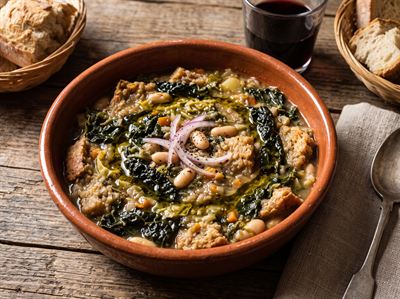
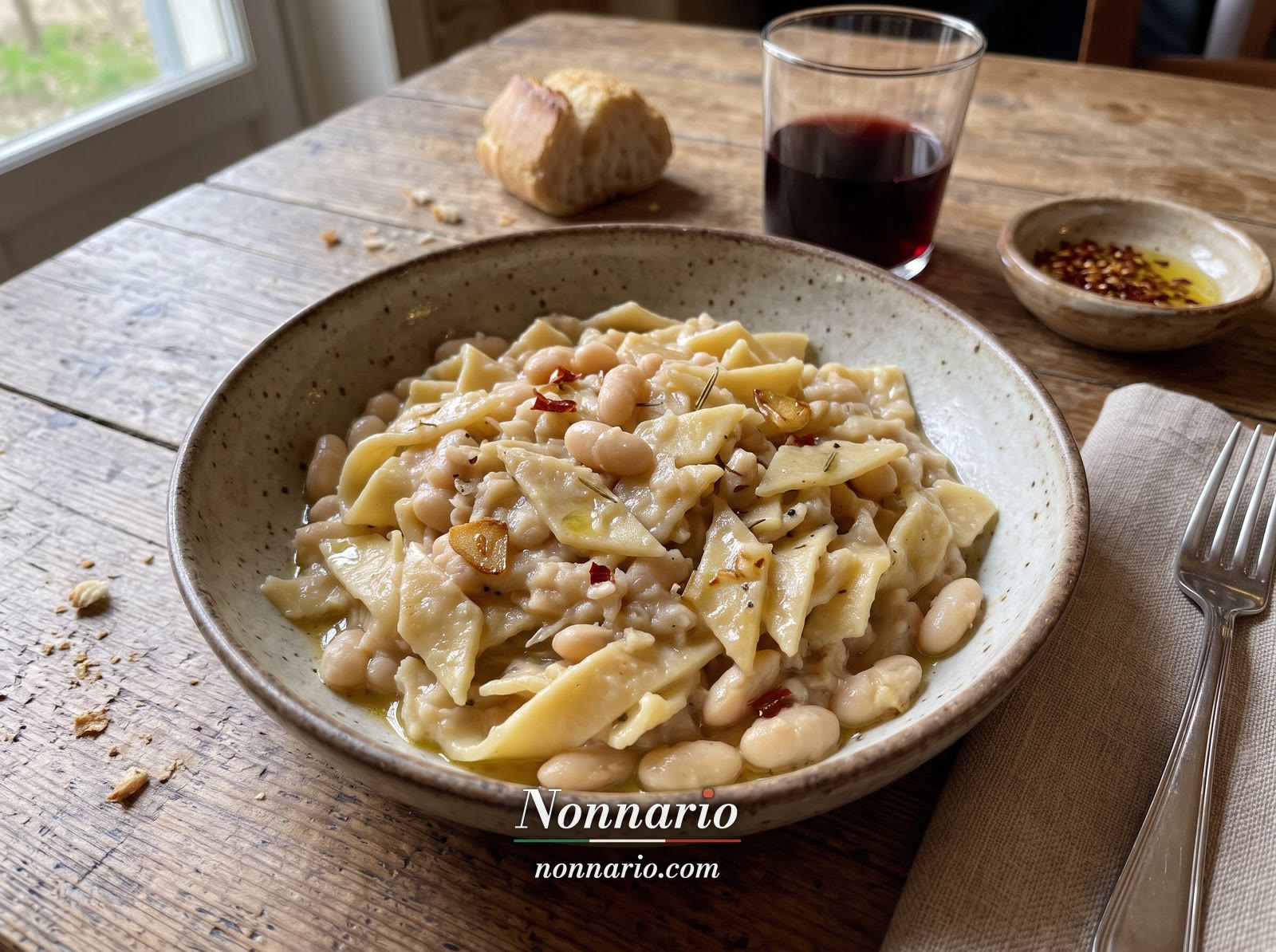
Short hand-cut semolina pasta with roughly crushed white beans, garlic, chilli and olive oil
Molise's sagne, short strips of semolina-and-water pasta, mixed in the tureen with small white beans cooked with onion and celery and roughly crushed, then dressed with hot olive oil, garlic, chilli and parsley.
- Course
- ZuppeSoups
- Serves
- 4
- Hands-on
- 52 min
- Cooking
- 1 h 13 min
- Plan
- 2 days
The video and the photos of every step are also gathered on a separate page.
In breve
In short
Also called sagne e fagioli bianchi and ’a murrecene.
- Vegetarian
- Vegan
- Sagne: a firm dough of semolina, water and salt, rolled about 2 mm thick and cut into strips 6 mm wide and about 4 cm long.
- Small round white beans, soaked overnight, boiled hard for half an hour with an onion and a stick of celery, then simmered, salted and roughly crushed.
- The dressing: olive oil heated with quartered garlic and chilli, poured over the moment the garlic starts to colour.
- Sagne, a little of their water and the beans are mixed in the tureen with chopped parsley: creamy, never liquid.
La provenienza
Where this recipe comes from
Sagne are a pasta Molise shares with Abruzzo and Lazio: flour, water and salt, cut into diamonds, strips, squares or rectangles. Before pasta was made by machine they were an everyday peasant dish, often paired with pulses, and in Molise they often come with beans, grass peas or chickpeas, with a little guanciale, lard or sausage for flavour. This version is from Isernia, where the sagne go with small round white beans called ’a mmurecene, grown locally and sought after for their flavour and softness: their soft skin does not come away from the bean, and their cooking water was once used to wean babies. Every village has its own bean, and those of the ‘Paolina’ at Riccia are much sought after too. Sagnetelle, Molise's white beans and the beans of Riccia are all on Italy's national list of traditional food products.
There is no official recipe. We compared 6 sources and publish the most widely recognised version. They agree on sagne of flour and water served with beans, and two of them cook the beans in an earthenware pot; they differ on the bean (small white ones here, borlotti elsewhere) and on whether a little pork goes in. On this page the beans are cooked with onion and celery and roughly crushed, the sagne are cut short and narrow, and everything is brought together in the tureen with oil just heated with garlic and chilli. Two things of ours matter most. For safety, the beans boil hard for their first half hour before they simmer, because undercooked beans can make you ill. And the dough as given uses very little water, so the page says how to add a little more, up to about 50 ml, if it will not come together.
- Provenance
- A regional tradition documented in cookbooks and local practice, with no single official text.
- Defined by
- Molisan tradition
- Reference
- Compared across 6 sources, listed below; this page publishes the most widely recognised version.
- Sources
- Accademia Italiana della Cucina: ‘Sagne e fagioli bianchi’, a Molisan recipe from Isernia, from its recipe collection (Italian)
- Gambero Rosso International: an alphabetical overview of the foods of Molise, by Francesca Fiore, 2021
- Dissapore, an Italian food magazine: twenty typical dishes of Molisan cooking, by Susanna Danieli, 2021 (Italian)
- Ministry of Agriculture (MASAF): national list of traditional agri-food products, 25th revision, 2025, Molise nos. 56, 57 and 133 (Italian)
- European Food Safety Authority (EFSA): lectins in food, undercooked beans pose a health risk, 2026
- USDA Food Safety and Inspection Service: Leftovers and Food Safety (archived copy of 29 May 2025)
Ingredienti
Ingredients
The original recipe serves 4
For the beans
For the sagne
To dress
Equipment
- A bowl for soaking the beans
- An earthenware bean pot if you have one, with a heat diffuser, or a heavy saucepan of about 4 l
- A potato masher or a wooden spoon
- A large wooden board for the dough, a long rolling pin and a sharp knife
- A tray lined with a clean cloth for the cut sagne
- A pot of about 5 l for the pasta, and a spider or a colander
- A small frying pan, about 16 cm across, for the oil
- A soup tureen or a deep serving bowl, and a ladle
Preparazione
Method
Scaled to 4 servings: the amounts in the steps follow. Pot and pan sizes and cooking times are still for the original 4.
Two days, with little work on the first. The evening before: put the beans to soak. On the day, about 2 hours: start the beans first (1–1 1/2 hours, mostly unattended). Once they are simmering, make the dough, roll it, let it dry and cut the sagne (about 45 minutes). Put the pasta water on as you start cutting. When the beans are soft, crush them and keep them hot; then cook the sagne and, while they cook, heat the oil with the garlic and chilli. The beans can also be cooked the day before: in shallow covered containers, in the fridge within 2 hours, in their liquid, and brought back to the boil before you go on; the 3 days count from the day the beans were cooked.
- 52 minhands-on
- 1 h 13 mincooking
- 2 daysfrom start to table
The evening before: soak the beans
-
Rest 12 h
Rinse the 300 g of dried beans, put them in the bowl and cover them with about three times their volume of cold water. Leave them for 12 hours, overnight.
Check The beans are plump, about twice their dry size, with smooth skins.
Tip Our guide: if the kitchen is warm, soak them in the fridge.
The beans
-
Hands-on 2 min
Drain the beans, throw away the soaking water and rinse them well under cold running water.
-
Cooking 10–15 minHeat medium-high
Put the beans in the pot with the halved onion and the pieces of celery, and pour in fresh cold water to cover them by about 5 cm (about 2 l), with no salt. Bring it to the boil, skimming off the foam that rises.
Check A full rolling boil, with the grey foam skimmed away.
Tip The traditional pot is the pignatta, an amphora-shaped earthenware pot. Our guide: set it on a heat diffuser and bring it up to the boil slowly over medium heat, never high; it takes longer, and a sudden blast of heat can crack the clay.
-
Cooking 30 minHeat medium-high, a steady boil
Keep the beans boiling steadily, bubbles breaking all over the surface, for 30 minutes, counted from when the water boils. Skim off any more foam.
Check The water has boiled without a break for the whole 30 minutes.
Tip Our guide, for safety: undercooked beans can cause nausea, vomiting, stomach pain and diarrhoea. Soaking them, throwing away the soaking water and boiling them hard for at least half an hour destroys most of the harmful lectins; then cook them on until soft.
-
Cooking 30 min to 1 hHeat moderate, a gentle simmer
Lower the heat so the beans simmer gently, half cover the pot and cook them until they are soft right through, usually another 30–60 minutes. Top up with boiling water from the kettle whenever they are no longer covered. Once they begin to soften, add salt.
Check Squeeze a bean between two fingers: it crushes easily into a smooth cream, with no firm or grainy centre. If not, give them another 10 minutes and test again.
Tip Our guide: the time depends on the beans and on how old they are; the squeeze test decides, not the clock.
Tip Our guide: salt them once they have begun to soften, then taste again at the end.
-
Hands-on 3 minHeat lowest
Lift out the pieces of celery. The liquid should come about level with the beans: if there is much more, boil it uncovered for a few minutes or ladle off the excess and keep it. Crush about half the beans, and the soft onion with them, with the potato masher or the back of a wooden spoon, leaving plenty whole. Cover the pot and keep it hot on the lowest heat.
Check A thick, creamy mass of beans, part crushed and part whole, in a little liquid, and well salted.
Tip Crush them only roughly. Our guide: a smooth purée is not the aim.
The sagne
Start the dough once the beans are simmering, so the sagne are cut as the beans finish.
-
Hands-on 2 min
Pile the 300 g of semolina on the board, mix in a pinch of salt and shape it into a mound with a wide well in the middle.
-
Hands-on 12–15 min
Pour the 100 ml of water into the well a little at a time, drawing the semolina in from the sides with a fork and then your fingers. When it has all come together, knead it with the heel of your hand, folding it over and turning it, for 10–15 minutes.
Check A firm, smooth, even dough that does not stick to your hands or the board and keeps a fingerprint.
Tip This is a very dry dough and most cooks will need more water. Our guide: if after 5 minutes of kneading it is still crumbly, add water a tablespoon at a time, then a teaspoon as it comes together, up to about 50 ml more, kneading well between each; stop as soon as it holds together and is firm.
Tip Our guide: if it fights back when you roll it, cover it with an upturned bowl for 10 minutes and try again.
-
Hands-on 10–12 min
Cut the dough in half and keep one half under an upturned bowl. Dust the board lightly with semolina and roll the other half with the rolling pin into an even sheet about 2 mm thick, turning it a quarter turn now and then so it does not stick. Roll the second half in the same way.
Check Two even sheets about 2 mm thick, the same at the edges as in the middle, with no holes.
Tip Our guide: 2 mm is about the thickness of a two-euro coin.
-
Rest 5–10 min
Leave the sheets on the lightly dusted board, uncovered, for a few minutes.
Check The surface is dry to the touch and no longer sticky, but the sheet still bends without cracking.
Tip Our guide: 5–10 minutes is enough; dried longer, the sheet cracks as you cut it.
-
Hands-on 1 min
Bring about 3 l of water to the boil in the large pot, covered, over high heat. It takes 15–20 minutes, while you cut the sagne.
-
Hands-on 15–20 min
With the knife, cut each sheet into bands about 4 cm wide, then cut the bands across into strips 6 mm wide. Toss the strips in a little semolina and spread them out on the cloth-lined tray.
Check Short strips about 6 mm wide and 4 cm long that come apart freely.
Tip Our guide: stack two or three bands to cut them faster, dusting between them so they do not stick.
Cook, dress and serve
-
Hands-on 2 min
Fill the tureen with hot water from the tap or kettle, leave it a minute, then empty and dry it.
Tip Our guide: a warm tureen keeps the dish hot while you mix it.
-
Cooking 3–5 minHeat high
Salt the boiling water (about 10 g per litre), shake the excess semolina off the sagne and drop them in, stirring gently so they do not stick together. Cook them for 3–5 minutes from the moment the water returns to the boil, then lift them out with the spider, or drain them, keeping a ladle of the cooking water.
Check Bite a strip: tender, with a little firmness at the centre (al dente).
-
Hands-on 2–4 minHeat medium-low
While the sagne cook, put the 80 ml of olive oil, the quartered garlic and the crumbled chilli in the small pan over medium-low heat. As soon as the garlic starts to colour, take the pan off the heat.
Check The oil sizzles gently around the garlic, which has just turned pale gold at the edges; it must not brown.
Tip Our guide: the garlic goes on colouring in the hot oil, so take the pan off the heat a moment early rather than late.
-
Hands-on 2 min
Put the sagne in the warm tureen with a little of their cooking water (about half a ladle) and the hot beans. Pour the hot oil over at once, garlic and chilli included, scatter with the chopped parsley and mix well.
Check Creamy, not liquid: the crushed beans coat the sagne and only a little sauce is left at the bottom. If it looks dry, add a spoonful or two more of the cooking water.
Tip Our guide: pour the oil while it is still hot, straight off the heat, so it sizzles as it meets the sagne.
-
Hands-on 1 min
Bring the tureen to the table and serve straight away, piping hot.
Tip Leftovers: into the fridge within 2 hours, in shallow covered containers, and eat them within 3 days of cooking the beans, the day ahead included. Reheat them in a pan with a splash of water, stirring, until they come back to the boil.
The essentials, for cooks who know the dish. Switch to Detailed for quantities, temperatures, times and checks at every step.
Press “I’m here” on the step you are on, and again when it is done.Tap the pin on the step you are on, and the tick when it is done. Timers keep running while you scroll.
Da sapere
Good to know
Errori comuni
Common mistakes
- Stopping before the beans are soft right through: squeeze one, and give them more time if the centre is firm.
- Simmering the beans gently from the start: they need their first half hour at a full boil.
- Leaving too much liquid with the beans: the dish should be creamy, not a soup with pasta in it.
- Letting the garlic brown: take the oil off the heat the moment it starts to colour.
- Pouring all the extra water into the dough at once: add it a tablespoon, then a teaspoon at a time, only while the dough is still crumbly.
Fuori dall'Italia
Cooking it outside Italy
- ’A mmurecene beans are rarely found outside Molise; any small round white bean will do, such as navy or haricot beans.
- Farina di semola is re-milled durum wheat semolina (semola rimacinata), as fine as flour; coarse semolina makes a grainy dough that is hard to roll.
From nonnario.com/recipes/sagne-e-fagioli/, where you will find its sources, its story and the step photos. Sources checked in November 2026.