Capracotta, Molise
Pezzata
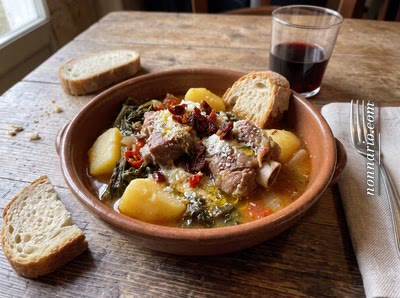
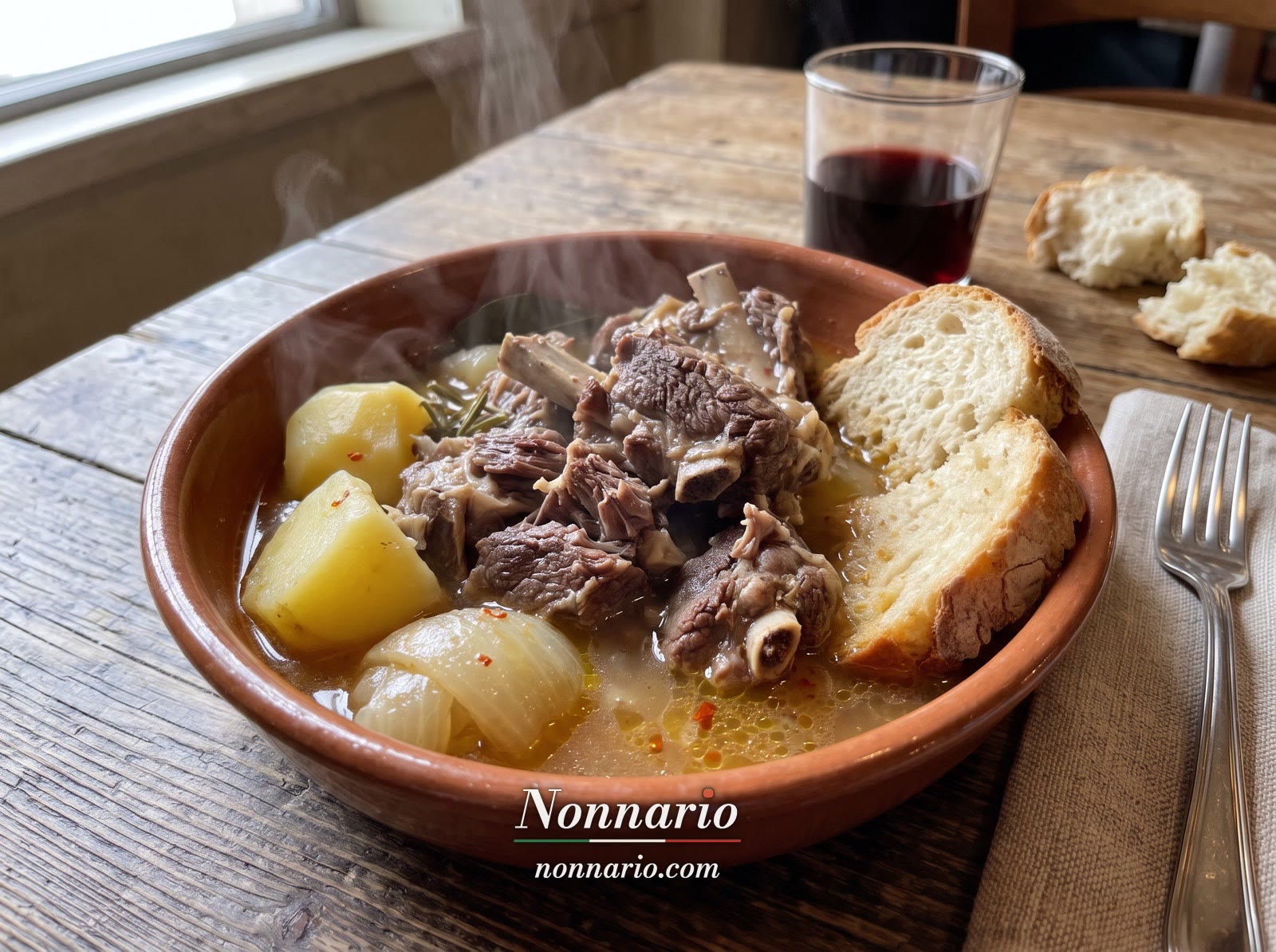
Capracotta sheep boiled slowly with potatoes, celery and tomato
Large pieces of bone-in sheep started in cold salted water, skimmed with care, then cooked slowly with potato, celery, a little tomato and chilli until the water has almost gone; the dish of Capracotta's festival since 1961.
- Course
- SecondiMain Courses
- Serves
- 8
- Hands-on
- 1 h 15 min
- Cooking
- 3 h 30 min
The video and the photos of every step are also gathered on a separate page.
In breve
In short
Also called La Pezzata, Pezzata di Capracotta, pezzata di pecora and pecora pezzata.
- Sheep meat on the bone, in fairly large pieces trimmed of fat, put into cold salted water that stands well above it.
- Skimmed thoroughly as it comes to the boil: the foam takes the fat and the strong smell of the sheep with it.
- Only then the potato, celery, tomato and a little chilli; the tomato colours the broth without making it too red.
- Cooked covered over a low heat, stirred now and then, for at least four hours, until the water has almost gone.
- The potato and the reduced water make a loose, creamy sauce around the meat; served very hot.
La provenienza
Where this recipe comes from
Pezzata is sheep boiled for hours in a great cauldron, the dish of Capracotta, a town at over 1,400 metres in the Alto Molise. It goes back to the transhumance, when shepherds drove their flocks for months between these mountains and the plains of Puglia. Now and then an animal went lame fording a river or crossing rough ground and could go no further: it became the shepherds' supper, cut into pieces and cooked with the little a travelling caravan had, in a pot on a tripod of logs over a wood fire, with water, salt and wild herbs. Lame animals went into it, and ewes that were barren, or old and worn out by the journey. Potatoes and tomato came later and are now part of it. Where the name comes from is uncertain: from the animal cut into pieces, or from the cloth, the pezza, used to skim and strain the broth or to cover the pot. In 1961 the provincial tourist board turned the shepherds' homecoming feast into a Day of Hospitality, and the town council made a festival of the dish: the pezzata, at first offered free to everyone, became the dish of the day. The festival is still held on the first Sunday of August on the Prato Gentile plateau, above 1,500 metres, hosted by the Pro Loco, and visitors take home a wooden fork, a bowl and a terracotta cup; its 60th edition was on 2 August 2026. La Pezzata is on Italy's list of traditional food products for Molise.
The reference is the town's own recipe, La Pezzata, ricetta tipica di Capracotta, written by the Comune di Capracotta, its Pro Loco and the Isernia delegation of the Accademia Italiana della Cucina. We read it as published in 2025 by a local association and on the province's tourist pages; the two agree word for word, down to the line that it cooks for at least four hours, as the Comune's own page also says. The town's own pages describe a shorter base, sheep, salt, a few potatoes and a few tomatoes, and treat celery and chilli as additions. The reference recipe is written for 30 to 40 people from one sheep of 15 to 20 kg, and calls a tinned copper cauldron on a tripod over a wood fire essential. This page keeps its proportions for eight: half a kilo of meat on the bone a head, one potato and a quarter of a celery stalk. The town's pages speak of sheep boiled with herbs, and the old shepherds' dish had wild ones, but the recipe lists none, so none are here. The recipe gives no amounts for the tomato, chilli, salt or water and no heat for the boil: those are ours, marked as our guide, and so is keeping the lid ajar, since a home pot holds in far more steam than a cauldron over a fire and the water must almost dry up. Also ours: a probe in the thickest piece checks that it has reached at least 71 °C.
- Provenance
- A reference recipe set by a protection consortium or by the town the dish is named after.
- Defined by
- Comune di Capracotta, Pro Loco di Capracotta and Accademia Italiana della Cucina, Delegazione di Isernia
- Reference
- "La Pezzata, ricetta tipica di Capracotta", for 30 to 40 people, read as published by the Amici di Capracotta association (2025) and on the Provincia di Isernia's tourist site; quantities scaled to its own proportions for 8
- Sources
- Amici di Capracotta (a local association): the Pezzata, its history and the typical recipe of Capracotta, a text by the Accademia Italiana della Cucina's Isernia delegation, the Pro Loco and the Comune di Capracotta, 2025 (Italian)
- Provincia di Isernia, its tourist office's site Isernia Turismo: La Pezzata, typical recipe of Capracotta (Italian)
- Comune di Capracotta: the town's traditions, La Pezzata (Italian)
- Comune di Capracotta: the 60th edition of La Pezzata, 2 August 2026 (Italian)
- Ministero dell'agricoltura, della sovranità alimentare e delle foreste (MASAF), Italy's Ministry of Agriculture: national list of traditional food products, 25th revision, 2025 (Italian)
- Regione Molise: conference on fifty years of the pezzata, Capracotta, 2012 (Italian; archived copy)
- Regione Molise, its Expo 2015 site: the Sagra della Pezzata (Italian; archived copy)
- Il Giornale del Cibo (food magazine published by CIRFOOD): the Pezzata di Capracotta, its origins and a recipe, 2020 (Italian)
- GuideSlow, tourist guide to Molise: the pezzata di pecora, its history and a recipe, 2022 (Italian)
- Turismo.it: Capracotta and the pastoral flavours of the pezzata, 2019 (Italian)
- USDA Food Safety and Inspection Service: Leftovers and Food Safety
Ingredienti
Ingredients
The original recipe serves 8
Equipment
- A wide, heavy pot of 12 l–15 l with a lid (in Capracotta, a tinned copper cauldron on a tripod over a wood fire)
- A skimmer or a ladle, and a bowl of water to rinse it in
- A sharp knife and a board
- A long wooden spoon
- Probe thermometer
- Deep plates or bowls, and a plate for the bones
Preparazione
Method
Scaled to 8 servings: the amounts in the steps follow. Pot and pan sizes and cooking times are still for the original 8.
About 4½–6 hours, nearly all of it on the stove: about 25 minutes to trim the meat and prepare the vegetables, 40–60 minutes to bring the pot slowly to the boil while you skim it, then 3½–4½ hours of slow cooking, checked and stirred every half hour, for at least four hours on the heat in all. Have the butcher cut the meat through the bone when you buy it.
- 1 h 15 minhands-on
- 3 h 30 mincooking
The meat
-
Hands-on 5 min
Have the butcher cut the 4 kg of mutton through the bone into fairly large pieces.
Check The pieces are roughly the same size, each about as big as a fist, so they cook in the same time.
Tip Our guide: pieces of about 200 g–300 g, from several cuts, as a whole sheep would give: shoulder, leg, neck, breast and ribs. Some cooks use only shoulder and leg, for a leaner dish.
Tip The bone is cut with a saw or a cleaver; it is easier for the butcher than at home.
-
Hands-on 10–15 min
Cut away the thick layers of fat on the outside of the pieces and any loose lumps of fat.
Check No thick white fat is left on the outside; only thin streaks and the thin membrane over the meat.
Tip The town's recipe puts the sheep into the water already trimmed. Mutton fat has a strong smell; what is left melts out in the pot and is skimmed off.
-
Hands-on 5 min
Peel the potato, or scrub it and leave it in its skin, and cut it into large chunks. Wash the tomato and the celery; quarter the tomato. Rinse the chilli.
Check The vegetables are ready in a bowl beside the stove, so they go in as soon as the skimming is done.
Tip Our guide: the potato in 4–6 chunks, the celery in one piece, the chilli whole, so it is easy to lift out at the end.
The boil and the skimming
-
Hands-on 5 minOfficial text
Put the fairly large pieces of sheep, already trimmed of fat, into the pot of cold salted water, keeping the water well above the meat.
Check All the meat is under water, with a good depth of water above it.
Tip Our guide: enough cold water to stand at least 5 cm above the meat, about 4 l–5 l in a wide pot of 12 l–15 l, with about 20 g of salt.
Tip Salt lightly now: nearly all the water cooks away, and the salt stays behind. You will taste and add more at the end.
Tip In Capracotta the town's recipe calls a tinned copper cauldron on a tripod over a wood fire essential. At home, use the widest heavy pot you have: a wide pot also lets the water reduce.
-
Hands-on 40 min to 1 hHeat mediumOfficial text
Bring it to the boil, taking off all the foam as it forms. This must be done carefully: with the fat, it carries away the smell and the strong taste of the animal.
Check The water is boiling, and what rises is no longer thick grey foam, only a little white froth and clear drops of fat.
Tip Our guide: over a medium heat it takes about 30–50 minutes to boil, and a slow rise brings up more foam to take off. Skim every few minutes, rinsing the skimmer in the bowl of water each time, and carry on for about 10 minutes more once it boils.
Tip Some cooks then pour the broth through a fine sieve or a cloth and put it back with the meat.
The slow cooking
-
Hands-on 3 minOfficial text
When the skimming is done, add to the meat the potato in pieces, the celery, the tomato and a little chilli.
Check Everything is in the pot and the water is coming back to a simmer.
Tip The potato goes in to soak up the fat the meat keeps releasing, and the tomato only to colour the broth, not to make it too red.
-
Cooking 3 h 30 min to 4 h 30 minHeat low, a gentle simmerOfficial text
Leave it to cook covered, over a low heat, stirring now and then, until the water has almost dried up. With the help of the potato it forms a loose but creamy sauce that gives the meat more flavour. It cooks in at least four hours.
Check The meat is very tender and comes away from the bone, and the water has dropped below the meat to a little cloudy, creamy sauce at the bottom of the pot. A probe in the thickest piece, away from the bone, reads at least 71 °C.
Tip An older animal takes longer. Our guide: count the four hours from when the pot goes on the heat.
Tip Our guide: a home lid holds in far more steam than a cauldron's over a fire, so leave yours ajar by a couple of centimetres. Look and stir every 30 minutes, scraping the bottom with the wooden spoon: as the potato breaks up, the liquid thickens and can stick.
Tip Our guide: with the lid ajar only a little of the water cooks away. Look after about 2 hours of slow cooking: if the liquid still covers the meat, take the lid off for the rest of the time and let it simmer a little more briskly. If the meat is tender before the water has almost gone, lift it out, boil the liquid down hard to a few centimetres and put the meat back. If it dries out before the meat is tender, add a ladle of hot water.
To the table
-
Hands-on 2 min
Lift out the chilli and the celery if they are still whole. Taste the sauce and add salt if it needs it.
Check The sauce tastes well seasoned, of meat and potato, mildly hot.
-
Hands-on 5 min
Serve at once, very hot, in deep plates or bowls: pieces of meat with some potato and a spoonful of the sauce over them.
Check Each plate has meat, potato and some of the creamy sauce.
Tip Put out toasted bread to dip in the sauce, and a plate for the bones.
Tip Whatever is not eaten goes into the fridge within 2 hours of cooking, in shallow covered containers, and is eaten within 3 days of cooking. Bring it back to the boil, with a splash of water if it has thickened, until it reaches 75 °C at the centre.
The essentials, for cooks who know the dish. Switch to Detailed for quantities, temperatures, times and checks at every step.
Press “I’m here” on the step you are on, and again when it is done.Tap the pin on the step you are on, and the tick when it is done. Timers keep running while you scroll.
Da sapere
Good to know
- WhenQuando
- At Capracotta it is the dish of the festival held every year on the first Sunday of August, on the Prato Gentile plateau. Source
- VariantsVarianti
- With carrot and onion: The base is sheep, salt, a few potatoes and a few tomatoes for colour; some cooks add celery, carrot, onion and a pinch of chilli. Source
- Blanched first, with herbs: The pieces are boiled for about 10 minutes in a very large pot, then lifted out into cold water in a covered pan and boiled over a medium heat, uncovering now and then to skim off foam and fat. Potatoes, tomatoes, fresh herbs, salt, and if liked chilli and chopped celery, carrot and onion go in, and it cooks until the water has almost gone, to be eaten with toasted bread dipped in the sauce. Source
- Strained after skimming, with onion: Shoulder or leg in large pieces, in salted water that covers it, brought to the boil and skimmed again and again; the broth is then strained through a sieve, and potatoes, celery, onions, tomatoes and chilli go in. It cooks over a low heat for about four hours, stirred now and then, until the water has almost gone, and is served very hot in small terracotta dishes. Source
Errori comuni
Common mistakes
- Starting the meat in hot water: it goes into cold salted water and comes slowly to the boil.
- Skimming carelessly: all the foam must come off, or the dish keeps the fat and the strong smell of the sheep.
- Adding the vegetables before the skimming is done.
- Too much tomato: it only colours the broth and must not make it too red.
- Boiling it hard: once the vegetables are in it cooks slowly, over a low heat.
- Stopping too soon or serving it wet: it cooks for at least four hours in all, until the water has almost gone and only a creamy sauce is left.
- Salting heavily at the start: the water cooks away and the salt stays behind.
Fuori dall'Italia
Cooking it outside Italy
- Pecora is meat from an adult sheep, sold in English as mutton. Ask a butcher for bone-in mutton cut through the bone into large pieces; halal and Greek butchers often have it. Our guide: hogget, from a sheep of about one to two years, is the nearest substitute.
- Lamb has been used for the dish too; it is milder and needs much less time, so start checking it after about 2 hours of slow cooking (our guide).
- Any wide, heavy stockpot does the work of the copper cauldron: stainless steel or enamelled cast iron, of 12 l–15 l.
From nonnario.com/recipes/pezzata/, where you will find its sources, its story and the step photos. Sources checked in November 2026.