Ancona, Marche
Brodetto all'anconetana
Ancona's fish stew of many kinds of Adriatic fish, with vinegar and tomato
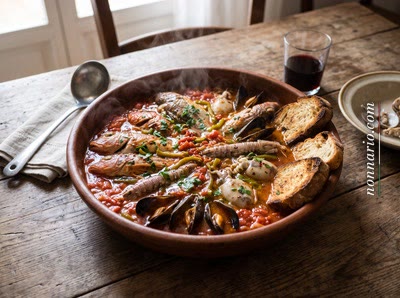
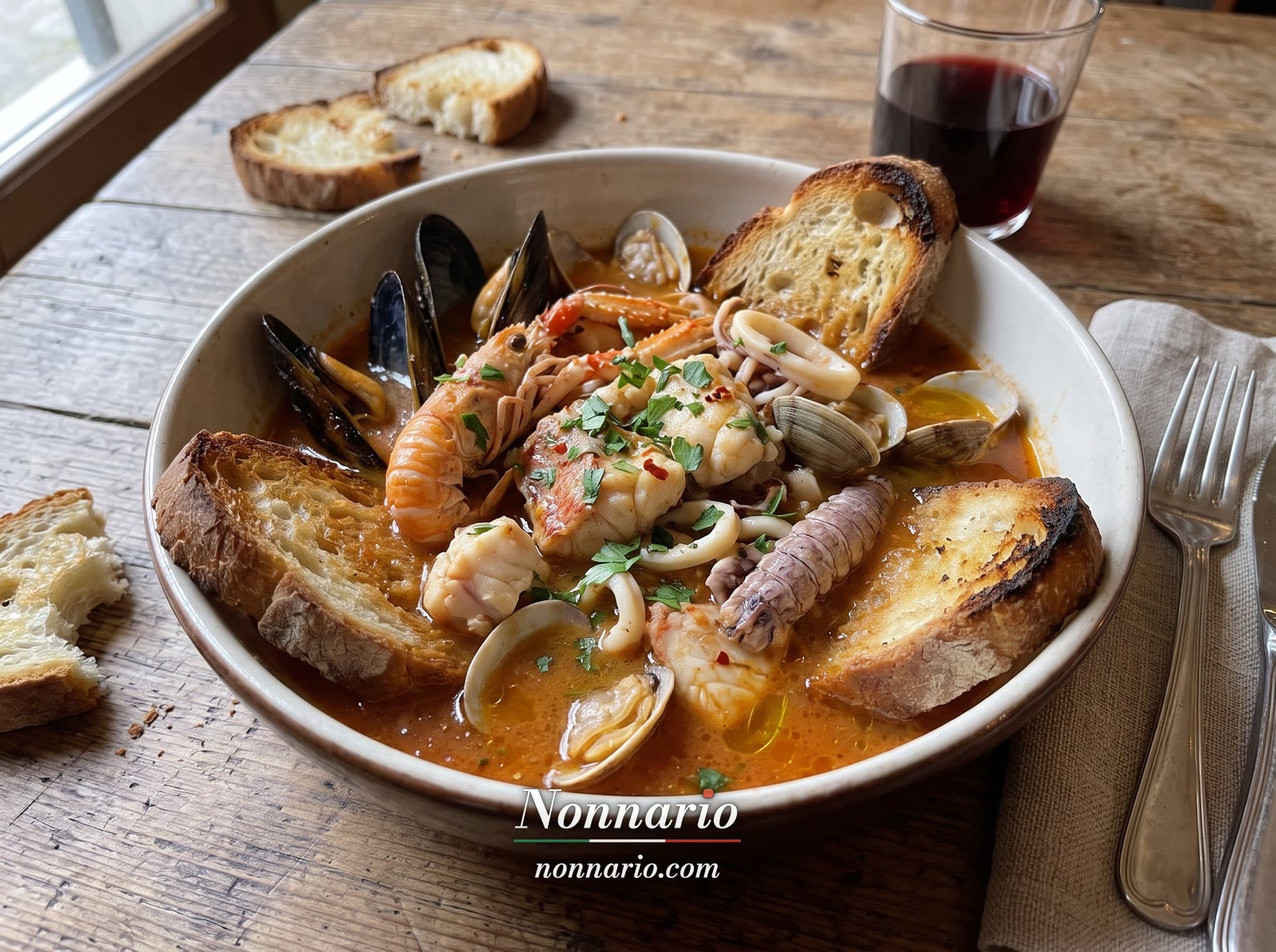
Ancona's fish stew of at least thirteen kinds of Adriatic fish, cuttlefish, squid and crustaceans, cooked in a wide pan with olive oil, onion, vinegar and tomato, and served very hot with toasted country bread rubbed with garlic.
- Course
- SecondiMain Courses
- Serves
- 8
- Hands-on
- 1 h 33 min
- Cooking
- 44 min
- Resting
- 15 min+
The video and the photos of every step are also gathered on a separate page.
In breve
In short
Also called brodetto anconetano, brodetto all'anconitana, brudetu, Ancona fish stew and Ancona-style brodetto.
- At least thirteen kinds of Adriatic fish, cuttlefish, squid and crustaceans, cleaned with their heads on; never clams or mussels.
- Onion fried pale gold in plenty of olive oil, then a glass of vinegar, never wine, with parsley, garlic and tomato paste.
- The fish go in by cooking time: cuttlefish and squid, then crustaceans in their shells, firm fish, and the delicate ones last.
- About 20 minutes on a very gentle heat in a wide, shallow pan that is never aluminium, then 15 minutes' rest, covered.
- Served very hot in the pan it cooked in, with slices of stale country bread toasted and rubbed with garlic.
La provenienza
Where this recipe comes from
Brodetto is the fish stew of the Marche coast, and its ports each claim their own. Ancona's is sharpened with vinegar rather than wine and, by tradition, made with thirteen kinds of fish caught between Rimini and the river Tronto. Some link the number to the diners at the Last Supper, others to the thirteen spouts of the Fontana del Calamo, the fountain of the Tredici Cannelle that the people of Ancona hold dear. The dish was born on the fishing boats, as a way to cook the fish that could not be sold: too small, or damaged by the nets. In 2014 a group of Ancona restaurateurs, cooks and experts drew up a recipe of their own for the city, setting the rule of thirteen aside in favour of what is in season; we could not find its text published, and we found no recipe for the dish deposited with a notary or a Chamber of Commerce.
There is no official recipe. We compared five serious sources and publish the most widely recognised version: for eight, three kilos of mixed fish with their heads on, a quarter of a litre of olive oil, a glass of vinegar and tomato paste, the fish added in order of cooking time, finished over a very gentle heat and rested before serving. The sources agree on what matters: many kinds of fish, the cuttlefish first; onion fried in olive oil, then vinegar left to bubble before the tomato goes in; bread to go with it. They differ on clams and mussels, which this version forbids and others include, on passata, tinned or fresh tomatoes, and on whether the pan is covered while the fish cook. Ours are the weight of each group of fish, the sizes, the heat levels, a probe check of 63 °C for the fish and the fridge rules, following food-safety guidance.
- Provenance
- A regional tradition documented in cookbooks and local practice, with no single official text.
- Defined by
- Ancona tradition
- Reference
- Compared across 5 sources, listed below; this page publishes the most widely recognised version.
- Sources
- Accademia Italiana della Cucina: brodetto all'anconetana, from its recipe collection, for 8 (Italian)
- Comune di Ancona: the city's tourism portal, Ancona's fish dishes, with a recipe for brodetto all'anconetana (Italian)
- Centropagina, a Marche news site: brodetto all'anconetana, its history and a chef's recipe, 19 July 2018 (Italian)
- AnconaToday, a local news site: restaurateurs and experts set out to codify Ancona's brodetto, 18 February 2014 (Italian)
- AnconaToday: the brodetto codified in 2014 served at Portonovo, and the fish it used, 6 April 2014 (Italian)
Ingredienti
Ingredients
The original recipe serves 8
The fish
For the base
To serve
Equipment
- A wide, shallow pan of terracotta, iron or steel, about 40 cm across, or two of about 32 cm with everything shared between them; never aluminium
- A heat diffuser, if the pan is terracotta and the hob is gas
- Fish scissors, a sharp knife and a fish scaler, or the back of a knife
- Kitchen paper and four plates or trays, one for each group of fish
- A probe thermometer
- A wide spoon and a fish slice, for basting and serving
- A grill or a dry frying pan, for toasting the bread
Preparazione
Method
Scaled to 8 servings: the amounts in the steps follow. Pot and pan sizes and cooking times are still for the original 8.
Allow about 1¼ hours to clean and cut the fish, then about 1½ hours at the stove, the 15-minute rest included. Buy the fish on the day you cook it, choosing it by the freshness checks in the first step, and keep it in the fridge at 4 °C or below until you start; once cleaned, keep each group covered in the fridge, in the order it goes into the pan. Chop the parsley and garlic and slice the onion before the oil goes on the heat, and toast the bread during the rest. Serve it as soon as it is back to temperature; any leftovers go into the fridge within 2 hours.
- 1 h 33 minhands-on
- 44 mincooking
- 15 minresting, at least
Cleaning and cutting the fish
The quantities and the method follow one recipe whole; the weights of each group of fish, the sizes, heat levels, checks and tips marked ‘Our guide’ are ours.
-
Hands-on 30–40 min
Clean the fish without taking their heads off.
Check Every fish is scaled and empty, with no gills and no blood left along the backbone, and still has its head.
Tip Our guide: buy only fresh fish: clear, bulging eyes, bright red gills, firm flesh that springs back when pressed, and a clean smell of the sea. The crustaceans should be live, or have firm heads that are not blackened; the cuttlefish and squid shiny and firm. Keep it all in the fridge at 4 °C or below, and take each group out only when it goes into the pan.
Tip Our guide: scrape off the scales from tail to head under a thin stream of cold water, slit the belly and pull out the guts, then cut out the gills with scissors: left in, they make the broth bitter. Rinse inside and out.
Tip Our guide: weever and scorpionfish have stinging spines. Hold them with a cloth and cut off the spiny fins on the back and the gill covers with scissors before you clean them, or ask the fishmonger to do it.
Tip Our guide: ask the fishmonger to skin the ray. Keep each group of fish on its own plate, covered, in the fridge while you work.
-
Hands-on 10–15 min
Clean the cuttlefish and squid and cut them into pieces.
Check No bone, quill, beak, eyes or ink sac is left; the bodies are white and the pieces are about the same size.
Tip Our guide: for cuttlefish, cut along the back, lift out the bone, pull away the head and innards, and cut the tentacles off just in front of the eyes; squeeze out the beak. Keep the ink sac out of the pan. Cut the bodies into strips about 2 cm wide and the tentacles into two or three pieces.
Tip Our guide: for squid, pull the head and innards out of the body, take out the clear quill, cut the tentacles off in front of the eyes and squeeze out the beak. Cut the bodies into rings about 2 cm wide.
-
Hands-on 10–15 min
Cut the larger fish across into steaks, so that every piece is about the size of the small fish.
Check The steaks and the small whole fish are all of a similar size, so they cook in the same time.
Tip Our guide: steaks about 3 cm–4 cm thick, through the bone; the heads of the large fish go in too. Cut the ray into pieces about 6 cm across.
Tip Our guide: the fish keep their bones, as they do in Ancona: warn your guests.
-
Hands-on 3 min
Rinse the crustaceans, leaving them in their shells.
Check The crustaceans are clean, whole and in their shells.
Tip Our guide: mantis shrimp have sharp spines along the tail and claws that can cut: handle them by the body.
-
Hands-on 5 min
Pat all the fish dry and salt it.
Check The fish is dry to the touch and lightly salted on both sides.
Tip Our guide: salt lightly: the cuttlefish are salted again in the pan. Put each group back on its plate, covered, in the fridge until it goes in.
The base
-
Hands-on 5 min
Chop most of the parsley, two handfuls, together with the garlic.
Check A fine, even mixture of parsley and garlic, with no whole leaves or large pieces of garlic.
Tip Our guide: the 3 cloves of garlic, peeled, with most of the parsley; keep a small handful of leaves aside to chop fresh at the end.
-
Hands-on 3 min
Slice the 200 g of onion thinly.
Check Thin, even slices, about 3 mm.
-
Hands-on 8–10 minHeat medium
Pour the 250 ml of olive oil into a wide, shallow pan of terracotta, iron or steel, never aluminium, and fry the onion in it until pale gold.
Check The onion is soft and pale gold all over, with no dark edges.
Tip Never aluminium: it reacts with the vinegar.
Tip Our guide: a pan about 40 cm across holds the fish in one layer; with two pans, share the oil, the onion and everything after it equally. Put terracotta on a heat diffuser over gas, and heat it gently.
Tip Our guide: stir now and then so the onion colours evenly.
-
Hands-on 1–2 minHeat medium-high
Pour in the 150 ml (a glass) of vinegar and let it evaporate a little.
Check The vinegar has bubbled for a minute or two and the sharpest smell has eased, but the base still smells clearly of vinegar.
Tip Our guide: pour it in at arm's length and keep your face away from the steam.
-
Hands-on 2 minHeat medium-high
Add the chopped parsley and garlic, then the 2 tablespoons of tomato paste diluted in hot water, and freshly ground black pepper or chilli.
Check The base is an even red, loose and liquid, with the parsley spread through it.
Tip Our guide: stir the tomato paste into about 200 ml of hot water before you start frying the onion, so it is ready. A few turns of the pepper mill, or a small dried chilli crumbled in.
Tip The modern way is 1 kg of small tomatoes, peeled and deseeded, instead of the tomato paste: see the variants.
-
Cooking 8 minHeat high
Let the base cook for 8 minutes on a lively heat.
Check The base is bubbling all over and has thickened a little, and drops of red oil show on the surface.
Tip Our guide: stir now and then. If it starts to catch on the bottom, lower the heat a little.
The fish, by cooking time
The fish go in one group at a time, the slowest first. Once they are in, do not stir: shake the pan gently by its handles and spoon the sauce over, so the fish stay whole.
-
Cooking 10 minHeat medium
Add the cuttlefish and squid, salt them and cook for about 10 minutes: they need the longest.
Check The cuttlefish and squid are opaque white all through and have firmed up.
Tip Our guide: keep it at a lively simmer, uncovered. Spread the pieces over the bottom of the pan and turn them once in the sauce.
-
Cooking 3 minHeat medium
Add the crustaceans, in their shells, and cook for a few minutes.
Check The shells have begun to change colour.
Tip Our guide: lay them over the cuttlefish and press them gently into the sauce with the back of a spoon.
-
Cooking 3–4 minHeat medium
Add the firm-fleshed fish.
Check The sauce comes back to a simmer around the fish, and their outsides have turned opaque.
Tip Our guide: lay the pieces side by side in one layer, nestled into the sauce, and spoon some sauce over them. Wait 3–4 minutes before the last fish.
-
Hands-on 2 min
Add the red mullet, the sole and the hake last of all.
Check All the fish are in the pan, the most delicate on top, with sauce spooned over them.
Tip Our guide: the flounder or small turbot go in now too: they are thin and cook as quickly. Lay these fish on top of the others rather than underneath, so they are not crushed.
-
Cooking 20 minTemp 63 °CHeat very low
Cook the brodetto for about 20 minutes on a very gentle heat.
Check The thickest piece of fish reads 63 °C or more near the bone, its flesh is opaque all through and comes away from the bone easily; the cuttlefish are tender and the crustaceans' flesh is opaque. The sauce has thickened.
Tip Our guide: keep it at the barest simmer, uncovered, and do not stir: every few minutes shake the pan gently by its handles and spoon the sauce over the fish.
Tip Our guide: if the sauce starts to catch before the time is up, add a few spoonfuls of hot water at the side of the pan.
Tip Our guide: probe the thickest part of the thickest steak, close to the bone but not touching it. If it reads less than 63 °C, give it a few minutes more.
Rest and serve
-
Rest 15 min
Take the pan off the heat, cover it and leave the brodetto to rest for 15 minutes.
Check The pan has stood covered for 15 minutes and is still hot to the touch.
Tip Our guide: a lid that fits, or a large tray or foil if the pan is too wide for any lid.
-
Hands-on 6–8 min
Meanwhile toast the slices of stale country bread and rub them with garlic.
Check The slices are golden and crisp on both sides, and smell of garlic.
Tip Our guide: under a hot grill or in a dry frying pan, 2–3 minutes a side. Rub one side of each slice with a halved clove while the bread is still hot.
-
Hands-on 3–5 minHeat medium-low
Scatter over a little freshly chopped parsley and bring the brodetto back to serving heat.
Check The sauce bubbles gently at the edges and the brodetto is steaming hot.
Tip Our guide: still no stirring; shake the pan gently instead.
-
Hands-on 5 min
Bring the brodetto to the table in the pan it cooked in and serve it very hot, with the bread.
Check Each plate has a share of every kind of fish, with sauce, and bread beside it.
Tip Our guide: lift the fish out with a fish slice and a wide spoon so they stay whole, and put a dish on the table for heads, shells and bones.
Tip Our guide: from the moment the pan comes off the heat for the rest, the brodetto may stand at room temperature for 2 hours at most (1 hour on a day above 32 °C). Put any leftovers in shallow containers in the fridge within that time and eat them within 3 days of cooking. Reheat them covered, over a gentle heat, shaking the pan rather than stirring, until the sauce bubbles and the thickest piece reads 75 °C.
The essentials, for cooks who know the dish. Switch to Detailed for quantities, temperatures, times and checks at every step.
Press “I’m here” on the step you are on, and again when it is done.Tap the pin on the step you are on, and the tick when it is done. Timers keep running while you scroll.
Da sapere
Good to know
- VariantsVarianti
- With fresh tomatoes: The modern way: in place of the tomato paste diluted in hot water, a kilo of small tomatoes, peeled and deseeded, for the same eight servings. Source
- With passata, poured over bread: An onion and two crushed garlic cloves fried golden in a glass of oil, then half a glass of vinegar boiled off; parsley, passata and a little tomato paste thinned with lightly salted water. The cuttlefish cook a good quarter of an hour, covered, on a low heat; once the sauce starts to thicken they are pushed to one side and the other fish go in for more than a quarter of an hour, until the sauce is thick. Slices of bread go in each bowl and the brodetto is poured over them. Source
- With mussels and clams: A kilo of cuttlefish and a kilo of mussels, clams and king prawns, with monkfish, hake, smooth-hound, sole, John Dory, mantis shrimp, ray and a few squid; peeled tomatoes and tomato paste in the base, and chilli if you like. The cuttlefish cook about 15 minutes, then the squid and king prawns go in at the bottom, the large fish above and the small ones on top, covered with the sauce and cooked at least 15–20 minutes with the lid on; toasted bread alongside. Source
Errori comuni
Common mistakes
- Adding clams or mussels: this brodetto has no bivalves at all.
- Using wine: the base is sharpened with vinegar, never wine.
- Cooking it in an aluminium pan, which reacts with the vinegar: use terracotta, iron or steel.
- Putting all the fish in at once: cuttlefish and squid first, then crustaceans, firm fish and the delicate fish last.
- Stirring once the fish are in: shake the pan and spoon the sauce over, or the fish break up.
- Taking off the heads, or skipping the 15-minute covered rest.
Fuori dall'Italia
Cooking it outside Italy
- The Italian names of the fish: triglie are red mullet, razza is ray or skate, sgomberi are mackerel and suri horse mackerel, passere are flounder and rombetti small turbot or brill, cefali are grey mullet, sogliole sole, palombo is smooth-hound (a small shark), naselli are hake.
- Pesce ragno is weever, pesce prete stargazer, pesce capone gurnard and scorfani scorpionfish; seppie are cuttlefish and calamari squid.
- Pannocchie, also called canocchie, are mantis shrimp; granchi are crabs and scampi are langoustines (Norway lobster).
- The dish is built on variety, and Ancona cooks follow the market and the season: buy as many of these kinds as your fishmonger has, always with some cuttlefish or squid, some crustaceans, firm fish and delicate fish.
- Conserva di pomodoro is a thick tomato paste, the concentrated kind sold in tubes and tins.
From nonnario.com/recipes/brodetto-all-anconetana/, where you will find its sources, its story and the step photos. Sources checked in November 2026.