Lake Trasimeno, Umbria
Torciglione
Umbrian almond snake from Lake Trasimeno, a Christmas sweet
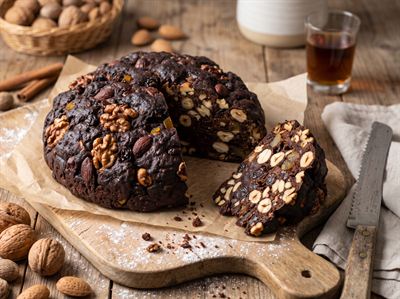
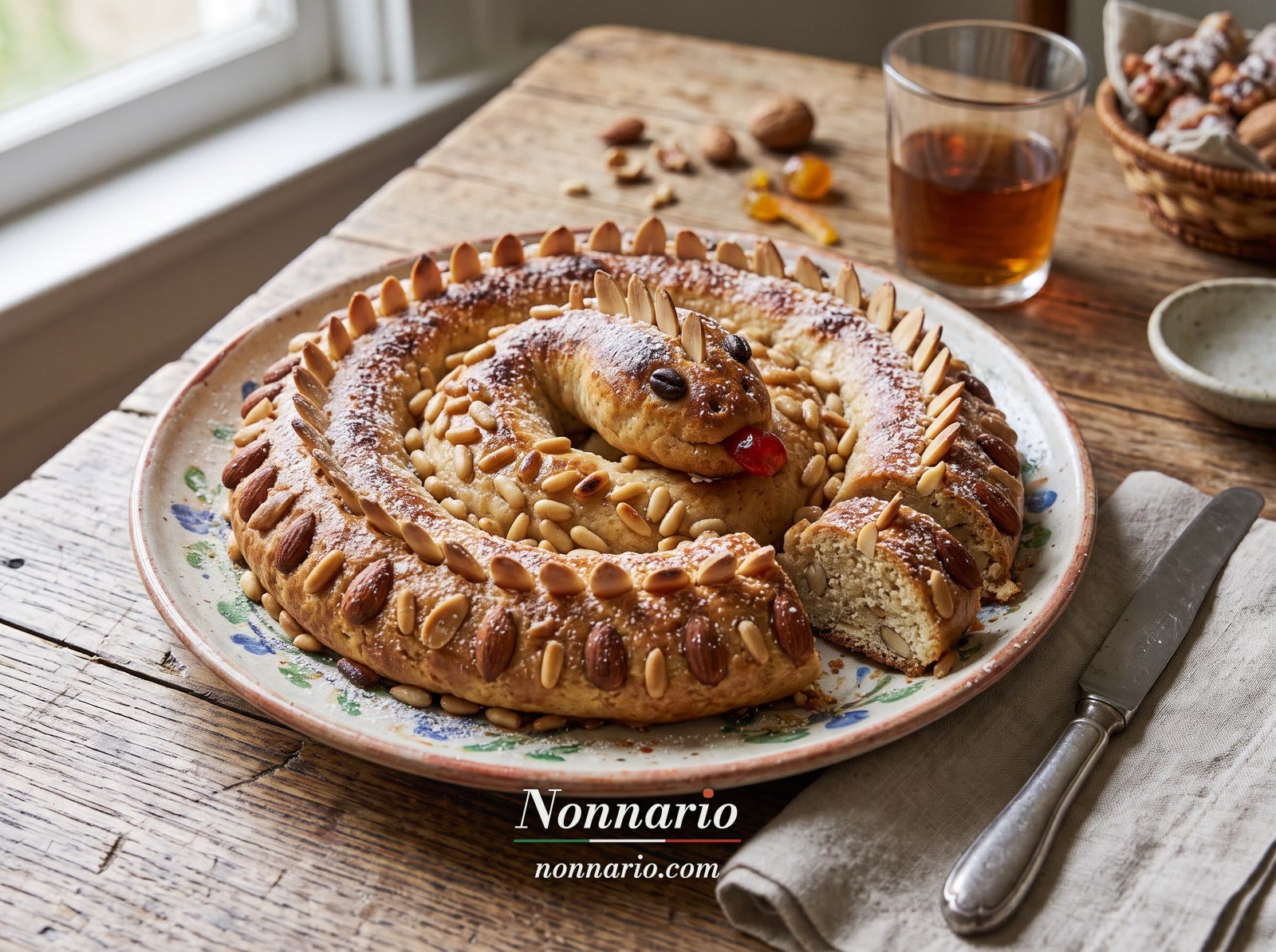
The almond snake of the Lake Trasimeno villages: toasted almonds and sugar in equal weights, bound with whipped egg whites and lemon zest, shaped by hand into a coiled snake with pine nuts for scales, candied ears and coffee-bean eyes, and baked until golden; one of Umbria's traditional food products.
- Course
- DolciDesserts
- Serves
- 16
- Hands-on
- 40 min
- Cooking
- 43 min
- Resting
- 1 h 20 min+
In breve
In short
Also called torciglione umbro and anguilla del lago.
- Vegetarian
- Gluten-free
- Toasted sweet almonds, ground, and sugar in equal weights, bound with stiffly whipped egg whites and grated lemon zest, worked by hand to a soft paste.
- Shaped by hand into a coiled snake: pine nuts or almonds for scales (or scored scales), candied citron for ears, coffee beans or red confetti for eyes.
- Baked on a tray lined with baking paper at 180 °C for about 20–30 minutes, until golden.
- Its shape recalls the eels of Lake Trasimeno; once eaten from Christmas to New Year, it is made all year today.
La provenienza
Where this recipe comes from
Torciglione is a dry almond sweet shaped like a snake coiled on itself. Its shape recalls the eels of Lake Trasimeno, and it began as a speciality of the villages on the lake shore before spreading across the province of Perugia. An oral legend, told in several forms, has it made by the nuns of the lake (some say of the convent on Isola Maggiore) in a hard winter when important churchmen came to visit and there was no fish to give them: one nun took the almonds and eggs left in the larder and shaped them into the eel her guests expected. Others read the shape as a snake, a sign of eternal life linked to the winter solstice. It has nothing to do with the Lombard tortiglione, a roll of puff pastry filled with raisins, pine nuts and spices. Once it was eaten from Christmas to New Year, and it was the custom to keep one from one year to the next so that it came to the Christmas lunch well aged; today it is made all year. It is on Italy's national list of traditional food products for Umbria.
There is no official recipe. We compared six sources and publish the most widely recognised version. They agree on almonds, sugar and egg white, often with grated lemon zest, worked into a paste, shaped by hand into a snake on a tray lined with baking paper and decorated, almonds or pine nuts along the back and coffee beans or something red for the eyes; the decorations are where cooks show the most freedom. They differ on the proportions, on bitter almonds, vanilla, rum, alchermes or cinnamon (the version of Todi adds the last three with bitter almonds), on whether flour and yolks go in, and on the oven, from 140 to 180 °C. This version is the one recorded for the Trasimeno: equal weights of toasted almonds and sugar, six whipped egg whites and the zest of a lemon, baked at 180 °C. The recipe gives no oven or time for toasting the almonds, no size for the snake and no amount for the decorations: those are ours, marked as such.
- Provenance
- A regional tradition documented in cookbooks and local practice, with no single official text.
- Defined by
- Tradition of the Lake Trasimeno villages and the province of Perugia
- Reference
- Compared across 6 sources, listed below; this page publishes the most widely recognised version.
- Sources
- Regione Umbria: identification sheet of the traditional food product torciglione, quoting the Trasimeno recipe from Remo Coppini's Umbria a tavola (1983), archived copy (Italian)
- Ministry of Agriculture (MASAF): national list of traditional food products, 25th revision, 2025, Umbria (Italian)
- Regione Umbria, Umbria Tourism (the Region's tourism site): il torciglione, a traditional recipe (Italian)
- Cookist: torciglione umbro, the recipe, 2023 (Italian)
- Rolling Stone Italia: snake-shaped sweets of the Italian holidays, 2023 (Italian)
- Italia.it (Italy's official tourism site, Ministry of Tourism and ENIT): Lake Trasimeno and its villages (Italian)
Ingredienti
Ingredients
Makes one torciglione of about 1.2 kg, about 25 cm across: 16 servings
For the paste
To decorate
Equipment
- Kitchen scale
- A baking tray at least 30 cm × 40 cm, and baking paper
- A food processor, for the almonds
- A fine grater for the lemon zest
- A large bowl, and a clean, grease-free bowl with an electric whisk for the egg whites
- A flexible spatula
- A small knife or kitchen scissors, if you score the scales
- Some foil, a wire rack and a serrated knife
Preparazione
Method
About 2¾–3 hours from start to table, all on one day. The almonds are toasted (25 minutes with the oven heating) and cooled (20 minutes); grinding them and making the paste takes about 20 minutes, shaping and decorating the snake about 25, the bake 20–30 minutes. Then it cools on its tray for about an hour before it is moved or cut. It keeps 2 or 3 days, so it can be made a day or two ahead.
- 40 minhands-on
- 43 mincooking
- 1 h 20 minresting, at least
The almonds
The almonds are toasted, then cooled completely before they are ground.
-
Cooking 15 minTemp 170 °CHeat top and bottom heat, no fan
Switch the oven on to 170 °C, static (top and bottom heat), with a shelf in the middle.
Check The oven's light or signal shows it has reached temperature.
Tip Our guide: the recipe says the almonds are toasted but gives no oven or time; 170 °C colours them evenly without scorching.
-
Cooking 8–10 minTemp 170 °CHeat top and bottom heat, no fan
Spread the 500 g of almonds in one layer on a tray and toast them for 8–10 minutes, until they turn a light gold.
Check Pale gold all over and fragrant; one broken in half is cream-coloured right through, not brown.
Tip Our guide: shake the tray halfway through. Almonds go from gold to burnt quickly, so look at them from 7 minutes.
-
Rest 20 min
Tip the almonds onto a cold plate or tray and leave them until they are completely cold. Meanwhile turn the oven up to 180 °C for the bake.
Check Cold to the touch, even in the middle of the heap.
Tip Our guide: warm almonds release their oil in the processor and turn to a greasy paste.
-
Hands-on 5 min
Put the almonds in the food processor with about 100 g of the 500 g of sugar and grind them in short pulses to a coarse flour.
Check A dry, sandy powder with a few grains the size of a lentil, and no oily clumps.
Tip Our guide: the sugar soaks up the oil the almonds give off. Pulse rather than run the machine, and stop to scrape down the sides.
The paste
-
Hands-on 2 min
In a large bowl, mix the ground almonds with the rest of the sugar and the finely grated zest of the lemon.
Check Even in colour, with the zest spread through it.
Tip Our guide: grate only the yellow part of the peel; the white pith underneath is bitter.
-
Hands-on 5 min
In a clean, grease-free bowl, whip the 6 egg whites with the electric whisk until they are stiff.
Check White and glossy; a peak lifted on the whisk stands straight, and the bowl can be tipped without the whites sliding.
Tip Our guide: a trace of yolk or grease stops the whites from whipping; whites at room temperature whip faster.
-
Hands-on 5–8 min
Add the whipped whites to the almond mixture and fold them in with the spatula, then work everything together with your hands in the bowl until you have a soft, even paste.
Check One soft, sticky, even mass, with no dry almond and no streaks of white.
Tip Our guide: the whites lose their volume as you work the paste; that is expected. The paste is soft: it holds a shape but sticks to dry hands.
Shaping the snake
Build the snake straight on the baking paper on its tray: the soft paste cannot be moved once it is shaped.
-
Hands-on 5 min
Line the tray with baking paper. With wet hands, roll the paste into a rope about 4 cm thick and about 85 cm long, keeping one end a little thicker for the head.
Check An even rope, about as thick as two fingers side by side, with a thicker end.
Tip Our guide: it is easier in three or four pieces, rolled one after the other and joined end to end with wet fingers as you coil them.
-
Hands-on 3 min
Starting from the thin end, the tail, at the centre of the tray, coil the rope round on itself, leaving about 1 cm between the coils, and finish with the head on the outside.
Check A flat spiral about 25 cm across, the head at the outer end, the coils close but not pressed together.
Tip Our guide: the paste spreads a little in the oven, and the gap stops the coils from merging into one cake.
-
Hands-on 3 min
Lift the head end slightly off the coil and model it with wet fingers into a rounded, slightly flattened head, and smooth the tail to a point.
Check A recognisable head and a pointed tail, with no cracks in the paste.
Tip Our guide: smooth any cracks with a wet finger; dry patches crack further in the oven.
-
Hands-on 10 min
Press the 60 g of pine nuts (or whole almonds) into the back of the snake in close rows, like scales. Or, instead, score the back with the point of a small knife or scissors in small cuts shaped like scales.
Check The whole back covered from head to tail, each pine nut pushed in about halfway so it holds.
Tip Our guide: press each pine nut in at a slight angle, pointing towards the tail, so the rows overlap like real scales.
-
Hands-on 2 min
Push the two small pieces of candied citron into the head, behind the eyes, as ears, and the 2 coffee beans (or red confetti) into the front of the head as eyes.
Check Two ears and two eyes, set evenly and pushed in firmly.
Baking
-
Cooking 20–30 minTemp 180 °CHeat top and bottom heat, no fan
Bake the torciglione in the middle of the oven at 180 °C for about 20–30 minutes, until it is golden.
Check Evenly golden all over, the surface firm and dry to the touch, the pine nuts light gold; a skewer pushed into the thickest part, by the head, comes out with no wet, sticky paste on it.
Tip Our guide: look at it after 15 minutes; if the pine nuts or the head are darkening fast, lay a sheet of foil loosely over the top for the rest of the time.
Tip Our guide: if the skewer still comes out with wet paste, give it 5 minutes more under the foil and test again.
-
Rest 1 h
Leave the torciglione on its tray until it has cooled, then slide it, on its paper, onto a wire rack or a board.
Check Cold right through, firm enough to lift without bending.
Tip Our guide: about an hour. Hot almond paste is soft and breaks if it is moved too soon.
Tip Our guide: to serve, cut it across the coils with a serrated knife, or bring it to the table whole.
The essentials, for cooks who know the dish. Switch to Detailed for quantities, temperatures, times and checks at every step.
Press “I’m here” on the step you are on, and again when it is done.Tap the pin on the step you are on, and the tick when it is done. Timers keep running while you scroll.
Da sapere
Good to know
- WhenQuando
- Once eaten through the Christmas holidays up to New Year; today it is made all year. Source
- KeepingConservazione
- Fresh, it keeps in a cool, dry place and is eaten within 2 or 3 days. Source
- VariantsVarianti
- As made in Todi: To the same paste, Todi adds 50 g of bitter almonds, three small glasses of alchermes and two of rum, and a pinch of cinnamon. Source
- With bitter almonds and vanilla, baked low: For eight: 300 g of ground skinned almonds, 10 g of bitter almonds, 240 g of sugar, the grated zest of an unwaxed lemon and the tip of a teaspoon of vanillin, with 70 g of egg white whipped with a pinch of salt. The paste is divided in two and each half shaped into a snake; small cuts make the scales, with a whole almond in each, a red candied cherry for the tongue and coffee beans for the eyes. Rested 30 minutes under a cotton cloth, then baked at 140 °C for about 35 minutes, until lightly golden. Source
- With flour and whole eggs: For eight: the yolks of 2 eggs worked with 200 g of icing sugar, 2 tablespoons of rum and grated lemon zest; then 500 g of almond flour and 80 g of type 00 flour, and the 2 whipped whites folded in. Shaped into a snake on a lined tray, decorated with almonds, pine nuts, raisins and coloured confetti (some use candied fruit instead) and baked at 160 °C, static, for 40 minutes. Source
Errori comuni
Common mistakes
- Grinding the almonds while still warm: they turn oily and the paste goes greasy.
- Under-whipping the whites: they should stand in stiff peaks before they go in.
- Shaping the snake on the worktop and moving it to the tray: build it on the baking paper.
- Lifting it hot from the tray: the almond paste is soft until it has cooled.
Fuori dall'Italia
Cooking it outside Italy
- Skinned almonds are sold as blanched almonds. Our guide: if you start from ready-ground blanched almonds, toast them spread thinly on a tray at 170 °C, stirring every 2 minutes and looking from about 4 minutes, until pale gold; they colour much faster than whole ones.
- Candied citron is sold as candied citron peel; a piece of candied orange peel will do for the ears.
- Confetti are sugared almonds (Jordan almonds in the US); use whole roasted coffee beans otherwise.
From nonnario.com/recipes/torciglione/, where you will find its sources, its story and the step photos. Sources checked in November 2026.