Perugia, Umbria
Torta al testo
Umbrian flatbread cooked on the testo
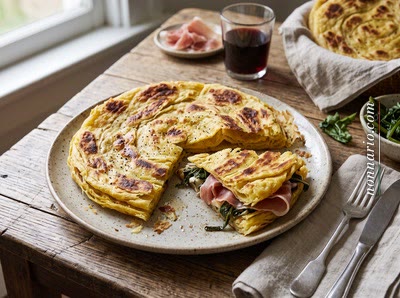
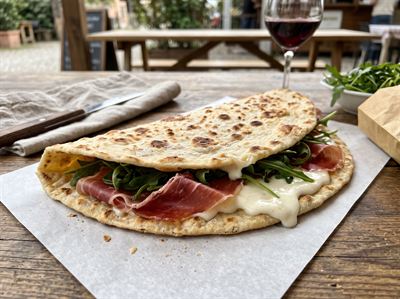
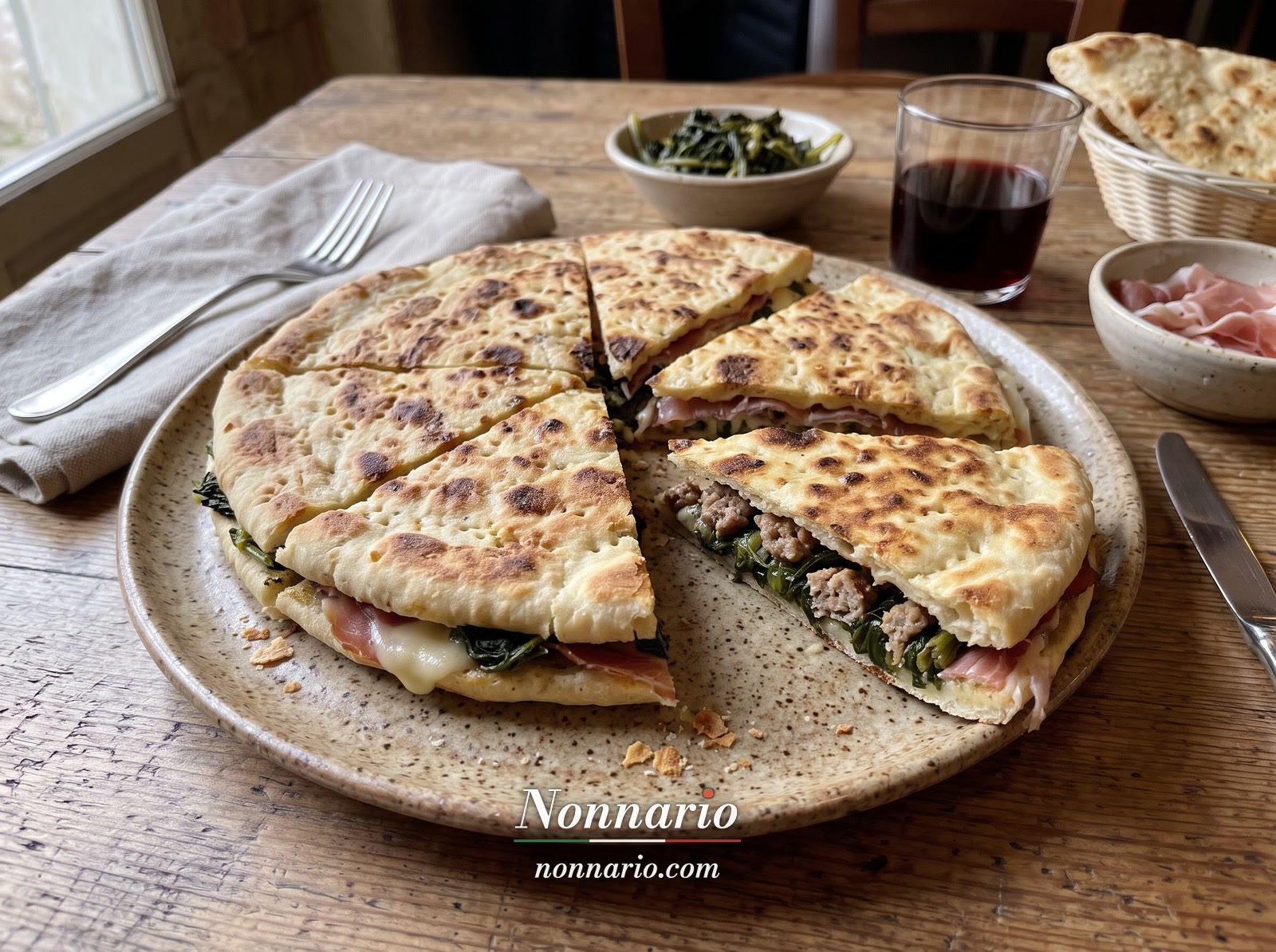
Umbria's flatbread of flour, water, salt and bicarbonate, rolled about a centimetre thick, pricked and cooked dry on the testo, a hot disc of stone, clay or iron; one of the Region's traditional food products.
- Course
- Pizze e PaniPizza & Bread
- Serves
- 6
- Hands-on
- 21 min
- Cooking
- 20 min
In breve
In short
Also called torta sul panaro, crescia sul panaro, torta del panaro, ciaccia, pizza sotto il fuoco and Umbrian flatbread.
- Vegetarian
- Vegan
- Soft wheat flour, water, salt and a chemical raising agent, here bicarbonate, so there is no rising time.
- Kneaded by hand to a soft, smooth dough, then rolled into a round disc about 1 cm thick.
- Pricked all over with a fork, so it does not blister as it cooks.
- Cooked dry on a testo heated over a low flame, turned several times, about 10 minutes on each side.
La provenienza
Where this recipe comes from
Torta al testo is the flatbread of the Perugia area, named after the testo it is cooked on: once a plain, roughly round flat stone, later a disc of clay and marble dust fired in the oven, and today also cast iron, or cement and refractory earth about 3 cm thick, heated on the fire or the hob. In the countryside it often took the place of bread, being cheap and quick to make, and was carried into the fields for the harvest; it is still eaten beside grilled sausages and meat and greens from the pan, or split and filled. At Terni it is called pizza sotto il fuoco and at Città di Castello ciaccia; the testo's other name, panaro, gives torta or crescia sul panaro. Around Gubbio the bread of the testo is the crescia, which the town has registered as a De.Co.; a request to protect the Crescia di Gubbio as an EU PGI, for Gubbio and four neighbouring towns, was at the national stage in 2026. It is a product of its own, with its own rules, and is not the recipe on this page.
The Umbria Region lists torta al testo among its traditional food products, and it is on Italy's national list. The Region's product sheet describes soft wheat flour, water, salt and a chemical raising agent, kneaded by hand, rolled, pricked with a fork and turned several times on the hot testo; it sets no quantities. There is no official recipe for torta al testo itself. We compared 9 sources and publish the most widely recognised version: the plain dough with bicarbonate, rolled about 1 cm thick and cooked slowly over a low flame. Some cooks use yeast or baking powder instead of bicarbonate, and many add a little olive oil. The heat of the testo in degrees, the temperature inside when it is done and the two smaller discs for an ordinary pan are ours, so that a cook who has never used a testo can judge the heat and tell when the bread is cooked through.
- Provenance
- A regional tradition documented in cookbooks and local practice, with no single official text.
- Defined by
- Umbrian tradition
- Reference
- Compared across 9 sources, listed below; this page publishes the most widely recognised version.
- Sources
- Regione Umbria: traditional food product sheet for torta al testo, archived copy (Italian)
- Ministry of Agriculture (MASAF): national list of traditional food products, 25th revision, 2025, Umbria no. 60 (Italian)
- Umbriatourism, the Umbria Region's official tourism portal: torta al testo, a traditional recipe (Italian)
- Umbriatourism, the Umbria Region's official tourism portal: torta al testo or crescia (Italian)
- Italia.it, Italy's official tourism portal: lamb with truffle and torta al testo, a video recipe (Italian)
- Dissapore, food magazine: torta al testo, the Umbrian recipe (Italian)
- GialloZafferano, recipe site: torta al testo (Italian)
- Regione Umbria, Legislative Assembly: press release of 28 September 2023 on the regional De.Co. law, naming the crescia di Gubbio among the De.Co. products (Italian)
- Ministry of Agriculture (MASAF): note of 2 October 2026 with the proposed specification of the PGI Crescia di Gubbio, a scanned copy published by Umbria24 (Italian)
Ingredienti
Ingredients
The original recipe serves 6
Equipment
- A testo at least 35 cm across (stone, refractory clay and cement, or cast iron); without one, a heavy non-stick or cast-iron pan
- Kitchen scale and measuring spoons
- A large bowl
- A wooden board and a rolling pin
- A fork
- A wide spatula, to turn the disc
- Infrared thermometer and probe thermometer (useful, not essential)
Preparazione
Method
Scaled to 6 servings: the amounts in the steps follow. Pot and pan sizes and cooking times are still for the original 6.
About 45 minutes. Put the testo on a low flame first: it heats while you mix and knead the dough (about 15 minutes). Rolling and pricking take about 5 minutes, then the torta cooks for about 20 minutes, turned every 5. In an ordinary pan the dough is cooked as two smaller discs, one after the other, which adds another 20 minutes.
- 21 minhands-on
- 20 mincooking
The testo and the dough
-
Temp 180 °C–200 °CHeat low
Set the testo, dry and ungreased, over a low flame and leave it to heat while you make the dough. A stone or refractory testo takes about 20 minutes; a cast-iron testo or a heavy pan takes about 10, so put it on when you start kneading.
Check A pinch of flour scattered on the surface turns light brown in about half a minute, without burning at once. With an infrared thermometer, about 180 °C–200 °C.
Tip Our guide: 180 °C–200 °C on the surface. The torta is thick and must cook through slowly, so the testo should be hot but not fierce.
Tip Never grease the testo or the pan: the dough goes onto the dry surface.
-
Hands-on 5 min
Put the flour, the bicarbonate and the salt in a large bowl and stir them together. Pour in the lukewarm water a little at a time, mixing with your hand, until everything comes together into one even dough. Turn it out onto the board.
Check No dry flour left in the bowl: a single soft, rather sticky mass.
Tip Our guide: half a teaspoon of bicarbonate weighs about 2 g–3 g, half a teaspoon of fine salt about 3 g.
-
Hands-on 10 min
Knead the dough on the board for about 10 minutes, pushing it away with the heel of your hand and folding it back, until it is elastic and soft with a smooth, even surface.
Check Smooth and soft all over; pressed with a finger, it springs slowly back.
Tip Our guide: if it sticks, flour your hands rather than the dough, which should stay soft.
Rolling and cooking
-
Hands-on 3–5 min
Dust the board and the rolling pin lightly with flour and roll the dough into one round disc about 1 cm thick, turning it a quarter turn every few strokes so it stays round. For this amount it will be about 33 cm across.
Check An even 1 cm all over, edge included, with no thin patches.
Tip Our guide: if the dough keeps shrinking back as you roll, cover it with a cloth for 10 minutes, then roll again.
Tip Our guide: in a pan smaller than the disc, divide the dough in two and roll two discs about 24 cm across, still 1 cm thick, and cook them one after the other.
-
Hands-on 1 min
Prick the disc all over with a fork, right through, every 2 cm–3 cm, so that no bubbles form as it cooks.
Check Holes across the whole surface, out to the edge.
Tip Our guide: the spacing of the holes is ours; the point is to leave no wide patch unpricked.
-
Cooking 20 minTemp 180 °C–200 °CHeat low
Slide the disc onto the hot, dry testo and keep the flame low. Cook it for about 20 minutes in all, about 10 on each side: turn it with the spatula about every 5 minutes, so each side goes down twice.
Check Golden on both sides with brown spots, the edge firm and dry, and a hollow sound when you tap the underside. A probe pushed sideways into the middle reads at least 95 °C.
Tip Our guide: if the first side shows dark brown spots within 2 or 3 minutes, the testo is too hot, so lower the flame; if it is still pale after 5 minutes, raise it a little.
Tip Our guide: 95 °C or more in the middle means the crumb is cooked through.
Tip Our guide: in a pan, cook each of the two smaller discs in the same way, about 20 minutes each. A pan does not give quite the same result as a testo.
-
Hands-on 2 min
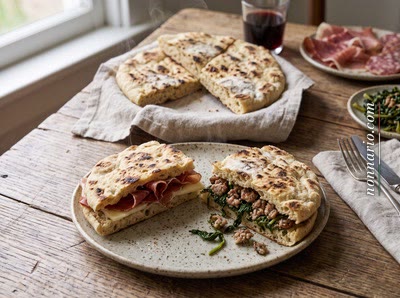
Cut the torta into wedges and serve it while still hot, beside grilled sausages, meat or vegetables. To fill it, slit a wedge through its thickness with a knife and fill it with sausage and sautéed greens, ham or cheese.
Check Served within a few minutes of leaving the testo, still warm inside.
The essentials, for cooks who know the dish. Switch to Detailed for quantities, temperatures, times and checks at every step.
Press “I’m here” on the step you are on, and again when it is done.Tap the pin on the step you are on, and the tick when it is done. Timers keep running while you scroll.
Da sapere
Good to know
- KeepingConservazione
- Keep it in a cool, dry place and eat it the same day if you can. Source
- VariantsVarianti
- With baking powder: Instant raising agent in place of the bicarbonate. One recipe gives 15 g of bicarbonate, or of instant raising agent, for 500 g of type 0 flour, with 250 ml of sparkling water, a teaspoon of salt and 25 ml of extra virgin olive oil. Source
- With olive oil: 40 ml of extra virgin olive oil worked into 500 g of type 1 flour with 250 ml of water, 10 g of salt and a teaspoon of bicarbonate; the dough rests for 30 minutes and is rolled into three discs 25 cm–30 cm across, each cooked for about 7 minutes. Source
- With cheese or eggs: Seed or olive oil, Parmigiano and/or pecorino, or eggs, added to the basic dough of flour, water, salt and raising agent. Source
- With milk or an egg: Milk in place of the water, for a softer crumb, or an egg in the dough, as is done at Città di Castello. Source
Errori comuni
Common mistakes
- Greasing the testo or the pan: the dough goes onto a dry surface.
- Forgetting the fork: unpricked, the disc blisters as it cooks.
- A high flame: the outside scorches before a disc 1 cm thick is cooked through. Keep it low.
- Rolling it thin: this is a thick bread, about 1 cm, cooked slowly.
Fuori dall'Italia
Cooking it outside Italy
- Type 0 flour is Italian soft wheat flour; plain (all-purpose) flour is the nearest elsewhere.
- Bicarbonate of soda is called baking soda in the US.
- Without a testo, use a heavy non-stick or cast-iron pan heated dry, never greased; the result is not quite the same as on a testo. For a pan about 28 cm across, cook the dough as two discs about 24 cm across, one after the other.
From nonnario.com/recipes/torta-al-testo/, where you will find its sources, its story and the step photos. Sources checked in November 2026.