Urbino, Marche
Crescia sfogliata
Urbino's flaky flatbread with eggs, lard and pepper, cooked on the testo
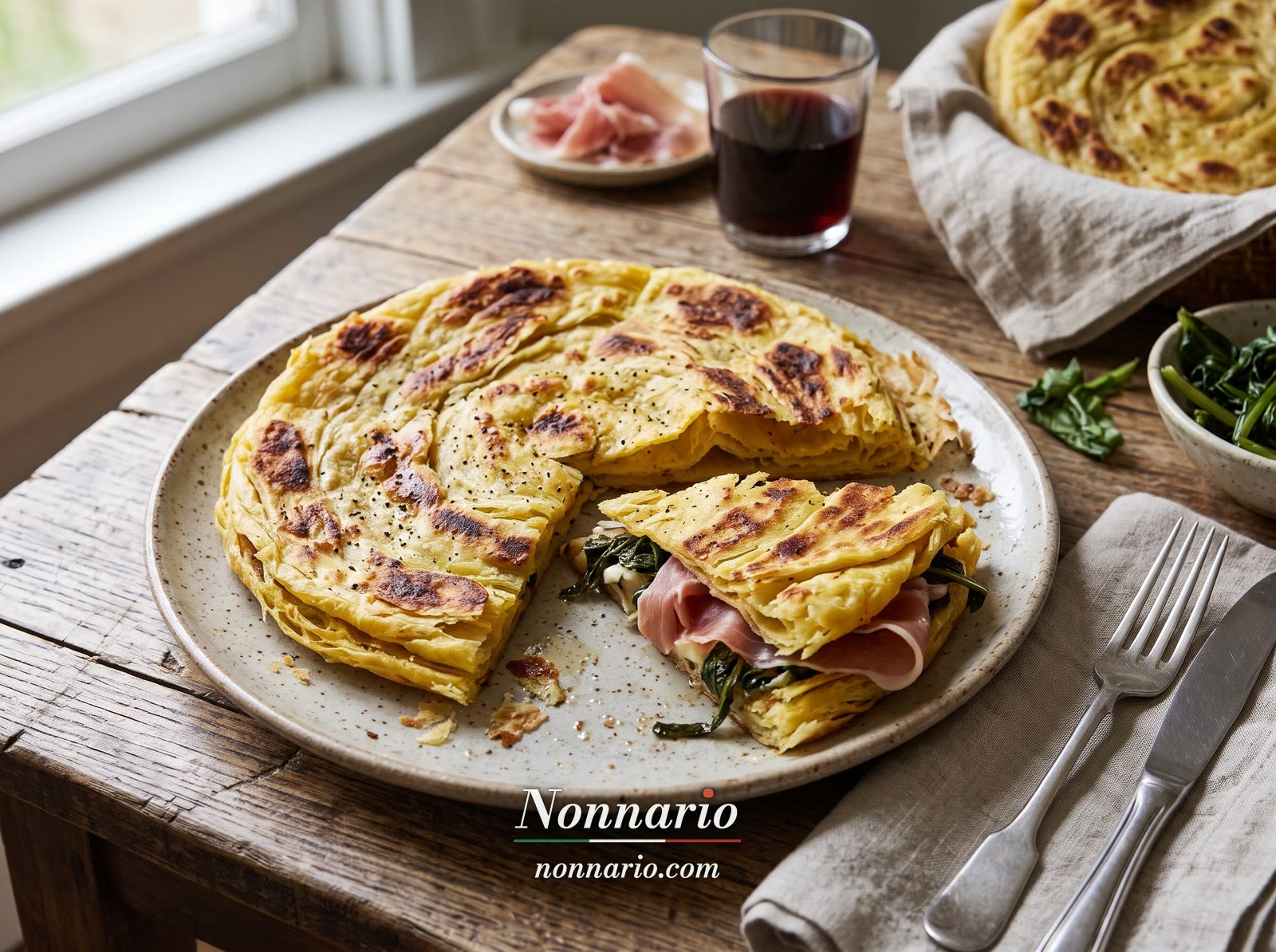
The flaky flatbread of Urbino, a dough of flour, eggs, lard, salt and plenty of black pepper rolled thin, spread with lard, rolled up into a coil, then rolled out again and cooked on a hot testo; one of the Marche's traditional food products.
- Course
- Pizze e PaniPizza & Bread
- Serves
- 8
- Hands-on
- 1 h 6 min
- Cooking
- 0 min
- Resting
- 1 h+
The video and the photos of every step are also gathered on a separate page.
In breve
In short
Also called crescia sfogliata di Urbino, crescia urbinate and Urbino flatbread.
- Soft wheat flour, eggs, lard, salt, lukewarm water and plenty of black pepper: the eggs and the pepper set it apart from piadina.
- Lard twice: worked into the dough, then spread thinly over each sheet rolled very thin.
- Each sheet is rolled up tight, coiled into a spiral and chilled, so the lard stays in layers.
- The coils are rolled out again into rounds and cooked on a very hot testo or pan, a few minutes on each side.
La provenienza
Where this recipe comes from
The crescia sfogliata belongs to Urbino and the Montefeltro hills around it. It looks like the piadina of nearby Romagna, but its dough is richer, with eggs and a generous amount of black pepper, and it is layered: the dough is rolled thin, spread with lard, rolled up, coiled and rolled out again, so it cooks flaky, golden and crisp. It was traditionally cooked on a slab of clay, later on clay or cast-iron plates. A legend tells of a young baker who saw the sun caught between the towers of the Palazzo Ducale and made a round, sun-coloured bread; the name is said to come from the way it swells a little on the heat. Accounts place it at the court of the Montefeltro dukes as early as the fifteenth century, and it became a working lunch in the fields. In a letter of 1903 the poet Giovanni Pascoli remembered the Baciocca, an osteria in Urbino, where they had cresce made. It is eaten hot, folded round prosciutto crudo, Casciotta d'Urbino or other cheese, lonza, sausages or greens from the pan. In 2025 the Sagra della crescia sfogliata of Urbino reached its fifteenth edition, held at the end of June at Castelcavallino and run by a local association with the town's patronage. The Crescia fogliata of Fiuminata, also on the Marche list, is a different thing: a sweet, filled with ricotta, raisins and nuts.
The crescia sfogliata di Urbino is on the Marche Region's list of traditional food products and on Italy's national list; the Region's sheet for the crostoli del Montefeltro, a close relative listed separately, describes the same work of lard, rope, twist and disc. There is no official recipe for the crescia itself: we found no De.Co., consortium or festival text. We compared 12 sources and publish the most widely recognised version. They agree on soft wheat flour, egg, lard spread on the thin sheet (and, in most, in the dough too), salt and plenty of black pepper, rolled up, coiled, chilled and rolled out again for the testo. They divide on the liquid, milk in most of the full recipes and water in others, and on one egg or two to 500 g: this page follows one complete recipe, with lukewarm water and two eggs. Some cooks use oil in the dough in place of the lard, one adds a raising agent, and some leave the coils in the fridge for hours or overnight. The amounts of salt and pepper, the sizes and thicknesses, the heat of the testo in degrees and the minutes on each side are ours, so that a cook who has never made one can judge each stage.
- Provenance
- A regional tradition documented in cookbooks and local practice, with no single official text.
- Defined by
- Tradition of Urbino and the Montefeltro
- Reference
- Compared across 12 sources, listed below; this page publishes the most widely recognised version.
- Sources
- Ministry of Agriculture (MASAF): national list of traditional food products, 25th revision, 2025, Marche no. 124 (Italian)
- Regione Marche: traditional food product sheets, 2017 update, with the sheets for the crostoli del Montefeltro and for the crescia fogliata of Fiuminata, a different product (Italian)
- Turismo Marche, the Marche Region's tourism portal: the crescia sfogliata of Urbino, a recipe (Italian)
- Agrodolce, food magazine: crescia sfogliata, the recipe, archived copy of 29 June 2025 (Italian)
- Dissapore, food magazine: crescia sfogliata di Urbino, the recipe (Italian)
- GialloZafferano, recipe site: crescia sfogliata (Italian)
- Sale&Pepe, food magazine: crescia sfogliata di Urbino with prosciutto di Carpegna (Italian)
- Accademia Italiana della Cucina, recipe collection: crescia sfogliata (Italian)
- La Cucina Italiana, magazine: the crescia of the Marche and the piadina of Romagna, an article of 2015 (Italian)
- CiboToday, food magazine: the crescia sfogliata of Urbino, its history and character (Italian)
- Il Resto del Carlino, newspaper: the fifteenth Sagra della crescia sfogliata of Urbino, 2025 (Italian)
- USDA Food Safety and Inspection Service: Leftovers and Food Safety (archived copy of 29 May 2025)
Ingredienti
Ingredients
The original recipe serves 8
For the dough
For the layers
Equipment
- A testo (a flat terracotta or cast-iron griddle) at least 28 cm across; without one, a heavy cast-iron or non-stick pan of the same size
- Kitchen scale and measuring spoons
- A wooden board and a rolling pin
- A pepper mill
- A small spatula or the back of a teaspoon, to spread the lard
- A tray, cling film and room in the fridge
- A wide spatula, to turn the crescia
- A clean cotton cloth, to keep the cooked ones warm
- Infrared thermometer (useful, not essential)
Preparazione
Method
Scaled to 8 servings: the amounts in the steps follow. Pot and pan sizes and cooking times are still for the original 8.
About 2–2¼ hours, an hour of it resting. The dough takes about 12 minutes to make, then rests for 30 minutes. Dividing it, rolling each piece very thin, spreading it with lard, rolling it up and coiling it takes about 20–25 minutes for the 6 pieces; the coils then chill for 30 minutes, and the testo goes on to heat for the last 10 of them. Each crescia takes about 5–6 minutes on the testo, one at a time, so about 35 minutes for all 6: roll out the next coil while one cooks.
- 1 h 6 minhands-on
- 0 mincooking
- 1 hresting, at least
The dough
-
Hands-on 3 min
Heap the 500 g of flour on the board and make a wide hollow in the middle. Break the 2 eggs into it and add the 50 g of soft lard for the dough, the salt and a generous grinding of black pepper.
Check A ring of flour holding the eggs, the lard, the salt and the pepper, with nothing running out.
Tip Our guide: about 10 g of salt, 2% of the flour, and about 3 g of freshly ground pepper to start. The pepper is what gives the crescia its character, so be generous rather than cautious.
Tip Our guide: keep the wall of flour high; if it breaks, push the flour back with a scraper or your hand.
-
Hands-on 8–10 min
Work the eggs, lard, salt and pepper into the flour with your fingers, drawing it in from the inside of the wall, then knead by hand, pouring in the 200 g of lukewarm water a little at a time as the dough takes it up. Knead until the lard has disappeared and the dough is one smooth, even ball.
Check A smooth, even dough, soft but not sticky, with no streaks of lard or egg and no dry flour left on the board.
Tip Our guide: about 8–10 minutes of kneading, pushing the dough away with the heel of your hand and folding it back.
Tip Our guide: flours absorb water differently; if the dough turns sticky before the water is all in, stop adding it.
-
Rest 30 min
Cover the dough with a bowl or a cloth, or wrap it in cling film, and leave it at room temperature for 30 minutes.
Check The 30 minutes are up and the dough has relaxed: pressed with a finger, it gives easily and no longer springs straight back.
Tip Our guide: the rest relaxes the dough, so it rolls out very thin without shrinking back.
The layers and the coils
After dividing the dough, take one ball at a time through rolling, spreading, rolling up and coiling, keeping the others covered so they do not dry out. The times given for these four steps are for all 6.
-
Hands-on 3 min
Divide the dough into 6 equal pieces and shape each into a smooth round ball. Cover them with a cloth.
Check 6 balls of the same weight, smooth on top.
Tip Our guide: weigh them. With all the water in, each comes to about 145 g.
Tip For one crescia each, divide the dough into 8 smaller balls instead, and roll them a little smaller; they cook in the same way.
-
Hands-on 10–12 min
On the lightly floured board, roll a ball with the rolling pin into a very thin round sheet, turning it a quarter turn every few strokes so it stays even.
Check An even sheet about 1.5 mm thick and about 30 cm across, with no holes and no thick patches.
Tip Our guide: about 1.5 mm; flour the board lightly, not the top of the sheet, so the lard will spread.
Tip Our guide: if it keeps shrinking back, leave it under the cloth for a few minutes and roll again.
-
Hands-on 3–4 min
Spread a thin, even layer of the soft lard for the layers over the whole sheet, right out to the edge.
Check The whole surface shines with a thin film of lard, with no bare patches and no lumps.
Tip Our guide: about 8 g on each sheet, so that the 50 g is shared among the 6. Use the back of a teaspoon or a small spatula.
Tip Our guide: soft lard, at room temperature, spreads without tearing the sheet; cold from the fridge, it drags.
-
Hands-on 3–4 min
Starting from one edge, roll the sheet up on itself, tightly, into a long, thin rope.
Check A firm rope with no air pockets, the lard sealed inside.
Tip Our guide: roll it tight, without trapping air, so the layers stay close together.
-
Hands-on 2 min
Wind the rope round on itself into a flat spiral, like a snail shell, and tuck the end underneath. Set it on a tray and cover it with cling film. Do the same with the other balls.
Check 6 flat spirals on the tray, each with its end tucked under, all covered with film.
Tip Our guide: leave a little room between them on the tray so they do not stick together.
-
Rest 30 min
Put the tray of covered coils in the fridge for 30 minutes.
Check The 30 minutes are up and the coils are cool and firm to the touch.
Tip Our guide: the chill firms the lard, so it stays in its layers when the coils are rolled out again.
Tip Start heating the testo when 10 minutes are left.
Rolling out and cooking
-
Temp 200 °C–220 °CHeat medium
About 10 minutes before the coils come out of the fridge, set the testo or pan, dry and ungreased, over medium heat to heat right through. A terracotta testo takes longer than cast iron: put it on earlier.
Check Very hot all over: on metal, a drop of water flicked on it beads up and skates across rather than sizzling away. With an infrared thermometer, about 200 °C–220 °C.
Tip Our guide: 200 °C–220 °C on the surface. A terracotta testo can boil a drop of water away even when hot, so there use the thermometer, or cook a scrap of dough first.
Tip Our guide: there is no need to grease it: the lard in the layers is enough.
-
Hands-on 2–3 min
Take one coil from the fridge, press it flat with your hands, then roll it out with the rolling pin into a round, turning it a quarter turn every few strokes. Roll each of the others in the same way while the one before it cooks.
Check A round about 24 cm across and about 3 mm thick, with the faint lines of the spiral showing on the surface.
Tip Our guide: about 24 cm and 3 mm; roll gently, so the layers are pressed thin, not kneaded together.
Tip Keep the other coils in the fridge until you roll them.
-
Hands-on 30–36 minTemp 200 °C–220 °CHeat medium
Lay the round on the hot testo. Cook it for about 3 minutes, until the underside is golden with brown spots, then turn it with the spatula and cook the other side for 2–3 minutes, turning it once more if one side needs colour. Cook all 6 in the same way, one at a time.
Check Golden on both sides with brown spots, the edge crisp and the layers showing where it is cut. A piece torn from the middle is dry and flaky inside, not doughy.
Tip Our guide: about 5–6 minutes for each crescia, 30–36 minutes for all 6.
Tip Our guide: if brown spots appear within a minute, the testo is too hot, so lower the heat; if it is still pale after 3 minutes, raise it a little.
Tip Our guide: as each one is done, wrap it in the clean cloth, so it stays hot while you cook the rest.
-
Hands-on 2 min
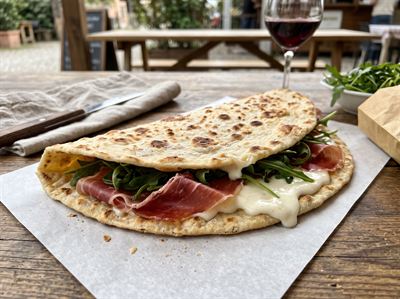
Serve the cresce hot, whole or cut into wedges, on their own or folded round prosciutto crudo and a soft cheese, or round greens sautéed in a pan.
Check On the table within a few minutes of leaving the testo, still crisp outside.
Tip Our guide: a crescia not eaten within 2 hours of cooking goes into the fridge, wrapped. Cured meats and soft cheese for the filling go back in the fridge within 2 hours too.
The essentials, for cooks who know the dish. Switch to Detailed for quantities, temperatures, times and checks at every step.
Press “I’m here” on the step you are on, and again when it is done.Tap the pin on the step you are on, and the tick when it is done. Timers keep running while you scroll.
Da sapere
Good to know
- KeepingConservazione
- Once cooked, it keeps for a couple of days in the fridge. Reheat it in a non-stick pan that is hot but not scorching, first on one side and then on the other, over gentle heat so that it does not turn hard. Source
- VariantsVarianti
- With milk and oil, rested overnight: 500 g of type 0 flour, black pepper, 20 g of salt, an egg, 50 ml of oil and 320 ml of whole milk, kneaded soft; balls of 150 g rolled about 5 mm thick, spread with lard, rolled up and coiled, then left in the fridge for 10–12 hours under film; rolled out to about 22 cm and cooked over charcoal, on a hot plate or in a lightly oiled pan, turned three times. Source
- With milk and baking powder, without pepper: For 6 cresce, 500 g of type 0 flour, 250 g of milk, an egg, 100 g of lard, 4 g of baking powder for savoury bakes and 10 g of salt, kneaded smooth; rolled into a rectangle, brushed with 40 g more lard, melted, rolled up along the long side and cut into six pieces, their ends closed and pressed flat with the ends upright; rested for some hours or overnight in the fridge, rolled very thin and cooked one by one on a terracotta or iron testo. Source
- Richer, with more eggs and a little milk: 600 g of 00 flour, about 5 eggs (295 g), 100 g of lard in the dough and 50 g to spread, 80 g of whole milk, 12 g of salt and 6 g of black pepper; rested 30 minutes, divided into 8 pieces of 140 g, each rolled into a rectangle about 1 mm thick, spread, rolled up from the short side and coiled, rested about an hour, rolled 1.5 mm thick and cooked in a non-stick pan for 3 minutes on each side. Source
- Crostolo di Urbania: Maize flour in place of the white wheat flour. Source
Errori comuni
Common mistakes
- Too little pepper: with the eggs, it is what sets the crescia apart from piadina.
- Rolling the sheet thick, or rolling it up loosely: the layers will not form.
- Spreading the lard unevenly: every part of the sheet needs its thin layer.
- Skipping the chill: the coils go into the fridge before they are rolled out again.
- Putting the first crescia on a testo that is not yet well heated.
Fuori dall'Italia
Cooking it outside Italy
- Tipo 00 flour is Italian soft wheat flour; plain (all-purpose) flour is the nearest elsewhere.
- Strutto is lard, rendered pork fat, not lardo (cured back fat). Without it, clarified butter can be used in its place, but the crescia is then no longer the traditional one.
- Without a testo, use a heavy cast-iron or non-stick pan at least 28 cm across, heated dry.
From nonnario.com/recipes/crescia-sfogliata/, where you will find its sources, its story and the step photos. Sources checked in November 2026.