Pavullo nel Frignano, Emilia-Romagna
Crescentine
Modenese mountain breads cooked in the tigelliera, with cunza
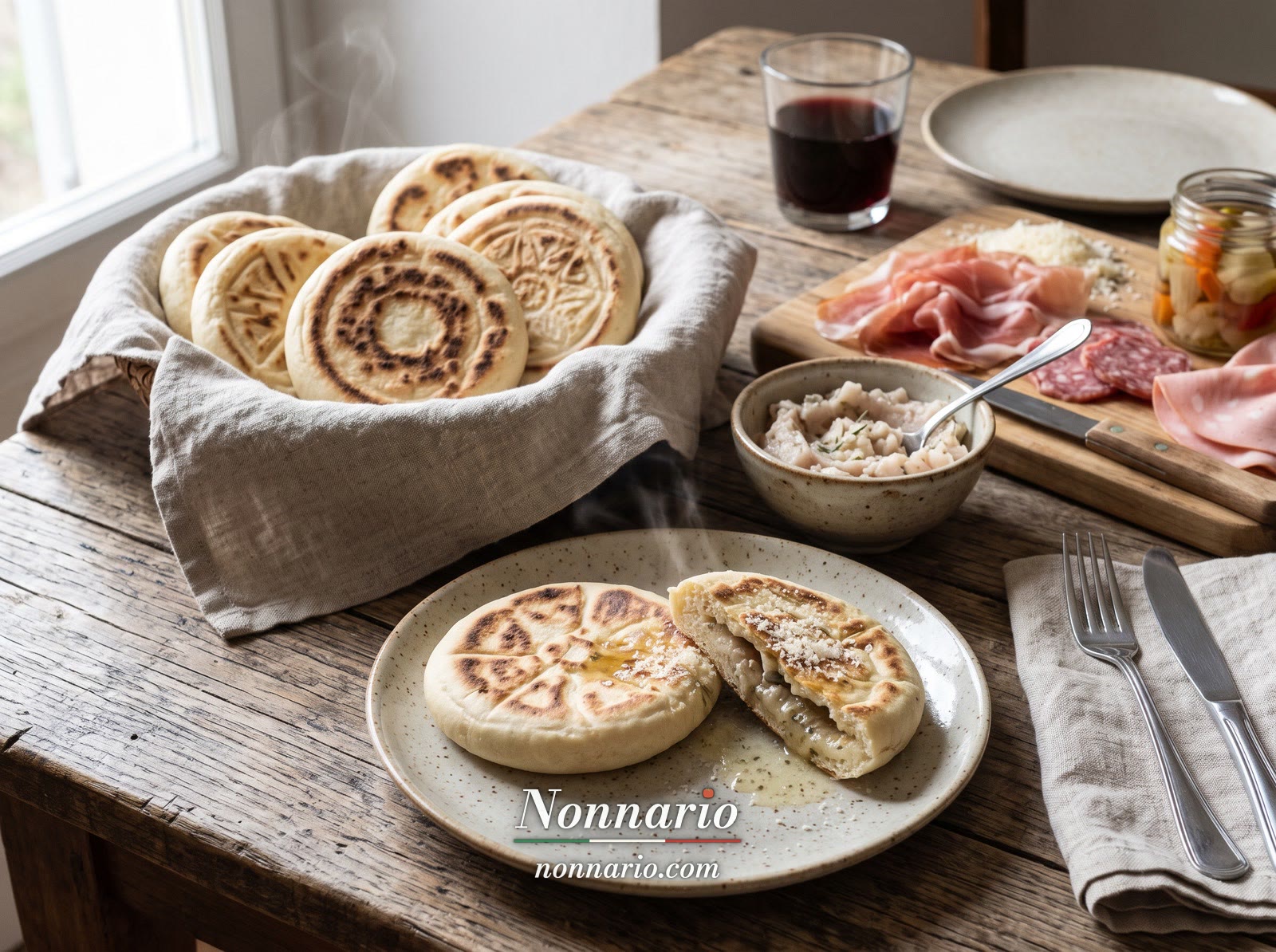
The small round breads of the Modenese Apennines, a soft dough of flour, milk, water, lard and yeast cooked in a hot tigelliera, then split and filled with cunza, lardo pounded with garlic and rosemary, under grated Parmigiano Reggiano; one of Emilia-Romagna's traditional food products.
- Course
- Pizze e PaniPizza & Bread
- Serves
- 6
- Hands-on
- 59 min
- Cooking
- 54 min
- Resting
- 3 h+
The video and the photos of every step are also gathered on a separate page.
In breve
In short
Also called tigelle, tigella, crescentina, crescenta, crescentina modenese, tigella modenese and cherscènta modenese.
- Soft wheat flour, milk and water, lard, yeast and salt, kneaded by hand until very soft, then left to double, at least 2 hours at about 25 °C.
- Rolled just under 1 cm thick and cut into rounds 8 cm across.
- Cooked in a well-heated tigelliera greased with lardo, over a low flame, 4 minutes on each side.
- Split while hot and filled with cunza (lardo, garlic and rosemary chopped fine with a mezzaluna) and grated Parmigiano Reggiano.
- The fireplace dough was flour, water and salt alone; yeast and a little milk came with iron plates and the tigelliera.
La provenienza
Where this recipe comes from
Crescentine are the everyday bread of the Modenese Apennines, the Frignano between the Secchia and the Panaro, where for generations they took the place of bread and were carried to the fields; Pavullo nel Frignano holds a crescentina festival at the end of every August. The name speaks of dough that rises. Tigella, the name most people use outside the mountains, belonged to the tool: a disc of clay about 10 cm across, made in winter from earth dug half a metre down in the chestnut woods, mixed with finely crushed white stone, shaped in a willow mould, dried for 15 days and fired under the embers. Many were carved, often with a six-pointed star, so the pattern printed itself on the bread. Heated by the fire until they turned red, the discs were stacked with the raw crescentine between them, each laid on chestnut leaves, turned and finished under the ashes; rubbing a raw crescentina on a disc showed by its mark whether it was too hot. Iron and cast-iron plates followed, and today the tigelliera, a hinged aluminium mould set on the flame or an electric one with stones. The dough of the fireplace was flour, water and salt alone, worked by hand at length; for plates and moulds a little yeast and milk are added, and richer doughs some lard or oil. In the mountains each one is still shaped by hand from a ball of dough. Split while hot, crescentine take the cunza, pork fat pounded with garlic and rosemary, under plenty of grated Parmigiano Reggiano, or cured meats such as prosciutto, salame, pancetta and coppa, or soft cheese.
The name Crescentina (Tigella) di Modena belongs to a collective mark of the Modena Chamber of Commerce, whose specification for producers in the province allows soft wheat flour, salt at about 2% of the flour, water and, if they wish, lard or olive oil, milk, malted flour and yeast or bicarbonate, and sets the size of the finished bread. It is also on Emilia-Romagna's and Italy's lists of traditional food products. None of these sets a recipe for the home kitchen. We compared 14 sources and publish the most widely recognised version: a dough of flour, milk, water, lard and yeast, kneaded by hand, left to double, rolled and cut, cooked in a stovetop tigelliera greased with lardo, then filled with cunza and Parmigiano. Its milk is about a quarter more than the specification allows, as in every household recipe we read that gives an amount of milk, and its teaspoon of sugar is not on the specification's list: these are household crescentine, not the marked bread. The heat of the tigelliera in degrees, the temperature inside when done, the ways to cook without a tigelliera, how much cunza to make, the timing for the re-rolled scraps and the food-safety times for the cunza are ours.
- Provenance
- A regional tradition documented in cookbooks and local practice, with no single official text.
- Defined by
- Modenese tradition
- Reference
- Compared across 14 sources, listed below; this page publishes the most widely recognised version.
- Sources
- Camera di Commercio di Modena: production specification of the collective mark Crescentina (Tigella) di Modena, 2022 text (Italian)
- Camera di Commercio di Modena, Tradizione e Sapori di Modena: the Crescentina (Tigella) di Modena product page (Italian)
- Ministry of Agriculture (MASAF): national list of traditional food products, 25th revision, 2025, Emilia-Romagna no. 280 (Italian)
- Regione Emilia-Romagna: regional list of traditional food products, 26th revision, no. 281 (Italian)
- Provincia di Modena, Modena magazine no. 24, 1999: Crescentine montanare, with the tigelle and a recipe (Italian)
- Provincia di Modena, Storie di terra e di rezdore: crescentine cooked in the tigelle, a household recipe from Sestola (Italian)
- Comune di Pavullo nel Frignano: the town's food specialities, the crescentina and its festival (Italian)
- Travel Emilia Romagna, the regional tourist board's site: all there is to know about tigelle
- Agrodolce, food magazine: tigelle, the recipe (Italian)
- GialloZafferano, recipe site: crescentine (or tigelle) with cunza (Italian)
- Il Cucchiaio d'Argento: crescentine modenesi (tigelle), the recipe (Italian)
- Dissapore, food magazine: tigelle, five mistakes not to make (Italian)
- Accademia della Crusca, language advice: crescentine or tigelle (Italian)
- USDA Food Safety and Inspection Service: Leftovers and Food Safety (archived copy of 29 May 2025)
Ingredienti
Ingredients
Makes about 22–23 crescentine 8 cm across, with the scraps rolled again once: 6 servings
For the dough
For the tigelliera
For the cunza and to serve
Equipment
- A stovetop tigelliera (a hinged aluminium mould for crescentine, often with 7 moulds), or an electric one; without one, two heavy cast-iron pans of the same size
- A gas burner with a double ring and a flame diffuser to set under the tigelliera
- A round cutter 8 cm across
- A wooden board and a rolling pin
- A fork, a bowl and a damp tea towel
- A mezzaluna (a curved two-handled chopping knife), or a large knife, for the cunza
- Kitchen scale and measuring spoons
- Infrared thermometer (useful on a non-stick or seasoned mould, not on bare aluminium) and probe thermometer
Preparazione
Method
About 3½ hours for the first cut, most of it waiting; about 4¼ hours with the scraps rolled again. The dough takes about 25 minutes to make, then rises for at least 2 hours; make the cunza while it rises and keep it in the fridge. Put the tigelliera on to heat 30 minutes before you want to cook: it heats while you roll and cut. The first cut gives about 18–19 rounds, three rounds of about 8 minutes in a tigelliera with 7 moulds; serve them as they come off. The scraps, kneaded again, rest at least an hour while those cook, then give the last 4 or so in one more round: about 22–23 in all.
- 59 minhands-on
- 54 mincooking
- 3 hresting, at least
The dough
-
Hands-on 3 minTemp 30 °C–35 °C
Pour the 130 g of milk and the 130 g of lukewarm water into a bowl and crumble the 12 g of fresh yeast into them.
Check The liquid feels just warm on the inside of your wrist, not hot, and the yeast is crumbled into small pieces.
Tip Our guide: the milk at room temperature or just warm, so that the mixed liquid is about 30 °C–35 °C. Much hotter, and the yeast suffers.
-
Hands-on 2 min
Add the teaspoon of sugar and stir with a spoon until the yeast has dissolved.
Check No lumps of yeast left: an even, pale, cloudy liquid.
-
Hands-on 3 min
Heap the 500 g of flour on the board and make a hollow in the middle. Pour the yeast liquid into it and add the 50 g of lard and the teaspoon of salt.
Check A ring of flour holding the liquid, with the lard and salt in it and nothing running out.
Tip Our guide: keep the wall of flour high and wide enough to hold all the liquid; if it breaks, push the flour back with a scraper or your hand.
Tip The lard in the dough is what makes crescentine soft and full of flavour.
-
Hands-on 5 min
Crush the lard with a fork so that it melts into the liquid. Then, still with the fork, draw part of the flour from the inside of the wall into the liquid, a little at a time, until it is too thick to stir.
Check The lard has disappeared into a thick, sticky batter that the fork can no longer move.
Tip Our guide: soft lard, at room temperature, melts into the liquid easily; cold from the fridge, it stays in lumps.
-
Hands-on 10 min
Bring in the rest of the flour with your hands and knead for about 10 minutes, pushing the dough away with the heel of your hand and folding it back, until it is even.
Check A smooth, even dough, very soft but no longer sticking to your hands or the board.
Tip The dough should stay very soft: do not knead in extra flour to make it firmer.
Tip Our guide: if it still sticks after 10 minutes, flour your hands lightly rather than the dough.
-
Rest 2–3 hTemp 25 °C
Put the dough in a bowl, cover it with a damp tea towel and leave it to rise for at least 2 hours at about 25 °C, until it has doubled. In a cooler room it takes longer.
Check At least 2 hours have passed and the dough has doubled in volume. A floured finger pressed in leaves a dent that fills back only slowly.
Tip Wait for it to double, however long it takes; the time is only a guide.
Tip Our guide: the finger test is ours; if the dent springs back at once, give the dough more time.
The cunza, while the dough rises
-
Hands-on 10–15 min
Peel the garlic and strip the needles from the rosemary. Chop the lardo, the rosemary and the garlic together, then go on pounding and chopping them with the mezzaluna until they come together into one fine, smooth paste.
Check An even, pale, spreadable paste, flecked green with rosemary, with no pieces of garlic or lardo left whole.
Tip Our guide: allow a heaped teaspoon of cunza, about 8 g–10 g, for each crescentina: about 200 g–250 g of lardo for the whole batch, with 1–2 cloves of garlic and the needles of 1–2 sprigs of rosemary. Garlic is a matter of taste.
Tip Our guide: cover it and keep it in the fridge until the crescentine go to the table. Leftover cunza that has never left the fridge keeps, covered, for up to 3 days from making it.
Rolling and cooking
-
Cooking 30 minTemp 180 °C–200 °CHeat low to medium-low
Set the closed tigelliera on a flame diffuser over a double-ring gas burner and heat it for 15 minutes, then turn it over and heat the other side for 15 minutes. Roll and cut the dough while it heats.
Check Both plates are hot right through: a drop of water flicked into a mould sizzles hard and vanishes within a second or two, or skates across in beads. On a non-stick or well-seasoned mould an infrared thermometer reads about 180 °C–200 °C; on bare aluminium it reads far too low, so go by the water drop and the colour of the first round.
Tip Our guide: the flame low to medium-low; the diffuser spreads it so the whole mould heats evenly.
Tip Our guide: leave the tigelliera on the low flame between rounds, and while the scraps rest, so it stays hot.
Tip Our guide: an electric tigelliera only needs heating, closed, until its light says it is ready; then cook the crescentine closed for 4–6 minutes, both sides at once.
Tip Our guide: without a tigelliera, heat two heavy cast-iron pans of the same size over a low flame for about 10 minutes. Grease the lower one with the lardo, lay the rounds in it and set the second pan on top, base down, as a hot lid; cook 4 minutes, turn the rounds and cook 4 minutes more. They will not take the pattern of the moulds.
-
Hands-on 5 min
Turn the risen dough onto the lightly floured board, flatten it a little with your fingers, then roll it with the rolling pin into a circle about 40 cm across and just under 1 cm thick.
Check An even sheet just under 1 cm thick all over, edges included.
Tip Our guide: if it keeps shrinking back as you roll, leave it for a few minutes under the tea towel and roll again.
-
Hands-on 5 min
Cut out rounds with the 8 cm cutter, as close together as you can. The first sheet gives about 18–19.
Check About 18–19 clean rounds 8 cm across, each just under 1 cm thick.
Tip Our guide: a 40 cm circle has room for about 18–19 rounds of 8 cm; the scraps, rolled again once, give about 4 more, about 22–23 in all. The figure of about 25 that some recipes give counts every last scrap rolled again and again.
Tip Our guide: cover the rounds with a dry tea towel while they wait for the tigelliera, so they do not form a skin.
Tip The cut rounds can also be brushed with a little lard before they go into the tigelliera.
-
Rest 1 h
Gather the scraps, knead them together again by hand into one smooth ball and leave it under the tea towel for at least 1 hour, until it has swelled and is soft and easy to roll again. Cook the first rounds while it rests.
Check The timer is running for at least 1 hour; when it rings, the ball has swelled and rolls out without springing back.
Tip Start the timer and go straight on to the next step: the first rounds cook while the scraps rest.
Tip The rest lets the worked scraps swell again and turn soft and easy to roll.
Tip Our guide: if you would rather not wait, the first cut alone makes about 18–19 crescentine.
-
Hands-on 1 min
Open the hot tigelliera and rub each mould with the piece of lardo.
Check Every mould shines with a thin film of fat, with no pools.
Tip Our guide: hold the lardo with a fork or in a fold of paper, as the moulds are very hot.
-
Cooking 8 minTemp 180 °C–200 °CHeat low
Lay a round in each mould, close the tigelliera and cook over a low flame for 4 minutes. Turn the whole tigelliera over and cook for 4 minutes more.
Check Golden on both sides, with a crisp crust and, if the mould has one, its pattern printed on it. On the first round, a probe pushed sideways into the middle of one reads at least 95 °C.
Tip The tigelliera must be well heated before the first round goes in: that is what gives the golden, crisp crust.
Tip Our guide: if they turn dark brown within 2 minutes, the flame is too high; if they are still pale at 4 minutes, raise it a little.
Tip Our guide: 95 °C or more in the middle means the crumb is cooked through.
-
Cooking 16 minHeat low
Go on in the same way until all the rounds of the first cut are cooked. Keep the cooked ones wrapped in a clean tea towel in a basket while the others cook.
Check Every crescentina golden on both sides; the ones in the cloth still hot and soft.
Tip Our guide: with 7 moulds the 18–19 rounds of the first cut take three rounds of about 8 minutes; fewer moulds, more rounds.
Tip Our guide: rub the moulds with the lardo again if the crescentine start to stick.
-
Hands-on 13 minHeat low
Roll the rested ball just under 1 cm thick, cut it into 8 cm rounds, rub the moulds with lardo and cook them as before, 4 minutes on each side over a low flame.
Check About 4 more rounds, golden on both sides: about 22–23 crescentine in all.
Tip Our guide: what is left after this second cut is too little to roll again; cook it as one small piece or throw it away.
To the table
-
Hands-on 2 min
Take the cunza out of the fridge. Split each hot crescentina in half with a knife, spread the inside with cunza, sprinkle it with grated Parmigiano Reggiano, close it and eat it straight away, while the heat melts the cunza. They can also be filled with cured meats and cheeses.
Check The cunza melts into the hot crumb as soon as it goes on.
Tip Our guide: put on the table only as much cunza as you will use. It stays out for at most 2 hours; whatever is left then is thrown away, not put back for another day.
Tip Our guide: fill them only as they are eaten. A filled crescentina is eaten at once.
The essentials, for cooks who know the dish. Switch to Detailed for quantities, temperatures, times and checks at every step.
Press “I’m here” on the step you are on, and again when it is done.Tap the pin on the step you are on, and the tick when it is done. Timers keep running while you scroll.
Da sapere
Good to know
- KeepingConservazione
- Best eaten hot. Unfilled, they keep for a couple of days at room temperature in a paper bag or wrapped in a clean tea towel. They also freeze, once cool, for 2–3 months, separated by baking paper in a freezer bag; thaw them at room temperature and warm them in the oven at 180 °C for about 10 minutes, or for a few minutes on a hot plate. Source
- VariantsVarianti
- The fireplace way, without yeast: Flour, lukewarm water and salt only, worked at length by hand on a wooden board, covered and rested for 2 hours, shaped into fist-sized balls and pressed out by hand. The clay tigelle are heated in the fireplace until they turn red; then tigelle and crescentine are stacked, each crescentina on chestnut leaves (dried ones soaked in water will do), turned so they cook evenly and finished under the ashes, about 10 minutes in all. Cooked on electric plates or iron plates, the same dough takes a little yeast and a drop of milk. Source
- With olive oil: 50 ml of olive oil in place of 60 g of lard, in a dough of 500 g of type 0 flour, 150 ml of lukewarm milk, 80 ml of lukewarm water, 10 g of fresh yeast and 2 teaspoons of fine salt; doubled in about 2 hours, rolled about 1 cm thick, cut 10 cm across, rested 30 minutes and cooked for 5–6 minutes in a well-heated tigelliera, turning it several times. Source
- With herbs in the dough: Chopped rosemary or sage kneaded into the dough, for more flavour. Source
- Cunza by weight: 200 g of lardo, 2 sprigs of rosemary and 2 cloves of garlic for 22 crescentine: the lardo cut with a knife to an even texture, the rosemary needles and then the garlic chopped finely, all mixed and beaten with the base of the knife, unhurried, for about 10 minutes, until soft and silky. With a food processor, chop the rosemary with the garlic first, then the lardo on its own. Source
Errori comuni
Common mistakes
- Kneading in extra flour: the dough should be very soft, though not sticky.
- Rolling and cutting before the dough has doubled.
- A tigelliera not heated through: the crescentine go pale and never take a crisp crust.
- A high flame once they are in: the outside darkens before the inside is cooked. Keep it low.
- Letting them go cold before filling: the cunza should melt into hot bread.
Fuori dall'Italia
Cooking it outside Italy
- Tipo 00 flour is Italian soft wheat flour; plain (all-purpose) flour is the nearest elsewhere.
- Strutto is lard, rendered pork fat. Lardo is a different thing: pork back fat cured with salt. Some recipes use olive oil in the dough in place of the lard.
- Our guide: in place of 12 g of fresh yeast, about 4 g of active dried yeast, dissolved in the same way.
- Semi-skimmed milk is called reduced-fat or 2% milk in the US.
- Without a tigelliera, crescentine can be cooked in a heavy pan. Our guide is two cast-iron pans, one set on top of the other as a hot lid (see the step for heating the tigelliera).
From nonnario.com/recipes/crescentine/, where you will find its sources, its story and the step photos. Sources checked in November 2026.