Reggio Emilia, Emilia-Romagna
Erbazzone reggiano
Reggio Emilia's spinach and chard pie
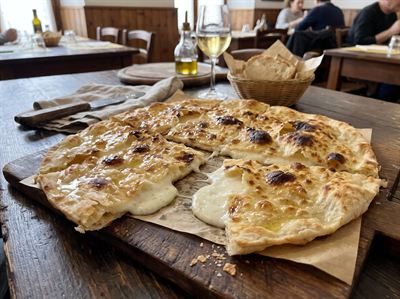
Reggio Emilia's savoury pie of greens, a PGI since 2026: spinach and chard cooked with onion and lardo, then breadcrumbs and long-aged Parmigiano Reggiano, between two thin sheets of lard pastry topped with crisp curls of lardo.
- Course
- Pizze e PaniPizza & Bread
- Serves
- 6
- Hands-on
- 1 h 50 min
- Cooking
- 42 min
- Resting
- 40 min+
In breve
In short
Also called erbazzone, scarpazzone, scarpasòun and scarpazzoun.
- Two thin sheets of unleavened pastry: soft wheat flour, water, salt and lard, at least 6% of the flour's weight, with no oil and no yeast.
- A soft but dry filling: cooked spinach and chard, at least 60% of it, seasoned with a soffritto of onion and lardo, then breadcrumbs and Parmigiano Reggiano.
- Parmigiano Reggiano aged at least 24 months, at least 5% of the filling; the specification's filling lists no egg, ricotta or rice.
- The filling weighs at least half the raw pie, and slivers of salted lardo go on the top sheet before baking, to crisp in the oven.
- Baked at 200 °C–250 °C until the top is golden, then cut into squares or wedges.
La provenienza
Where this recipe comes from
Erbazzone comes from the peasant cooking of the Reggio Emilia countryside: a savoury pie of greens. In dialect it is scarpasòun, scarpazzone, because farming families filled it with chard, not only the leaves but also the stalks, which they called scarpe; when spinach and other greens took the chard's place out of season, the name perhaps moved to erbazzone. Its origins are said to go back to the Middle Ages, and a story has it that the first was made by a rezdora, the woman who ran the farmhouse and its kitchen. For a long time it was made in every town of the province, mostly for the family; in the second half of the 1900s it appeared fresh in bakeries, pastry shops, bars and restaurants, and in 1984 a group of local craftsmen began to sell it frozen. Consumer cooperatives once held popular contests for the best scarpazzone. Today it is baked in large trays and sold in slices, a dish for feasts and for every day, eaten as a starter, as a snack and, standing at the counter, at breakfast in bars and cafés.
Erbazzone Reggiano has been a PGI since 2026: Commission Implementing Regulation (EU) 2026/736 of 20 March 2026 entered it in the EU register, on Italy's application published in the Official Journal in October 2025, and the protection rests on the pie's reputation. Only an erbazzone made in the province of Reggio Emilia under the specification may carry the name; one sold raw and frozen is the only kind that may be baked elsewhere, and one company outside the area may keep using the name until the end of 2028. The specification fixes proportions rather than a recipe: two thin sheets of unleavened pastry of soft wheat flour and water, with at least 6% lard and at most 4% salt on the flour's weight, and pasteurised hen's eggs, at most 1%, allowed; a filling of cooked spinach and chard (at least 60% of it), seasoned with a soffritto of onion and lardo, then grated Parmigiano Reggiano aged at least 24 months (at least 5%) and breadcrumbs (at most 12%), with garlic, parsley, pepper, extra virgin olive oil, butter and milk allowed and no preservatives, flavourings or other additives; a filling that weighs at least half the raw pie; lardelli, salted pork lardo, scattered over the top; and a bake at 200–250 °C until golden. The pie is round or rectangular, 1–3 cm thick and from 200 g to 3 kg, its curls of lardo crisp and darker than the pastry.
No published home recipe we found keeps to all of these rules: most put oil in the pastry, leave out the breadcrumbs or the onion, or add the lardo late or not at all. So the quantities on this page are our own, computed inside the specification's limits for one tin of about 24 × 34 cm, and they have not yet been tested in a kitchen; every stage has a check to judge it by. The oven is at 200 °C, the bottom of the range and the heat most home recipes use, for 35–40 minutes. The filling is chilled while the pastry rests, so it does not steam the base, and nothing perishable spends more than about an hour and ten minutes out of the fridge before the oven, inside the 2-hour food-safety limit. Made anywhere but the province of Reggio Emilia, it is an erbazzone, never Erbazzone Reggiano.
- Provenance
- The dish itself is protected by an EU specification (TSG, PDO or PGI) that fixes how it is made.
- Defined by
- European Union
- Reference
- PGI ‘Erbazzone Reggiano’, Commission Implementing Regulation (EU) 2026/736; single document in OJ C/2025/5627; specification published by the Italian Ministry of Agriculture (MASAF)
- Sources
- MASAF, the Italian Ministry of Agriculture: the production specification of the PGI, its 2025 text, listed among the registered PGIs (Italian)
- EU Official Journal C/2025/5627 of 20 October 2025: Italy's application, with the single document (EUR-Lex, Italian)
- Commission Implementing Regulation (EU) 2026/736, entering the PGI in the register (EUR-Lex, Italian)
- Comune di Reggio Emilia, Reggio Emilia Welcome, the town's official tourist site: Erbazzone Reggiano IGP (Italian)
- Comune di Reggio Emilia, Reggio Emilia Welcome: the erbazzone recipe, with Correggio's scarpasot (Italian)
- Travel Emilia Romagna, the regional tourist board's site: the history and a recipe of Erbazzone reggiano IGP (Italian)
- Comune di Reggio Emilia, Musei Civici: the erbazzone among the museum's recipes, from a 1985 manual of Reggio cooking (Italian)
- Regione Emilia-Romagna, Agricoltura, November 2006: an article on erbazzone, with the Region's sheet on it as a traditional food product (Italian)
- Accademia Italiana della Cucina: scarpazzone or erbazzone reggiano, from its recipe collection (Italian)
- Il Cucchiaio d'Argento: erbazzone, the recipe (Italian)
- Sonia Peronaci: erbazzone, a recipe tested in her Milan kitchen (Italian)
- USDA Food Safety and Inspection Service: Leftovers and Food Safety (archived copy of 29 May 2025)
Ingredienti
Ingredients
Pastry (doesn't change with servings)
Filling (doesn't change with servings)
Topping and tin (doesn't change with servings)
Equipment
- Large pot, at least 6 l
- Frying pan 28 cm–30 cm across
- Colander and a slotted spoon
- Kitchen scale
- Large tray or dish, for cooling the filling
- Rolling pin and a large board
- Ruler or tape measure
- Low metal baking tin about 24 cm × 34 cm, about 3 cm deep
- Fork and a thin spatula
- Oven thermometer and probe thermometer (optional)
Preparazione
Method
About 3¼ hours, most of it hands-on: about 70 minutes for the greens and the filling; 15 minutes to make the pastry, which then rests 30 minutes while the filling chills and the oven heats; about 30 minutes to assemble; 35–40 minutes in the oven and 10 to settle. The greens and the soffritto spend little more than an hour in all out of the fridge before the pie goes in the oven, inside the 2-hour food-safety limit. These quantities are ours, computed within the specification and not yet tested: go by the checks.
- 1 h 50 minhands-on
- 42 mincooking
- 40 minresting, at least
The greens and the filling
-
Hands-on 2 min
Bring about 5 l of water to the boil in a large pot with about 30 g of salt. It heats while you trim the greens.
Check At a full, rolling boil by the time the greens are washed.
-
Hands-on 20 min
Cut the base off the chard; keep the leaves and the tender part of the stalks, sliced across about 1 cm wide, and throw away any tough, stringy ends. Pick over the spinach, removing the roots and thick stems. Weigh them: about 1 kg of each. Wash both in several changes of cold water, lifting them out each time so the grit stays behind.
Check No grit at the bottom of the last rinsing water.
-
Hands-on 12 minHeat medium-low
In the frying pan, melt the 80 g of finely chopped lardo over a medium-low heat. Add the onion, and the crushed garlic clove if you use it, and cook gently, stirring now and then, until soft and translucent. Take the pan off the heat until the greens are ready.
Check The lardo has melted and the onion is soft and translucent, pale gold at most, never brown.
Tip Keep the heat low: the onion should soften without browning.
-
Cooking 5 min
Put the chard, stalks and leaves, into the boiling water and cook it for 5 minutes from when the water returns to the boil. Lift it out into the colander with the slotted spoon, keeping the water boiling.
Check A slice of stalk is tender when pierced with a knife.
-
Cooking 2 min
Put the spinach into the same water for 1–2 minutes, until it has just wilted, then drain it into the colander with the chard.
Check Completely wilted and bright green.
-
Hands-on 10 min
Run cold water over the greens in the colander for a minute or so, until you can handle them. Then squeeze them hard, a handful at a time, until hardly any more water comes out.
Check A squeezed ball of greens no longer drips.
-
Hands-on 5 min
Chop the squeezed greens coarsely with a knife, then weigh them.
Check At least 650 g, so that the greens make up at least 60% of the filling. If you have less, blanch, cool and squeeze more spinach until the scale reaches it.
-
Hands-on 10 minHeat mediumOfficial text
Season the cooked spinach and chard with the soffritto of onion and lardo, which may be flavoured to taste with garlic, parsley and pepper.
Check No liquid runs to the side when you tilt the pan: the greens look dry and glossy.
Tip Our guide: put the greens back over a medium heat with the soffritto and stir for about 10 minutes, until dry. Add salt at the end, a little at a time: the lardo and the Parmigiano are both salty.
Tip Our guide: take out the garlic clove; the parsley, if you use it, goes in later with the Parmigiano.
-
Hands-on 3 min
Off the heat, stir the 50 g of breadcrumbs into the hot greens. Spread the filling out on a large tray or dish, no more than 2 cm deep, to cool.
Check An even, thin layer, steaming freely.
Tip Our guide: the breadcrumbs go in while the greens are hot, the Parmigiano only once the filling is cool.
The pastry
-
Hands-on 1 minTemp 200 °CHeat top and bottom heat, no fan
Put a shelf in the lower third of the oven and heat it to 200 °C, with top and bottom heat and no fan. It heats while you make the pastry and the pastry rests.
Check An oven thermometer reads 200 °C before the pie goes in.
-
Hands-on 12 minOfficial text
Work the soft wheat flour, water, lard and salt together until the dough has the consistency you want.
Check Smooth, soft and even, not sticky; pressed with a finger, the dent fills back slowly.
Tip Our guide: rub the 30 g of lard into the 300 g of flour and 5 g of salt with your fingertips, pour in 130 g of water and mix, then knead on the board for 8–10 minutes.
Tip Our guide: add the last 10 g of water a spoonful at a time, only if the dough stays crumbly.
-
Hands-on 1 min
Put the tray of filling in the fridge, loosely covered, while the pastry rests.
Check In the fridge within about 20 minutes of leaving the pan.
-
Rest 30 min
Leave the dough at room temperature for 30 minutes, under a clean cloth.
Check Relaxed: pressed, it gives instead of springing back.
Tip Rested, it rolls out thin without shrinking back.
Assembling
-
Hands-on 2 min
Take the filling out of the fridge and stir in the 130 g of grated Parmigiano Reggiano, and the chopped parsley if you use it.
Check Cool to the touch, soft but dry: a squeezed spoonful leaves your fingers barely damp. It weighs about 1 kg–1.2 kg.
Tip Our guide: the specification wants the filling to weigh at least half the raw pie, so at least as much as all the pastry and lardo together, 515 g; this filling has room to spare.
-
Hands-on 1 min
Grease the low metal tin, about 24 cm × 34 cm and 3 cm deep, with a little lard.
-
Hands-on 6 min
Cut the pastry into two equal pieces, about 235 g–240 g each. On a lightly floured board, roll one out into a rectangle about 34 cm × 44 cm.
Check Measured with a ruler, it reaches about 34 cm × 44 cm: at that size it is about 1.3 mm thick.
-
Hands-on 3 min
Roll the sheet loosely round the pin, unroll it over the tin and ease it into the corners and up the sides, leaving the extra hanging over the rim.
Check Bottom and sides covered with no tears, a little hanging over the rim all round.
-
Hands-on 3 minOfficial text
Spread the filling in a single layer on the thin pastry. The thickness of filling and pastry is up to you, as long as the filling is at least 50% of the weight of the raw pie.
Check An even layer about 1.5 cm deep, right into the corners.
Tip Our guide: level it with the back of a spoon without pressing it down.
-
Hands-on 6 min
Roll the second piece out thinner than the first, to about 38 cm × 48 cm.
Check Measured with a ruler, it reaches about 38 cm × 48 cm: at that size it is about 1.1 mm thick.
-
Hands-on 3 min
Dust the sheet lightly with flour and roll it loosely onto the floured pin, then gently push its two ends towards the middle of the pin so that it gathers into folds. Unroll it over the filling.
Check The whole filling covered by a sheet in soft folds.
-
Hands-on 4 minOfficial text
Close the filling in at the edges, between the two layers of pastry.
Check A continuous pressed rim all round, with no gap where the filling shows.
Tip Our guide: trim both sheets level with the rim of the tin, then fold their edges inwards together over the filling and press them into a small rim, about 1.5 cm wide.
-
Hands-on 1 min
Prick the top sheet all over with a fork, about every 3 cm–4 cm.
Check Holes over the whole top, none missed in the corners.
Tip The holes let the steam out, which would otherwise break the pastry.
-
Hands-on 2 minOfficial text
Scatter the top layer of pastry with lardelli, salted pork lardo.
Check Slivers spread evenly over the whole top.
Tip Our guide: the 40 g of lardo, cut into thin slivers about 3 cm long.
Baking
-
Cooking 35–40 minTemp 200 °CHeat top and bottom heat, lower thirdOfficial text
Bake in the oven at 200 °C–250 °C until the surface is golden.
Check The top light to mid brown with golden, amber tones, the lardo curls crisp and darker than the pastry. Lift a corner with the spatula: the underside is golden, not pale. A probe in the centre reads at least 75 °C.
Tip Our guide: at 200 °C, the bottom of the range, for 35–40 minutes.
Tip Our guide: if the top is ready but the underside is still pale, move the tin to the lowest shelf for 5 minutes more.
-
Rest 10 min
Leave it in the tin for 10 minutes, so the filling sets before you cut it.
Check Warm, no longer steaming hard.
-
Hands-on 3 min
Cut it in the tin into squares or rectangles and serve it warm or at room temperature.
Tip Our guide: put leftovers in the fridge, covered, within 2 hours of baking, and eat them within 3 days, reheated in the oven to 75 °C in the centre.
The essentials, for cooks who know the dish. Switch to Detailed for quantities, temperatures, times and checks at every step.
Press “I’m here” on the step you are on, and again when it is done.Tap the pin on the step you are on, and the tick when it is done. Timers keep running while you scroll.
Da sapere
Good to know
- WhenQuando
- Traditionally made while chard is harvested, from the end of June to the end of October; in the other months its place in the filling goes to other greens, such as spinach. Source
- KeepingConservazione
- Leftovers go into the fridge, covered, within 2 hours of baking. Eat them within 3 days, reheated in the oven until piping hot, 75 °C in the centre. Source
- VariantsVarianti
- Scarpasòt, without pastry: Correggio's version, which has held the town's De.Co. since 2012, has no pastry at all. In one recipe for it, 1 kg of raw white chard, chopped, is mixed by hand with 30 g of ground lardo, about 80 g of Parmigiano Reggiano, 2 eggs, a tablespoon of chopped parsley, 4 tablespoons of flour, 2 chopped spring onions, 2 teaspoons of fine salt, a chopped garlic clove and a pinch of spices, then cooked very slowly in a covered pan with a little oil and turned over once or twice. Leftovers are reheated in the oven or eaten cold. Source
- Scarpasòun muntanèr, with rice: In the Reggio Apennines the filling is made richer with rice, a memory of the old seasonal journeys to the rice fields of the Po plain. Source
- With ricotta in the pastry: A pastry of 220 g of flour, 50 g of ricotta, a knob of lard, two tablespoons of oil, lukewarm water, salt and pepper. Source
Errori comuni
Common mistakes
- A wet filling. Squeeze the greens hard and dry them in the pan until no liquid runs when you tilt it, or the base turns soggy: the specification wants the filling soft but dry.
- Oil in the pastry, or bought puff or shortcrust pastry. The specification's pastry is unleavened, with lard as its fat; it allows extra virgin olive oil and butter only in the filling, alongside the lardo.
- Leaving out the breadcrumbs or the onion. Both are among the filling's required ingredients.
- Spinach alone, or chard alone. The specification names both, spinach and chard, in the filling.
- Adding the lardo at the end, or not at all. The lardelli go on the top sheet before baking and crisp in the oven; the specification makes them a mark of the pie.
- A young Parmigiano or another grating cheese. The specification asks for Parmigiano Reggiano aged at least 24 months, for its savour and because it grates well.
- Spreading the filling on the pastry while it is still hot: its steam softens the base. Chill it while the pastry rests.
- Thick pastry around a thin layer of greens. Roll the sheets thin: the filling must weigh at least half the raw pie.
Fuori dall'Italia
Cooking it outside Italy
- Lard: use pure rendered pork lard. Some shelf-stable lards sold outside Italy contain preservatives such as BHA, and the specification allows no additives.
- Lardo is salt-cured pork back fat, sold by Italian delicatessens; the specification calls the topping lardelli, salted pork lardo.
- Chard is Swiss chard. Plain (UK) or all-purpose (US) flour will do: the specification asks for common (soft) wheat flour, not durum semolina.
- A Parmesan made elsewhere is not Parmigiano Reggiano: look for the name and an age of 24 months or more on the label.