Gubbio, Umbria
Crescia di Gubbio
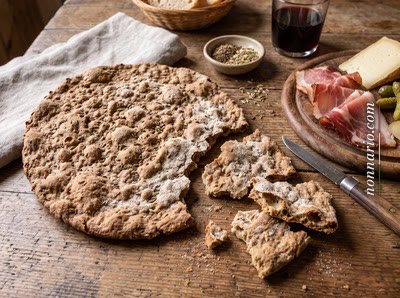
Gubbio's flatbread, cooked on the panaro
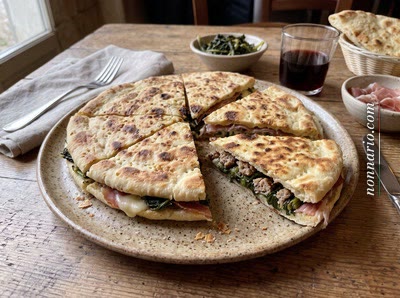
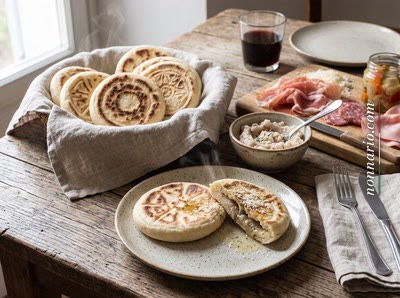
Gubbio's round flatbread of soft wheat flour, water, sea salt and a raising agent, with no added fat, risen briefly, rolled and cooked on both sides on the panaro, as its proposed PGI specification of 2026 sets.
The PGI is at the Italian stage: the Ministry of Agriculture's proposed specification goes to a public hearing in Gubbio on 17 December 2026, so it is not yet granted, and the specification may change before it is.
- Course
- Pizze e PaniPizza & Bread
- Serves
- 6
- Hands-on
- 21 min
- Cooking
- 16 min
- Resting
- 25 min+
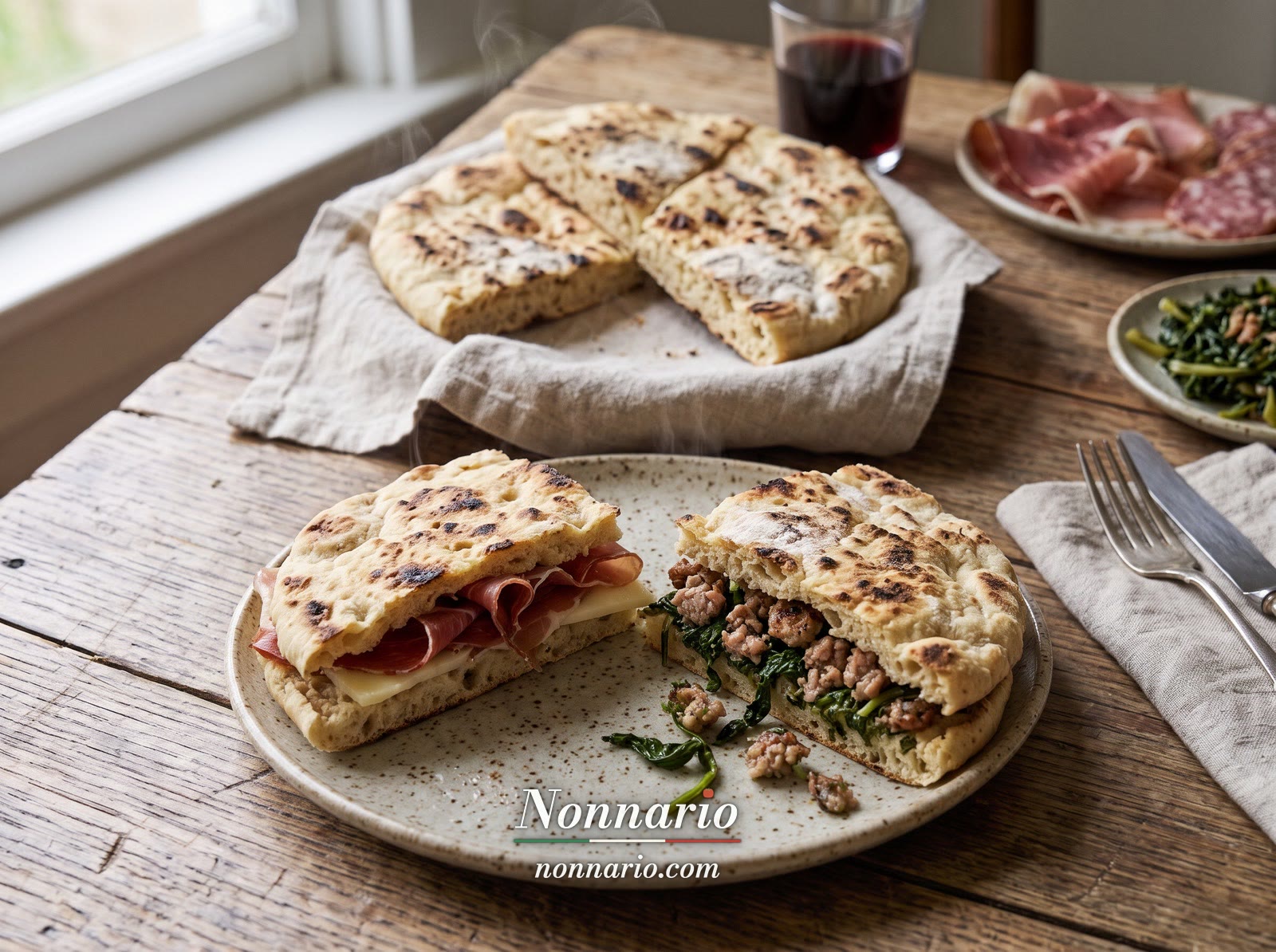
The video and the photos of every step are also gathered on a separate page.
In breve
In short
Also called Gubbio flatbread.
- Soft wheat flour tipo 0, water, sea salt and raising agents: no oil, lard or other added fat, under 2 g of fat in 100 g.
- Raised with brewer's yeast, lievito madre or bicarbonate, each with an instant raising agent, in ranges set per kilo of dough.
- Kneaded for 20 minutes at most, divided into pani and left to rise for 15–20 minutes before rolling.
- A disc 15 cm–42 cm across and 1 cm–2 cm thick, pricked with a fork as it cooks.
- Cooked on both sides on the panaro or a hot plate at 150 °C–250 °C, for 4–10 minutes by size.
La provenienza
Where this recipe comes from
The crescia is the round, flat bread of Gubbio and of four neighbouring towns in the province of Perugia: Scheggia e Pascelupo, Costacciaro, Fossato di Vico and Sigillo. It is cooked on the panaro, the name used at Gubbio for the testo, a heavy round griddle heated over a fire or a gas flame; the Region's list of traditional foods has a related flatbread of the province, torta al testo, also called crescia sul panaro. Its proposed specification traces the crescia to the sacred and farming culture of the ancient Umbrians and to the Iguvine Tables, engraved between the third and the first century BC and found in the territory of Gubbio in 1444, and calls cooking on the panaro older than baking in an oven. What sets it apart from similar breads made elsewhere, the same text says, is its low fat, since it is traditionally made with none added. The town of Gubbio had already registered it as a De.Co. by 2023, under its De.Co. rules of 2018, amended in 2025.
A promoting committee, the Comitato Promotore della Crescia di Gubbio IGP, has asked for it to be registered as a PGI. The Ministry of Agriculture drew up a proposed specification, sent with its note of 2 October 2026, and called a public hearing in Gubbio for 17 December 2026; the PGI is not yet granted, and the text may change before it is. This page follows that proposed specification. It sets soft wheat flour tipo 0, water and sea salt, with no fat, and three doughs by raising agent, each given as a range per kilo of dough: brewer's yeast, lievito madre or bicarbonate, each with an instant raising agent; it also allows preservatives within the law, which this batch does not use. The dough is kneaded for 20 minutes at most, divided, left to rise for 15–20 minutes, rolled into a disc 15–42 cm across and 1–2 cm thick, then cooked on both sides at 150–250 °C for 4–10 minutes, pricked with a fork. The specification sets ranges, not a household recipe: the batch here is one kilo of dough from the brewer's yeast table, with values of ours inside each range, and the other two doughs are given as variants. The griddle temperature, the times inside the specification's ranges and the size of each crescia are ours too, and say so where they appear.
- Provenance
- An application to protect the dish in the EU (TSG, PDO or PGI) is under way; this page follows its specification as it stands, which may change before it is granted.
- Defined by
- Ministry of Agriculture (MASAF), proposed PGI specification
- Reference
- Proposed specification of the PGI ‘Crescia di Gubbio’, attached to the Ministry's note no. 0529740 of 2 October 2026 calling the public hearing of 17 December 2026; not yet registered by the EU
- Sources
- Ministry of Agriculture (MASAF): note of 2 October 2026 calling the public hearing on the PGI request, with the proposed PGI specification ‘Crescia di Gubbio’ attached (a scan, as published by the newspaper Umbria24) (Italian)
- Regione Umbria, regional council (Assemblea legislativa): press release on the regional De.Co. law, 28 September 2023 (Italian)
- Comune di Gubbio: mayor's decree no. 14 of 31 August 2026, naming the De.Co. commission under the town's De.Co. rules (Italian)
- Regione Umbria: traditional food product sheet ‘Torta al testo’ (archived copy, Italian)
- Dissapore: the raising agents for cakes and how to use them, 2023 (Italian)
Ingredienti
Ingredients
The original recipe serves 6
Equipment
- A testo or panaro, or a heavy cast-iron or non-stick pan at least 28 cm across
- Kitchen scale
- A large bowl and a jug
- A wooden board and a rolling pin
- A fork
- A wide spatula, to turn the disc
- A clean cotton cloth
- A wire rack
- Infrared thermometer and probe thermometer (useful, not essential)
Preparazione
Method
Scaled to 6 servings: the amounts in the steps follow. Pot and pan sizes and cooking times are still for the original 6.
About 1 hour 15 minutes. Weighing, mixing and kneading take about 20 minutes. Divide the dough and put the griddle on to heat: it comes up to temperature while the pani rise for 15–20 minutes. Then roll the first disc and cook it for 8–10 minutes, rolling the second while it cooks, and cook that one in turn. Leave them to cool for about 10 minutes before cutting.
- 21 minhands-on
- 16 mincooking
- 25 minresting, at least
The dough
The specification gives each ingredient as a range per kilo of dough. This batch is one kilo from its brewer's yeast table, with values of ours inside each range.
-
Hands-on 5 min
Put the 650 g of flour, the 10 g of baking powder and the 8 g of sea salt in a large bowl and stir them together. In the jug, crumble the 15 g of fresh yeast into the 320 ml of lukewarm water and stir until it has dissolved.
Check No lumps of yeast left in the water, and the baking powder evenly mixed into the flour.
Tip Our guide: per kilo of dough, the specification's brewer's yeast table allows 600 g–700 g of flour, 5 g–25 g of instant raising agent, 10 g–20 g of brewer's yeast, 3 g–10 g of sea salt and 200 g–400 g of water, and preservatives within the law. The values here sit inside every range, with no preservatives.
Tip Our guide: water at about 30 °C feels just warm on the wrist and helps the yeast start; it should never feel hot.
Tip No oil, lard or butter, in the dough or on the board: the specification adds no fat at all.
-
Hands-on 10–15 minOfficial text
Mix all the ingredients, by hand or with a mixer, until they form an even dough. Knead only until it is even, and never for more than 20 minutes.
Check One smooth, even dough with no dry flour left: firm rather than soft, and barely sticky. Pressed with a finger, it springs slowly back.
Tip Our guide: pour the yeasted water into the flour, mix in the bowl, then turn the dough out onto the board. By hand this takes about 10–15 minutes; with a dough hook on low speed, about 8–10.
Tip Our guide: the dough is firm, with about half the flour's weight in water. If it will not come together, add water a tablespoon at a time; the table allows up to 400 g per kilo of dough.
Dividing and rising
-
Hands-on 2 minOfficial text
Divide the dough, by hand, into pani of the size you want each crescia to be.
Check Pieces of equal weight, each shaped into a smooth ball.
Tip Our guide: 2 pani of about 500 g each, for discs about 24 cm across in a pan of 28 cm. In a smaller pan, make 3 pani of about 330 g, for discs about 20 cm across.
Tip Our guide: tuck the edges under each piece to make a smooth ball; it rolls out rounder.
-
Temp 200 °C–220 °CHeat medium
Set the testo or pan, dry and ungreased, over a medium flame now, so that it is hot by the time the pani have risen.
Check An infrared thermometer reads about 200 °C–220 °C on the surface. Without one, a pinch of flour scattered on it turns light brown in about 15–20 seconds, without burning at once.
Tip Our guide: 200 °C–220 °C, inside the specification's 150 °C–250 °C. A cast-iron pan takes about 10 minutes to get there; a thick stone or clay testo takes longer, so put it on as soon as you start kneading.
Tip Never grease the griddle: the disc goes onto the dry surface.
-
Rest 15–20 minOfficial text
Leave the pani to rise for 15–20 minutes.
Check Slightly puffed and softer to the touch; a finger pressed in leaves a dent that fills slowly.
Tip Our guide: cover them with the cloth on the board, so that no skin forms on top.
Rolling and cooking
-
Hands-on 2–3 minOfficial text
With the rolling pin, roll each pane into a round disc of the size the specification sets for the crescia: 15 cm–42 cm across and 1 cm–2 cm thick.
Check An even thickness all over, edge included, with no thin patches.
Tip Our guide: flour the board lightly. A pane of 500 g rolled 1 cm thick makes a disc about 24 cm across; it thickens a little on the griddle. Turn it a quarter turn every few strokes, so it stays round.
Tip Our guide: roll the second pane while the first one cooks, so the discs never wait stacked.
-
Cooking 16–20 minTemp 200 °C–220 °CHeat mediumOfficial text
Cook the disc on the panaro, over a wood fire or gas, or on a gas-heated plate, at 150 °C–250 °C, on both sides, turning it over by hand. To help it cook, prick its surface with a fork or another metal utensil. The cooking takes 4–10 minutes, according to the size of the crescia and the way it is cooked.
Check Both sides from ivory to dark amber, with amber patches and the fork holes on both faces; the edge firm, and a hollow sound when you tap the underside. A probe pushed sideways into the middle reads at least 95 °C.
Tip Our guide: at home, a testo or pan heated to 200 °C–220 °C; lay the disc on the dry surface and turn it with the spatula. For a disc of about 24 cm, 8–10 minutes in all, turned about every 2 minutes; a crescia of 15 cm is ready in nearer 4–5. Then cook the next disc in the same way.
Tip Our guide: prick the top as soon as the disc is on the griddle, and the other side right after the first turn, so the holes go through both faces as the specification describes.
Tip Our guide: dark brown spots within the first minute mean the griddle is too hot, so lower the flame; still pale after 3 minutes, raise it a little.
Tip Our guide: 95 °C or more in the middle means the crumb is cooked through.
-
Rest 10 minOfficial text
Leave each crescia to cool at room temperature.
Check Warm rather than hot when you lift it, and the crust still crisp.
Tip Our guide: on the rack, about 10 minutes before cutting, so the crust does not go soft underneath. At home it can be cut while still warm.
-
Hands-on 2 min
Cut the crescia into wedges and serve it as bread, for instance with Umbrian cured meats.
Check Crisp outside and soft inside when you cut it.
The essentials, for cooks who know the dish. Switch to Detailed for quantities, temperatures, times and checks at every step.
Press “I’m here” on the step you are on, and again when it is done.Tap the pin on the step you are on, and the tick when it is done. Timers keep running while you scroll.
Da sapere
Good to know
- KeepingConservazione
- Once cool, it is packed straight away in food bags. It may also be frozen, packed as soon as it has cooled. Source
- VariantsVarianti
- With lievito madre: The specification's second dough, per kilo: 600 g–750 g of tipo 0 flour, 140 g–180 g of lievito madre instead of brewer's yeast, 5 g–25 g of instant raising agent, 3 g–10 g of sea salt and 200 g–350 g of water, made in the same way. Source
- With bicarbonate: The specification's third dough, per kilo: 600 g–750 g of tipo 0 flour, 5 g–12 g of bicarbonate of soda instead of yeast, 5 g–25 g of instant raising agent, 3 g–10 g of sea salt and 200 g–400 g of water, made in the same way. Source
Errori comuni
Common mistakes
- Adding oil or lard. The specification uses no fat at all, and the finished crescia has less than 2 g of fat in 100 g.
- Kneading for more than 20 minutes: the specification stops at 20, however the dough is made.
- Leaving out the rise. The pani rest for 15–20 minutes before they are rolled.
- Rolling it too thin. The specification's crescia is at least 1 cm thick.
- Cooking it too long. Ten minutes is the specification's limit, for the largest size.
Fuori dall'Italia
Cooking it outside Italy
- Use a plain soft wheat flour (plain in the UK, all-purpose in the US), not a strong bread flour.
- The specification's ‘lievito istantaneo’ is what English calls baking powder. Use a plain, unflavoured one.
- Fresh yeast is sold in small cubes in the chilled section. With active dry yeast, use about a third of the weight, 5 g for this batch, dissolved in the water in the same way.
- Without a testo, a heavy cast-iron pan or a flat griddle plate works; the specification itself allows a gas-heated plate.
From nonnario.com/recipes/crescia-di-gubbio/, where you will find its sources, its story and the step photos. Sources checked in November 2026.