Napoli, Campania
Parmigiana di melanzane
Neapolitan baked aubergine with tomato, fior di latte and Parmigiano
Long aubergines salted, fried and layered with tomato sauce, fior di latte, basil and Parmigiano, then baked until crisp on top: the Neapolitan parmigiana, one of Campania's traditional food products.
- Course
- SecondiMain Courses
- Serves
- 6
- Hands-on
- 1 h 30 min
- Cooking
- 1 h 10 min
- Resting
- 2 h 30 min+
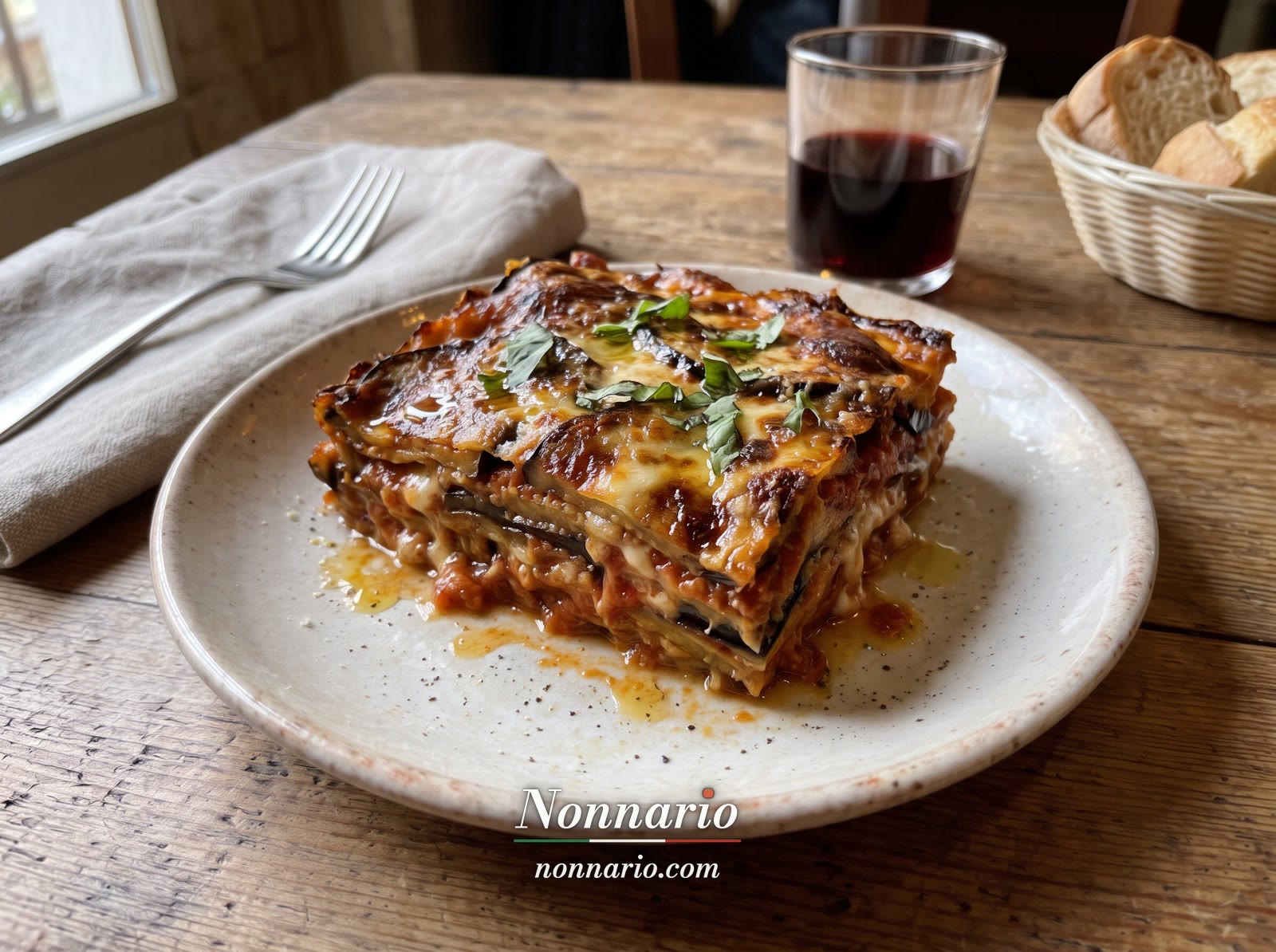
The video and the photos of every step are also gathered on a separate page.
In breve
In short
Also called melanzane alla parmigiana, parmigiana 'e mulignane, parmigiana, aubergine parmigiana and eggplant parmigiana.
- Vegetarian
- Gluten-free
- Long aubergines, trimmed, sliced lengthwise and salted, then fried a few at a time in plenty of oil.
- Drained for about an hour after frying, so the dish does not swim in oil.
- Layers of aubergine, tomato sauce cooked with onion and basil, cubes of fior di latte, basil leaves and Parmigiano.
- Finished with tomato and Parmigiano only, baked at 200 °C until the top is crisp, and served warm.
La provenienza
Where this recipe comes from
Parmigiana di melanzane is made all over Campania, in countless versions, and the Region lists it among its traditional food products: a timballo of aubergines, served at Neapolitan family feasts and in quick everyday meals alike. Campania's listing traces the term ‘alla parmigiana’ to late medieval dishes of fried meat or fish laid in layers and closed in pastry, which in time lost their case. In Naples, the 1839 edition of Ippolito Cavalcanti's Cucina teorico-pratica, in its appendix of home cooking written in dialect, already has molignane a la parmisciana: peeled aubergines sliced, salted under a weight, squeezed and fried, then laid in a pan layer upon layer with grated cheese, chopped basil and the broth of a stew or tomato sauce, and stewed under a lid heaped with embers. Sicily claims the dish too, and some add Emilia-Romagna for its cheese. Sicilian accounts take the name from parmiciana, a window shutter of overlapping wooden slats, like the slices in the dish; a historian of food calls it the likeliest explanation, though unproven, and on that reading the name has nothing to do with the cheese.
There is no official recipe. We compared ten sources and publish the most widely recognised version, the Neapolitan one, with long aubergines. Most agree on aubergines sliced, salted and fried, then layered in a baking dish with tomato, basil and cheese and baked. They differ on flouring the slices or dipping them in egg, on the cheese (fior di latte, mozzarella, provola or caciocavallo), and on a tomato sauce or a meatless ragù; the Sicilian versions add hard-boiled eggs. The slices drain for about an hour after frying, and the dish is served warm, not hot. The weights of aubergine, sauce and cheese, the oven at 200 °C and the hour of draining are the tradition's; the amounts of onion, oil, salt and basil, the slice thickness, the salting time, the frying oil and its temperature, the sauce's time, the size of the dish and the baking and resting times are our guide, set from comparable recipes. Leftovers go into the fridge within 2 hours, the limit of the food-safety guidance we follow.
- Provenance
- A regional tradition documented in cookbooks and local practice, with no single official text.
- Defined by
- Neapolitan tradition
- Reference
- Compared across 10 sources, listed below; this page publishes the most widely recognised version.
- Sources
- Accademia Italiana della Cucina: parmigiana di melanzane as made in Campania, from its recipe collection (Italian)
- Accademia Italiana della Cucina: parmigiana di melanzane as made in Sicily, from its recipe collection (Italian)
- Regione Campania, Assessorato Agricoltura: parmigiana di melanzane among Campania's traditional food products (PAT) (Italian)
- Regione Campania, Assessorato Agricoltura: the long Neapolitan aubergine (melanzana lunga di Napoli), a traditional food product (PAT) (Italian)
- Accademia Italiana della Cucina: L'Accademia no. 138, 2003, ‘Ipotesi sulla parmigiana’, an article on the dish's name (Italian)
- Il Cucchiaio d'Argento: parmigiana di melanzane, a recipe for 6 (Italian)
- Il Cucchiaio d'Argento: parmigiana di melanzane, its origin and history, an article (Italian)
- Ippolito Cavalcanti: Cucina teorico-pratica, second edition, Naples 1839 (Italian and Neapolitan)
- GialloZafferano: parmigiana di melanzane, editorial recipe for 8 (Italian)
- USDA Food Safety and Inspection Service: Leftovers and Food Safety (archived copy of 29 May 2025)
Ingredienti
Ingredients
The original recipe serves 6
For the aubergines
For the sauce
To assemble
Equipment
- Chef's knife and a large board
- Large colander set over a bowl, a plate and a weight, for salting; the same colander again for draining
- Wide saucepan or casserole, for the sauce, and a wooden spoon
- Wide, deep frying pan about 28 cm across and at least 7 cm deep, a kitchen thermometer, a slotted spoon or tongs, and a lid at hand
- Kitchen paper
- Rectangular oven dish about 20 cm × 25 cm, at least 5 cm deep
- A ladle, a grater for the Parmigiano and, ideally, a probe thermometer
Preparazione
Method
Scaled to 6 servings: the amounts in the steps follow. Pot and pan sizes and cooking times are still for the original 6.
Allow about 4½ hours, most of it waiting. Salt the aubergines for an hour and make the sauce meanwhile; fry them, then let them drain for about an hour while the oven heats; assemble, bake for 30–40 minutes and let it rest for 30–45 minutes, so it is served warm. If you can, the day before, leave the fior di latte uncovered in the fridge for 12–24 hours so it gives off less water in the oven.
- 1 h 30 minhands-on
- 1 h 10 mincooking
- 2 h 30 minresting, at least
Salting the aubergines
-
Hands-on 15 min
Wash and dry the aubergines. Cut off the head (the stalk end) and the tail. Lay each one on its side and cut a thin strip off the two long sides, the back and the belly, so that no slice is all skin. Then cut them lengthwise into slices about 5 mm thick.
Check Long, even slices of flesh edged with skin, all about the same thickness.
Tip Our guide: even slices fry evenly; thicker ones stay raw in the middle while the outside colours.
-
Hands-on 5 min
Lay the slices in the colander in layers, sprinkling each layer lightly and evenly with the fine salt (15 g in all). Set the colander over a bowl, put a plate and a weight on top, and leave them to lose their water.
Tip Our guide: the salt draws water out of the flesh, so the slices take up less oil and fry rather than stew.
-
Rest 1 h
Leave the aubergines under salt for 1 hour. Make the sauce meanwhile.
Check Beads of water on the slices and liquid in the bowl; the slices are limp and bend without breaking.
The sauce
-
Hands-on 6–8 minHeat medium-low
Warm the 3 tablespoons of extra virgin olive oil in the saucepan over medium-low heat, add the sliced onion and cook it, stirring often, until golden.
Check Soft and pale gold, not browned.
-
Cooking 40–50 minHeat very low, uncovered
Pour in the 1 kg of passata, add some salt and a few basil leaves, and let it reduce, uncovered, over the lowest heat, stirring now and then. Taste for salt at the end.
Check Thickened and darker, reduced by about a third: a spoon drawn across the bottom of the pan leaves a trail that closes slowly.
Tip Our guide: a thick sauce keeps the layers from turning watery; it only needs to tremble, not boil hard, or it catches.
Frying
-
Hands-on 10 min
Brush the salt off the slices and press them, a few at a time, between sheets of kitchen paper until they are dry.
Check Dry to the touch on both sides.
Tip Wet slices spit in hot oil. If a slice tastes very salty, rinse them all quickly in cold water and dry them thoroughly.
-
Hands-on 10 minTemp 170 °C–175 °CHeat medium-high
Pour the frying oil into the wide, deep pan (at least 2 cm deep) and heat it to 170 °C–175 °C, checking with the thermometer.
Check The thermometer reads 170 °C–175 °C; the oil shimmers but does not smoke, and a scrap of aubergine dropped in sizzles at once with steady small bubbles.
Tip Never leave hot oil unattended, keep the pan no more than a third full, and keep a lid at hand: never put water on burning oil. If the oil smokes, take the pan off the heat and let it cool to 175 °C before frying.
-
Hands-on 30–40 minTemp 170 °C–175 °C
Fry the slices a few at a time, without crowding the pan, for 2–3 minutes, turning them once, until light golden on both sides. Lift them out with the slotted spoon, let the excess oil drip back, and lay them in the clean colander. Let the oil come back to 170 °C before each new batch.
Check Light golden on both sides and soft right through, not crisp and never dark.
Tip Our guide: too many slices at once cool the oil, and the aubergines soak it up instead of frying.
-
Rest 1 h
Leave the fried slices in the colander, over a bowl, for about an hour, so the oil drains away. Heat the oven to 200 °C (static) towards the end, and cut the fior di latte into cubes of about 1 cm, leaving them in a sieve to drain.
Check No more oil drips from the slices.
Tip Our guide: an hour at room temperature is well within the 2-hour limit for cooked food; the dish is then baked.
Assembling and baking
-
Hands-on 2 min
Spread a ladle of the sauce over the bottom of the oven dish.
Check A thin, even veil of sauce with no bare patches.
-
Hands-on 10–15 min
Lay a layer of fried aubergine over the sauce, the slices side by side and just overlapping. Spoon sauce over it, scatter cubes of fior di latte and a few basil leaves, and sprinkle with grated Parmigiano. Repeat, layer after layer, until the aubergines are used up.
Check About four even layers, the last one of aubergine.
Tip Our guide: before you start, set aside two ladles of sauce and a good handful of the 100 g of Parmigiano for the top, then share out the rest of the sauce, the fior di latte and the cheese by eye among the layers.
-
Hands-on 2 min
Cover the last layer of aubergine with the sauce you kept back and sprinkle it with the rest of the Parmigiano. No fior di latte goes on top.
Check The top is evenly red with sauce under a light coat of cheese.
-
Cooking 30–40 minTemp 200 °C
Bake on the middle shelf of the oven at 200 °C until the surface is crisp.
Check The top is crusted and crisp at the edges, the sauce bubbles at the sides, and a knife pushed into the centre comes out hot (a probe reads at least 75 °C).
Tip Our guide: if the top is crisp before the centre is hot, cover it loosely with foil and give it a few minutes more.
-
Rest 30–45 min
Take the dish out and let it rest at room temperature until it is warm rather than hot, then cut it into squares and serve.
Check Warm to the touch in the middle; a square lifts out with its layers in place.
Tip Leftovers: put them in the fridge, covered, in portions or shallow containers, within 2 hours of baking, and eat them within 3 days of baking, the day or two it may be made ahead included. Reheat them covered in the oven until the centre reaches 75 °C.
The essentials, for cooks who know the dish. Switch to Detailed for quantities, temperatures, times and checks at every step.
Press “I’m here” on the step you are on, and again when it is done.Tap the pin on the step you are on, and the tick when it is done. Timers keep running while you scroll.
Da sapere
Good to know
- WhenQuando
- Served at Neapolitan family feasts and in quick everyday meals alike, as a starter, in place of the first course or as a main. Source
- KeepingConservazione
- It can be made a day or two before it is eaten. Source
- VariantsVarianti
- With egg: The slices dipped in beaten egg with salt, pepper and grated pecorino or Parmigiano before frying; beaten egg may also go on top for the gratin. Source
- With ragù and other cheeses: Layered with the sauce of a meat ragù, without the meat, and with strips of caciocavallo, provola or fior di latte, finished with plenty of grated cheese. Source
- Half grilled: Half the aubergines fried and half grilled on a griddle, or all of them grilled, for less fat. Source
- Floured: The slices dredged in flour before frying. Source
- Sicilian style: Unpeeled slices salted for at least half an hour and fried until crisp, layered with a sauce of fresh tomatoes, garlic and a little sugar, sliced hard-boiled eggs, tuma, grated caciocavallo and plenty of basil, and baked briefly at 180 °C; served warm or cold. Source
Errori comuni
Common mistakes
- Frying too many slices at once: the oil cools and the aubergines soak it up.
- Frying the slices crisp or dark: they should be golden and soft; the crust comes from the oven.
- Layering the slices straight from the pan: drain them for about an hour first, or the dish swims in oil.
- A thin sauce or wet fior di latte: the layers turn watery.
- Cutting it hot from the oven: serve it warm, once the layers have settled.
Fuori dall'Italia
Cooking it outside Italy
- For the aubergines, the long dark Neapolitan kind is best; large, firm, dark oval aubergines will also do, sliced lengthwise in the same way.
- Fior di latte is a mozzarella made from cow's milk; an ordinary mozzarella will do, well drained.
- Tomato passata is sieved tomato, sold in bottles; it is not tomato purée or concentrate.
From nonnario.com/recipes/parmigiana-di-melanzane/, where you will find its sources, its story and the step photos. Sources checked in November 2026.