Napoli, Campania
Genovese napoletana
Neapolitan beef and onion sauce, cooked down for hours
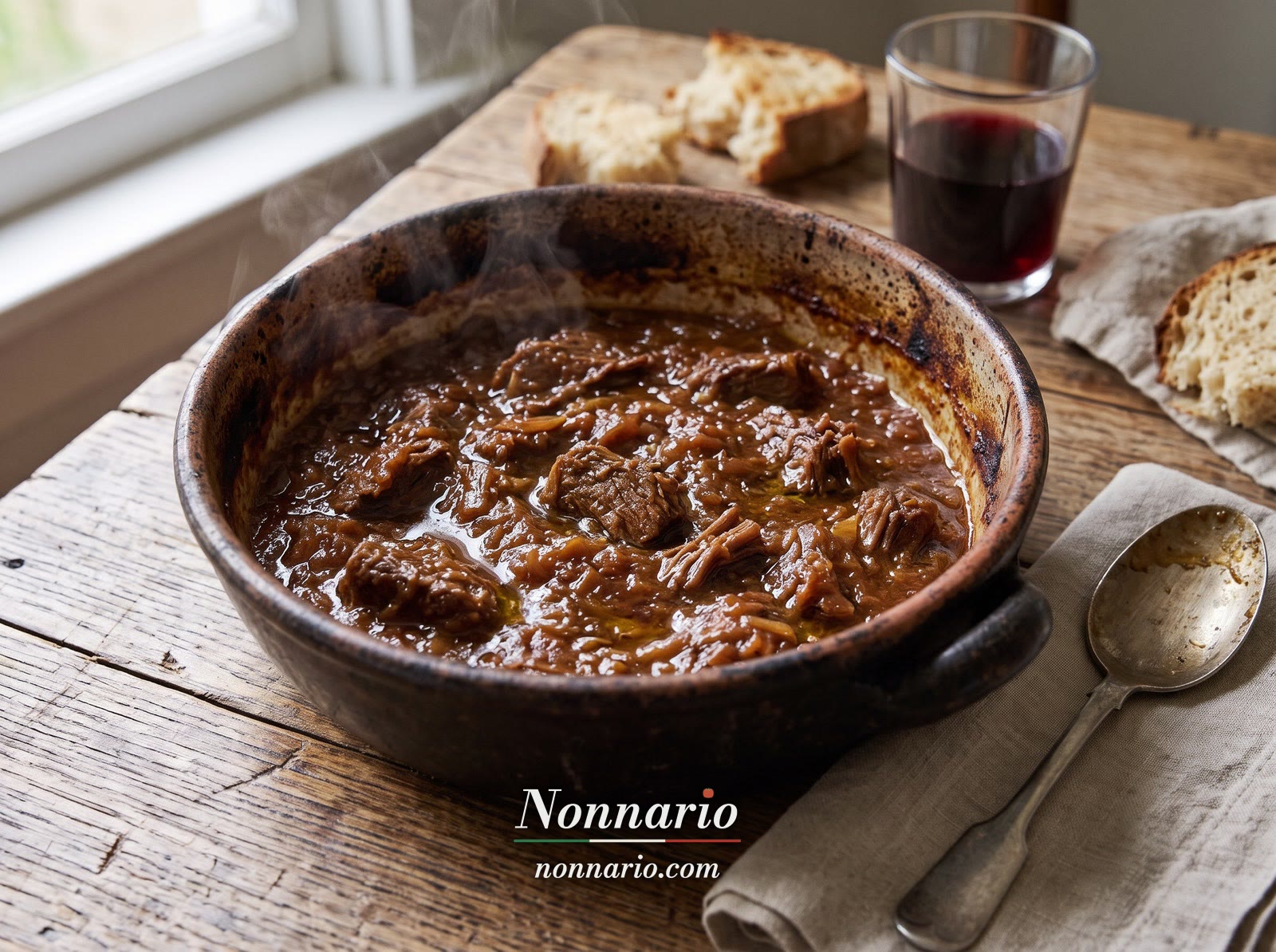
Onions cooked down for at least three hours with a piece of beef until they melt into a dense amber cream: the Neapolitan sauce for pasta, with the meat served as a second course, one of Campania's traditional food products.
- Course
- SughiSauces
- Serves
- 6
- Hands-on
- 1 h 26 min
- Cooking
- 3 h 12 min
- Resting
- 10 min+
The video and the photos of every step are also gathered on a separate page.
In breve
In short
Also called genovese, salsa genovese, sugo alla genovese, pasta alla genovese, carne alla genovese and Genovese sauce.
- A piece of beef cooked with one and a half times its weight in onions: 1.5 kg of onions to 1 kg of girello.
- A chopped base of onion, celery, carrot and lardo, in butter, lard and extra virgin olive oil.
- Dry white wine added a little at a time, then a glass of water and at least three hours, covered, on the lowest heat.
- Done when the meat is very tender and the onions have melted into a dense, amber cream.
- The sauce dresses pasta, or rice, with grated Parmigiano; the meat is eaten apart, as the second course.
La provenienza
Where this recipe comes from
Genovese is a sauce of beef and onions from the city of Naples, made all over Campania, which lists it among its traditional food products. A great weight of onions cooks for hours with a piece of beef until it turns into a sweet, amber cream; the sauce dresses the pasta, and the meat is eaten apart. Despite its name, the dish is unknown in Genoa, and the accounts of the name differ. One takes it back to the fifteenth century, when crews of the Republic of Genoa lodged by the port of Naples, and to a Genoese meat dish called u tuccu; another, to cooks from Genoa working in Naples in the fifteenth and sixteenth centuries; others speak of Swiss mercenaries from Geneva, or of a cook from Geneva (génevois) in the kitchen of an aristocratic Neapolitan family; and one, to a group of Genoese who settled in the Spanish Quarters of Naples in the second half of the nineteenth century. Each is told as a possibility, and none settles it.
There is no official recipe. We compared eight sources and publish the most widely recognised version: a whole piece of beef cooked with one and a half times its weight in chopped onions, over a base of celery, carrot and lardo in butter, lard and olive oil, with dry white wine and a glass of water, covered, on the lowest heat for at least three hours. The sources agree on beef, a great weight of onions, celery, carrot, white wine and hours of slow cooking, and on the sauce for pasta, most often ziti, with the meat kept for the second course. They differ on slicing or chopping the onions, on the fats, on the time and on when the wine goes in: many add it near the end, over a higher heat, to brown the sauce, and a few add a tomato or two. The quantities, the order of the work, the time and the signs of doneness are those of the version we publish; the size of a glass, the heat and length of each stage, when to season, the amount of pasta and the resting and slicing of the meat are our guide. If the sauce and the meat are not eaten at once, they go into the fridge within 2 hours of cooking, the limit of the food-safety guidance we follow.
- Provenance
- A regional tradition documented in cookbooks and local practice, with no single official text.
- Defined by
- Neapolitan tradition
- Reference
- Compared across 8 sources, listed below; this page publishes the most widely recognised version.
- Sources
- Accademia Italiana della Cucina: salsa genovese as made in Naples, from its recipe collection (Italian)
- Accademia Italiana della Cucina: maccheroni alla genovese as made in Naples, from its recipe collection (Italian)
- Accademia Italiana della Cucina: salsa genovese as made in Molise, from its recipe collection (Italian)
- Regione Campania, Assessorato Agricoltura: genovese among Campania's traditional food products (PAT) (Italian)
- GialloZafferano: genovese, editorial recipe for 4 (Italian)
- Il Cucchiaio d'Argento: pasta alla genovese, a recipe for 4 (Italian)
- La Cucina Italiana: pasta alla genovese, a modern recipe for 6 (Italian)
- USDA Food Safety and Inspection Service: Leftovers and Food Safety (archived copy of 29 May 2025)
Ingredienti
Ingredients
The original recipe serves 6
For the sauce
To serve
Equipment
- Chef's knife and a large board (or a food processor, used in short pulses)
- Kitchen string
- Heavy casserole with a lid, about 28 cm across and holding about 6 l: earthenware, enamelled or tinned copper
- Wooden spoon, a carving fork and a sharp carving knife
- A small pan, for the sauce kept back for the meat
- A warm plate and aluminium foil, for resting the meat
- Large pot for the pasta and a colander
- Shallow containers and a probe thermometer, if you make it ahead
Preparazione
Method
Scaled to 6 servings: the amounts in the steps follow. Pot and pan sizes and cooking times are still for the original 6.
Allow about 5–6 hours, most of it unattended: about 40 minutes to chop and tie, about 45 minutes to brown the meat and add the wine, at least 3 hours of covered cooking on the lowest heat, with a stir and a turn of the meat every 20–30 minutes, then about 30 minutes for the pasta and the meat. Put the pasta water on about 20 minutes before the sauce is done. It can be made ahead: the sauce and the meat into the fridge within 2 hours of cooking, eaten within 3 days of cooking, and the sauce brought back to the boil before you dress the pasta.
- 1 h 26 minhands-on
- 3 h 12 mincooking
- 10 minresting, at least
Preparation
-
Hands-on 25 min
Peel the 1.5 kg of onions, halve them from top to root and chop them with the knife, fairly finely.
Check A heap of evenly chopped onion, with no long strips or large pieces left.
Tip Our guide: pieces of about 3 mm–5 mm. Small, even pieces melt into the cream at the same pace.
Tip Our guide: a food processor saves time and tears: work in batches with short pulses and stop while it is still a chop. A purée gives off its water at once and stews instead of cooking down.
-
Hands-on 10 min
Trim and wash the 2 celery sticks, peel the 3 carrots and chop them finely with the 50 g of lardo. Add them to the onions.
Check The lardo is in small pieces through the vegetables, with no strips left.
Tip Our guide: the lardo chops more easily straight from the fridge, while it is firm.
-
Hands-on 5 min
Tie the 1 kg piece of girello with kitchen string, a loop every 3 cm–4 cm along its length, so it keeps its shape through the long cooking.
Check A neat, even roll that holds together when you lift it by the string.
Tip Our guide: if the piece is wet, pat it dry with kitchen paper first, so it colours better.
Browning
-
Hands-on 5 minHeat medium
Put the whole chopped mixture in the casserole with the 50 g of butter, the 100 g of lard and the glass of extra virgin olive oil (about 150 ml). Set it over medium heat and stir until the fats have melted.
Check The fats have melted and the mixture sizzles gently all over.
Tip Our guide: a casserole of about 6 l; the onions sink to well under half that as they cook.
-
Hands-on 20–30 minHeat medium
Push the vegetables aside, lay the tied beef on the bottom of the casserole and brown it, turning it every 5 minutes or so and stirring the vegetables each time, until it has coloured on every side.
Check The meat has lost its raw red colour all over and has golden-brown patches; the onions are soft and translucent and most of their water has evaporated, so the mixture sizzles rather than simmers.
Tip Our guide: at first the onions give off a good deal of water and the meat stews more than it browns; keep going, and it colours as that water evaporates.
Tip Our guide: if the vegetables start to catch before the meat has coloured, lower the heat a little; nothing should turn dark at this stage.
-
Hands-on 10–15 minHeat medium
Pour in the dry white wine (about 300 ml) in about three goes, letting each bubble off before you add the next, stirring and scraping the bottom with the wooden spoon.
Check Hold your face over the pan: you can no longer smell wine, only meat and onion.
Tip Our guide: a glass is about 150 ml, so the two glasses are about 300 ml in all.
The long cooking
-
Hands-on 2 minHeat lowest
Pour in the glass of water (about 150 ml), stir, and cover the casserole with its lid. Turn the heat down to the lowest it will go.
Check Under the lid, a lazy bubble breaks the surface every few seconds; no more.
-
Cooking 1 h 30 minHeat lowest
Leave it to cook, covered, on the lowest heat. Every 20–30 minutes, lift the lid, turn the meat and stir the onions from the bottom with the wooden spoon.
Check The onions have collapsed and turned pale gold, and there is still moisture in the pan.
Tip Our guide: if the bottom starts to stick, add 2 or 3 tablespoons of hot water and scrape it free. Never let it fry dry.
Tip Our guide: if even the lowest flame makes it bubble hard, set the casserole on a heat diffuser.
-
Cooking 1 h 30 min to 2 h 30 minHeat lowest
Keep it covered on the lowest heat, still stirring and turning the meat every 20–30 minutes, for at least three hours in all, until the meat is very tender, the vegetables have melted into a cream and the sauce is dense and amber.
Check A carving fork slides into the thickest part of the meat and out again without resistance; the onions no longer show as pieces but as a thick cream that holds a trail when the spoon is drawn through it; the colour is a warm amber. If not, cover again and check every 20 minutes.
Tip Our guide: as it thickens, it catches more easily: stir more often in the last hour.
Tip Our guide: put the pasta water on about 20 minutes before you expect it to be done.
-
Hands-on 2 min
Taste the sauce and season it with salt and black pepper.
Check Seasoned to your taste.
Tip Our guide: season only now: the lardo is salt-cured, and the sauce has reduced a great deal.
The pasta, then the meat
-
Rest 10 min
Lift the meat onto a warm plate and cover it loosely with foil. Keep the sauce covered on the lowest heat.
Check The juices have settled: a little liquid has gathered on the plate.
Tip To make it ahead: within 2 hours of the end of cooking, cool the sauce in shallow containers and slice the meat, then cover both and put them in the fridge. Eat them within 3 days of the day they were cooked (a portion frozen within those days and thawed in the fridge has what is left of them). Bring the sauce back to a full boil, stirring, and heat the slices in it until they are at least 75 °C at the centre. Once reheated and served, anything left goes back in the fridge within 2 hours, within the same 3 days, or is thrown away, and is not reheated or set out again.
-
Cooking 12 minHeat high
Bring about 5 l of water to the boil and salt it, 10 g per litre. Break the 500 g of ziti by hand into 3 or 4 pieces each, drop them in, stir and cook them until al dente.
Check Bite a piece: it is cooked through but still firm at the centre.
Tip Our guide: drain them about a minute before the time on the packet, since they finish in the sauce.
Tip Our guide: break them over the pot, or inside a clean cloth, so the pieces do not fly.
-
Hands-on 2 minHeat lowest
Spoon a few ladles of sauce into a small pan for the meat. Drain the ziti and tip them into the casserole with the rest of the sauce; toss them over the lowest heat for about a minute.
Check Every piece is coated in the onion cream.
Tip Serve at once, with grated Parmigiano at the table.
-
Hands-on 5 min
Cut the string off the meat and slice it across the grain, about 1 cm thick. Warm the sauce kept back, lay the slices on a warm platter and spoon it over them. Serve it after the pasta, as the second course.
Check Clean slices that hold together and are tender to the fork.
Tip Our guide: cutting across the grain keeps the slices from coming out stringy.
The essentials, for cooks who know the dish. Switch to Detailed for quantities, temperatures, times and checks at every step.
Press “I’m here” on the step you are on, and again when it is done.Tap the pin on the step you are on, and the tick when it is done. Timers keep running while you scroll.
Da sapere
Good to know
- WhenQuando
- In Naples, one of the great Sunday dishes. Source
- KeepingConservazione
- The sauce keeps for a couple of days in the fridge in an airtight container, and it can be frozen. Source
- VariantsVarianti
- Browned with the wine at the end: The tied beef cooked covered for about two hours with sliced onions, chopped celery and carrot, Neapolitan salame, a few split cherry tomatoes, oil, butter and two glasses of water; then the meat comes out, the heat goes up and the sauce is browned, the wine poured in and boiled off in several goes, until it is a glossy dark cream. The meat goes back with a glass of water for about ten minutes, and the pasta is served with grated Parmigiano and romano cheese. Source
- With pork as well: Ham, or the muscle of the pig's shin called gallinella, cooked with the beef. Source
- Without water, the wine at the end: Thinly sliced onions, celery and carrot cooked in olive oil with the beef in pieces, covered, for about three hours with no water, the onions giving off their own; then the heat goes up and the wine goes in a little at a time, uncovered, for about another hour as the bottom dries. Source
- With a little tomato: A few cherry tomatoes, or a little tomato concentrate, cooked in the sauce. Source
- Molise style: Made with copertella (also called biancostato) and a few sinews, fatty ham with its rind, onions, celery, carrot and parsley, browned over a lively heat, splashed with white wine and cooked for about two hours; served on broken candele, paccheri or fresh egg pasta with plenty of Parmigiano, and the meat may be minced for meatballs. Source
Errori comuni
Common mistakes
- Hurrying it over a higher heat: the onions catch on the bottom before they have melted. Keep it covered on the lowest heat for at least three hours.
- Leaving it unstirred for long: the thick onion cream sticks. Stir it and turn the meat every 20–30 minutes, more often towards the end.
- Stopping while the onions still show as pieces or are pale: they must be a dense, amber cream.
- Salting at the start: the lardo is salt-cured and the sauce reduces a great deal. Taste and season at the end.
- Slicing the meat straight from the pot, or along the grain: rest it for 10 minutes and cut across the grain.
Fuori dall'Italia
Cooking it outside Italy
- Girello, or lacerto, is the eye of round, a long, lean muscle; ask for one piece of about 1 kg. Fattier, sinewy cuts of adult beef, such as the shoulder (chuck), are also used, and suit the long cooking.
- Lardo is cured pork back fat, sold in a piece or in slices; strutto is rendered pork lard, sold as lard.
- Any white, golden (yellow) or copper-skinned onion will do; in Campania white or copper-skinned (ramata) onions are used.
- Ziti are long, hollow tubes of dried pasta, and candele (zitoni) are similar, broken by hand the same way; without them, paccheri will do.
From nonnario.com/recipes/genovese/, where you will find its sources, its story and the step photos. Sources checked in November 2026.