Palermo, Sicilia
Pasta con le sarde
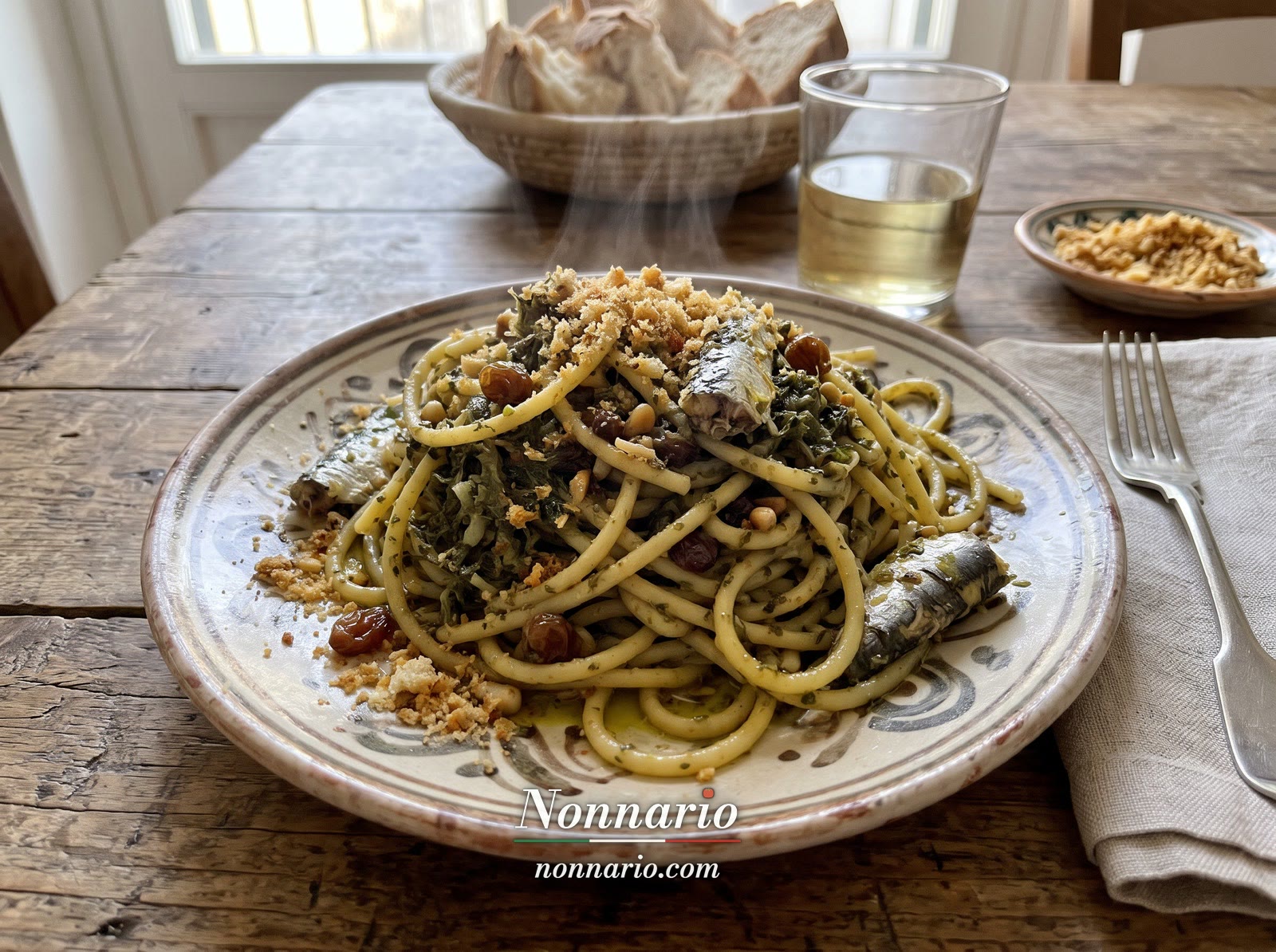
Bucatini with fresh sardines, wild fennel, raisins, pine nuts and saffron, Palermo style
Bucatini boiled in the water of wild fennel and dressed with fresh sardines cooked with onion, melted salted anchovies, small raisins, pine nuts, the fennel and saffron, finished with toasted breadcrumbs: the pasta of Palermo, on Italy's national list of traditional food products.
- Course
- Primi & RisottiPasta & Rice
- Serves
- 4
- Hands-on
- 1 h 1 min
- Cooking
- 36 min
The video and the photos of every step are also gathered on a separate page.
In breve
In short
Also called pasta chi sardi, pasta che sàrdi, pasta con le sarde alla palermitana, bucatini con le sarde, pasta with sardines and Sicilian pasta with sardines and fennel.
- Fresh sardines, cleaned and boned, cooked with onion, salted anchovies, small raisins and pine nuts, then with the wild fennel and saffron.
- Wild fennel boiled for 15 minutes from the boil, and its water kept to cook the pasta.
- Bucatini boiled al dente in the fennel water and dressed with the sauce.
- Toasted breadcrumbs scattered over instead of cheese.
- No tomato in this version: some versions add it, and some bake the dressed pasta in the oven.
La provenienza
Where this recipe comes from
Pasta con le sarde is the pasta of Palermo, made all over Sicily: fresh sardines and wild fennel, which grows in plenty on the island, with raisins and pine nuts for sweetness, usually saffron and anchovies too, and, in the Palermo way, breadcrumbs toasted golden, the muddica atturrata, scattered over in place of cheese. Every area has its own version: with tomato sauce, without it, or baked in the oven, sometimes in layers like a pie. When sardines could not be caught or were too dear, Palermo made the same dish without them, with anchovies instead, and called it pasta con le sarde a mare, the sardines having stayed in the sea. The Region of Sicily describes the dish as pasta chi sardi among its traditional food products, for Bagheria, and the national list carries it as pasta che sàrdi.
There is no official recipe. We compared eleven sources and publish the most widely recognised version: wild fennel boiled for a quarter of an hour, a chopped onion turned golden in olive oil with salted anchovies melted into it, fresh sardines cooked with small raisins and pine nuts, then the fennel and saffron, and bucatini boiled in the fennel water and dressed with the sauce, served at once with toasted breadcrumbs. Most of them agree on fresh sardines and wild fennel, on boiling the fennel and cooking the pasta in its water, and on onion; most add raisins and pine nuts, saffron and anchovies, and finish the dish with toasted breadcrumbs. They differ on tomato, on the oven, on frying some of the sardines, and on how much of each ingredient. This page serves it straight from the pot, without the oven, as one version of the recipe we follow does. Ours are the weights that recipe leaves to the cook, the heat at each stage, and the checks: the sardines cook well past the 63 °C that food-safety guidance gives for fish, and leftovers go into the fridge within 2 hours.
- Provenance
- A regional tradition documented in cookbooks and local practice, with no single official text.
- Defined by
- Sicilian tradition
- Reference
- Compared across 11 sources, listed below; this page publishes the most widely recognised version.
- Sources
- Accademia Italiana della Cucina: pasta con le sarde all'uso di Palermo, from its recipe collection, for 4 (Italian)
- Regione Siciliana, Department of Tourism (Visit Sicily portal): pasta con le sarde, a recipe for 6, with the local versions (Italian)
- Regione Siciliana, Department of Agriculture: the 2021 sheets of Sicily's traditional agri-food products, ‘Pasta con le sarde, Pasta chi sardi’ (archived copy, Italian)
- Ministry of Agriculture (MASAF): the 25th revision of the national list of traditional agri-food products, 2025, with ‘Pasta che sàrdi’ for Sicily (Italian)
- La Cucina Italiana: pasta con le sarde alla siciliana, recipe for 4, 2018 (Italian)
- GialloZafferano: pasta con le sarde, editorial recipe for 4 (Italian)
- Dissapore: pasta con le sarde alla siciliana, baked, for 4, 5 October 2021 (Italian)
- Sale&Pepe: pasta con le sarde al finocchietto, with tomato, for 4, March 2026 (Italian)
- Gambero Rosso: pasta con le sarde a mare, the Palermo version without sardines, with a recipe, 25 August 2025 (Italian; archived copy)
- USDA Food Safety and Inspection Service: Safe Minimum Internal Temperature Chart, fish and shellfish at 145 °F (archived copy)
- USDA Food Safety and Inspection Service: Leftovers and Food Safety (archived copy of 29 May 2025)
Ingredienti
Ingredients
The original recipe serves 4
For the sauce
For the bucatini
To finish
Equipment
- A small sharp knife and kitchen scissors, for cleaning the sardines and anchovies, and kitchen paper
- A large pot of about 6 l with a lid, a slotted spoon, a colander and a mug for pasta water
- A wide frying pan or sauté pan about 28 cm across, and a wooden spoon
- A small frying pan, for the breadcrumbs
- A ladle, a fork and a food thermometer
- A serving bowl, warmed
Preparazione
Method
Scaled to 4 servings: the amounts in the steps follow. Pot and pan sizes and cooking times are still for the original 4.
Start about 1¾ hours before you eat. Clean the sardines and anchovies first, about 30 minutes, and keep them in the fridge; put the water on and trim the fennel while it heats. The fennel boils for 15 minutes, then its water waits at a simmer for the pasta. Toast the breadcrumbs, then make the sauce: about 30 minutes. The bucatini go into the fennel water as the sauce begins its last 10 minutes, so both are ready together. The dish is eaten as soon as it is made.
- 1 h 1 minhands-on
- 36 mincooking
Getting ready: the sardines and the anchovies
The quantities and the method follow one recipe whole, served straight from the pot without the oven, as one of its own versions does; the weights it leaves to the cook, the heat levels, the checks and the tips marked ‘Our guide’ are ours.
-
Hands-on 8–10 min
Scale the 500 g of sardines, then take off the heads and pull out the guts.
Check No loose scales come away when you run a finger from tail to head, and the belly cavity is empty.
Tip Our guide: work under a thin stream of cold water and scrape from the tail towards the head with the back of a small knife. Pull each head forward between two fingers: most of the guts come away with it.
-
Hands-on 15–20 min
Bone the sardines completely: open each one along the belly and press it flat like a book, then lift out the backbone and cut it off with the tail. Rinse them quickly and pat them dry.
Check Each sardine lies open in one piece or two fillets, with no backbone, tail, fins or dark matter left; a few hair-fine bones may remain.
Tip Our guide: slit the belly to the tail with your thumb or the scissors, press the fish flat skin side up along the backbone, turn it over and lift the backbone from the head end towards the tail, then snip it off with the tail.
Tip Our guide: the hair-fine bones that remain soften in the cooking. Keep the cleaned sardines covered in the fridge until they go into the pan, and wash your hands, the board and the sink with soap and hot water.
-
Hands-on 5 min
Clean and bone the 3 salted anchovies.
Check 6 clean fillets with no salt, backbone or tail left on them.
Tip Our guide: rinse each anchovy under cold water, rubbing off the salt; open it along the belly with your thumb, pull away the backbone and tail and pat the fillets dry. Keep them with the sardines.
The wild fennel and its water
-
Hands-on 2 minHeat high
Bring the 4 l of water to the boil in the large pot, covered.
Check The pot is on the heat, covered; it takes about 15 minutes to boil, while you trim the fennel and chop the onion.
Tip Our guide: this same water cooks the fennel and then the pasta, so the pot must hold both.
-
Hands-on 8–10 min
Trim the bunch of wild fennel, discarding only the tough parts of the stalks, and wash it in cold water.
Check Only the tender stalks and the feathery leaves are left, and no grit sinks to the bottom of the washing water.
Tip Our guide: a stalk is too tough if it will not snap cleanly between your fingers.
-
Hands-on 3–5 min
Peel the onion and chop it finely.
Check Small, even pieces, about 3 mm.
-
Cooking 15 minHeat high, then a steady boil
When the water boils, add the 30 g of coarse salt and the fennel and boil it for 15 minutes from the moment the water comes back to the boil.
Check A stalk is tender right through when pierced with a knife, and the water has turned green.
Tip Our guide: start the 15 minutes when the water boils again after the fennel goes in.
-
Hands-on 5 min
Lift the fennel out of the pot with the slotted spoon, keeping all the cooking water in the pot. Squeeze it and cut it into small pieces of 1 cm–2 cm.
Check The fennel is squeezed of most of its water and cut into short, even pieces; the pot still holds its green water.
Tip Our guide: let the fennel cool for a minute in the colander before you squeeze it with your hands, over the pot so the water goes back in.
Tip Our guide: put the lid back on the pot and keep the water at a gentle simmer for the pasta.
The breadcrumbs and the sauce
-
Hands-on 4–5 minHeat medium-low, in a dry pan
In the small pan, toast the 60 g of breadcrumbs until golden, then tip them into a bowl.
Check The crumbs are an even golden brown, dry and smelling toasted, with no dark specks.
Tip Our guide: stir all the time, as they colour suddenly at the end; tip them out at once, or the hot pan carries on browning them.
-
Hands-on 6–8 minHeat medium-low
Heat 4 tablespoons of olive oil in the wide pan, add the onion and let it turn golden.
Check The onion is soft and pale gold, with no dark edges.
Tip Our guide: stir often; if it starts to brown at the edges, turn the heat down.
-
Hands-on 2 minHeat low
Add the anchovy fillets and break them up with a fork until they melt into the oil.
Check No pieces of anchovy can be seen; the oil is cloudy and smells of anchovy.
Tip Our guide: keep the heat low, so the anchovies melt rather than fry.
-
Cooking 10 minHeat medium-low
Add the sardines, the 20 g of raisins and the 20 g of pine nuts, season with salt and pepper, stir gently and let them cook together for 10 minutes.
Check The sardine flesh is opaque all through and flakes, and a thermometer in the thickest piece reads at least 63 °C; the raisins have swollen.
Tip Our guide: stir now and then with the wooden spoon, gently: the sardines break into pieces, and that is right, but they should not turn to a paste.
Tip Our guide: 63 °C is the temperature US food-safety guidance gives for fish; the sardines go on cooking for 10 minutes more with the fennel.
Tip Our guide: taste for salt before adding much: the anchovies bring plenty.
-
Cooking 10 minHeat low
Dissolve the saffron in about 200 ml of the fennel water (two ladles for four) and add it to the pan with the fennel. Stir gently, lower the heat and cook for 10 minutes more. As soon as the fennel is in, turn the fennel water up to a full boil, topping it up with a little boiling water if needed, and put in the 400 g of bucatini.
Check The sauce is golden yellow, moist and loose but not soupy, and the fennel has softened into it; the bucatini are boiling.
Tip Our guide: if the sauce dries out, add a spoonful or two of the fennel water.
Tip Our guide: the pot should hold about 4 l again before the pasta goes in; boil some water in the kettle to top it up. Stir the bucatini in the first minute so they do not stick.
Tip Our guide: if the packet gives the bucatini less than 10 minutes, put them in a little later, so they are ready when the sauce is.
The pasta
-
Cooking 1–3 min
Cook the bucatini until al dente, usually 10–12 minutes, or the time on the packet, and drain them, keeping back a mug of the water.
Check Bite a strand: tender, with a slight firmness at the centre.
Tip Our guide: warm the serving bowl with a little of the boiling water and pour it away just before draining.
-
Hands-on 3 min
Tip the bucatini into the warmed bowl, pour the sauce over and toss gently. Serve at once, with the toasted breadcrumbs scattered over.
Check Every strand is coated and flecked with sardine, fennel, raisins and pine nuts, and the dish is steaming hot.
Tip Our guide: if it looks dry, toss in a spoonful or two of the water you kept.
Tip Our guide: scatter half the breadcrumbs over the bowl and pass the rest at the table, so they stay crisp.
The essentials, for cooks who know the dish. Switch to Detailed for quantities, temperatures, times and checks at every step.
Press “I’m here” on the step you are on, and again when it is done.Tap the pin on the step you are on, and the tick when it is done. Timers keep running while you scroll.
Da sapere
Good to know
- WhenQuando
- In Bagheria, near Palermo, it has always been one of the dishes of the feast of San Giuseppe, the town's patron saint, in March. Source
- KeepingConservazione
- Leftovers go into the fridge, in a shallow airtight container, within 2 hours of cooking, and keep for one day at most. Warm them in a frying pan with a little oil and a spoonful of water over a low heat, stirring gently, until piping hot (75 °C); the microwave dries out the sardines and makes the pasta rubbery. Source
- VariantsVarianti
- Baked: The dressed pasta put into a greased baking dish, sprinkled with the toasted breadcrumbs and baked at 220 °C for ten minutes; some cooks layer it with the sauce before baking. The dish is also made without breadcrumbs. Source
- Baked with fried sardines: Half the sardines floured and fried in seed oil, the rest cooked in the sauce; the pasta, finished in the pan with a ladle of its water, layered in a greased dish with the fried sardines, ending with sardines, and baked at 180 °C for ten minutes. Source
- With tomato, Bagheria style: Tomato extract dissolved in the onion with a little water before the blanched fennel, the cleaned sardines, pine nuts and raisins go in, all cooked about ten minutes; the breadcrumbs toasted with sugar and a drop of oil. Source
- Pasta con le sarde a mare: Without sardines: anchovies in oil melted into the onion, with raisins, pine nuts, a ladle of the fennel water, a spoonful of tomato concentrate and saffron, then the fennel, a splash of white wine and about ten minutes' cooking; the bucatini cooked in the fennel water and dressed with plenty of toasted breadcrumbs. Source
Errori comuni
Common mistakes
- Throwing away the fennel water: the bucatini cook in it.
- Leaving the backbones in the sardines: they are boned completely before cooking.
- Frying the anchovies: they melt into the oil over a low heat.
- Stirring the sardines hard: they break into pieces, but should not turn to a paste.
- Adding the breadcrumbs too early: scattered over at the table, they stay crisp.
Fuori dall'Italia
Cooking it outside Italy
- Sardines are the European pilchard, Sardina pilchardus; buy them fresh and whole, or ask the fishmonger to clean and bone them.
- Wild fennel is hard to find outside Italy. In its place, use finely sliced fennel bulb, or the feathery fronds of fennel bulbs with a teaspoon of fennel seeds crushed in a mortar, added to the sauce.
- Uva passolina is the small, dark, seedless raisin also called the Corinth raisin, sold as currants.
- Bucatini are thick spaghetti with a hole down the middle.
- Saffron threads can replace the powder: toast them in a dry pan for a moment, then add the fennel water and let it turn yellow.
From nonnario.com/recipes/pasta-con-le-sarde/, where you will find its sources, its story and the step photos. Sources checked in November 2026.