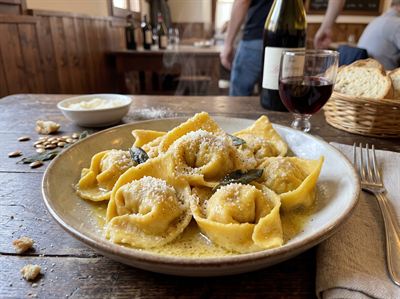
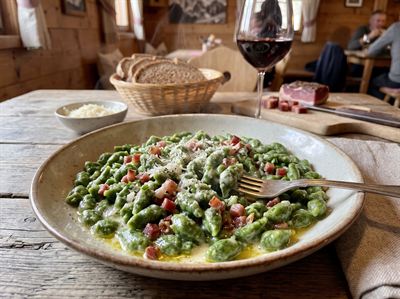
Val del But (Carnia), Friuli-Venezia Giulia
Cjarsons
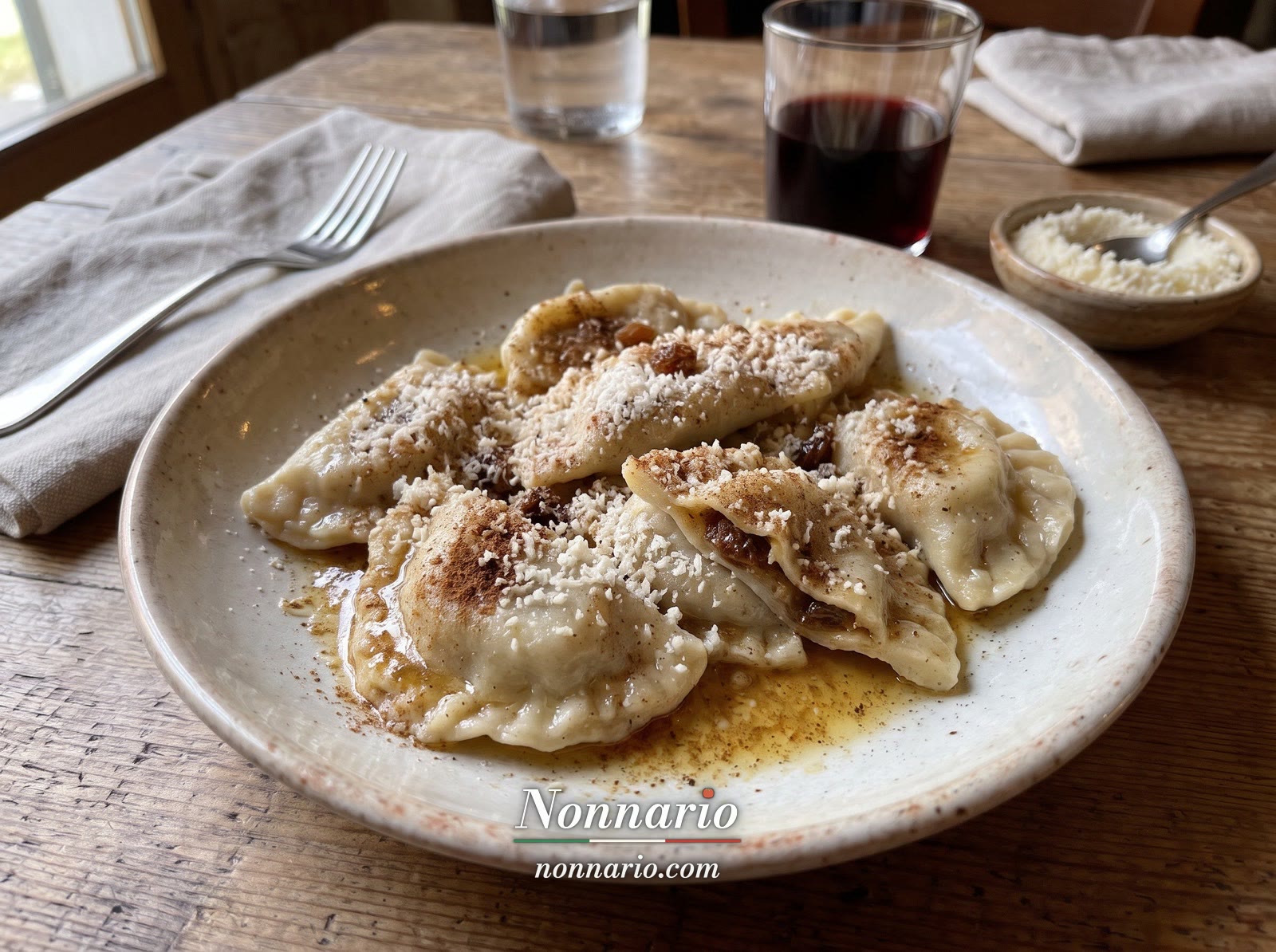
Carnia's filled half-moons, here of potato dough with a sweet and savoury filling
The filled pasta of Carnia as made in the Val del But: discs of potato dough folded over a filling of potato, smoked ricotta and herbs sweetened with sultanas, cocoa, fruit and cinnamon, boiled and dressed with melted butter and smoked ricotta.
- Course
- Primi & RisottiPasta & Rice
- Serves
- 6
- Hands-on
- 2 h 5 min
- Cooking
- 53 min
- Resting
- 45 min+
The video and the photos of every step are also gathered on a separate page.
In breve
In short
Also called cjalsons, cjalzons, cjalsòns, cjarsòns, cjalzòns and Carnia ravioli.
- Vegetarian
- Here a dough of boiled, sieved potatoes with a little 00 flour and an egg (elsewhere flour and water), cut into 7 cm discs and folded into half-moons.
- This valley's filling, the pistùm, is savoury and sweet at once: potato, smoked ricotta and herbs, with sultanas, cocoa, sugar, jam, fruit and cinnamon.
- Boiled until they float, then dressed with melted butter, grated smoked ricotta and a dusting of cinnamon.
- No meat: in Carnia they are a meatless dish for feast days.
La provenienza
Where this recipe comes from
Cjarsons, also written cjalsons or cjalzons, are the filled pasta of Carnia, the Alpine corner of Friuli, and the region lists them among its traditional food products. The name goes back to the medieval Latin calzone and is found in Friuli by the end of the 1300s, already tied to a sweet taste. The spices in the filling probably came with the cramârs, the Carnic pedlars who from the 1700s carried spices bought in Venice across the Alps on their backs; what was left at the bottom of their wooden chests of drawers went into the filling. They were a meatless dish for feast days: Christmas Eve before the evening service, Easter, Ascension, confirmations and weddings.
There is no official recipe: every valley, almost every house, has its own. The dough is flour and water, or potatoes with a little flour, which is the younger kind, since the potato only spread in the region in the 1800s; the filling is of herbs or of fruit, from sweetish to sharp. What they share is the half-moon cut from a disc, the boiling, and the dressing of melted butter and smoked ricotta, often with cinnamon. We compared eight sources and publish a version from the Val del But, one of Carnia's valleys, with a potato dough and a filling that is savoury and sweet at once. Ours are the serving count, the kind and weight of the potatoes, how much filling goes in each, the boiling and cooking times, the thickness of the sheet and the salt in the water; the recipe does not say when the sweet ingredients join the filling, so on this page they are mixed in with the ricotta and herbs.
- Provenance
- A regional tradition documented in cookbooks and local practice, with no single official text.
- Defined by
- Carnic tradition
- Reference
- Compared across 8 sources, listed below; this page publishes the most widely recognised version.
- Sources
- Linkiesta: cjarsons, the dish that tells the story of Carnia, with Gianni Cosetti's recipe for the cjalsons of the Val del But (Italian)
- ERSA, the Region's rural development agency: Cibario del Friuli Venezia Giulia, the atlas of its traditional food products, 2017 edition (Italian)
- Turismo FVG, the Region's tourism agency: cjarsons, a typical product (Italian)
- QN Quotidiano.net: the Festa dei Cjarsòns in Sutrio, and a home recipe for savoury cjarsons (Italian)
- QN Quotidiano.net: the cjalsons of Timau, a Paluzza restaurant's recipe (Italian)
- Dissapore: Friulian cjarsons, the sweet ravioli of Carnia (Italian)
- Scatti di Gusto: cjarsons, a sweet recipe with a potato dough (Italian)
- MICHELIN Guide Italy: cjarsons, the filled pasta of Friuli (Italian)
Ingredienti
Ingredients
The original recipe serves 6
For the dough
For the filling (pistùm)
To cook and dress them
Equipment
- Large pan for the potatoes
- Potato ricer or fine sieve
- Small frying pan, for the herbs, and a small pan for the butter
- Fine grater
- Shallow dish with a lid or cling film, for the filling in the fridge
- Large wooden board and a rolling pin
- Round cutter or glass, 7 cm across
- Trays lined with clean cotton cloths, dusted with flour
- Pot of at least 6 l for 6 servings (for more, use two pots or cook more batches), and a skimmer or slotted spoon
- Ovenproof serving dish
Preparazione
Method
Scaled to 6 servings: the amounts in the steps follow. Pot and pan sizes and cooking times are still for the original 6.
About 3 hours, most of it hands-on: about 45 minutes to boil the potatoes, 30 minutes for the filling and the dough, about an hour and a quarter to shape some 70 cjarsons (longer the first time), then about 30 minutes to cook them in batches and dress them. Boil all the potatoes together, unless you make the filling the day before (below). The cooked potato is perishable: the dough and the filling wait in the fridge, covered, and come out a piece at a time; the shaped cjarsons go into the fridge on their trays as each tray is filled, unless they will be in the pot within 2 hours of the potatoes coming out of theirs. The filling can be made the day before and left to rest overnight in the fridge, as is traditional: then boil only its 3 potatoes that day, and only the dough potatoes on the day you shape. The 2 hours count from the dough potatoes; the 3 days count from the first potatoes boiled, the filling's.
- 2 h 5 minhands-on
- 53 mincooking
- 45 minresting, at least
The potatoes
-
Cooking 30–40 minHeat high to boil, then medium
Wash the 800 g of potatoes for the dough and the 3 for the filling and put them, whole and unpeeled, into the large pan. Cover with cold water by about 3 cm, bring to the boil and cook at a steady simmer for 30–40 minutes, depending on their size.
Check A thin knife slides into the centre of the largest potato with no resistance.
Tip Our guide: floury potatoes give a dry mash that needs less flour, so the dough stays tender.
-
Hands-on 10–15 min
Drain the potatoes and peel them while they are still hot, holding each in a cloth. Pass them through the ricer or the sieve, keeping the 3 for the filling apart from the rest. Spread the dough potatoes out in a wide bowl to let the steam escape.
Check Fine and fluffy, with no lumps left.
Tip Note the time the potatoes came out of the pot: from then, the cooked potato has 2 hours out of the fridge. If you made the filling the day before, boil only the 800 g for the dough today.
The filling (pistùm)
-
Hands-on 8 minHeat low
Pick the leaves of the parsley, mint, lemon balm, marjoram, scented geranium and basil, and chop them finely with the chives and fennel fronds. Melt the 10 g of butter in the small frying pan and cook the herbs for 5 minutes, stirring.
Check Wilted, dark green and fragrant, not browned.
Tip Our guide: keep the heat low; browned herbs turn bitter.
-
Hands-on 10 min
To the 3 sieved potatoes add the 50 g of grated smoked ricotta and the herbs with their butter. Then add the 50 g of sultanas, 30 g of cocoa, 30 g of sugar, 30 g of jam, the 2 grated savoiardi, the grated half pear and half apple, the lemon zest, the 1 teaspoon of cinnamon and a pinch of salt. Mix until it is all one even paste: this is the pistùm. Taste and add salt if needed.
Check An even, soft but firm brown paste, with no streaks of ricotta or cocoa; a teaspoonful holds its shape.
Tip Our guide: the recipe lists these sweet ingredients for the filling but does not say when they go in; mixing them in here, with the ricotta and herbs, makes one even pistùm.
Tip In Carnia the filling is traditionally left to rest, often overnight, so the flavours blend: cover it and keep it in the fridge (see the plan).
-
Rest 30 min
Spread the filling in the shallow dish, cover it and put it in the fridge while you make the dough.
Check Cool to the touch all through, and firm enough to scoop.
Tip Our guide: a cold filling is easier to shape, and the cooked potato in it is back in the fridge well within 2 hours.
The dough
-
Rest 15 min
Leave the sieved dough potatoes spread out until they are lukewarm.
Check You can hold your hand in the mash comfortably, and it no longer steams.
Tip Our guide: hot potato would start to set the egg and make a sticky dough that takes too much flour.
-
Hands-on 5–8 min
Add the 200 g of 00 flour, the 1 egg, a pinch of salt and a pinch of pepper to the potatoes. Work them together with your hands on the board, briefly, just until they form a soft, smooth dough. Dust with a little more flour only if it sticks.
Check Smooth and soft, no longer sticky to the touch, with no streaks of flour.
Tip Our guide: do not knead it like a pasta dough; a potato dough worked for long turns sticky.
-
Hands-on 5 min
Divide the dough in four. Wrap three pieces in cling film and put them in the fridge, to take out one at a time. Dust the board with flour and roll the fourth out to about 3 mm.
Check An even sheet about 3 mm thick that lifts from the board without tearing.
Tip Our guide: the thickness is ours; the recipe gives none. Thinner tears with a potato dough; much thicker and the cjarsons turn heavy.
-
Hands-on 5 min
Cut the sheet into discs 7 cm across with the cutter or the glass. Gather the scraps into a ball, wrap it and put it in the fridge with the other pieces; take it out with the next piece to roll in.
Check Clean round discs, 7 cm across.
Shaping the cjarsons
-
Hands-on 15 min
Take about a quarter of the filling from the fridge and leave the rest there, covered. Put a teaspoon of it, about 10 g, in the centre of each disc. Fold the disc in half over the filling into a half-moon and press the edges together firmly all round, pushing out the air as you go. Lay them on a floured cloth on a tray, not touching.
Check Plump half-moons sealed all round, with no air bubble around the filling and no filling on the edge.
Tip Typically a small pleat is then pinched into the middle of the curved edge, which gives cjarsons their almost triangular look; some cooks seal the edge with the prongs of a fork instead.
Tip Our guide: if an edge will not stick, touch it with a fingertip dipped in water.
-
Hands-on 1 h to 1 h 15 min
Roll, cut and fill the rest of the dough the same way, taking one piece of dough and about a quarter of the filling from the fridge at a time, with the chilled scraps rolled in; after each piece, wrap the new scraps and put them back in the fridge. Put each tray into the fridge as soon as it is full, unless the cjarsons will be in the pot within 2 hours of the potatoes coming out of theirs. Any dough or filling not yet shaped stays in the fridge, covered, until you use it.
Check About 70 cjarsons; the exact count depends on how thin you roll.
Tip Raw cjarsons can be frozen on the tray at this point (see Keeps).
Cooking and serving
-
Cooking 20–25 minHeat high
While you shape the last tray, bring the 5 l of water to the boil in the large pot with the 50 g of coarse salt. Put the ovenproof dish in the oven at 80 °C to warm.
-
Hands-on 5 minHeat low
Melt the 150 g of butter gently in the small pan and keep it warm. Grate the 150 g of smoked ricotta.
Check The butter is fully melted and golden, not browned.
-
Cooking 3–4 minHeat high, the water at a steady boil
Drop in about 15 cjarsons. When they rise to the surface, after about 3–4 minutes, lift them out with the skimmer, let them drain and lay them in the warm dish. Spoon over some of the butter and scatter some of the ricotta, and keep the dish in the oven while you cook the next batch the same way.
Check They float, and the edge of one you cut open is tender, not floury.
Tip Our guide: small batches keep the water boiling, so the cjarsons do not stick together or split.
-
Hands-on 2 min
Pour the last of the butter over the dish, scatter the rest of the smoked ricotta and finish with a pinch of cinnamon. Serve at once.
Tip Some cooks add a little sugar with the cinnamon.
Tip Leftovers go into the fridge in a shallow covered container within 2 hours, and keep until 3 days after the first potatoes were boiled (the filling's, if you made it the day before). Reheat them until hot all through, 75 °C.
The essentials, for cooks who know the dish. Switch to Detailed for quantities, temperatures, times and checks at every step.
Press “I’m here” on the step you are on, and again when it is done.Tap the pin on the step you are on, and the tick when it is done. Timers keep running while you scroll.
Da sapere
Good to know
- WhenQuando
- In Carnia, a meatless dish for Christmas Eve, eaten before the evening service; in some valleys, such as the Canale d'Incarojo, for the last Thursday of January. In the Friulian plain they belong to Easter, once called the Easter of the cjalsons. Source
- KeepingConservazione
- Raw cjarsons can be frozen: spread them on a tray until hard, then move them to freezer bags. Cook them from frozen, a few minutes longer. Freeze them on the day you make them; once cooked, they have only what is left of the 3 days counted from when the first potatoes were boiled (the filling's, if made the day before). Source
- VariantsVarianti
- With a flour and water dough: No potato in the dough: 500 g of 00 flour, half a glass of boiling water and a pinch of salt, worked by hand into a soft, elastic dough, rolled into logs, cut into pieces and pressed into discs with a flat-bottomed glass. Source
- Savoury, with onion and herbs: A filling of boiled potatoes with half an onion and parsley, lemon balm and mint browned in clarified butter, a handful of sultanas, two or three dried figs, breadcrumbs, a little cinnamon and sugar, lemon zest, salt and pepper, rested a few hours; sealed with a fork, dressed with smoked ricotta and melted clarified butter. Source
- Of Timau: A filling of potatoes with chopped sultanas, dried figs and carob, cinnamon, cocoa, dried mint, lemon zest, sugar, salt and pepper, bound with butter in which an onion was browned and then removed, and a little flour; dressed with melted butter and plenty of smoked ricotta. Source
- Sweet, with fresh ricotta: A filling of sieved fresh ricotta with cinnamon, sugar or honey, soaked sultanas, candied orange or citron peel and bitter cocoa, in a dough of sieved potatoes, flour and an egg; dressed with butter, smoked ricotta and cinnamon. Source
- From the plain, with meat: In the Friulian plain: cooked, chopped spinach with minced meat, fried in lard with pounded almonds, sultanas, mostarda, pine nuts, rocket and salt; usually served as a one-dish meal. Source
- With morchia: Dressed with morchia, melted butter with cornmeal or breadcrumbs toasted in it, a dressing once used to save on cheese. Source
Errori comuni
Common mistakes
- Making the dough with hot potatoes: it turns sticky and takes too much flour. Let them cool to lukewarm.
- Too much filling: the edges will not meet and seal. A teaspoon is enough.
- Air left around the filling: the cjarsons can split in the water. Press it out as you seal them.
- Leaving the shaped cjarsons out for hours: the cooked potato needs the fridge within 2 hours.
Fuori dall'Italia
Cooking it outside Italy
- Smoked ricotta is ricotta affumicata, scuete fumade in Friulian.
- Savoiardi are ladyfingers; melissa is lemon balm; erba cipollina is chives; geranio profumato is a scented-leaved geranium (pelargonium).
From nonnario.com/recipes/cjarsons/, where you will find its sources, its story and the step photos. Sources checked in November 2026.