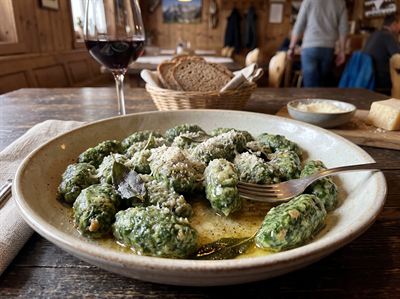
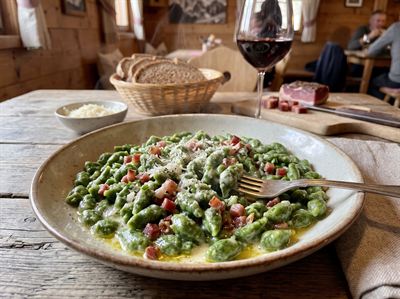
Ferrara, Emilia-Romagna
Cappellacci di zucca ferraresi
Ferrara's pumpkin-filled pasta hats
Ferrara's egg pasta folded like a farmer's straw hat around oven-baked violina pumpkin, grated cheese, breadcrumbs and nutmeg, a PGI since 2016.
- Course
- Primi & RisottiPasta & Rice
- Serves
- 6
- Hands-on
- 2 h 2 min
- Cooking
- 2 h 25 min
- Resting
- 2 h 15 min+
In breve
In short
Also called cappellacci di zucca, cappellacci ferraresi, caplaz, Ferrara pumpkin cappellacci and Cappellacci di zucca ferraresi PGI.
- Vegetarian
- A filling of only violina pumpkin baked in the oven, grated cheese, breadcrumbs and nutmeg, with sugar if needed; no colourings or preservatives.
- Egg pasta of tipo 00 and durum wheat flours, mostly soft wheat, rolled 0.4 mm–0.7 mm thin and cut into squares of 6.5 cm–9.5 cm.
- Each square folded into a triangle, then its two sharp corners joined into the hat shape: 4 cm–7 cm across, 10 g–28 g.
- The PGI covers the filled pasta only; in Ferrara it is dressed with melted butter, sage and Parmigiano, or with a meat ragù.
La provenienza
Where this recipe comes from
Cappellacci are the great filled pasta of Ferrara. Their shape copies the straw hat, the ‘caplaz’ in dialect, that farmers of the Ferrara countryside wore until the middle of the last century, and gives them their name. Pumpkin has been grown in that countryside since 1570, above all the long violina, whose flesh has few strings and keeps well. Historians trace the dish to the Renaissance court of the Este: Giovan Battista Rossetti, steward to Duke Alfonso II, wrote of pumpkin tortelli with butter in his Dello Scalco of 1584, with the same ingredients as today and ginger and pepper besides. Humble as the filling is, the dish was served at feasts and official lunches through the twentieth century, among them the Italian President's visit to Ferrara in 1988.
‘Cappellacci di zucca ferraresi’ has been a Protected Geographical Indication since 2016, under Commission Implementing Regulation (EU) 2016/164: only cappellacci made in the province of Ferrara as its specification sets may carry the name. The specification fixes the filled pasta and gives the doses for one kilo, which this page uses as they stand: 250 g of tipo 00 and durum wheat flours, mostly soft wheat, and 165 g of eggs for the pasta; 400 g of violina pulp baked for 120 to 140 minutes, 122 g of grated cheese, 60 g of breadcrumbs and 3 g of nutmeg for the filling, with sugar if needed and no salt. The sheet is 0.4–0.7 mm thick, cut into squares, folded into a triangle and closed into a hat. The specification does not say how to dress them: in Ferrara they go to the table in a tureen with melted butter, sage and Parmigiano, or with a meat ragù, and this page serves them the first way. This page's own choices are the split of the flours, the size of the squares and the oven at 160 °C, the bottom of the official range, so that a home-sized squash can bake for the full time without scorching.
- Provenance
- The dish itself is protected by an EU specification (TSG, PDO or PGI) that fixes how it is made.
- Defined by
- European Union
- Reference
- PGI ‘Cappellacci di zucca ferraresi’, Commission Implementing Regulation (EU) 2016/164, with its specification as published in the Gazzetta Ufficiale of 29 February 2016; dressed as on the province of Ferrara's official tourist site
- Sources
- Gazzetta Ufficiale n. 49 of 29 February 2016: the PGI specification as registered, published by the Ministry of Agriculture (Italian)
- EU Official Journal C 317 of 25 September 2015: the application for registration, with the single document (EUR-Lex, Italian)
- Commission Implementing Regulation (EU) 2016/164, registering the PGI (EUR-Lex, Italian)
- Ferrara Terra e Acqua, the official tourist site of the province of Ferrara: cappellacci di zucca, the traditional recipe (Italian)
- Ferrara Terra e Acqua, the official tourist site of the province of Ferrara: Cappellacci di zucca ferraresi IGP (Italian)
- Emilia-Romagna Region, official tourist site: Cappellacci di zucca ferraresi IGP (Italian)
- Dissapore: cappellacci di zucca, the Ferrara recipe (Italian)
Ingredienti
Ingredients
For the pasta
For the filling
To cook and dress
Equipment
- Oven, and a baking tray lined with baking paper
- Large knife and a metal spoon
- Fine sieve and two bowls
- Shallow container with a lid, about 20 cm × 15 cm, for chilling the filling
- Kitchen scale that reads single grams
- Wooden board and a wooden rolling pin, or a pasta machine
- Ruler and a pasta wheel
- Four lightly floured trays or large plates, one for each round, and a clean cloth
- Pot of at least 6 l and a slotted spoon
- Small pan for the butter
- Tureen or deep serving dish
Preparazione
Method
About 5½–6½ hours, two of them with the pumpkin in the oven and an hour and a half with the filling in the fridge. The easy way is to make the filling the day before and keep it covered in the fridge. Make the dough while the pumpkin bakes (with the filling made ahead, on the day you shape) and keep it in the fridge, 12 hours at most. Clear room in the fridge for four trays or large plates. Shape in four rounds, a quarter of the dough at a time, and put each tray in the fridge as soon as its round is shaped: about 55–60 cappellacci take 40–50 minutes of folding in all. The filling and the shaped pasta should spend no more than 2 hours in all out of the fridge. Bring the water to the boil during the last round, and cook them straight from the fridge.
- 2 h 2 minhands-on
- 2 h 25 mincooking
- 2 h 15 minresting, at least
The filling
Start here: the pumpkin needs two hours in the oven. Make the dough while it bakes.
-
Hands-on 10 minOfficial text
Wash and dry the pumpkin, cut it in half lengthwise and remove the seeds and the visible strings.
Check No seeds or loose strings left in the hollow.
Tip Our guide: heat the oven to 160 °C, conventional heat, while you do this. Scrape the hollow clean with the metal spoon.
-
Cooking 2 h to 2 h 20 minTemp 160 °COfficial text
Lay the halves on a baking tray and bake them for 120–140 minutes at 160 °C–200 °C.
Check A spoon goes through the flesh to the skin with no resistance, and the cut surface looks dry, not wet.
Tip Our guide: 160 °C, the bottom of the range, with the halves cut side up on baking paper, so a home-sized squash dries for the whole time without scorching. If the edges darken before the end, cover them loosely with foil.
Tip Baking dries the flesh: a wet filling softens the pasta, which tears and empties in the water.
-
Rest 30 minOfficial text
When they are done, set the halves on the work surface and leave them to cool.
Check Cool enough to hold in your hand.
Tip Our guide: about 30 minutes, until you can hold them; then scoop and mix the filling straight away, so it goes into the fridge soon.
-
Hands-on 10 minOfficial text
Scoop the pulp out into a bowl and, if needed, pass it through a sieve to remove any strings left.
Check A smooth purée with no strings.
Tip Our guide: weigh out 400 g, the specification's dose for 1 kg of cappellacci.
-
Hands-on 5 minOfficial text
Mix the pulp with the grated cheese, the nutmeg, the breadcrumbs and, if you like, sugar.
Check Smooth and compact: a spoonful holds its shape on a plate.
Tip The specification lists no salt: the cheese seasons it. Our guide: taste it, and add a little sugar only if the pumpkin tastes bland.
Tip Our guide: if it is too soft to hold its shape, stir in up to 20 g more breadcrumbs, the specification's tolerance.
-
Rest 1 h 15 min to 1 h 30 minTemp 4 °C
Spread the filling about 2 cm deep in the shallow container, cover it and chill it in the fridge until it is cold right through.
Check Cold to the touch right through, and firm.
Tip The filling is cooked pumpkin and cheese: from the oven to the pot it should spend no more than 2 hours in all out of the fridge, counting cooling, mixing and shaping. A shallow layer cools fast.
Tip A cold filling is easier to portion and keeps its shape on the pasta. If the middle still feels cool rather than cold, give it 15 minutes more. Made the day before, it keeps covered in the fridge overnight: the easy way.
The pasta
Make it while the pumpkin bakes.
-
Hands-on 15 minOfficial text
Work the flours and the eggs together until the dough is even.
Check Smooth and even in colour, with no dry crumbs; firm and no longer sticky.
Tip The specification uses a mixer. Our guide by hand: heap the two flours on the board, break the eggs into a well in the middle, beat them with a fork and draw in the flour little by little, then knead for about 10 minutes.
Tip No salt, oil or water: the specification's pasta is flour and eggs only. It is a soft dough. Our guide: if it is still sticky after 5 minutes of kneading, work in more tipo 00 flour a spoonful at a time, up to 50 g, the specification's tolerance; dust the board lightly if it sticks.
-
Rest 30 minOfficial text
If you are not using the dough at once, rest it in the fridge, at 3 °C–4 °C, for 12 hours at most.
Check Relaxed: pressed with a finger, the dent fills back slowly.
Tip Our guide: wrap it in film and keep it in the fridge until the filling is cold, at least 30 minutes: a relaxed dough rolls out without shrinking back.
Shaping
-
Hands-on 15–20 minOfficial text
Roll the dough out by hand on a wooden board with a wooden rolling pin, or by machine, into a sheet 0.4 mm–0.7 mm thick.
Check Even all over, and thin enough that the grain of the board shows faintly through it: about 0.6 mm.
Tip Our guide: aim for about 0.6 mm. Work in four rounds: roll a quarter of the dough, cut, fill and fold it, and put the tray in the fridge before you roll the next. Keep the rest of the dough wrapped, so it does not dry.
-
Hands-on 5 minOfficial text
Cut the sheet into squares of 6.5 cm–9.5 cm a side, by hand with a pasta wheel.
Check Squares of 9 cm, measured with the ruler.
Tip Our guide: 9 cm squares give cappellacci about 5 cm across. Gather the scraps, knead them together, wrap them and roll them again.
-
Hands-on 10 minOfficial text
Put a portion of filling on each square.
Check About 10 g, a heaped teaspoon, in the middle of each square, with a clean border all round.
Tip Our guide: take out of the fridge only the filling for the squares in hand, about a quarter at a time, and keep the rest cold.
Tip Keep the squares you are not filling covered with the cloth, so the pasta does not dry and refuse to seal.
-
Hands-on 40–50 minOfficial text
Fold each filled square into a triangle, then join its two sharp corners, so that the filling cannot escape and the pasta takes the typical cappellaccio shape.
Check Sealed all round with no air inside; about 5 cm across and about 16 g, inside the specification's 4 cm–7 cm and 10 g–28 g. A batch makes about 55–60.
Tip Our guide: press the edges of the triangle together from the filling outwards, pushing out the air. Then wrap it round your fingertip and pinch the two sharp corners at the ends of the long side together, one over the other.
Tip If the edges no longer stick, touch them with a barely damp fingertip.
-
Hands-on 5 min
Set the cappellacci on a floured tray or large plate, not touching, and put it in the fridge as soon as the round is shaped. Use a fresh tray for each of the four rounds.
Check Each tray is in the fridge less than an hour after its first cappellaccio was shaped.
Tip The specification has producers store them at 0 °C–4 °C, or frozen, within 60 minutes of making them, before the filling weeps, the pasta cracks and the orange filling turns grey-brown.
Tip To keep them, freeze the trays instead, then bag the cappellacci, and cook them straight from the freezer.
Cooking and serving
-
Cooking 15 minHeat high
Bring 5 l of water to the boil in the large pot and add the coarse salt. Warm the tureen with a little of the hot water, then pour it away.
Check A full rolling boil, the salt dissolved.
-
Hands-on 4 minHeat low
Melt the butter in the small pan over a low heat with the sage leaves, until it foams and the leaves turn crisp. Keep it warm.
Check Golden and foaming, the leaves crisp; the butter has not browned.
-
Cooking 10 minHeat medium, a gentle boil
Take the trays from the fridge and cook the cappellacci in two batches at a gentle boil, until they rise to the surface: about 5 minutes for each batch.
Check They float, and the pasta at the joined corners is tender when you bite one.
Tip Two batches keep the water boiling; a gentle boil keeps them whole.
-
Hands-on 3 min
Lift them out with the slotted spoon into the warm tureen, a layer at a time, spooning the sage butter and scattering the grated Parmigiano over each layer. Serve at once.
Tip Our guide: leftovers go into the fridge, covered, in a shallow container, within 2 hours; eat them within 3 days, reheated until they reach 75 °C.
The essentials, for cooks who know the dish. Switch to Detailed for quantities, temperatures, times and checks at every step.
Press “I’m here” on the step you are on, and again when it is done.Tap the pin on the step you are on, and the tick when it is done. Timers keep running while you scroll.
Da sapere
Good to know
- WhenQuando
- Through the twentieth century, a dish for feast days and grand official lunches; village festivals in the province celebrate it, two of them in the last ten days of August. Source
- KeepingConservazione
- Uncooked, they freeze for three months and go into the boiling water still frozen. Cooked, they keep for a couple of days in a covered container in the fridge, and can be warmed in a pan with a knob of butter until the edges crisp. Source
- VariantsVarianti
- With ragù: Dressed with a meat ragù instead of butter and sage, the other classic way in Ferrara. Source
- With tomato sauce: Served with a tomato sauce, an alternative to butter and sage. Source
- The Renaissance dish (1584): The cappellacci of the Este court as Giovan Battista Rossetti recorded them in his Dello Scalco of 1584: the same ingredients as today, with ginger and pepper, spices then in common use. Source
Errori comuni
Common mistakes
- Steaming or boiling the pumpkin. The specification bakes it, which dries the flesh; a wet filling softens the pasta, which tears and empties as it cooks.
- Adding amaretti or mostarda, as other towns do in their pumpkin pasta: the specification's filling is pumpkin, grated cheese, breadcrumbs and nutmeg, with sugar if needed.
- Rolling the sheet thicker than 0.7 mm, the specification's limit: the joined corners turn heavy.
- Leaving air in the triangle or the corners loose: the filling escapes into the water.
- Leaving the filling or the shaped cappellacci at room temperature: the filling weeps and turns grey-brown, and cooked pumpkin and cheese should spend no more than 2 hours in all out of the fridge. Chill or freeze each tray within the hour, as the specification has producers do.
Fuori dall'Italia
Cooking it outside Italy
- The violina is a Cucurbita moschata, the species of butternut squash, which is the nearest substitute; the specification also allows frozen violina.
- Tipo 00 is a fine soft wheat flour: plain flour in the UK, all-purpose in the US. Semola rimacinata is finely milled durum wheat semolina.
- The specification asks only for grated cheese; in Ferrara it is Parmigiano Reggiano or Grana Padano.
- Use plain, fine, dry breadcrumbs, not seasoned crumbs.