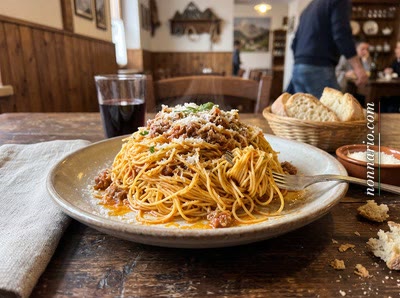
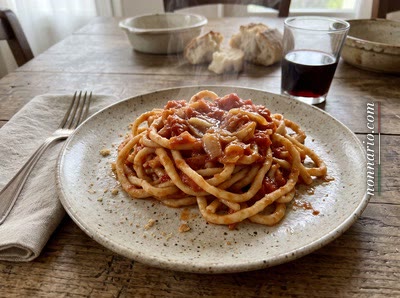
Campidano di Cagliari, Sardegna
Malloreddus alla campidanese
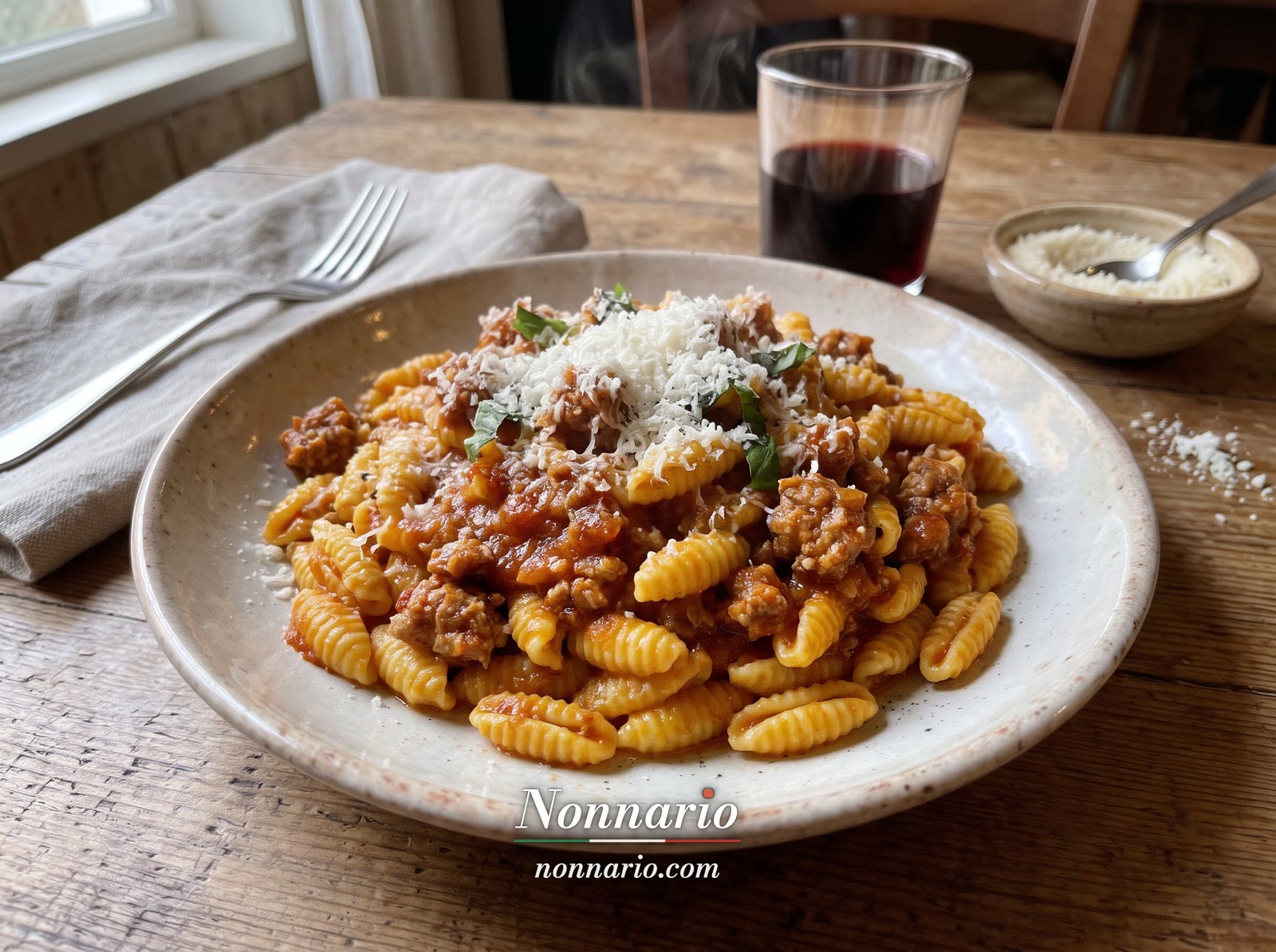
Sardinian ridged semolina gnocchetti with sausage, tomato and saffron
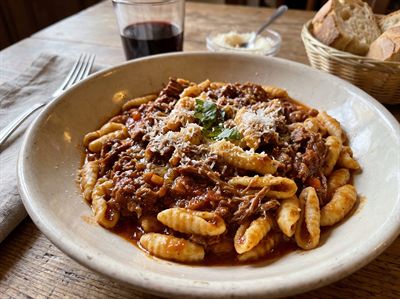
Sardinia's small ridged gnocchetti of durum wheat semolina, made by hand and dried for three days, dressed in the Campidano way with sausage, tomato, Sardinian saffron and grated Pecorino Sardo.
- Course
- Primi & RisottiPasta & Rice
- Serves
- 6
- Hands-on
- 2 h 3 min
- Cooking
- 1 h
- Plan
- 4 days
The video and the photos of every step are also gathered on a separate page.
In breve
In short
Also called malloreddus a sa campidanesa, gnocchetti alla campidanese, gnocchetti sardi, Sardinian gnocchetti and malloreddus with sausage and saffron.
- Malloreddus are durum wheat semolina and lukewarm salted water; here a fifth of the dough is coloured gold with saffron.
- Ropes 5 mm thick cut into 1.5 cm pieces, each rolled under the thumb on a reed basket (su ciuliri) to ridge it.
- Dried on a floured cloth for three days, in the sun if possible, then cooked moderately al dente.
- The sausage is browned in olive oil and set aside; garlic, onion and tomato cook in its fat until thick.
- Bay, basil and Sardinian saffron go in at the end, the sausage last; finished with plenty of grated matured Pecorino Sardo.
La provenienza
Where this recipe comes from
Malloreddus are the most widespread pasta of Sardinia, and perhaps its oldest: small ridged shells of semolina and water, called malloreddus in the Campidano, the island's largest plain, and cigiones around Sassari, macarones cravaos around Nuoro, chiusoni in Gallura and cassulli at Carloforte. The name is usually traced to the Latin mallolus, a morsel; another account takes it from the Sardinian malloru, a bull, so that malloreddus would be little calves. Each piece is ridged by rolling it under the thumb on a basket of woven reeds, su ciuliri. Dressed alla campidanese, with sausage, tomato and saffron, is the best known way to eat them, and the dish is often called the most representative of the island. The saffron is Sardinian: the Zafferano di Sardegna, protected by the EU as a PDO since 2009, is grown only in San Gavino Monreale, Turri and Villanovafranca, in the Medio Campidano. The cheese, Pecorino Sardo, has been a PDO since 1996.
No official recipe has been published: the press reports that a recipe was deposited in the past by the Cagliari Castello delegation of the national culinary academy, but no date, deed or text of it could be found. We compared eleven sources and publish the most widely recognised version, as it is made in the Campidano di Cagliari: a pasta of semolina and lukewarm salted water, a fifth of it worked with saffron, ridged on the ciuliri and dried for three days; a sauce of sausage browned in olive oil, then tomatoes cooked in its fat with garlic and onion, finished with bay, basil and saffron. The sources agree on the sausage, the tomato, the saffron and the Sardinian pecorino; they differ on the pasta's saffron (in a part of the dough, in all of it, or only in the sauce), on how long to dry it (three days, one day, or not at all) and on the sauce, which some cooks make with white wine and others start with celery and carrot. The times, heat levels and sizes the recipe does not give are ours, and the tips say so.
- Provenance
- A regional tradition documented in cookbooks and local practice, with no single official text.
- Defined by
- Sardinian tradition, Campidano di Cagliari
- Reference
- Compared across 11 sources, listed below; this page publishes the most widely recognised version.
- Sources
- Accademia Italiana della Cucina: gnocchetti alla campidanese (malloreddus a sa campidanesa) as made in the Campidano di Cagliari, from its recipe collection (Italian)
- Accademia Italiana della Cucina: sugo alla campidanese (bagna a sa campidanesa), from its recipe collection (Italian)
- Accademia Italiana della Cucina: gnocchetti alle noci (malloreddus cun nuxis), from its recipe collection (Italian)
- Regione Sardegna, SardegnaTurismo, the Region's official tourism site: the traditional hand-made pastas of Sardinia (Italian)
- La Cucina Italiana: malloreddus alla campidanese, 2016 (Italian)
- GialloZafferano: malloreddus alla campidanese (Italian)
- Dissapore: malloreddus alla campidanese, by Nunzia Clemente, 2017 (Italian)
- Official Journal of the EU, C 117 of 14 May 2008: the PDO Zafferano di Sardegna, summary of the application (Italian)
- Official Journal of the EU, C 318 of 1 November 2013: the PDO Pecorino Sardo, single document of the amended specification, approved by Regulation (EU) No 313/2014 (Italian)
- USDA Food Safety and Inspection Service: Leftovers and Food Safety (archived copy of 29 May 2025)
- L'Unione Sarda: the Cagliari Castello delegation deposits the cordula recipe, 19 November 2022, p. 21, as hosted by the Accademia Italiana della Cucina (Italian)
Ingredienti
Ingredients
The original recipe serves 6
For the malloreddus
For the sauce
To cook and serve
Equipment
- A large, wide bowl (the xivedda), for mixing the dough
- Wooden pastry board, and a rolling pin
- Cling film or two upturned bowls, to cover the dough
- A small knife or a dough scraper, for cutting
- Su ciuliri, the Sardinian reed basket, for ridging (or a ridged gnocchi board, or a fork)
- Two or three clean cotton cloths and trays, dusted with semolina, for drying
- A wide, heavy pan (tegame) and a wooden spoon, for the sauce
- Large pot (at least 6 l) and a colander
- A grater for the pecorino, and a kitchen thermometer
Preparazione
Method
Scaled to 6 servings: the amounts in the steps follow. Pot and pan sizes and cooking times are still for the original 6.
Four days from start to table. Day 1: make the dough (about 30 minutes), rest it for more than an hour, then shape the malloreddus, the long part: about 750 g of dough makes well over a thousand pieces, 1½–2 hours for practised hands and up to 3 hours the first time. Days 1 to 4: they dry for three days, ideally in sun and dry weather. Day 4: the sauce takes about an hour; put the pasta water on while the tomatoes simmer, and cook the malloreddus only once the sauce is finished.
- 2 h 3 minhands-on
- 1 hcooking
- 4 daysfrom start to table
Day 1: the dough
In the Campidano the dough is made in two phases with their own names: cummossai, mixing the semolina with the water in the xivedda, the bowl, and ciuexi, the long working on the board that makes it soft. The amount of water, its temperature, the times and the sizes of the sheet are ours.
-
Hands-on 3 minTemp 38 °C
Warm about 250 ml of water until lukewarm, 35 °C–40 °C, and dissolve about 5 g of salt in it. Put the pinch of saffron threads for the dough in a small cup with a teaspoon of the warm water and leave it to soak while you mix.
Check The water feels just warm on the inside of your wrist, not hot.
Tip Our guide: the saffron only needs to be moistened, not covered; a teaspoon of water is enough to wake its colour.
-
Hands-on 5–8 min
Pour the 500 g of semolina into the wide bowl and make a well in the middle. Pour in the salted water a little at a time, drawing the semolina in with your fingers, until it comes together into a dough that is firm, but not too firm. Stop adding water as soon as it does.
Check One firm mass with no dry semolina left in the bowl; it gives a little under a firm press and does not crumble.
Tip Our guide: 500 g of semolina usually takes 230 ml–250 ml. Keep the last 20 ml back and add it only if the dough stays crumbly; semolinas differ.
Tip A dough that is too wet sticks to the basket and loses its ridges; one that is too dry cracks when you roll the ropes.
-
Hands-on 5 min
Shape the dough into a ball and move it to the board. Roll it under your palms into a long oval, then fold it so the two ends meet in the middle. Do this three times in all.
Check The dough holds together without cracks at the folds.
-
Hands-on 8–10 min
Flatten the dough with the rolling pin into a thin sheet, about 3 mm. Turn it over, fold it over on itself and roll it out again. Repeat several times, until the dough is soft.
Check Smooth, soft and elastic: a fingertip pressed in leaves a dent that slowly fills again.
Tip Our guide: six to eight times is usually enough. If the dough tears, rest it for 5 minutes under a bowl and go on.
-
Hands-on 5 min
Cut off a fifth of the dough (about 150 g). Flatten it, put the soaked saffron and its water in the middle and work it in, folding and pressing, until the colour is even.
Check An even golden yellow, with no darker streaks and no pale patches.
Tip If the extra water makes it sticky, work in a pinch of semolina.
-
Rest 1 h to 1 h 30 min
Shape the plain dough and the saffron dough into two separate balls, cover them with cling film or upturned bowls and leave them for more than an hour at room temperature.
Check Both feel softer and more supple than before the rest.
Day 1: shaping the malloreddus
The plain and the saffron dough are shaped the same way, so the finished dish has pale and golden pieces. Keep the dough you are not working covered all the time.
-
Hands-on 1 min
Pinch off a small piece of dough and roll it under your fingers on the board into a rope half a centimetre across (5 mm).
Check Even thickness all along the rope.
Tip Dust the board only very lightly, or not at all: the dough needs to grip the wood to roll.
-
Hands-on 1 min
Cut the rope into little cylinders 1.5 cm long.
Check All the pieces the same length, so they cook evenly.
-
Hands-on 2 min
Lay a piece on the reed basket (su ciuliri, also called su xibiru) and press it with your thumb as you roll it over on itself, so it curls into a little shell with ridges on the outside. Lay each malloreddu on a cloth dusted with semolina, well apart from the others.
Check A curled shell, hollow inside, ridged all over the outside, about as long as a fingernail is wide.
Tip Press firmly enough to mark the ridges, not so hard that the dough flattens and tears.
Tip No ciuliri: a ridged wooden gnocchi board, or the back of a fork's tines, gives the same ridges with the same thumb movement.
-
Hands-on 1 h 15 min to 3 h
Go on the same way with all the plain dough and all the saffron dough: rope, pieces, ridges, and onto the cloths, never touching.
Check All the dough is shaped and every piece lies apart from its neighbours.
Tip Our guide: there are well over a thousand pieces. Practised hands take 1½–2 hours; the first time, allow up to 3. Two people at the board halve the time.
-
Rest 3 days
Leave the malloreddus to dry on the cloths for three days, in the sun if possible, and best in dry weather.
Check Hard right through: a piece snaps cleanly in two, with no soft centre, and they rattle when you shake the tray.
Tip Our guide: turn them gently once a day so they dry evenly underneath. On a wet day, or with no sun, dry them indoors in a dry, airy room, away from the stove; never in the fridge.
Tip Some cooks dry them for a single day, and others cook them fresh, as soon as they are shaped; fresh, they cook in a few minutes, until they float.
Day 4: the sauce
-
Hands-on 6–8 minHeat medium
Cut the 300 g of sausage into pieces of about 1.5 cm–2 cm. Heat the 100 ml of olive oil in the wide pan over medium heat and brown the pieces until golden.
Check Golden on every side, with fat in the pan.
Tip Our guide: spread them in one layer and turn them only when they release from the pan.
-
Hands-on 1 min
Lift the sausage out with a slotted spoon onto a plate and leave the fat in the pan.
-
Hands-on 5–7 minHeat medium-low
Lower the heat. Add the lightly crushed garlic clove and the finely chopped small onion to the fat and cook them gently until blond.
Check The onion is soft, translucent and pale gold, not brown.
Tip Stir often: burnt garlic turns the whole sauce bitter.
-
Hands-on 2 min
Take out the garlic clove and pour in the 1 kg of passata, or the peeled and chopped fresh tomatoes. Season with salt.
-
Cooking 25–35 minHeat low, uncovered
Bring the sauce to a gentle simmer and stir it often with the wooden spoon until it thickens.
Check Thick and glossy: a spoon drawn across the bottom of the pan leaves a path that closes slowly, and no watery layer forms at the edges.
Tip Our guide: put the pasta water on now, so it is at a full boil when the sauce is finished.
Tip Fresh tomatoes give off more water than passata and take the longer time.
-
Cooking 5 minHeat low
Add the bay leaf, the 3 basil leaves and the pinch of Sardinian saffron threads, and let the sauce cook for a few minutes more.
Check The sauce has turned a warmer orange and smells of saffron.
-
Cooking 5 minHeat low
Take out the bay leaf and the basil leaves. Put the sausage back with any juices from the plate and cook briefly, so the flavours come together.
Check The sausage is hot right through, at least 75 °C at the centre on a thermometer.
Tip Anything not eaten: within 2 hours of taking it off the heat, cool the sauce in shallow containers and put it in the fridge; use it within 3 days. Bring it back to the boil before eating.
Day 4: cooking and serving
-
Cooking 15–20 minHeat high
While the sauce simmers, bring about 5 l of water to the boil in the large pot and salt it, about 10 g per litre. Wait for a full, rolling boil.
Check Big bubbles that do not stop when you stir.
-
Cooking 10–15 minHeat high
Tip in all the dried malloreddus, stir once so they do not stick, and cook them at a full boil until moderately al dente.
Check Bite one: tender outside, still firm at the centre, with no white, floury core.
Tip Our guide: start tasting after 8 minutes; how long they take depends on how thick and how dry they are.
-
Hands-on 2 min
Drain the malloreddus well and mix them with the sauce.
Check Every piece is coated, with sauce caught in the ridges.
Tip Our guide: keep a ladle of the cooking water before you drain, and add a little if the sauce is too thick to coat the pasta.
-
Hands-on 2 min
Grate the 120 g of matured Pecorino Sardo just before serving, dust it generously over the malloreddus and serve at once.
Check Served hot, the cheese just melting into the sauce.
The essentials, for cooks who know the dish. Switch to Detailed for quantities, temperatures, times and checks at every step.
Press “I’m here” on the step you are on, and again when it is done.Tap the pin on the step you are on, and the tick when it is done. Timers keep running while you scroll.
Da sapere
Good to know
- KeepingConservazione
- The sauce keeps in the fridge for 2–3 days and can be frozen for up to 3 months; thawed in the fridge, it has only what is left of those days. Fresh, undried gnocchetti can be frozen on a tray as soon as they are shaped, then bagged, and cooked straight from frozen. Source
- VariantsVarianti
- Malloreddus cun nuxis: With walnuts, as made in the Campidano di Cagliari: the same pasta, dressed with garlic browned in olive oil, then bay, parsley, walnuts pounded in a mortar and thin slices of fresh Pecorino Sardo. Source
- Malloreddus a casu furriau: Dressed with melted pecorino. Source
- Malloreddus a mazza frissa: Dressed with a sauce made with cream. Source
Errori comuni
Common mistakes
- Adding all the water at once: pour it in a little at a time and stop when the dough is firm but not too firm.
- Laying the shaped malloreddus touching each other: they stick together as they dry.
- Cooking them half-dried: they cook unevenly. Dried for three days, they snap cleanly.
- Leaving the bay and basil in the sauce: they go in for a few minutes only and come out before the sausage goes back.
- Browning the garlic: it should only turn blond, and it comes out before the tomatoes go in.
Fuori dall'Italia
Cooking it outside Italy
- Outside Sardinia, use a coarse fresh pork sausage; Sardinian sausage for this sauce is sometimes seasoned with aniseed.
- Pecorino Sardo PDO comes in two types, dolce (young, 20–60 days) and maturo (matured at least two months): ask for maturo.
- If Sardinian saffron is not to be had, use other good saffron threads; some cooks use a sachet of powdered saffron instead.
- Semola di grano duro is durum wheat semolina; re-milled semola rimacinata is sometimes labelled semolina flour.
From nonnario.com/recipes/malloreddus/, where you will find its sources, its story and the step photos. Sources checked in November 2026.