Sardinia (the whole island), Sardegna
Porceddu
Sardinian suckling pig roasted on a spit by the fire
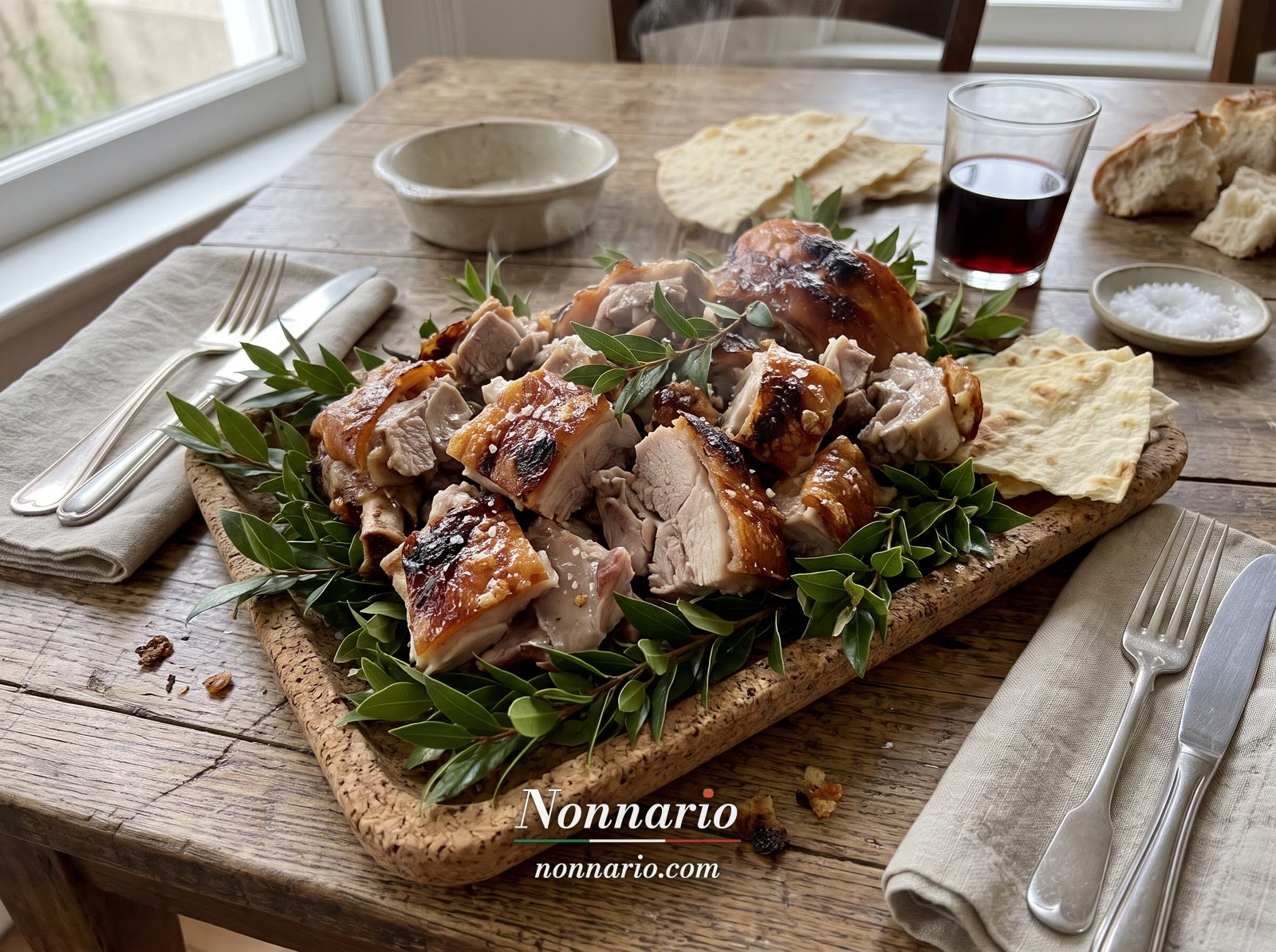
A whole milk-fed piglet set upright on a spit before embers of olive or juniper wood and roasted slowly for 4–5 hours, salted halfway and basted with melted lard until the skin is crisp: Sardinia's porceddu, whose piglet is on Italy's list of traditional food products.
- Course
- SecondiMain Courses
- Serves
- 8
- Hands-on
- 1 h 53 min
- Cooking
- 4 h
- Resting
- 15 min+
The video and the photos of every step are also gathered on a separate page.
In breve
In short
Also called porcheddu, proheddu, porcheddeddu, su porceddu, porcetto, porcetto sardo da latte, maialetto sardo arrosto, maialino sardo, Sardinian suckling pig and Sardinian roast suckling pig.
- Gluten-free
- A whole milk-fed piglet, 30–45 days old, a carcass of 5 kg–9 kg.
- On a spit set upright before embers of olive or juniper wood, beside the fire and not over it, roasted slowly for 4–5 hours.
- Salted only halfway through, then basted with melted lard; the skin is never wetted or covered.
- Done when the skin is golden and crisp and the thickest part of the leg reads at least 63 °C.
- Rested on and under myrtle branches, then cut into pieces with a knife and served hot.
La provenienza
Where this recipe comes from
Porceddu is the Campidano's name; around Nuoro it is porcheddu, proheddu or porcheddeddu. Sardinia's own sheet for its traditional products describes the animal: a piglet of 30 to 45 days, with a carcass of 5 to 9 kg, fed almost only on its mother's milk, with firm, tasty meat under a good layer of white or pinkish fat. An account of the island's customs printed in 1850, describing the hospitality of its villages, says that the guest's table never lacked a suckling pig, cooked in the oven and more often under the ashes, soft and buttery. Many hold that the slow art of the turning spit came with the Spanish, at the end of the 16th century. A piglet was a luxury: to roast one was to give up the hams, sausages and lard it would have become, so it was kept for Easter and great occasions such as weddings. Until the middle of the last century it was common to brush the meat with the animal's own blood before cooking, for a crisper crust, and in the Barbagia, around the Gennargentu, the pig was cooked buried in a pit of embers. African swine fever reached the island in 1978, and from 2011 Sardinian pigs and their meat could not leave it, until a European vote at the end of 2022 lifted the ban for most of the island; in September 2024 the European Commission took the last Sardinian zones off its list of areas restricted for the disease. In 2024 breeders, slaughterers and processors formed a committee to seek a PGI, ‘Porcetto di Sardegna’, for the animal; in November 2026 the EU register had no application for it.
There is no official recipe: the listing covers the piglet, not how it is cooked. We compared the serious sources and publish the most widely recognised version. They agree on a whole piglet on a spit, cooked slowly by the fire, not over it, for about four or five hours; on salt added only during the cooking, as most of them do; on basting with melted lard, a habit of the mountains above all; and on myrtle, in the belly or under the pig as it rests, although some cooks serve it without. Ours are the distances, the turning, the second fire, the amounts of salt and lard and the fire safety, and a probe check: 63 °C in the thickest part of the leg and shoulder, then a rest, the figure US food-safety guidance gives for whole cuts of pork.
- Provenance
- A regional tradition documented in cookbooks and local practice, with no single official text.
- Defined by
- Sardinian tradition
- Reference
- Compared across 12 sources, listed below; this page publishes the most widely recognised version.
- Sources
- Region of Sardinia, Department of Agriculture: list of traditional food products, fresh meats, with the sheet for the Sardinian suckling pig (porcetto sardo da latte) (Italian)
- Ministry of Agriculture (MASAF): national list of traditional food products (PAT), 25th revision, 2025, sheet ‘Sardegna’ (Italian)
- Agrodolce, food magazine (T-Mediahouse): porceddu and its rites, how the dish is made, 2020 (archived copy, Italian)
- Agrodolce, food magazine (T-Mediahouse): Sardinian suckling pig made at home, a recipe for the home oven, 2024 (archived copy, Italian)
- MICHELIN Guide Italy: Il Porceddu, 2021 (Italian)
- L'Unione Sarda, Cagliari daily: the Sardinian roast piglet, an interview with a restaurateur of Ussassai, 2024 (Italian)
- Scatti di Gusto, food magazine: a Sardinian cook’s suckling pig with myrtle on the spit, roasted near Rome, 2013 (Italian)
- Cookist (Ciaopeople), food news site: porceddu may again leave Sardinia, on the end of the swine-fever embargo, 2022 (Italian)
- Sardegna Ieri-Oggi-Domani, a Sardinian online newspaper: a committee for a PGI ‘Porcetto di Sardegna’ formed in Macomer, 2024 (Italian)
- Antonio Bresciani: Dei costumi dell'isola di Sardegna, Naples, 1850, the scan on the Internet Archive (Italian)
- European Commission: Implementing Regulation (EU) 2024/2526 on African swine fever, removing the last restricted zones in Sardinia, 2024 (EUR-Lex, Italian)
- USDA Food Safety and Inspection Service: Leftovers and Food Safety, on cooking pork to a safe temperature and keeping leftovers (archived copy of 29 May 2025)
Ingredienti
Ingredients
Makes one whole suckling pig of 5 kg–9 kg: 8 servings
For one pig
Equipment
- A metal spit (or a straight, sharpened iron rod) a little longer than the pig, that can be planted upright in the ground or held upright on a stand
- Butcher's string, and thin stainless or iron wire to hold the spine to the spit
- Plenty of dry olive or juniper wood, and a safe place for an open fire on bare ground or stone
- A long-handled shovel to move embers, heat-resistant gloves
- A bucket of water or a garden hose (or a fire extinguisher) beside the fire
- A long fork to hold the lard at the fire
- Probe thermometer; an oven thermometer, if you have one
- A large board or tray, and a heavy, sharp knife
Preparazione
Method
A whole day, outdoors, about 6 to 7¼ hours from start to table: light the fire first, and while it burns down to embers (45–60 minutes) take the pig from the cold, clean, fill and skewer it; then 4–5 hours by the fire, 15 minutes’ rest on myrtle and the carving. Start in the morning for a meal in the afternoon. A pig of 5 kg–6 kg serves about 8; a larger one serves more. Choose a calm, dry day, and check before you start that open fires are allowed where you are.
- 1 h 53 minhands-on
- 4 hcooking
- 15 minresting, at least
The fire
There is no official recipe. This page follows the most widely recognised way: a whole piglet, upright on a spit before the embers, for 4–5 hours. The distances, turning, salt amounts and checks are ours, marked ‘Our guide’.
-
Hands-on 10 min
Choose bare ground or stone, in the open, away from dry grass, bushes, trees, buildings and anything that burns, on a calm day. Clear a wide circle around the fire, put a bucket of water or a hose and the shovel beside it, and keep children and pets well back.
Check Nothing that can burn lies within a few metres of the fire place, and water is at hand.
Tip Our guide: check the local rules first. In many places, Sardinia among them, open fires in the countryside are banned or need permission in the dry season, and a high wind makes any fire dangerous.
Tip Never leave the fire alone, from lighting it until it is out.
-
Hands-on 5 min
Light a fire of dry olive or juniper wood, and a second, small fire to one side to make new embers as you go. Leave it to burn down to a deep bed of glowing embers, without flames: it takes 45–60 minutes. Meanwhile, prepare the pig (the next steps).
Check The wood has caught well and is burning steadily.
Tip Our guide: you need embers for 4–5 hours. Keep feeding the side fire with wood a little at a time, and shovel its embers in front of the pig as the first ones fade.
Tip Keep the pig cold until the fire is lit: it comes out only now, so it reaches the fire within about an hour.
The pig, while the fire burns down
-
Temp 0 °C–4 °C
Keep the pig cold, at 0 °C–4 °C, until you start work on it.
Tip Our guide: a whole piglet rarely fits a home fridge. Collect it from the butcher on the morning you cook it, or keep it in a cool box with ice packs, and take it out only once the fire is lit.
-
Hands-on 20 min
Scrape the skin all over with the back of a knife, and singe off any bristles left with a flame. Remove whatever is left of the innards, rinse the pig inside and out under cold running water and dry it thoroughly, inside and out, with a clean cloth.
Check The skin is smooth, with no bristles left; the belly cavity is clean; the pig is dry to the touch.
Tip Our guide: a gas blowtorch or the flame of a gas ring does the singeing; keep the flame moving so the skin does not burn.
Tip A dry skin crisps; a wet one steams. Do not salt it yet.
-
Hands-on 3 min
Put a few sprigs of fresh myrtle inside the belly cavity.
Check The sprigs sit inside the cavity, not sticking out of the opening.
Tip Some cooks use other herbs as well, or instead: bay, wild fennel, rosemary, thyme. Others give the pig a quick smoking over a fire of myrtle bushes before the real cooking starts.
-
Hands-on 25 min
Run the spit through the pig along its length, from the rear to the head, along the spine, with the pig spread out along the spit. If there is not room to stretch it out, fold it carefully and tie it into a compact shape with butcher's string.
Check When you lift the spit and turn it, the pig turns with it and does not slip or swing.
Tip Our guide: tie the front legs forward and the back legs back along the spit, and fasten the spine to the spit with wire in two or three places, through the meat beside the backbone. Keep the cavity closed loosely with string so the myrtle stays in.
Tip Some cooks split the pig open and spread it on the spit, held flat with branches.
Roasting
-
Hands-on 5 minHeat glowing embers, no flame
When the pig is on its spit, look at the fire: 45–60 minutes after lighting, it should have burnt down to embers.
Check A bed of red embers covered with a light grey ash, with no flames rising from it.
Tip If flames are still rising, wait a few minutes more, with the pig back in the cold if it will be longer than 15 minutes.
-
Hands-on 5 min
Plant the spit upright, or leaning slightly towards the fire, in front of the embers and at the side of them, never above, at the right distance for slow cooking.
Check The pig stands steady beside the embers, not over them.
Tip Our guide: start about 50 cm–60 cm from the embers. You should be able to hold your hand where the pig is for about 8–10 seconds; if there is an oven thermometer, the heat at the pig stays at 100 °C or below.
Tip A horizontal spit, turned slowly by hand or by a motor beside the embers, works the same way; the cooking must still be slow.
-
Cooking 2 hHeat embers beside the pig, not below it
Leave it to cook slowly, giving the spit a quarter turn every 15–20 minutes so every side faces the embers in turn, and pushing new embers in front of the pig as the old ones fade.
Check After 2 hours the skin is evenly pale gold, dry and taut, and the fat has begun to drip; nowhere is it blistered or black.
Tip Our guide: if the skin blisters, spits fat or darkens quickly, move the spit or the embers back by 10 cm; if after an hour it has not begun to colour, move it a little closer.
Tip Wind and cold slow the cooking down: allow for the longer time on a cool or windy day.
-
Hands-on 5 min
Halfway through, after about 2 hours, sprinkle the salt evenly over all the skin and inside the cavity.
Check An even, light film of salt over the whole skin.
Tip Our guide: about 10 g of fine sea salt per 1 kg of pig, so about 60 g for a 6 kg one.
Tip At this point turn the spit end over end, so the top and the bottom of the pig swap places.
-
Cooking 2–3 hHeat embers beside the pig
Keep cooking slowly, turning a quarter every 15–20 minutes and adding embers. Every 20–30 minutes, hold the piece of lardo on a long fork close to the embers until it melts and drips, and let it drip over the skin.
Check The skin turns golden-brown and dry, and hard and crisp to a tap of the knife.
Tip Never soften the skin: no water, wine or cover on it, ever.
Tip Basting with melted lard is a habit of the mountain villages above all; if you leave it out, the skin still crisps.
-
Hands-on 5 minTemp 63 °C
Push a probe into the thickest part of a back leg and of a shoulder, not touching the bone.
Check Both read at least 63 °C, and the skin is golden-brown and as crisp as a potato crisp all over.
Tip If the centre is not yet at 63 °C, keep cooking and check every 20 minutes. If the centre is done but the skin is not yet crisp, bring the pig closer to the embers for 10–15 minutes, turning it all the time and watching it.
Tip Our guide: about 4 hours for a piglet of 5 kg–6 kg, up to 5 for one of 8 kg–9 kg.
Resting and serving
-
Rest 15 min
Lay a thick bed of myrtle branches on a large board or tray, take the pig off the spit onto it, and cover it with more myrtle. Leave it to rest so the flavours settle.
Check The pig is still hot to the touch, and the skin is still hard.
Tip The meat must rest at least 3 minutes after cooking; about 15 is our guide, so that the skin stays crisp.
-
Hands-on 15 min
Cut and pull out the string and the wire, and cut the pig into pieces with a heavy, sharp knife, giving each piece some skin. Serve it hot, at once, on the myrtle.
Check Each piece has crisp skin on top and moist, white to pale pink meat underneath.
Tip Food out of the heat may stay out for at most 2 hours, and only 1 hour when it is above 32 °C, as on a summer day outdoors. Put what is not eaten, cut up, in shallow covered containers, into the fridge within that time.
Tip It is also good cold. Our guide: to eat leftovers hot, reheat the pieces, covered, in the oven until their centre reaches 75 °C, then uncover them for a few minutes to crisp the skin.
-
Hands-on 15 min
Spread the embers with the shovel, drown them with water, stir them and drown them again until no steam or hiss is left.
Check The ashes are cold to the back of your hand held just above them.
Tip Our guide: never leave embers to burn out on their own, and never bury them hot: they can smoulder for hours.
The essentials, for cooks who know the dish. Switch to Detailed for quantities, temperatures, times and checks at every step.
Press “I’m here” on the step you are on, and again when it is done.Tap the pin on the step you are on, and the tick when it is done. Timers keep running while you scroll.
Da sapere
Good to know
- WhenQuando
- A dish for feast days such as Easter and Christmas; once it was kept for Easter and great occasions such as weddings. Summer festivals are held for it, at Baunei in July and Palmadula in August. Source
- KeepingConservazione
- Leftovers, cooled, cut into portions and put in airtight containers, keep 3 days in the fridge, or 2–3 months in the freezer. Source
- VariantsVarianti
- In a home oven: Clean the piglet, singeing off even the toughest bristles, wash and dry it well, and rub it inside and out with coarse salt (and pepper, if you like). Fill the belly with 3–4 sprigs of fresh myrtle (or rosemary), with a few slices of lemon if you like. Put it on the oven's own spit, or on a rack over a roasting tin to catch the juices, into an oven heated to 170 °C, and roast it for at least 3 hours, brushing the skin with a little olive oil now and then. For the last 30 minutes raise the oven to 200 °C (or use the grill for the last 10 minutes) to brown the skin. Rest it 15–20 minutes, cut it into pieces and serve it hot, on fresh myrtle. Our guide: check before buying that the pig fits your oven, and probe it as on the spit, 63 °C in the thickest part of the leg. Source
- In quarters, for a larger piglet: Piglets of 8 kg–10 kg (in Cagliari called ‘porchettoni’) are cut into quarters, so every part cooks well, put on the spit and left still for an hour, then cooked over a slow fire of holm-oak wood, which makes little flame, for about 4 hours, and served on plates without myrtle. In a home oven the quarters take about 2½–3 hours at 200 °C. Source
- A carraxu, in a pit: The old way of the Barbagia, around the Gennargentu mountains: a pit is dug, a bed of embers made in it by burning myrtle branches, and the pig, perhaps sprinkled with herbs, is laid in and left to cook for about 7 hours. Source
Errori comuni
Common mistakes
- Putting the pig over the embers, or too close: the skin burns before the meat inside is cooked. It cooks beside the fire, slowly.
- Cooking over flames instead of embers.
- Salting it at the start: the salt goes on only halfway through.
- Wetting or covering the skin: it softens and will not crisp.
- Leaving it on the table all afternoon in summer: above 32 °C, an hour at most out of the heat.
- Leaving the fire alone, or the embers to burn out on their own.
Fuori dall'Italia
Cooking it outside Italy
- Order a whole suckling pig (milk-fed piglet) from a butcher, cleaned and gutted, giving the weight you want; many sell them frozen. Our guide: thaw it in the fridge, about a day for every 2 kg, so 3–5 days for most piglets.
- Olive and juniper wood are not sold everywhere: any dry hardwood that burns down to steady embers and makes little flame will do, such as oak (holm oak is used in Sardinia too); never resinous softwood or treated timber.
- Myrtle grows wild around the Mediterranean and is sold as a garden shrub; if there is none, use rosemary, as some cooks do anyway.
From nonnario.com/recipes/porceddu/, where you will find its sources, its story and the step photos. Sources checked in November 2026.