Province of Nuoro, Sardegna
Pane carasau
Sardinia's thin, crisp, twice-baked durum wheat bread
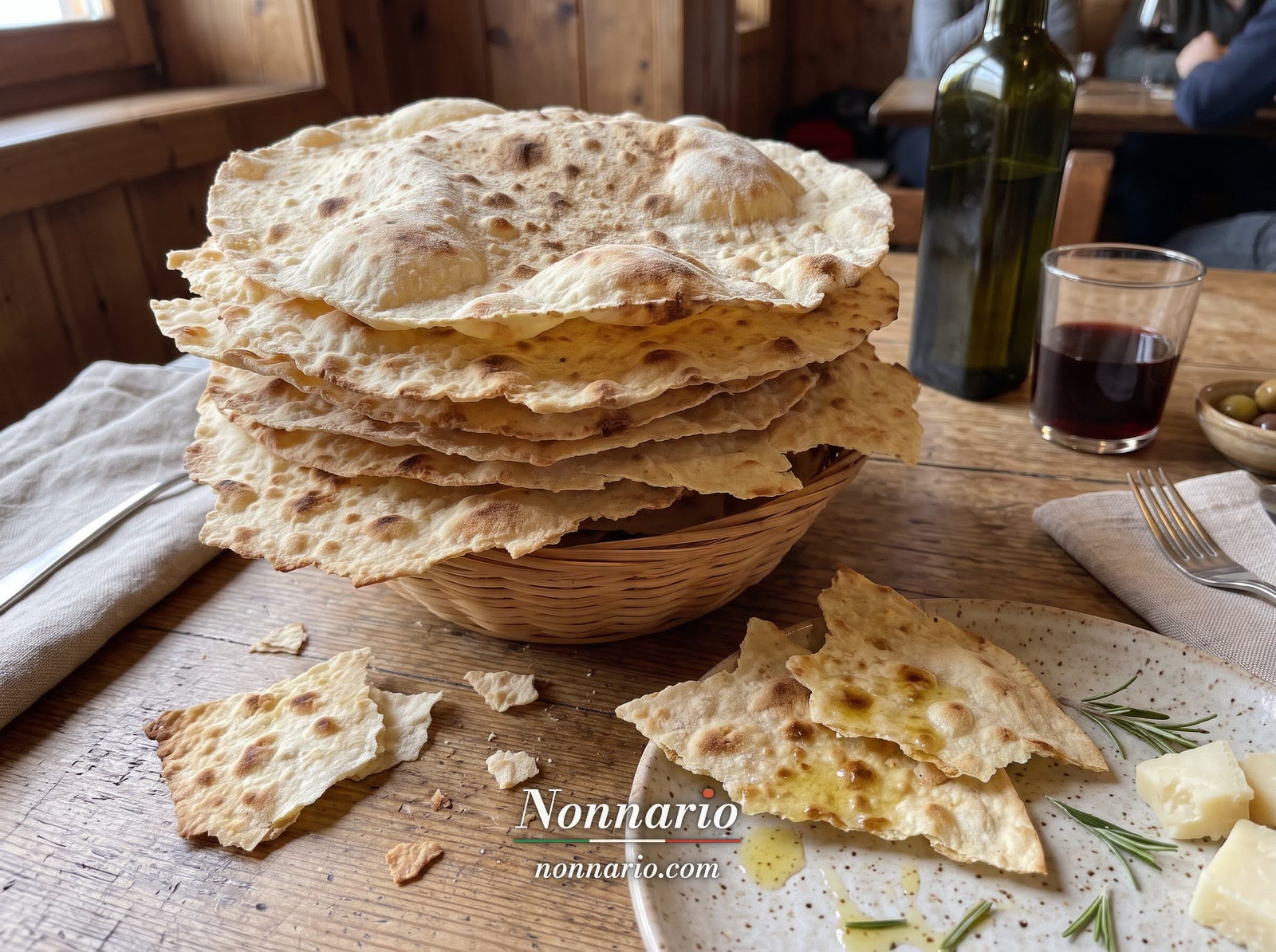
Sardinia's crisp, crumbless bread of durum wheat semolina: thin discs baked until they puff into a ball, split in two while hot and baked again until golden; on Italy's list of traditional food products.
- Course
- Pizze e PaniPizza & Bread
- Serves
- 4
- Hands-on
- 36 min
- Cooking
- 15 min
- Resting
- 2 h+
The video and the photos of every step are also gathered on a separate page.
In breve
In short
Also called carta da musica, carta musica, pane carasatu and music paper bread.
- Vegetarian
- Vegan
- Re-milled durum wheat semolina, water, salt and a leaven: brewer's yeast at home, natural ferments in the traditional product. No fat.
- A rise of 30–45 minutes, three balls of 250 g rested 30 minutes, then discs about 40 cm across rested 30 minutes on a cotton cloth.
- In a very hot oven each disc puffs into a ball; it is split into two sheets with a sharp knife while still hot.
- The carasatura: each sheet goes back in the oven for about a minute. After each bake the sheets are stacked and pressed lightly.
- Golden, crisp, crumbless discs 15 cm–40 cm across and a few millimetres thick, which keep for a long time.
La provenienza
Where this recipe comes from
Pane carasau is the bread of the province of Nuoro, in the Barbagia of central Sardinia; in recent years it has been made in the island's other provinces too. It was the shepherds' bread: with no crumb, it kept for a long time and could go with them on the transhumance, and Sardinian families once made it in large batches and stored it in chests. Its name comes from carasare, to toast, the second bake that makes it crisp, and the crack it makes when broken gave it its other name, carta da musica (music paper); it is also called pane carasatu. The whole making, sa cotta, was once a family ritual carried out by three women, friends or relatives, who helped one another or were paid in oil or ricotta. In 1979 a regional law, repealed in 2016, applied the bakery rules to the characteristic Sardinian bread of biscuit-like sheets, made from durum wheat, in bakeries whose ovens had at most 1.5 square metres of baking floor, and let new bakeries that made nothing else open without the usual test of how many bakeries a town already had. It is on Italy's national list of traditional agri-food products for Sardinia (2025 revision, number 171), and a committee of producers has asked for a PGI, Pane Carasau di Sardegna: in 2026 its specification had gone to the Region and the Ministry, awaiting the Ministry's first reply.
There is no official recipe. We compared ten sources and publish the most widely recognised version, a home recipe whose phases match the description of the traditional product on Sardinia's entry in the national list: re-milled durum wheat semolina, water and salt, kneaded until smooth and elastic; a first rise; thin discs left to rise on a cotton cloth; a very hot oven, in which each disc puffs into a ball; the disc split in two while hot, and the sheets stacked and pressed lightly so that the edges do not curl; then the carasatura, a second bake, and a second pressing. The sources differ on the leaven. The traditional product is raised with natural ferments, a leaven kept back from the previous dough, its discs rise on linen, cotton or hemp cloths for about two hours, and it is baked at 450 to 550 °C. The home recipes compared all use brewer's yeast, with rises of half an hour or so, and the specification proposed for the PGI is reported to allow brewer's yeast as an alternative to a sourdough leaven, which some in Sardinia oppose. What is ours: fresh yeast, the temperature of the water, the kneading time, the checks, and a home oven at its highest setting, at least 250 °C, with a baking stone switched on earlier than the recipe does, so that it heats for about an hour. Made with semolina you can buy, it is a home version of the Sardinian bread.
- Provenance
- A regional tradition documented in cookbooks and local practice, with no single official text.
- Defined by
- Sardinian tradition
- Reference
- Compared across 10 sources, listed below; this page publishes the most widely recognised version.
- Sources
- Agrodolce: pane carasau, a recipe by Alessandra Rosati, 2022 (archived copy of 29 June 2025) (Italian)
- Laore Sardegna, the Region of Sardinia's agency for agricultural development: pane carasau, its sheet as a traditional agri-food product (PAT), updated April 2021 (Italian)
- Ministry of Agriculture (MASAF): national list of traditional agri-food products, 25th revision, 2025, Sardinia no. 171 (Italian)
- Regione Sardegna, SardegnaTurismo, the Region's official tourism site: carasau, the shepherds' bread, an itinerary through Oliena, Gavoi and Dorgali (Italian)
- Italia.it, Italy's official tourism portal, by the Ministry of Tourism: the story of pane carasau (Italian)
- Dissapore: pane carasau, a recipe by its editors, 2022 (Italian)
- Cookist: pane carasau, a recipe by Michele Ghedini, 2025 (Italian)
- Edizioni Europee, a legal database: Sardinian Regional Law no. 50 of 20 June 1979 on making pane carasau, with the note of its repeal in 2016 (Italian)
- Cronache Nuoresi, a Nuoro daily: the PGI applications for pane carasau and pane pistoccu, 27 March 2026 (Italian)
- Di Testa e Di Gola, a food magazine: carasau and pistoccu on the way to a PGI, and the debate on the leaven, by Laura Manunta, 2026 (Italian)
Ingredienti
Ingredients
Makes 6 crisp sheets about 40 cm across, from 3 discs: 4 servings
For the dough (3 discs, 6 sheets)
Equipment
- Kitchen scale and a thermometer, for the water
- A large bowl, or a stand mixer with a dough hook
- A lidded container or a bowl and a plate, for the first rise
- A small rolling pin
- Three clean cotton cloths, such as large tea towels, each large enough for a disc of 40 cm, and one more to cover the balls
- A baking stone or steel about 40 cm across, or the oven's heavy tray turned upside down
- A peel or a thin, flat board, to slide the discs in and out
- A sharp knife
- A wooden board as large as the sheets, to press the stack
- Oven gloves
Preparazione
Method
About 3 hours from start to finish, most of it rising, and no starter needed. About 15 minutes to make the dough, 30–45 minutes' rise, 5 minutes to shape three balls (switch the oven on now, so the stone heats for about an hour), 30 minutes' rest, about 15 minutes to roll the discs and 30 minutes' rise on cloths. Then about 10 minutes to bake and split the three discs, about 10 to toast the six sheets, and half an hour to cool. You need 500 g of semola, plus a little for dusting, and a baking stone, or a heavy oven tray turned upside down, as large as your oven takes.
- 36 minhands-on
- 15 mincooking
- 2 hresting, at least
The dough
-
Hands-on 5 minTemp 30 °C–35 °C
Pour 250 ml of water into a large bowl, or the bowl of a stand mixer. Add 5 g of brewer's yeast, then 500 g of semola, and begin to knead.
Check The yeast has dispersed and the semola has drawn the water into a rough, shaggy dough.
Tip Our guide: warm the water until lukewarm, 30 °C–35 °C, and crumble fresh yeast into it, stirring until it dissolves, before you add the semola.
-
Hands-on 10–15 min
After a few minutes add 9 g of salt, and go on kneading until the dough is smooth and elastic.
Check A smooth, elastic, pale yellow dough that no longer sticks; a small piece stretched between your fingers makes a thin film that lets light through.
Tip Our guide: by hand, 10–15 minutes on the board, pushing the dough away with the heel of your hand and folding it back; in a stand mixer, 8–10 minutes at low speed with the dough hook.
Tip Our guide: the dough is firm. If it is too stiff to knead, wet your hands rather than add flour.
-
Rest 30–45 min
Put the dough in a container and leave it to rise for about 30–45 minutes.
Check It has relaxed and grown a little, and feels soft and smooth.
Tip Our guide: cover the container, so that the dough does not form a skin, and keep it somewhere warm, about 26 °C–28 °C.
Balls and discs
-
Hands-on 5 min
Turn the dough out onto the board and divide it into 3 pieces of 250 g each. Round each into a ball.
Check Three smooth, round balls of 250 g.
Tip Our guide: the dough weighs about 760 g, so each piece may be a few grams over; weigh them so that the discs match.
Tip Our guide: the discs must fit your stone or tray. If it is smaller than 40 cm, divide the dough into 4 or 5 equal balls and roll them smaller: the traditional discs measure anything from 15 cm to 40 cm.
-
Hands-on 2 minTemp 250 °C
Put a baking stone on a rack in the lower middle of the oven, or the oven's tray turned upside down, and heat the oven to its highest setting.
Check The oven is at its highest setting, and will have heated for about an hour when the first disc goes in.
Tip Our guide: the recipe switches the oven on as the discs start to rise, but a stone needs about an hour to heat right through, so start it now. Use the static setting, with no fan, and at least 250 °C.
Tip Our guide: if your oven has a pizza setting, heating from below as well as above, use it.
Tip The traditional product is baked at 450 °C–550 °C, which no home oven reaches.
-
Rest 30 min
Cover the balls with a cloth and leave them to rest for about 30 minutes.
Check The balls have relaxed and spread a little, and are soft to the touch.
-
Hands-on 12–15 min
With a small rolling pin, roll out each ball into a disc about 40 cm across. Lay each disc on its own cotton cloth.
Check Three thin, even discs about 40 cm across, with no holes or tears, each on its cloth.
Tip Our guide: dust the board lightly with semola, and give the disc a quarter turn after every few strokes so it stays round.
Tip Our guide: roll it about 2 mm thick: 250 g of dough spread over a disc 40 cm across comes to about that.
Tip Our guide: an even thickness matters more than the exact size: a hole, a tear or a thick patch stops the disc from puffing.
Tip Our guide: dust the cloths with semola, so the discs do not stick.
-
Rest 30 min
Leave each disc to rise on its cotton cloth for 30 minutes.
Check The discs look slightly puffy and soft, and the stone has heated for about an hour.
Tip Our guide: fold the edges of the cloth over the disc, or lay another cloth on top: a dry skin keeps a disc from puffing.
The first bake: a ball, then two sheets
-
Cooking 1–2 minTemp 250 °C
When the oven is ready, slide the first disc onto the hot stone. It soon forms its first bubbles and begins to swell on one side, and after a few seconds it has puffed up almost entirely. When it is well puffed, take it out.
Check The disc has swelled like a balloon, its two faces wide apart, and is still pale, with only a few light patches.
Tip Our guide: slide it in on the peel, shaking off any loose semola first, and shut the door. In a home oven it takes about 1–2 minutes; watch it through the glass.
Tip Our guide: take it out with the peel without piercing it, and before it browns, or the sheets crack when you split them.
Tip Our guide: if it does not puff at all, the stone is not hot enough, or the disc is too thick or has dried. Give the stone 10 minutes more before the next one.
-
Hands-on 1 min
Taking care not to burn yourself, split the disc in two with a sharp knife while it is still hot, to give 2 sheets.
Check Two thin, round sheets, each whole, with no crumb between them.
Tip Our guide: hold it with a cloth, run the knife round the edge where the two faces meet and pull them apart. Keep your face away as you cut: hot steam comes out.
Tip Our guide: kitchen scissors also work, cutting round the edge. If the faces stick in places, ease them apart with the knife flat; split cold, they tear.
-
Hands-on 1 min
Stack the 2 sheets and press them lightly, so that the edges do not curl over.
Check The sheets lie flat.
Tip Our guide: press them with a flat wooden board, and leave the board on top; its own weight is enough.
-
Cooking 6–10 minTemp 250 °C
Bake, split, stack and press the other 2 discs the same way, one at a time, adding each pair of sheets to the stack under the board.
Check A stack of 6 flat sheets under the board.
Tip Our guide: let the oven come back to heat for a minute between discs.
The carasatura
The second bake toasts the sheets, makes them crisp and lets them keep, and gives the bread its name.
-
Cooking 8–12 minTemp 250 °C
Put each sheet back in the oven to toast for about a minute, one at a time. Take it out, and stack and press the sheets lightly again as they come out.
Check Each sheet is golden, smells toasted, and snaps cleanly once it has cooled for a moment.
Tip Our guide: a thin sheet goes from golden to burnt quickly: watch it, and turn the oven down to 220 °C if the edges darken before the middle.
Tip Our guide: press them under the board again, so that they lie flat and do not crumble when stored.
-
Rest 30 min
Leave the stack under the board until the sheets are completely cool.
Check The sheets are cold, flat, dry and crisp right through.
Tip Our guide: keep them in a dry place, in a tin or a well-closed bag, so that they stay crisp.
The essentials, for cooks who know the dish. Switch to Detailed for quantities, temperatures, times and checks at every step.
Press “I’m here” on the step you are on, and again when it is done.Tap the pin on the step you are on, and the tick when it is done. Timers keep running while you scroll.
Da sapere
Good to know
- KeepingConservazione
- It keeps its freshness for a long time: Sardinian families once made it in large batches and stored it in chests. Source
- VariantsVarianti
- With a natural leaven: The traditional product is raised with natural ferments, and its thin discs rise on linen, cotton or hemp cloths for about two hours before they are baked at 450–550 °C. Source
- Pane guttiau: A version made with extra virgin olive oil and salt and baked in the wood oven: fragrant sheets that taste of the burning wood. Source
Errori comuni
Common mistakes
- Rolling a disc with a hole, a tear or a thick patch, or piercing it: the steam escapes and it cannot puff into a ball.
- Leaving the discs uncovered to rise: a dry skin keeps them from puffing.
- Baking on a stone that is not hot through: heat it for about an hour at the oven's highest setting.
- Letting the ball cool before you split it: it is split while still hot.
- Leaving the sheets unpressed: their edges curl. They are stacked and pressed lightly after each bake.
- Stopping after the first bake: the carasatura is what makes the sheets crisp and lets them keep.
Fuori dall'Italia
Cooking it outside Italy
- Look for semola rimacinata di grano duro, sold in English as re-milled durum wheat semolina: it is fine, like flour, unlike the coarse semolina sold for puddings.
- In Sardinia it is made from durum wheat grown on the island and Sardinian sea salt; elsewhere any re-milled durum semolina and fine sea salt make a home version.
- Fresh brewer's yeast is sold as compressed or cake yeast; dried yeast works too, at about 2 g for this batch.
- The traditional product is baked at 450 °C–550 °C; a home oven at its highest setting with a baking stone or steel is the home version.
From nonnario.com/recipes/pane-carasau/, where you will find its sources, its story and the step photos. Sources checked in November 2026.