Potenza, Basilicata
Lagane e ceci
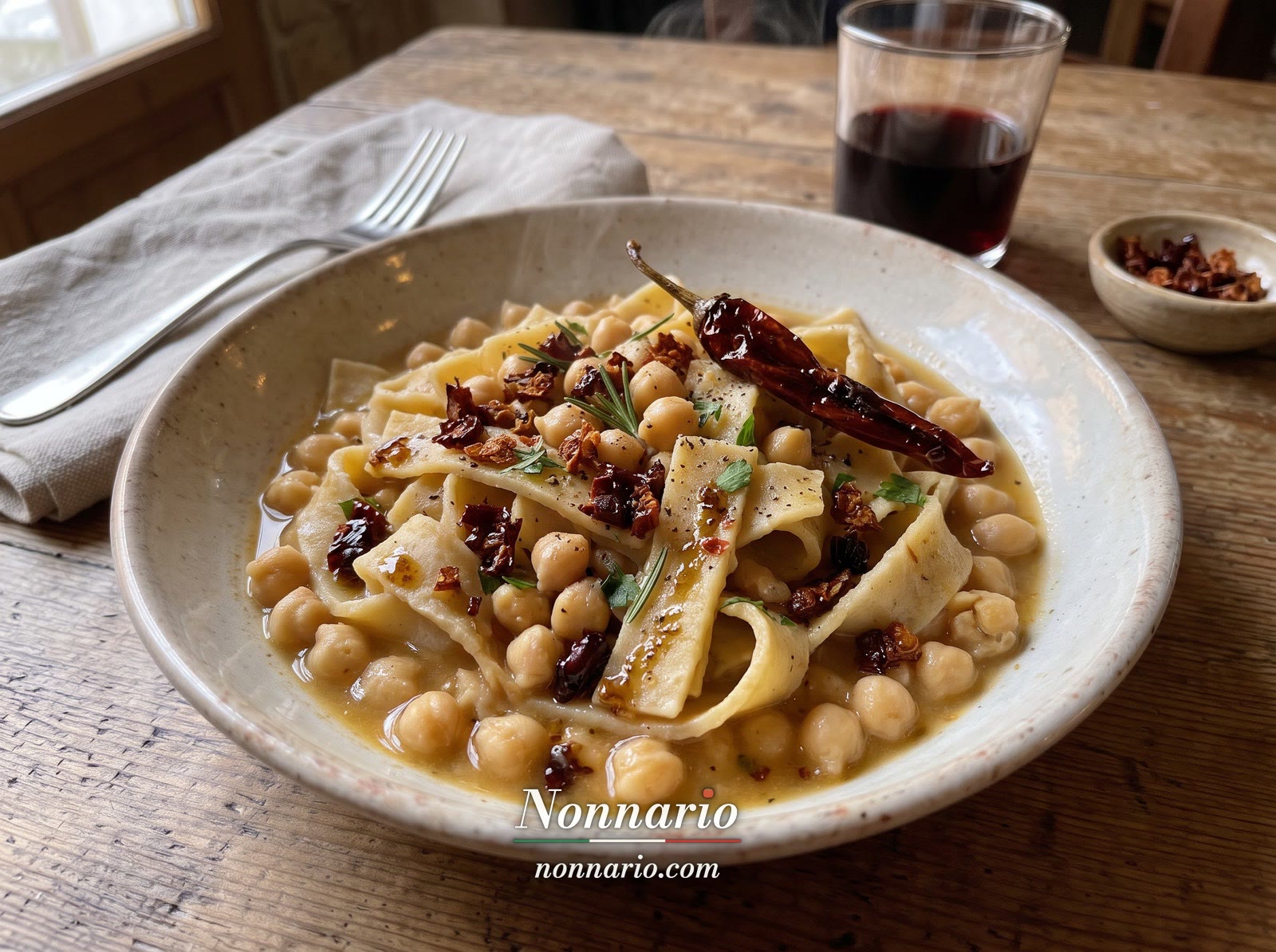
Broad hand-cut pasta with chickpeas and crisp-fried Senise peppers
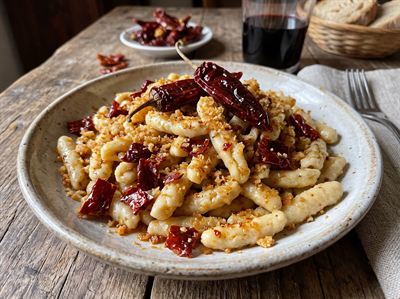
Basilicata's broad hand-cut lagane of durum wheat and egg, tossed with boiled chickpeas sautéed in garlic and olive oil, and finished with crisp-fried Peperoni di Senise PGI.
- Course
- Primi & RisottiPasta & Rice
- Serves
- 5
- Hands-on
- 54 min
- Cooking
- 1 h 43 min
- Plan
- 2 days
The video and the photos of every step are also gathered on a separate page.
In breve
In short
Also called piatto dei briganti and lagane ai ceci.
- Vegetarian
- Lagane: broad strips of hand-made pasta, cut a finger wide from a dough of durum wheat and soft wheat flour, eggs and lukewarm water.
- Chickpeas, boiled until soft, then sautéed in olive oil with garlic and salt until they take the flavour.
- Finished with peperoni cruschi: dried Peperoni di Senise, a PGI since 1996, fried for a few seconds until crisp.
- The dough rests 10 minutes, is rolled thin and dried 15 minutes; the lagane are boiled apart, then tossed with the chickpeas.
La provenienza
Where this recipe comes from
Lagane are broad strips of hand-made pasta, thicker than tagliatelle, and in Basilicata they are the pasta most often cooked with pulses: with beans, and with chickpeas too. Lagane e ceci is one of the home-made pastas of the Potenza table. Horace, who came from Venosa on the border of Lucania and Apulia, wrote in his Satires of going home in the evening, in Rome, to a bowl of leeks, chickpeas and lagana. A legend of oral tradition calls it the brigands' dish: the brigands who roamed the woods of Gallipoli Cognato in the second half of the 1800s were nicknamed ‘mangialagane’, the lagane-eaters.
There is no official recipe. We compared 14 sources and publish the most widely recognised version. The Lucanian and national recipes agree on what makes the dish: lagane cut in broad strips from a durum-wheat dough, chickpeas, garlic and olive oil, the pasta boiled and then dressed with the chickpeas. Some cooks add eggs to the dough and others never do; some add tomato or chilli. The Lucanian version on this page has eggs in the dough and is finished with peperoni cruschi, the dried Peperoni di Senise, protected as a PGI since 1996. The times for the chickpeas are this page's own: soaked overnight, then simmered with bay leaves for 1 1/2–2 hours, until soft right through.
- Provenance
- A regional tradition documented in cookbooks and local practice, with no single official text.
- Defined by
- Lucanian tradition
- Reference
- Compared across 14 sources, listed below; this page publishes the most widely recognised version.
- Sources
- APT Basilicata, the Region's tourism agency: ‘Lagane e ceci’, its recipe with peperoni cruschi di Senise, 2018 (Italian)
- APT Basilicata: lagane with peperoni cruschi di Senise, chickpeas and leek, ‘Horace's dish’, 2021 (Italian)
- APT Basilicata: Potenza, the typical dishes (Italian)
- La Cucina Italiana: ‘Lagane e ceci’, a recipe from Basilicata, 2015 (Italian)
- GialloZafferano: ‘Lagane e ceci’, editorial recipe (Italian)
- Sky TG24: the ten typical dishes of Lucanian cooking, chosen by the food writer Salvatore Cosenza, 2020 (Italian)
- Italia.it, Italy's official tourism portal: typical Lucanian products and dishes (Italian)
- Italia.it: the crunchy peperoni cruschi of Senise PGI (Italian)
- European Commission, eAmbrosia register: Peperoni di Senise, PGI since 1996
- Ministero dell'Agricoltura (MASAF), the Italian Ministry of Agriculture: the national list of traditional agri-food products, 25th revision, 2025 (Italian)
- The Latin Library: Horace's Satires, book I, the Latin text; satire 6 (Latin)
- The Latin Library: Horace's Satires, book II, the Latin text; satire 1 (Latin)
- Accademia Italiana della Cucina: ‘Ceci e laganelle’ as made in Caserta, its recipe collection (Italian)
- USDA Food Safety and Inspection Service: Leftovers and Food Safety (archived copy of 29 May 2025)
Ingredienti
Ingredients
The original recipe serves 5
For the lagane
For the chickpeas
To finish
Equipment
- A large wooden board for the dough and a long rolling pin
- A sharp knife and a tray lined with a clean cloth for drying the lagane
- A saucepan of about 3 l for the chickpeas, and a bowl for soaking them
- A large pot of about 6 l for the pasta, and a spider or a colander
- A wide frying pan or sauté pan, about 30 cm–32 cm across, for the chickpeas and the lagane
- A small frying pan, about 16 cm across, for the peppers, with a lid that fits it, kept within reach
- Tongs, a slotted spoon, kitchen paper and a dry cotton cloth
Preparazione
Method
Scaled to 5 servings: the amounts in the steps follow. Pot and pan sizes and cooking times are still for the original 5.
Two days, with little work on the first. The evening before: put the chickpeas to soak. On the day, about 2 1/2 hours: start the chickpeas first (1 1/2–2 hours, mostly unattended). About 45 minutes after they begin to simmer, make the dough, rest it, roll it, cut the lagane and leave them to dry (about 1 hour). Put the pasta water on and fry the peppers once the chickpeas are nearly tender, so the lagane go into the pot as soon as the chickpeas are in the pan. Cook the lagane within 2 hours of breaking the eggs. The chickpeas can also be cooked the day before: in the fridge within 2 hours, in their liquid.
- 54 minhands-on
- 1 h 43 mincooking
- 2 daysfrom start to table
The evening before: soak the chickpeas
-
Rest 12 h
Rinse the 250 g of dried chickpeas, put them in the bowl and cover them with about three times their volume of cold water. Leave them for 12 hours, overnight, in a cool place.
Check The chickpeas are plump, about twice their dry size, and have soaked up some of the water.
Tip Some cooks add a pinch of bicarbonate of soda to the soaking water to soften the skins; this version does not use it.
Tip Our guide: if the room is warm, soak them in the fridge.
The chickpeas
-
Hands-on 2 min
Drain the chickpeas, throw away the soaking water and rinse them well under cold running water.
-
Cooking 10–15 minHeat medium-high
Put the chickpeas in the saucepan with the 2 bay leaves and fresh cold water to cover them by about 5 cm, with no salt. Bring them to the boil over medium-high heat and skim off the foam that rises.
Check A full boil, and the grey foam skimmed away.
-
Cooking 1 h 30 min to 2 hHeat low, a steady gentle simmer
Lower the heat so the water bubbles gently but never stops, half cover the pan and cook for 1 1/2–2 hours. Top up with boiling water from the kettle whenever the chickpeas are no longer covered.
Check Squeeze a chickpea between two fingers: it crushes easily and is creamy right through, with no chalky or firm centre. If not, give them another 15 minutes and test again.
Tip Our guide: older chickpeas take longer; the test decides, not the clock.
Tip Do not salt the water until they are soft: the chickpeas are salted at the end.
-
Hands-on 2 min
Salt the chickpeas to taste, take out the bay leaves and leave the chickpeas in their liquid, covered, off the heat, until you need them.
Check Taste one: pleasantly salted, soft and whole.
The lagane
Start the dough about 45 minutes after the chickpeas begin to simmer, so the lagane are ready as the chickpeas finish.
-
Hands-on 3 min
Mix the 300 g of durum wheat semolina and the 200 g of soft wheat flour on the board and shape them into a mound with a wide well in the middle.
-
Hands-on 12–15 minTemp 35 °C
Break the 2 eggs into the well, add a pinch of salt and pour in the lukewarm water a little at a time, up to about 200 ml, drawing the flour in from the sides with a fork and then your fingers. When it comes together, knead it with the heel of your hand, folding it over and turning it, for about 10 minutes.
Check A smooth, even, firm dough that does not stick to your hands or the board, and springs back slowly when pressed.
Tip Our guide: lukewarm means about 35 °C, comfortably warm on the inside of your wrist.
Tip Stop adding water as soon as the flour has all come in: a dough that is too soft sticks to itself when rolled up for cutting.
-
Rest 10 min
Cover the dough with an upturned bowl and leave it to rest for 10 minutes.
Tip Our guide: covered, the surface does not dry and crack while it rests.
-
Hands-on 8–10 min
Cut the dough in half and keep one half under the bowl. Dust the board lightly with flour and roll the other half with the rolling pin into a thin, even sheet, about 2 mm thick, turning it a quarter turn now and then so it stays round and does not stick.
Check An even sheet about 2 mm thick, the same at the edges as in the middle, with no holes.
Tip Our guide: lagane are thicker than tagliatelle; 2 mm is about the thickness of a two-euro coin.
-
Hands-on 10–12 min
Dust the sheet lightly with flour, roll it up loosely on itself into a flat roll and, with the knife, cut it across into slices a finger wide, about 2 cm. Unroll the strips straight away. Roll and cut the second half of the dough in the same way.
Check Long strips about 2 cm wide that come apart freely when unrolled.
-
Rest 15 min
Toss the lagane in a little flour, spread them out on the cloth-lined tray and leave them to dry for 15 minutes.
Check Dry to the touch on the surface, no longer sticky, but still supple.
Tip Our guide: the dough has raw egg in it, so cook the lagane within 2 hours of breaking the eggs, or keep them in the fridge until then.
The peppers
-
Hands-on 1 min
Bring about 5 l of water to the boil in the large pot, covered, over high heat. It takes 15–20 minutes, while you deal with the peppers.
-
Hands-on 3 min
Wipe the 5 peppers with the dry cotton cloth. With the small end of the knife, cut off each stalk with the top of the pepper, then shake out the seeds.
Check No seeds left inside, and the peppers completely dry.
Tip Do not wash them: any water left on them makes the hot oil spit.
-
Hands-on 3 minHeat medium
Heat the frying oil, about 1 cm deep, in the small pan over medium heat. Test it with one pepper: it should sizzle at once. Fry the peppers one or two at a time for a few seconds, turning them constantly with the tongs, until they puff slightly and turn a shade darker, then lift them onto kitchen paper, spread out.
Check Puffed and a little darker red, with no brown or black patches. Once cool, they are crisp right through.
Tip They burn in moments: take each one out as soon as its colour changes.
Tip Stay at the pan: hot oil must never be left alone. Keep the lid within reach, and if the oil starts to smoke, take the pan off the heat. Never put water on hot or burning oil; smother a flame with the lid.
Dress and serve
-
Hands-on 2–3 minHeat medium-low
Put the 5 tablespoons of olive oil and the garlic in the wide frying pan over medium-low heat and cook until the garlic is golden.
Check The garlic is pale gold all over and the oil sizzles gently around it; it must not brown.
-
Hands-on 5 minHeat medium, then low
Lift the chickpeas out of their liquid with the slotted spoon, keeping the liquid, and add them to the pan with a little salt. Cook them for about 5 minutes, stirring now and then, so they take the flavour of the oil and garlic, then turn the heat to low.
Check The chickpeas are glossy with oil and hot through.
Tip Our guide: if the pan looks dry, add a spoonful or two of the chickpea liquid.
-
Cooking 3–5 minHeat high
Salt the boiling pasta water (about 10 g per litre), shake the excess flour off the lagane and drop them in, stirring gently so they do not stick together. Cook them for 3–5 minutes from the moment the water returns to the boil.
Check Bite a strip: tender, with a little firmness at the centre.
-
Hands-on 1 minHeat medium
Lift the lagane out with the spider straight into the pan with the chickpeas, or drain them, and toss them over medium heat for about a minute. Add a splash of the chickpea liquid if they look dry.
Check Every strip is coated with oil, the chickpeas are spread through the pasta, and only a little creamy liquid is left at the bottom of the pan.
-
Hands-on 2 min
Divide the lagane and chickpeas among the plates and crumble a fried pepper over each, leaving some pieces large. Serve at once, piping hot.
Tip Leftovers: into the fridge within 2 hours, in shallow covered containers, and eat them within 3 days of cooking the chickpeas, the day ahead included. Reheat them in a pan with a splash of water, stirring, until steaming hot all through (at least 75 °C); keep the peppers apart so they stay crisp.
The essentials, for cooks who know the dish. Switch to Detailed for quantities, temperatures, times and checks at every step.
Press “I’m here” on the step you are on, and again when it is done.Tap the pin on the step you are on, and the tick when it is done. Timers keep running while you scroll.
Da sapere
Good to know
- WhenQuando
- A dish for autumn and winter. Source
- KeepingConservazione
- Best eaten piping hot. The raw lagane can be frozen: spread them on a lightly floured tray until hard, then put them in a food bag. Source
- VariantsVarianti
- Horace's dish, with leek: Lagane of semola and egg with two fried peperoni cruschi ground into the dough, rested for an hour and cut 1.5 cm wide, tossed with chickpeas cooked ahead and a leek fried in Lucanian PGI olive oil. Source
- With tomato and chilli: Lagane of durum wheat and lukewarm water only, rolled to 2 mm, dried and cut 2 cm–3 cm wide; the boiled chickpeas go into oil with three cloves of garlic and a chilli, with a peeled tomato broken up in the pan. Source
- With passata and thyme: Lagane of re-milled semola and water; the chickpeas, cooked from dry, are sautéed with fresh chilli and thyme, then simmered for 20–25 minutes in tomato passata until creamy. Source
- Pettole e cicere: The Caserta version: laganelle of flour and water the size of fettuccine, dried for a few hours, cooked in chickpeas that have boiled gently for about four hours until almost falling apart, finished with oregano and parsley and served thick, not brothy. Source
Errori comuni
Common mistakes
- Stopping before the chickpeas are soft right through: squeeze one, and give them more time if the centre is chalky.
- Leaving the peppers in the oil: they burn in moments. Lift them out as soon as they darken slightly.
- Making the dough too soft: the rolled-up sheet sticks to itself and the strips will not unroll.
- Salting the chickpea water at the start: salt them only once they are soft.
Fuori dall'Italia
Cooking it outside Italy
- Peperoni cruschi are the dried Peperoni di Senise PGI, sold whole; they are sweet, not hot.
- Farina di grano duro is re-milled durum wheat semolina (semola rimacinata), as fine as flour; soft wheat flour is plain flour or Italian 00.
- Chickpeas already boiled are used in some versions: about 600 g drained replaces the 250 g of dried ones, and the soaking and simmering can be skipped.
From nonnario.com/recipes/lagane-e-ceci/, where you will find its sources, its story and the step photos. Sources checked in November 2026.