Rapallo, Liguria
Pansoti con salsa di noci
Ligurian herb-filled pasta triangles with walnut sauce
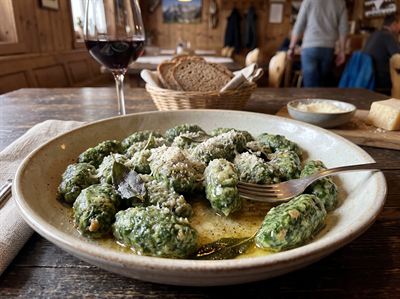
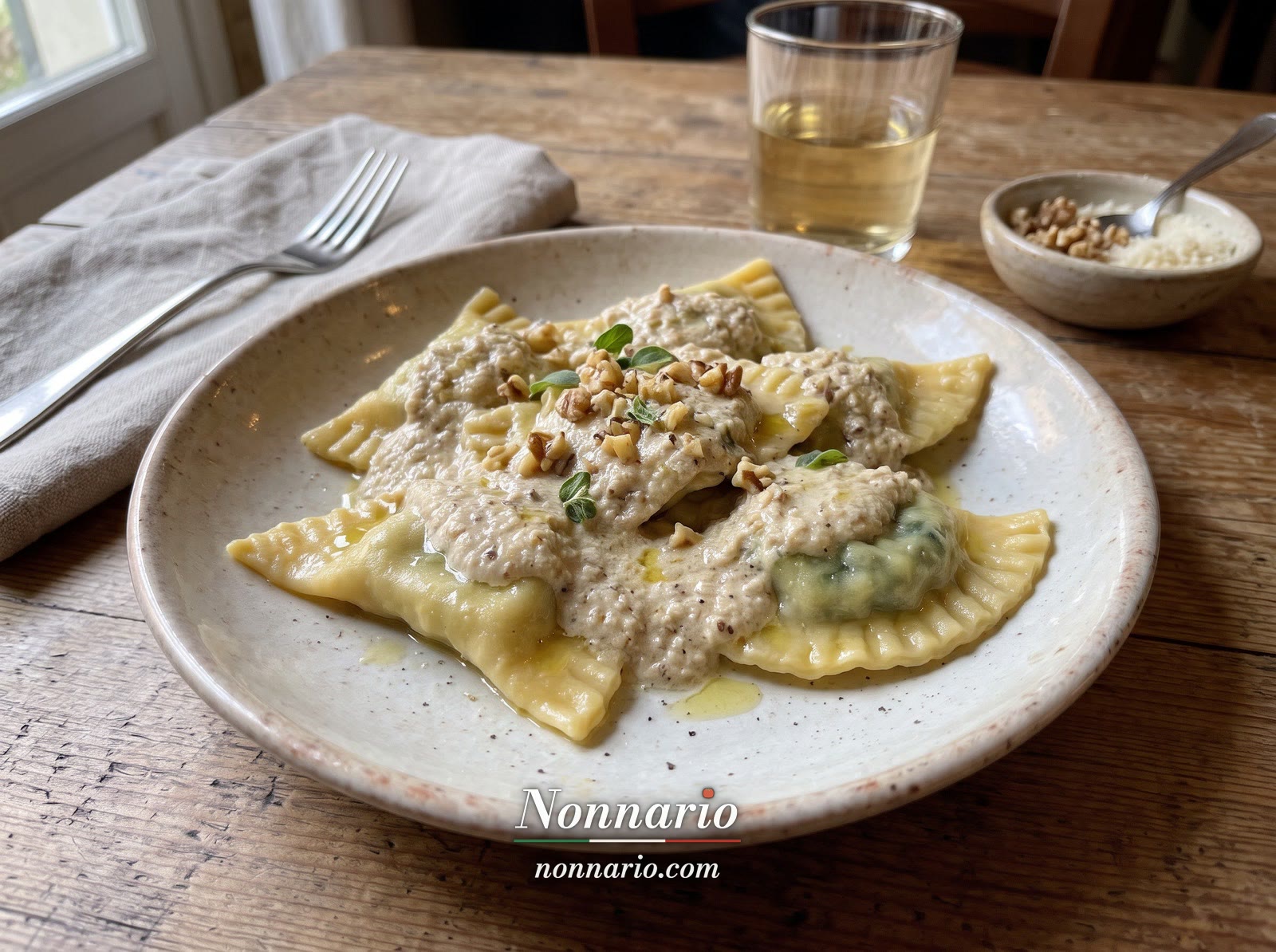
Liguria's meatless pansoti: triangles of thin pasta made with durum wheat flour, egg and white wine, filled with borage, wild herbs and prescinsêua, and dressed with walnuts pounded in a mortar; a De.Co. of Rapallo since 2013.
- Course
- Primi & RisottiPasta & Rice
- Serves
- 8
- Hands-on
- 2 h 41 min
- Cooking
- 1 h
- Resting
- 1 h 5 min+
The video and the photos of every step are also gathered on a separate page.
In breve
In short
Also called pansotti, pansotti con salsa di noci di Rapallo, pansöti co-a sàrsa de nôxe, raviolo alle erbette and pansoti al preboggion.
- Vegetarian
- Pasta of durum wheat flour, an egg and white wine, rolled no thicker than 1.5 mm.
- A meatless filling of at least four herbs, at least half of them borage, with prescinsêua, aged Parmigiano and eggs.
- Squares of about 5 cm folded corner to corner into triangles around a heaped teaspoon of filling, each about 15 g.
- Walnut sauce: peeled walnuts pounded in a mortar with garlic, then milk-soaked bread, prescinsêua, Parmigiano and oil; never heated.
La provenienza
Where this recipe comes from
Pansoti take their name from their plump, belly-like shape (panciuti, pot-bellied): parcels of pasta with no meat in them, filled with wild herbs, the preboggion, and fresh cheese, and dressed with walnuts. They are made all along the coast east of Genoa, and Rapallo, Bogliasco, Sori and Recco each claim them. A legend, thought unlikely even by those who tell it, has them first made early in the nineteenth century for a French garrison under a General Pansoit in the hills of Poggio and Sessarego, which ran out of food and was given the farmers' herbs. Others place their birth in San Martino di Noceto, a hamlet of Rapallo once rich in walnut trees. Rapallo, where pasta shops make them every day, says they became famous through its cooks and maids, who worked in the villas of English, German and Russian families between the wars. The Guida gastronomica d'Italia of 1931 already lists pansòti cu a salsa de nuge among Rapallo's specialities: ravioli filled with greens, hard-boiled eggs and grated cheese, dressed with walnuts pounded in a mortar with garlic, basil and grated cheese, with ricotta (priscinsua, in the guide's spelling) added and the sauce thinned with oil and melted butter. Walnut sauces are older in print: Ratto's Cuciniera Genovese, in its eighth edition of 1893, pounds peeled walnuts with toasted pine nuts and then fries them in oil with garlic and parsley, a cooked sauce for troffie, lasagne and tagliolini; it also explains preboggion as bunches of chard, early cabbage and parsley. The pansoto, the walnut sauce, prescinsêua (the Genoese fresh curd cheese) and preboggion are all on Italy's list of traditional food products for Liguria.
In 2013 the Città di Rapallo registered the Pansotti con salsa di noci di Rapallo as a De.Co., a municipal designation (Giunta resolution no. 371 of 17 October 2013). Its sheet sets the ingredients: pasta of durum wheat flour, water, sea salt, fresh eggs and white wine of the Golfo del Tigullio-Portofino DOC, with olive oil allowed; a filling of at least four herbs, at least half of them borage and no more than a fifth chard, with a mixture of cheeses (Parmigiano Reggiano or Grana Padano aged at least 24 months, and prescinsêua at most 30 per cent of it) and Riviera Ligure PDO olive oil from the Riviera di Levante; and a sauce of Italian walnuts, garlic (preferably from Vessalico), the same oil, prescinsêua, the same aged cheese and coarse sea salt, with pine nuts and bread soaked in milk allowed. The pasta may be no thicker than 1.5 mm, and each pansotto is about 6 to 8 cm long, 2.5 cm high and 15 g, made at least partly by hand. The shape itself is set by a photograph attached to the sheet, which is not published; the triangle here is the shape the other sources describe. The sheet gives no quantities and no method, so those come from a published Genoese recipe, and where the two differ this page follows the De.Co.: durum wheat flour, a sheet of 1.5 mm rather than 3, a spoonful of oil in the filling, and the recipe's greens and cheeses weighed out again in the sheet's proportions. The eggs, butter, nutmeg and marjoram in the filling are the published recipe's; the sheet does not list them. Ours are the servings, the weight of each herb and of each cheese (the recipe's 1 kg of greens and 250 g of cheese in all, shared out in the De.Co.'s proportions), the amounts of wine, oil and milk, the blanching times and the figures for the size of each pansotto.
- Provenance
- A reference recipe set by a protection consortium or by the town the dish is named after.
- Defined by
- Città di Rapallo
- Reference
- De.Co. (Denominazione Comunale) sheet for the Pansotti con salsa di noci di Rapallo, for the ingredients, the proportions of the herbs, the thickness and the size; quantities and home method from the City of Genoa's recipe on Visit Genoa, from the guide ‘Genova a Tavola’, 2013
- Sources
- Città di Rapallo: the De.Co. sheet for the Pansotti con salsa di noci di Rapallo, Annex A to Giunta resolution no. 371 of 17 October 2013 (Italian, PDF; copy hosted by Cucina Regionale Italiana)
- Città di Rapallo: Giunta resolution no. 371 of 17 October 2013, entering the pansotti in the town's De.Co. register (Italian, PDF; copy hosted by Cucina Regionale Italiana)
- Visit Genoa, the City of Genoa's tourism site: pansoti, from the guide ‘Genova a Tavola’ (Italian)
- Visit Genoa, the City of Genoa's tourism site: walnut sauce, from the same guide (Italian)
- Hello Rapallo, the Città di Rapallo's tourism site: pansoti in walnut sauce (Italian)
- Levante News: an account of Rapallo's De.Co. pansoto, by Gian Pietro Novella, 2013 (Italian)
- Levante News: Rapallo's three De.Co. products, 2013 (Italian)
- YouLiguria (Confartigianato Liguria): the pansoto of Rapallo and its De.Co., with its history and legend (Italian)
- Camera di Commercio di Genova: the pansoti of a Recco restaurant, with its ingredients, Genova Liguria Gourmet, 2021 (Italian, PDF)
- Il Cucchiaio d'Argento: pansotti alla genovese (Italian)
- Dissapore: pansoti al sugo di noci, 2022 (Italian)
- Mangiare in Liguria: pansoti con salsa di noci (Italian)
- Mangiare in Liguria: walnut sauce, with a note by Sergio Rossi of Genoa's Conservatorio delle Cucine Mediterranee (Italian)
- Donna Moderna: pansotti e preboggion, 2014 (Italian)
- Ministero dell'agricoltura, della sovranità alimentare e delle foreste (MASAF), Italy's Ministry of Agriculture: national list of traditional food products, 25th revision, 2025 (Italian)
- Giovanni Battista and Giovanni Ratto, La Cuciniera Genovese: the Genoese cookbook, eighth edition, Genoa, 1893 (Italian, Internet Archive)
- Touring Club Italiano, Guida gastronomica d'Italia: the 1931 guide, province of Genoa, p. 189 (Italian, Internet Archive)
- USDA Food Safety and Inspection Service: Leftovers and Food Safety
Ingredienti
Ingredients
The original recipe serves 8
For the pasta
For the filling
For the walnut sauce
For the water
Equipment
- Large wooden board and a long rolling pin, or a pasta machine
- Sharp knife or pastry wheel, and a ruler
- Large pot for the greens (about 6 l of water), a skimmer, a colander and a large tray
- Large mixing bowl, and a small pan to melt the butter
- Trays lined with clean cotton cloths, dusted with flour
- Marble mortar and wooden pestle (a blender will do)
- Pot of at least 8 l for the pasta
- Warm serving bowl
- Kitchen scale
Preparazione
Method
Scaled to 8 servings: the amounts in the steps follow. Pot and pan sizes and cooking times are still for the original 8.
About four hours, most of it by hand. Make and roll the dough, and let the sheets rest under a cloth while you boil the greens and mix the filling; then about an hour to cut and fold some 90 pansoti (longer the first time). Make the walnut sauce while the pasta water comes to the boil: it is never cooked. The pansoti cook in two batches of about 10 minutes.
- 2 h 41 minhands-on
- 1 hcooking
- 1 h 5 minresting, at least
The dough
-
Hands-on 5 min
Heap the 450 g of durum wheat flour on the board and make a well in the middle. Put the egg, the wine and the pinch of salt in the well, beat them with a fork, drawing in the flour from the inside, then work it together with your hands.
Check It gathers into one rough ball and no dry flour is left. If it stays crumbly, add water a spoonful at a time; if it sticks to your hands, a little flour.
Tip Our guide: a glass of wine is about 200 ml. The De.Co. lists water among the dough's ingredients; with this much wine the dough usually needs little or none, so add it a spoonful at a time only if the dough stays crumbly.
Tip The De.Co. also allows a little olive oil in the dough. The published recipe has none; if you add it, our guide is a tablespoon with the egg.
-
Hands-on 10 min
Knead firmly with the heel of your hand, folding and turning, until the dough is smooth and compact.
Check Smooth and compact, with no cracks; a dent pressed into it springs back slowly.
Tip Our guide: about 10 minutes.
-
Hands-on 15 minOfficial text
Roll the pasta out no thicker than 1.5 mm.
Check Hold it up to the light: you can see the shadow of your hand through it.
Tip Our guide: cut the dough into 2 or 3 pieces and roll them one at a time with the rolling pin on the lightly floured board, keeping the others covered. With a pasta machine, start at the widest setting and close the rollers a notch at a time, flouring the sheet well so it does not stick.
Tip Some recipes allow up to 3 mm; the De.Co. does not.
-
Rest 50 min to 1 h 10 min
Lay the sheets on the floured board, cover them completely with a clean cloth and leave them while you make the filling.
Check When you lift a corner it is still supple, not dry or brittle.
Tip If the edges dry out before you shape them, moisten them lightly with water as you seal.
The filling
-
Hands-on 2 minOfficial text
Use at least four kinds of herb, in varying proportions, as long as borage makes up at least half of them and chard no more than a fifth.
Check At least four kinds; borage at least half the weight, chard no more than a fifth.
Tip Our guide: 500 g of borage, 200 g of chard and 300 g of preboggion made of at least two other herbs, such as dandelion, salad burnet, sow thistle or rampion. This keeps the published recipe's 1 kg of greens in all, shared out in the De.Co.'s proportions.
-
Hands-on 20 min
Pick over the greens, discarding tough stalks and any yellow or damaged leaves, and wash them in several changes of cold water.
Check No grit is left at the bottom of the bowl after the last rinse.
-
Cooking 15 minHeat high
Bring 6 l of water to the boil in the large pot and salt it, about 10 g per litre.
Check A full, rolling boil.
-
Cooking 5 minHeat high
Put the chard in first, and after a minute add the borage and the preboggion. Boil them together for 3–4 minutes more, then lift them out with the skimmer into the colander.
Check The leaves are limp and tender, and the chard stems bend without snapping.
Tip Our guide: the times are ours; the chard goes in first because its stems are the toughest.
-
Rest 10 min
Spread the greens out on the tray and leave them until you can handle them.
Check Cool enough to squeeze hard in your hands.
-
Hands-on 10 min
Squeeze the greens by the handful as hard as you can, then chop them very finely with a knife.
Check No more water runs out when you squeeze a handful again; the chopped greens are fine and fairly dry.
Tip A wet filling softens the pasta and can break through it: squeeze hard.
-
Hands-on 3 minHeat low
Melt the 20 g of butter gently in the small pan and let it cool a little.
Check Liquid and warm, not hot, so it does not cook the eggs.
-
Hands-on 5 min
Put the chopped greens in the large bowl and add the 75 g of prescinsêua, the 3 eggs, the 175 g of grated Parmigiano, the melted butter and the tablespoon of oil. Mix gently until even, then flavour it with a grating of nutmeg and the chopped marjoram. Taste, and only then add salt if it needs it.
Check Even and soft, but it holds its shape on a spoon, and no liquid gathers in the bowl.
Tip Our guide: the published recipe's 250 g of cheese in all, shared out in the De.Co.'s proportion: prescinsêua no more than 30 % of the cheeses, the rest aged Parmigiano. With this much aged cheese the filling may need little or no salt.
Tip Our guide: the oil is the De.Co.'s; the published recipe has none, so the tablespoon is ours.
Tip Keep the filling covered in the fridge while you shape, taking out a portion at a time: it holds raw egg.
Shaping the pansoti
Work one sheet at a time and keep the others covered.
-
Hands-on 5 min
Cut a sheet into squares of about 5 cm with the knife or pastry wheel. Keep them under a cloth so they do not dry out.
Check Squares of even size, about 5 cm a side.
-
Hands-on 50 min to 1 h 10 min
Put a heaped teaspoon of filling in the middle of each square, about 10 g. Fold the square corner to corner over the filling into a triangle, pressing out the air, and press the edges firmly together with your fingers to seal. Lay the pansoti on the floured cloths, not touching. Cut and fill the other sheets the same way. Pansoti that will wait more than 2 hours from shaping go into the fridge on their trays until the water boils.
Check Every triangle is sealed all round, with no air trapped around the filling.
Tip Our guide: the published recipe says a teaspoon; a heaped one, about 10 g, brings each pansotto to the De.Co.'s 15 g. The filling then makes about 90 pansoti, and about a third of the dough is left over.
Tip If the pasta has dried and will not stick, moisten the edges lightly with water.
-
Hands-on 2 minOfficial text
Each pansotto is about 6 cm–8 cm long and about 2.5 cm high, and weighs about 15 g; making them includes work by hand.
Check Weigh one: about 15 g. The long side of the triangle measures 6 cm–8 cm, and the pansotto stands about 2.5 cm at its plumpest, across the filling.
Tip Our guide: a 5 cm square folded corner to corner has a long side of about 7 cm.
Tip The sheet sets the shape by a photograph attached to it, which is not published, so it does not show where the height is measured; we read it as the plump middle. The triangle is the shape the other sources describe.
The walnut sauce, while the water heats
-
Cooking 20–25 minHeat high
Bring 6 l of water to the boil in the large pot and salt it, about 10 g per litre. Make the sauce while it heats.
Check A full, rolling boil.
-
Hands-on 15–20 min
Drop the 400 g of walnut kernels into boiling water for 2–3 minutes, drain them, and rub off the thin skins with your fingers.
Check The kernels are pale, with no brown skin left in their folds.
Tip The skin is bitter: that is why it comes off.
Tip Our guide: the time is ours; peel them while they are still warm, when the skins come away most easily.
-
Rest 5 min
Soak the crumb of the roll in the milk until soft, then squeeze it well.
Check Soft and almost creamy, but no milk drips from it when you squeeze it.
Tip Bread that is not squeezed well makes a watery sauce.
-
Hands-on 3 min
In the mortar, pound the garlic with a few grains of coarse sea salt into a paste.
Check A smooth paste, with no pieces of garlic left.
-
Hands-on 10 min
Keep pounding as you add the walnuts a handful at a time, until they are finely ground.
Check A thick, fine paste with no large pieces.
Tip A blender will do. Our guide: work in short pulses, so the walnuts do not heat.
-
Hands-on 3 min
Scrape the paste into a bowl and add the squeezed bread, the 2 tablespoons of prescinsêua and the 100 g of grated Parmigiano. Mix carefully until even.
Check Even in colour, with no white streaks.
-
Hands-on 3 min
Stir in the oil a little at a time until the sauce is creamy.
Check Creamy and thick: it falls slowly from the spoon.
Tip Our guide: about 150 ml, but stop as soon as it is creamy.
Tip The sauce is never heated.
Cooking and serving
-
Cooking 10 minHeat medium-high
Lower half the pansoti into the boiling salted water and cook them at a gentle boil for about 10 minutes. Lift them out with the skimmer into the warm serving bowl and turn them gently in half the sauce.
Check The pasta at the folded corners is tender when you bite one.
Tip A hard boil can break them open.
-
Cooking 10 minHeat medium-high
Cook the rest the same way and add them to the bowl with the rest of the sauce. If the sauce is too thick, loosen it with a spoonful of the hot cooking water. Turn them gently and serve at once.
Check Every pansotto is coated in a creamy sauce.
Tip Some cooks add a few flakes of butter and more grated cheese as they serve.
Tip Leftovers go into the fridge within 2 hours of cooking, in a shallow covered container, and are eaten within 3 days; reheat them until hot through, at least 75 °C.
The essentials, for cooks who know the dish. Switch to Detailed for quantities, temperatures, times and checks at every step.
Press “I’m here” on the step you are on, and again when it is done.Tap the pin on the step you are on, and the tick when it is done. Timers keep running while you scroll.
Da sapere
Good to know
- WhenQuando
- A dish for lean days, since there is no meat in it: Fridays, Lent and Christmas Eve. Source
- KeepingConservazione
- Raw pansoti, once slightly dried, can be frozen on a tray and then moved to freezer bags; they keep about three months and go into the boiling water still frozen. Cooked and drained, they keep in an airtight container in the fridge for three days at most. Source
- VariantsVarianti
- With butter and sage: Dressed simply with butter and sage instead of the walnut sauce. Source
- With an egg-free dough: Pasta of 400 g of flour, half a glass of water, a spoonful of dry white wine and salt, rested for half an hour, around a filling of borage, ricotta, eggs, garlic and grated cheese. Source
- With pine nuts in the sauce: 200 g of walnuts with 150 g of pine nuts, bread soaked in milk, marjoram, a clove of garlic, 30 g of grated Parmigiano and 70 g of olive oil. Source
- With the walnut skins left on: The skins stay on the walnuts for those who like their slight bitterness, which also belongs to the tradition. In the same recipe the sauce has no cheese of its own: it is loosened with hot pasta water as it dresses the pansoti, with butter and Parmigiano added to taste. Source
- With chard alone: A filling of chard, eggs, prescinsêua or ricotta and Parmigiano in egg pasta, laid between two sheets, cut into any shape and dried in the air for about 2 hours before cooking. Source
Errori comuni
Common mistakes
- A wet filling: squeeze the greens hard, or the filling softens the pasta and can break through it.
- A sheet thicker than 1.5 mm: the De.Co. allows no more.
- Air trapped around the filling: press it out as you fold, or the pansoti can burst.
- Bread that drips milk: squeeze it well, or the sauce turns watery.
- Heating the walnut sauce: it is only loosened with hot cooking water, never cooked.
- A hard boil: keep the water at a gentle boil, so the pansoti do not break.
Fuori dall'Italia
Cooking it outside Italy
- Prescinsêua, the fresh Ligurian curd cheese, is hard to find outside Liguria: sheep's or cow's milk ricotta takes its place.
- Preboggion is a mix of wild herbs gathered in season. Where there are none to gather, chard or spinach is the usual stand-in, though it simplifies the taste.
- Borage is hard to find out of season and outside Liguria. Without it the filling can no longer follow the De.Co., which asks for at least half borage.
- Durum wheat flour is sold in Italy as semola rimacinata di grano duro: look for finely milled durum semolina.
- Grana Padano aged at least 24 months can replace the Parmigiano Reggiano.
- Ordinary garlic can stand in for Vessalico garlic, which the De.Co. asks for only where possible. Any white wine can stand in for the Golfo del Tigullio-Portofino DOC, though the dough then no longer follows the De.Co. to the letter.
From nonnario.com/recipes/pansoti-con-salsa-di-noci/, where you will find its sources, its story and the step photos. Sources checked in November 2026.