Genova, Liguria
Farinata
Ligurian chickpea flatbread
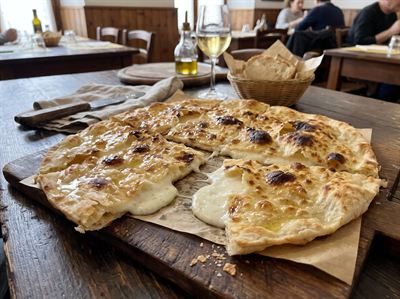
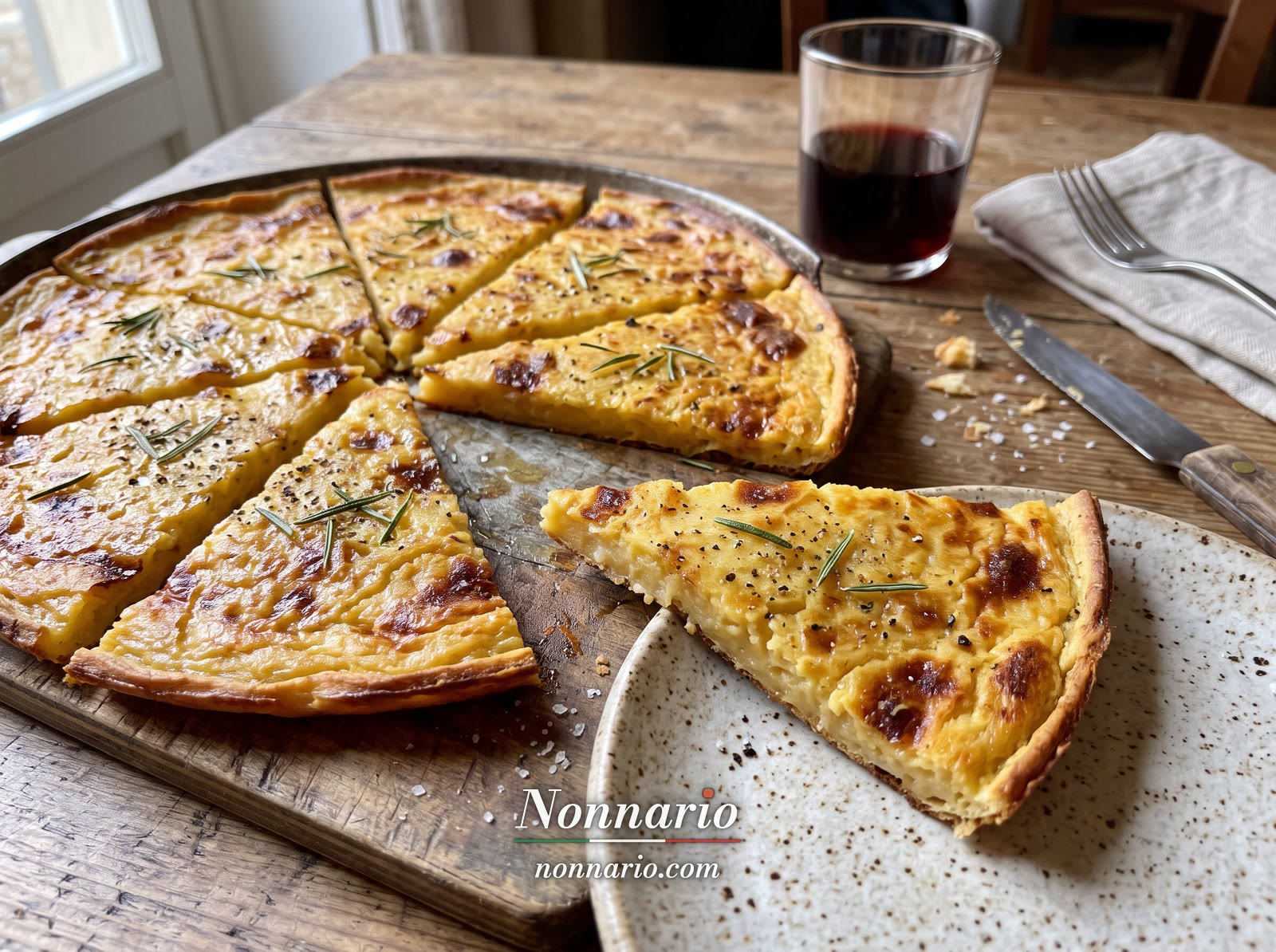
Liguria's farinata, or fainà: a thin round of chickpea flour, water, salt and olive oil, the batter rested for hours, then baked very hot until golden and crisp at the edges.
- Course
- Pizze e PaniPizza & Bread
- Serves
- 2
- Hands-on
- 18 min
- Cooking
- 30 min
- Resting
- 4 h 5 min+
The video and the photos of every step are also gathered on a separate page.
In breve
In short
Also called fainà, farinata di ceci and chickpea farinata.
- Vegetarian
- Vegan
- Gluten-free
- Only chickpea flour, water, salt and olive oil: three parts water to one of flour, whisked into a very liquid batter with no lumps.
- The batter rests at least 4–5 hours, or overnight in the fridge, and the foam that forms on top is skimmed off.
- A thin layer, about 6 mm–7 mm, in a hot, well-oiled round tin of tinned copper, iron or aluminium, never non-stick.
- Baked very hot near the top of the oven for about 13 minutes, the tin shaken and turned so the rising oil runs back down.
- Eaten at once, hot or warm, often with ground black pepper; the original is baked in a wood-fired oven.
La provenienza
Where this recipe comes from
Farinata, fainà in Genoese, is a thin unleavened round of chickpea flour, water, olive oil and salt, eaten from Genoa and its hinterland across Liguria and into lower Piedmont; Liguria lists it among its traditional agri-food products. By legend it was born in 1284, after Genoa beat Pisa at Meloria: in a storm on the way home, barrels of oil and chickpea flour spilt and were soaked with seawater, and the sailors dried the mixture in the sun and mockingly called it the gold of Pisa. The likelier story is that the maritime republics' trade brought the habit of eating chickpeas from the East in the Middle Ages. The oldest written notice is said to be a decree of the Republic of Genoa of 1447 forbidding poor oil in making it; another account dates the 'official' recipe to a document of 1477. In Liguria it is sold in bakeries, baked in large tins, and the original version needs a wood-fired oven: a very liquid batter is poured into huge, low rounds of tinned copper, the testi, and stirred at the very mouth of the oven, because the oil keeps rising to the top and the heat must set it at once. The crisp edges are the most fought-over part.
There is no official recipe. We compared nine sources and publish the most widely recognised version, made for a home oven. They agree on what matters: only chickpea flour, water, salt and olive oil, about three parts water to one of flour, a long rest for the batter, the foam skimmed off, a thin layer in a well-oiled tin, the hottest oven you have, and the farinata eaten hot or warm, often with ground black pepper. They differ on the amounts of oil and salt, on the rest (from an hour to a night) and on the oven. Without a wood oven, this page bakes it near the top of the oven under the grill, as hot as the oven goes, in a tin heated first so the farinata does not stick.
- Provenance
- A regional tradition documented in cookbooks and local practice, with no single official text.
- Defined by
- Ligurian tradition
- Reference
- Compared across 9 sources, listed below; this page publishes the most widely recognised version.
- Sources
- Dissapore: farinata made at home, the tin and the bake, with a recipe, by Cinzia Alfè, 2016 (Italian)
- Regione Liguria, AgriLiguriaNet: farinata di ceci, its sheet among Liguria's typical products (Italian)
- Comune di Genova, Visit Genoa: farinata di ceci, its history and a recipe (Italian)
- Accademia Italiana della Cucina: farinata, a Ligurian recipe from its collection (Italian)
- La Cucina Italiana: farinata di ceci, its Ligurian recipe (Italian)
- Camera di Commercio Riviere di Liguria: list of traditional products drawn from the regional atlas of traditional agri-food products, 2015 (Italian)
- Linkiesta: chickpea-flour dishes across Italy and the legend of the farinata, by Carla Reschia, 2023 (Italian)
- Borghi di Riviera, a tourism project funded by Regione Liguria: white farinata, Savona's wheat-flour version
- USDA Food Safety and Inspection Service: Leftovers and Food Safety (archived copy of 29 May 2025)
Ingredienti
Ingredients
Makes one farinata in a 30 cm round tin: 2 servings
The batter
For the tin and to serve
Equipment
- A round tin about 30 cm across with a low rim: a tinned copper testo, or failing that an iron or aluminium tin; never non-stick
- Kitchen scale
- A bowl and a whisk, or an immersion blender
- Cling film or a plate, to cover the batter
- A spoon or small ladle, to skim the foam
- A wooden spoon
- An oven with a grill or top heat: ideally 300 °C, at least 280 °C for the best result; a 250 °C oven works, more slowly
- Oven thermometer
- Oven gloves and a heatproof board
- A wooden or plastic spatula, to cut and lift the farinata
- Kitchen paper, for the tin
Preparazione
Method
About 5 hours, nearly all of it the batter's rest: mix it at least 4–5 hours before you want to eat, or the evening before and rest it in the fridge. Then about 20 minutes to heat the oven and the tin and skim the batter, 5–10 minutes more for the oven to climb to the grill's 300 °C with the batter in the tin, and about 13 minutes to bake (15–20 in an oven that stops at 250 °C). Serve it the moment it comes out. For more, make one batch per tin and bake them one after the other.
- 18 minhands-on
- 30 mincooking
- 4 h 5 minresting, at least
The batter, at least 4–5 hours ahead
-
Hands-on 5 min
Put the 120 g of chickpea flour and the 5 g of salt in a bowl. Pour in the 360 g of water a little at a time, whisking all the while so that no lumps form.
Check A smooth, very liquid batter: lift the whisk and no lumps or dry specks of flour show.
Tip An immersion blender does it in a minute and leaves no lumps.
Tip The oil does not go into the batter: it goes into the hot tin just before baking.
-
Rest 4–5 h
Cover the bowl and leave the batter to rest for at least 4–5 hours. You can also make it the evening before and rest it overnight in the fridge.
Check A layer of foam and small bubbles has formed on the surface.
Tip Our guide: cover it with cling film or a plate, and leave it at room temperature unless it is resting overnight, in which case it goes in the fridge.
Tip Our guide: after a night in the fridge, take the batter out about an hour before baking and stir it, so it is not icy cold when it meets the hot tin.
The oven and the tin
-
Cooking 15 minTemp 200 °C–220 °CHeat 200–220 °C, shelf second from the top
Put a shelf in the second position from the top and heat the oven to 200 °C–220 °C, no hotter.
Check An oven thermometer on the shelf shows 200 °C–220 °C.
Tip Our guide: an oven thermometer is worth having here, because many home ovens run hotter or cooler than their dial, and the next steps go to the limit.
-
Hands-on 2 min
While the oven heats, skim off all the foam and bubbles that have formed on the batter, with a spoon or a small ladle.
Check The surface of the batter is smooth and clear, with no foam left.
Tip Left on, the foam turns black in the oven, which looks and tastes bad.
-
Cooking 2 minTemp 200 °C–220 °CHeat 200–220 °C
Once the oven is at temperature, put the empty tin on the shelf for 1–2 minutes, then take it out with oven gloves and set it on a heatproof board.
Check The tin is hot all over: hold your hand just above it and you feel the heat rising.
Tip Heated first, the oil coats the tin better and the farinata does not stick.
Tip A tinned copper testo must never go above 220 °C while empty: at 230 °C the tin lining melts and is not fit to eat. That is why the oven heats only to 200 °C–220 °C for this step.
-
Hands-on 1 minHeat grill or top heat, 300 °C (or 280 °C)
As soon as the tin is out, switch the oven to the grill, or to top heat only, and set it to 300 °C; if your oven does not reach it, set 280 °C. Leave the shelf where it is.
Check The grill is on and the oven is heating towards 300 °C.
Tip The farinata bakes near the heat that comes from above: that is why the shelf is high and the grill is on.
Tip Below 280 °C the farinata still bakes, but more slowly and not quite as well. Our guide: if your oven stops at 250 °C, use top heat at its maximum and expect about 15–20 minutes in all; go by the checks in the baking steps.
Tip Our guide: if your grill has power levels rather than a thermostat, set it to full power, read the temperature on the oven thermometer and go by the checks.
Tip Our guide: never put an empty tinned testo back in the oven once the grill is on; it goes under the grill only with the batter in it.
Into the tin
-
Hands-on 1 min
Pour the 50 ml of olive oil into the hot tin and tilt it so the oil covers the whole base.
Check An even layer of oil over the whole base of the tin.
Tip Our guide: hold the tin with oven gloves; it is still very hot.
-
Hands-on 2 min
Pour the batter into the oiled tin. Then, slowly, with a wooden spoon, draw the oil from the edges of the tin in towards the centre of the batter, all the way round.
Check The batter lies in an even layer about 6 mm–7 mm deep, with the oil worked in from the edges all round.
Tip Keep the layer level: where it is thicker, the farinata stays soft and does not crisp.
-
Rest 5–10 min
Leave the batter in the tin until the oven has reached 300 °C under the grill (280 °C, or its maximum, if that is as far as it goes). Then, with oven gloves, take the tin to the open oven door, draw the oil through the batter once more from the edges with the wooden spoon, and slide the tin straight onto the shelf.
Check The oven thermometer reads 300 °C, or 280 °C if that is your oven's top, and the oil has been drawn through again right at the door.
Tip Our guide: 5–10 minutes is a usual climb from 220 °C; the thermometer decides.
Tip Stirring at the very mouth of the oven lets the heat set the oil and batter at once, before the oil rises again.
Baking
-
Cooking 2 minTemp 300 °CHeat grill, 300 °C, shelf second from the top
With the tin on the shelf, second from the top, bake for 2 minutes at 300 °C.
Check The batter sizzles and has begun to set at the edges.
Tip If your oven only reaches 280 °C, bake at 280 °C for the whole 13 minutes, shaking and turning the tin just the same.
-
Cooking 9 minTemp 275 °C–280 °CHeat grill, 275–280 °C
Turn the oven down to 275 °C–280 °C and bake for about 9 minutes more. A few times during the bake, open the door, shake the tin and turn it, so the oil that rises to the surface runs back down.
Check The top is turning golden and the edges are browning; after a shake, no pools of oil stand on the surface.
Tip Our guide: every 3 minutes or so, with oven gloves, pull the shelf out a little, shake and turn the tin, slide it back and close the door quickly, so the oven does not lose its heat.
-
Cooking 2 minTemp 300 °CHeat grill, 300 °C
For the last 2 minutes, if your oven reaches it, turn it back up to 300 °C to colour the farinata more; otherwise bake the last 2 minutes as you are.
Check Golden on top with darker brown patches, the edges brown and crisp, the centre set: shake the tin and nothing ripples like liquid. Lift the edge with the spatula: the underside is coloured and crisp.
Tip Our guide: about 12–13 minutes in all, or about 15–20 in an oven that stops at 250 °C. If it is still pale or the centre still trembles, give it another minute at a time and check again.
Serving
-
Hands-on 2 min
Take the tin out and, with a wooden or plastic spatula, cut the farinata into generous slices and lift them out. Serve straight away, hot or warm, with a grind of black pepper if you like.
Check The slices lift out whole, crisp and coloured underneath.
Tip Our guide: never cut it with a knife in a tinned copper tin: a metal blade scratches the lining.
Tip Our guide: anything not eaten goes in the fridge, covered, in a shallow container, within 2 hours, and is eaten within 3 days; reheat it in a hot oven until piping hot, 75 °C at the centre.
-
Hands-on 5 min
Once the tin has cooled, pour in some water and leave it for a couple of hours to soften whatever has stuck. Then remove the residue with your fingertips only, with no sponge or cloth, dry the tin gently, spread a tablespoon of clean oil over it with kitchen paper, wipe it lightly and put it away.
Check The tin is clean and glossy, with a thin film of oil left on it.
Tip The film of oil is what keeps the next farinata from sticking: never scrub it off with a sponge or washing-up liquid.
Tip A new testo: before its first farinata, wash it once (the only time) with water and washing-up liquid, pour in a generous half glass of oil, put it in the oven at 200 °C for 3–4 minutes, pour the oil away, dry it with kitchen paper only and store it upright. Before baking, wipe off the dust with kitchen paper dipped in a little clean oil.
Tip Expect the first four or five farinate in a new testo to stick in places. Clean it as above after each; once the film has built up, nothing sticks.
The essentials, for cooks who know the dish. Switch to Detailed for quantities, temperatures, times and checks at every step.
Press “I’m here” on the step you are on, and again when it is done.Tap the pin on the step you are on, and the tick when it is done. Timers keep running while you scroll.
Da sapere
Good to know
- KeepingConservazione
- Serve it at once, straight from the oven: it is eaten hot or warm. Source
- VariantsVarianti
- In a wood-fired oven: The original needs a wood oven: the very liquid, well-mixed batter goes into large, low, round testi of tinned copper, and is stirred at the mouth of the oven, because the oil rises to the top and the heat must set it at once. The wood fire makes it hot and crisp, above all at the edges. Source
- With rosemary, borage, artichokes and more: Above all in western Liguria: rosemary, borage, artichokes, mushrooms, gorgonzola, spring onions or floured whitebait, added to the batter after the oil has been stirred in, just before it goes into the oven. Source
- Farinata bianca: Savona's white farinata, made with wheat flour in place of chickpea flour (so not gluten-free): whiter and crisper, the batter rested a couple of hours, poured about 5 mm thick into a thinly oiled tin and baked in a hot oven for about fifteen minutes. Source
- Cecina: In Tuscany a similar round is called cecina or torta, and in Sardinia fainè; in Livorno it is also eaten in a bread roll, the cinque e cinque. Source
Errori comuni
Common mistakes
- Using a non-stick tin: its coating does not stand up to 280 °C and more. Use tinned copper, iron or aluminium.
- Leaving the foam on the batter: it turns black in the oven.
- Heating an empty tinned copper testo above 220 °C: at 230 °C the tin lining melts. It goes under the hot grill only once the batter is in it.
- An uneven or thick layer: where the batter is deeper, it stays soft instead of crisping.
- Leaving the tin still in the oven: shake and turn it now and then, or the oil that rises sits on top.
- Baking it in a moderate oven: it needs the highest heat your oven has, from above, and a short bake.
- Scrubbing the tin with a sponge and washing-up liquid after use: the film of oil goes, and the next farinata sticks.
Fuori dall'Italia
Cooking it outside Italy
- Chickpea flour is sold as garbanzo bean flour in the US.
- Without a tinned copper testo, use a round iron (carbon steel) or plain aluminium pan about 30 cm across, such as a pizza pan with a low rim; not non-stick.
- The grill is the broiler in the US; set it as high as it goes and check with an oven thermometer.
From nonnario.com/recipes/farinata/, where you will find its sources, its story and the step photos. Sources checked in November 2026.