Torino, Piemonte
Giandujotto di Torino
Turin's boat-shaped chocolate of cocoa, sugar and Piedmont hazelnuts
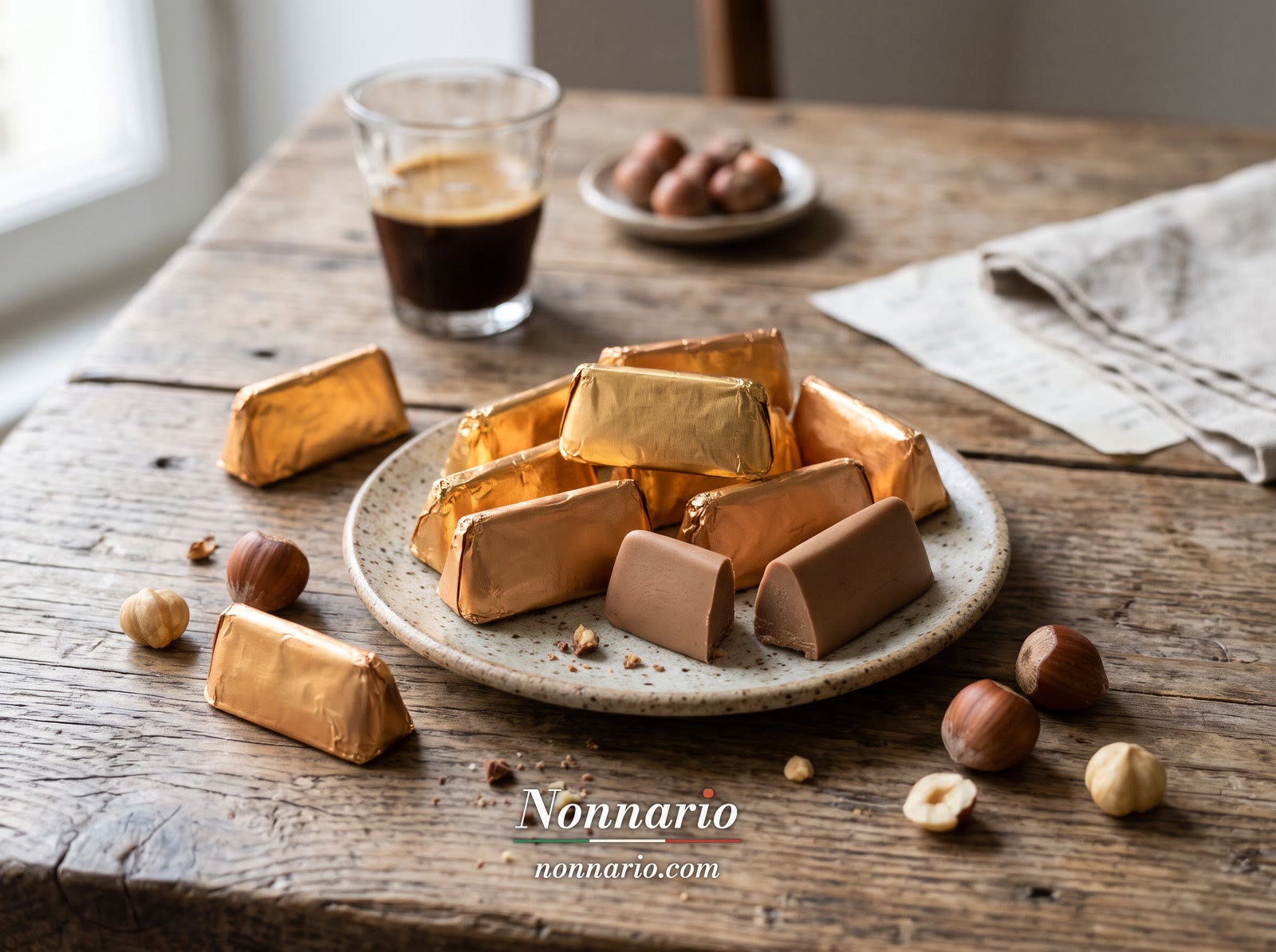
Turin's chocolate of toasted Piedmont hazelnuts, sugar and cocoa, with no milk, tempered and shaped as a small triangular prism like an upturned boat, then wrapped in foil; a PGI applied for in 2026.
The PGI ‘Giandujotto di Torino’ has been applied for (the application went to the European Commission in April 2026) but is not yet granted, and its specification may change before it is.
- Course
- DolciDesserts
- Serves
- 55
- Hands-on
- 1 h 19 min
- Cooking
- 0 min
- Resting
- 2 h 5 min+
The video and the photos of every step are also gathered on a separate page.
In breve
In short
Also called Giandujotto, Gianduiotto, Gianduiotti, Giandujotti, Gianduiotto di Torino, Giandujotto di Torino IGP, giandojòt and Turin hazelnut chocolate.
- Vegetarian
- Vegan
- Gluten-free
- Toasted Nocciola Piemonte PGI hazelnuts 30–45%, sugar 20–45%, cocoa at least 25%; only vanilla, lecithin and salt may be added, so no milk.
- Refined until no particle is larger than 25 microns, then tempered: it is very soft in the mouth, melting and a little sticky.
- A triangular prism with rounded edges, shaped by hand with spatulas, extruded, extruded and cut, or moulded.
- On average 4 g–12 g a piece when extruded or moulded, 8 g–16 g when shaped by hand.
- Each piece is wrapped in aluminium foil within 12 hours of cooling.
La provenienza
Where this recipe comes from
The giandujotto takes its name from Gianduja, the carnival mask of Turin, and its shape, like a segment or the upturned hull of a small boat, recalls the irregular hat the mask wears. It is made from gianduja paste, hazelnuts and cocoa worked together, which is thought to have been born of Napoleon's Continental Blockade of 1806: with less cocoa coming in, Turin's chocolate makers stretched it with ground hazelnuts. Turin had been a city of chocolate since the seventeenth century, the age of the ‘ciculatè’. The specification tells how, in the second half of the nineteenth century, Michele Prochet made a chocolate of cocoa paste and hazelnuts called Givu, put on sale, probably at the Fiera fantastica of 1867, under the name ‘Gianduja’ and soon called giandujotto by the public; the more usual story places its debut at the Carnival of 1865, when the firm of Caffarel gave it its boat shape and its foil wrapper, to keep the soft paste from the heat, and Gianduja handed the chocolates out to the crowds. The name ‘Giandujotto di Torino’ was written into Italian laws ratifying agreements on protected names with Germany (1966), France (1967) and Spain (1978), and early this century the Associazione Giandujotto was formed to regulate its making, ahead of the 2006 Turin Winter Olympics.
In 2025 the Comitato Giandujotto di Torino IGP presented a production specification in Turin, spelt with a j, and asked for the name to be registered as a PGI. The Ministry of Agriculture published it in the Gazzetta Ufficiale no. 123 of 29 May 2025 for objections, and in April 2026 sent the application to the European Commission; it is not yet registered. The specification rests the name on its reputation and covers the whole of Piedmont. It sets the shares of the finished piece: toasted Nocciola Piemonte PGI hazelnuts 30–45%, beet or refined cane sugar 20–45%, cocoa (beans, cocoa mass, cocoa butter or cocoa powder) at least 25%, and, if wanted, a little vanilla, sunflower or soy lecithin and salt; nothing else, so no milk, which many gianduiotti on sale contain. The maker doses and mixes the ingredients, refines them until no particle is larger than 25 microns, tempers the mass and shapes each piece into a triangular prism with rounded edges, by hand with spatulas, by extrusion, by extrusion and cutting, or in moulds; then the pieces are cooled and wrapped one by one in aluminium foil within 12 hours. Extruded or moulded pieces weigh 4–12 g, hand-shaped ones 8–16 g, on average; brown or reddish brown, glossy or matt, they taste intensely sweet with a slightly bitter finish, of toasted hazelnut, cocoa and vanilla.
The specification gives shares, not a household batch, and its maker refines the raw ingredients itself, which a home kitchen cannot do. This page therefore uses dark chocolate and pure hazelnut paste, both bought already refined and chosen so that they contain only what the specification allows, in the quantities of a published home recipe, 400 g of chocolate to 200 g of paste: with a chocolate of 50–65% cocoa, the pieces are a third hazelnut, 33–43% cocoa and 23–33% sugar, inside the specification's shares. The method is that recipe's too: two-thirds of the chocolate melted gently and poured over the rest, the paste stirred in at 28 °C, the moulds at least 2 hours in the fridge and the pieces 5 minutes at room temperature. The pieces are moulded, the one way of the four a home kitchen manages easily, at about 10 g each, and wrapped in foil as the specification requires. The melting temperature, the test smear, the piece size and the other times are our guide; the page has not yet been tested in a home kitchen, and every step has a check to judge it by. Made outside Piedmont, or from bought chocolate, it is a giandujotto in the Turin manner, not Giandujotto di Torino.
- Provenance
- An application to protect the dish in the EU (TSG, PDO or PGI) is under way; this page follows its specification as it stands, which may change before it is granted.
- Defined by
- Comitato Giandujotto di Torino IGP
- Reference
- Proposed specification of the PGI ‘Giandujotto di Torino’ (EU file PGI-IT-03510), published by the Ministry of Agriculture in the Gazzetta Ufficiale no. 123 of 29 May 2025 and sent to the European Commission in April 2026; not yet registered. The household batch and the home method follow Cookist's recipe for homemade gianduiotti (2025)
- Sources
- Ministry of Agriculture (MASAF): the proposed production specification of the PGI, as sent to the European Commission, listed on 21 April 2026 (Italian)
- Gazzetta Ufficiale no. 123 of 29 May 2025: the Ministry of Agriculture's notice of the application for the PGI, with the proposed specification published for objections (Italian)
- Cookist (Ciaopeople): homemade gianduiotti, a recipe, 2025 (Italian)
- Cookist (Ciaopeople): the gianduiotto, its history and how it is made, 2023 (Italian)
- Gambero Rosso: the true story of the gianduiotto, 2021, archived copy (Italian)
- Dissapore: the specification for the Giandujotto PGI presented in Turin, 13 March 2025 (Italian)
Ingredienti
Ingredients
The original recipe serves 55
The gianduja
Equipment
- Kitchen scale
- Heavy knife and a dry chopping board
- Small heavy-based saucepan, and a dry heatproof bowl
- Silicone spatula, and a wide metal spatula or scraper
- Thermometer for the chocolate, a probe or instant-read one: essential here
- Moulds for gianduiotti, silicone or rigid plastic, with cavities of about 10 g (about 4 cm long), enough for 55 pieces: two or three moulds
- A strip of baking paper, for testing the temper
- A wire rack
- Squares of aluminium foil for chocolates, about 8 cm across, one for each piece (55)
Preparazione
Method
Scaled to 55 servings: the amounts in the steps follow. Pot and pan sizes and cooking times are still for the original 55.
About 3½–4 hours, two of them in the fridge: 18 minutes to read the labels, chop, weigh and set out the moulds and foil; 20–37 to melt and temper the chocolate, stir in the hazelnut paste and test it; 11–15 to fill and tap the moulds; at least 2 hours in the fridge; 10 to turn the pieces out and let them lose the chill; then 25–35 to wrap them, within 12 hours. Have everything ready before you start: once tempered, the mixture waits for no one. The batch makes about 55 pieces of about 10 g; each serving here is one piece, so set the servings to the cavities in your moulds. The quantities and the method are a published home recipe's, within the specification's shares; the melting temperature, the test and the piece size are ours and have not yet been tested in a home kitchen.
- 1 h 19 minhands-on
- 0 mincooking
- 2 h 5 minresting, at least
Before you start
The specification's maker refines the hazelnuts, sugar and cocoa itself, to particles no larger than 25 microns, which takes a refiner. At home, a chocolate and a hazelnut paste that are already refined do that job, so the labels decide what goes into the pieces.
-
Hands-on 3 min
Check that the chocolate says 50–65% cocoa and lists only cocoa mass (or cocoa beans), sugar and cocoa butter, with at most soy or sunflower lecithin and vanilla. Check that the hazelnut paste lists only hazelnuts, Nocciola Piemonte PGI (Piedmont hazelnuts), toasted.
Check No milk, milk fat, vanillin, ‘flavouring’, vegetable fat or any other emulsifier in the chocolate; nothing but toasted Piedmont hazelnuts in the paste.
Tip The specification allows no ingredient beyond hazelnuts, sugar, cocoa (beans, cocoa mass, cocoa butter or cocoa powder), vanilla, sunflower or soy lecithin and salt: anything else on the label rules the product out.
Tip Our guide: two parts of a 50–65% chocolate to one of paste give pieces that are a third hazelnut (the specification asks 30–45%), 33–43% cocoa (at least 25%) and 23–33% sugar (20–45%). Above 65% the sugar nears the specification's 20% minimum; from about 70% it falls below it.
Tip The specification's sugar is beet sugar or refined cane sugar; a chocolate sweetened with unrefined (whole) cane sugar does not fit it.
-
Hands-on 10 min
Chop the chocolate finely with the heavy knife and weigh 400 g. Put two-thirds of it, about 270 g, in the saucepan and the remaining third, about 130 g, in the dry bowl. Stir the hazelnut paste in its jar until smooth, then weigh 200 g of it into a small bowl and leave it at room temperature.
Check The chocolate in small, even pieces, none bigger than about 1 cm; the paste smooth and evenly coloured, with no oil left floating on top.
Tip Our guide: small pieces melt evenly; in the bowl they melt quickly into the warm chocolate later. Chocolate sold as drops needs no chopping.
Tip Our guide: pure hazelnut paste separates in the jar, the oil rising to the top. Stir it all back in before you weigh, or the pieces will have too little fat and the jar too much.
Tip Our guide: the paste should be at room temperature, about 20 °C–25 °C: straight from a cold larder or the fridge it would set the chocolate too fast.
-
Hands-on 5 min
Set out the moulds, clean and completely dry, on a tray that fits in the fridge. Lay out the baking paper strip, the wire rack and the squares of foil.
Check Dry moulds with about 55 cavities in all, on a tray with room for it on a fridge shelf.
Tip Our guide: do not grease the moulds; a clean, dry, polished cavity gives the glossiest piece.
Tip Our guide: with fewer cavities, set the servings to the number you have; the tempered mixture will not wait while a first round sets.
Tempering the gianduja
The specification tempers the mass before shaping. Here it is done by seeding: two-thirds of the chocolate melted, the rest stirred in to cool it, and the hazelnut paste added once it reaches 28 °C. Keep the thermometer in hand and every drop of water out of the bowl.
-
Hands-on 5–8 minTemp 45 °C–50 °CHeat lowest
Melt the 270 g of chocolate in the saucepan over the lowest heat, stirring all the time with the spatula, until it is completely melted and reaches 45 °C–50 °C. Take it off the heat.
Check Completely melted, smooth and flowing, with no lumps, and the thermometer reads 45 °C–50 °C, never above 50 °C.
Tip Our guide: lift the pan off the heat now and then as you stir, so that the chocolate on the base does not overheat; it scorches above about 50 °C and turns thick and dull.
Tip Our guide: a bowl over a pan of hot water, off the heat, does the same more gently; wipe the base of the bowl dry when you lift it, as a drop of water makes melted chocolate seize.
-
Hands-on 8–12 minTemp 28 °C
Pour the melted chocolate over the 130 g of chopped chocolate in the bowl and stir without stopping until it has all melted and the chocolate is smooth and fluid. Keep stirring until the thermometer reads 28 °C.
Check A smooth, fluid, glossy chocolate with no pieces left, at 28 °C.
Tip Our guide: the cold pieces cool the melted chocolate and bring the right crystals with them. Stirring spreads them; it takes 8–12 minutes in a cool kitchen.
Tip Our guide: if a few pieces are still whole at 28 °C, lift them out with a fork rather than heating the bowl.
-
Hands-on 2 minTemp 26 °C–27 °C
Add the 200 g of hazelnut paste to the chocolate at 28 °C and stir until the mixture is completely even.
Check One even colour, with no streaks of paste; thicker than the chocolate alone, but still flowing from the spatula. The thermometer reads about 26 °C–27 °C.
Tip Add the paste only once the chocolate is at 28 °C.
Tip Our guide: the hazelnut oil makes gianduja softer than chocolate and keeps it workable at lower temperatures.
-
Hands-on 5–15 min
Dip the tip of a knife or spoon in the mixture and smear a strip on the baking paper. Leave it at cool room temperature, stirring the bowl now and then.
Check In a cool room, below about 20 °C, the strip has set within about 10–15 minutes, even in colour and without grey streaks, and comes away from the paper cleanly.
Tip Our guide: if the strip is still soft and sticky after 15 minutes, or sets with grey streaks, keep the mixture at about 27 °C, stirring all the time, for 3–4 minutes more, and test again: stirring at this temperature builds the crystals that make it set.
Tip Our guide: if the mixture thickens too much while you wait, warm it for a few seconds over hot water, stirring, never above about 29 °C, or the temper is lost.
Shaping
-
Hands-on 8–12 minOfficial text
Shape the mixture into the characteristic triangular prism, by moulding.
Check Every cavity full to the brim, about 10 g each and none more than 12 g.
Tip Our guide: spoon the mixture into the cavities, or pipe it from a piping bag with the tip cut off, a little over full. Weigh the first piece, and the mould before and after, to judge 10 g.
Tip The specification allows four ways of shaping: by hand with spatulas, by extrusion, by extrusion and cutting, or by moulding. A moulded piece weighs 4 g–12 g on average; see the variants for shaping by hand.
-
Hands-on 3 min
Scrape the wide spatula across the mould to remove the excess, then tap the mould a few times on the worktop to bring up any air bubbles and settle the mixture into the corners.
Check Flat, clean backs level with the mould, no bubbles rising, and no mixture left between the cavities.
Tip Our guide: lift the mould about 2 cm and let it drop flat, for a minute or two. Scrape the excess back into the bowl; it can go into the next mould.
Cooling and wrapping
-
Rest 2 hOfficial text
Leave the giandujotti to cool.
Check The backs are firm to a light touch, and the pieces have shrunk a little from the sides of the mould.
Tip Our guide: on the tray, in the fridge, for at least 2 hours; keep to the time before you turn them out.
Tip Our guide: well-tempered gianduja shrinks as it sets, which is what lets the pieces come out cleanly.
-
Hands-on 5 min
Take the moulds out of the fridge and turn the giandujotti out gently onto the wire rack.
Check Each piece comes out whole: a small triangular prism with rounded edges, brown or reddish brown, glossy or matt.
Tip Our guide: peel a silicone mould away from the pieces; turn a rigid mould over above the rack and tap it. Handle the pieces as little as you can: warm fingers mark them.
-
Rest 5 min
Leave the giandujotti on the rack at room temperature for 5 minutes.
Check The pieces no longer feel cold, and their surface is dry.
-
Hands-on 25–35 minOfficial text
Wrap each giandujotto, by hand, in a sheet of aluminium foil, within twelve hours at most of cooling.
Check Every piece wrapped on its own, the foil closed snugly around it.
Tip Our guide: set a piece on its flat base in the middle of a foil square, fold two opposite sides over the top, then press the ends in and around it.
Tip The specification's wrapper protects the soft piece and keeps its flavour; it allows no other kind of wrapper than aluminium foil.
The essentials, for cooks who know the dish. Switch to Detailed for quantities, temperatures, times and checks at every step.
Press “I’m here” on the step you are on, and again when it is done.Tap the pin on the step you are on, and the tick when it is done. Timers keep running while you scroll.
Da sapere
Good to know
- WhenQuando
- Above all at Carnival, when Gianduja's mask is in every confectioner's window; in Piedmont boxes of them are also a usual Christmas present, and they are given at weddings and other occasions. Source
- KeepingConservazione
- At room temperature, in a tin, away from heat, for a week at most. Source
- VariantsVarianti
- Shaped by hand: The specification also allows the giandujotti to be shaped by hand, with the special spatulas called coltelle, instead of in moulds; hand-shaped pieces weigh 8 g–16 g on average. It allows extrusion, or extrusion and cutting, too, at 4 g–12 g on average. Source
- With vanilla or a pinch of salt: Vanilla, as the pod, the powder or an extract, at most 0.3% of the piece (1.8 g in this batch, counting any vanilla already in the chocolate), and salt, at most 0.04% (about 0.2 g, a tiny pinch), are the only flavourings the specification allows. Source
- With home-made hazelnut paste: Toasted hazelnuts ground in a food processor with strong blades, in short bursts, first to coarse crumbs, then to a flour that starts to release its oil, and at last to a smooth, velvety paste. Our guide: a home processor does not reach the specification's 25 microns, so the pieces will be a little less smooth. Source
Errori comuni
Common mistakes
- Using a milk chocolate, or a dark one with milk fat, vanillin or other flavourings: the specification allows none of them.
- Using a sweet hazelnut spread instead of pure hazelnut paste.
- Using a chocolate above 65% cocoa: the sugar nears the specification's 20% minimum, and from about 70% falls below it.
- Overheating the chocolate above 50 °C while it melts.
- Adding the hazelnut paste before the chocolate is down to 28 °C, or using it cold from the fridge.
- Letting a drop of water or steam into the bowl: the chocolate seizes.
- Skipping the test smear: untempered gianduja stays soft and sticks to the mould.
- Making the pieces too big: moulded giandujotti weigh 4 g–12 g on average.
- Turning them out before 2 hours in the fridge.
- Leaving them unwrapped for more than 12 hours after cooling.
Fuori dall'Italia
Cooking it outside Italy
- Dark chocolate is sold in the US as semisweet or bittersweet chocolate: choose one marked 50–65% cacao whose ingredients are only chocolate (chocolate liquor or cocoa mass), sugar and cocoa butter, with at most soy or sunflower lecithin and vanilla or vanilla extract; not one with milk fat, milk, ‘natural flavor’ or vanillin.
- Hazelnut paste is sold as pure hazelnut paste or hazelnut butter. The specification wants Piedmont hazelnuts (Nocciola Piemonte PGI), which pastry suppliers sell as Piedmont hazelnut paste; it must be smooth and made only of roasted hazelnuts. Not Nutella or any chocolate hazelnut spread.
- Moulds for gianduiotti are sold by chocolate and pastry suppliers as gianduiotto moulds; squares of aluminium foil for wrapping chocolates are sold beside them.
From nonnario.com/recipes/giandujotto-di-torino/, where you will find its sources, its story and the step photos. Sources checked in November 2026.