Caltanissetta, Sicilia
Torrone di Caltanissetta
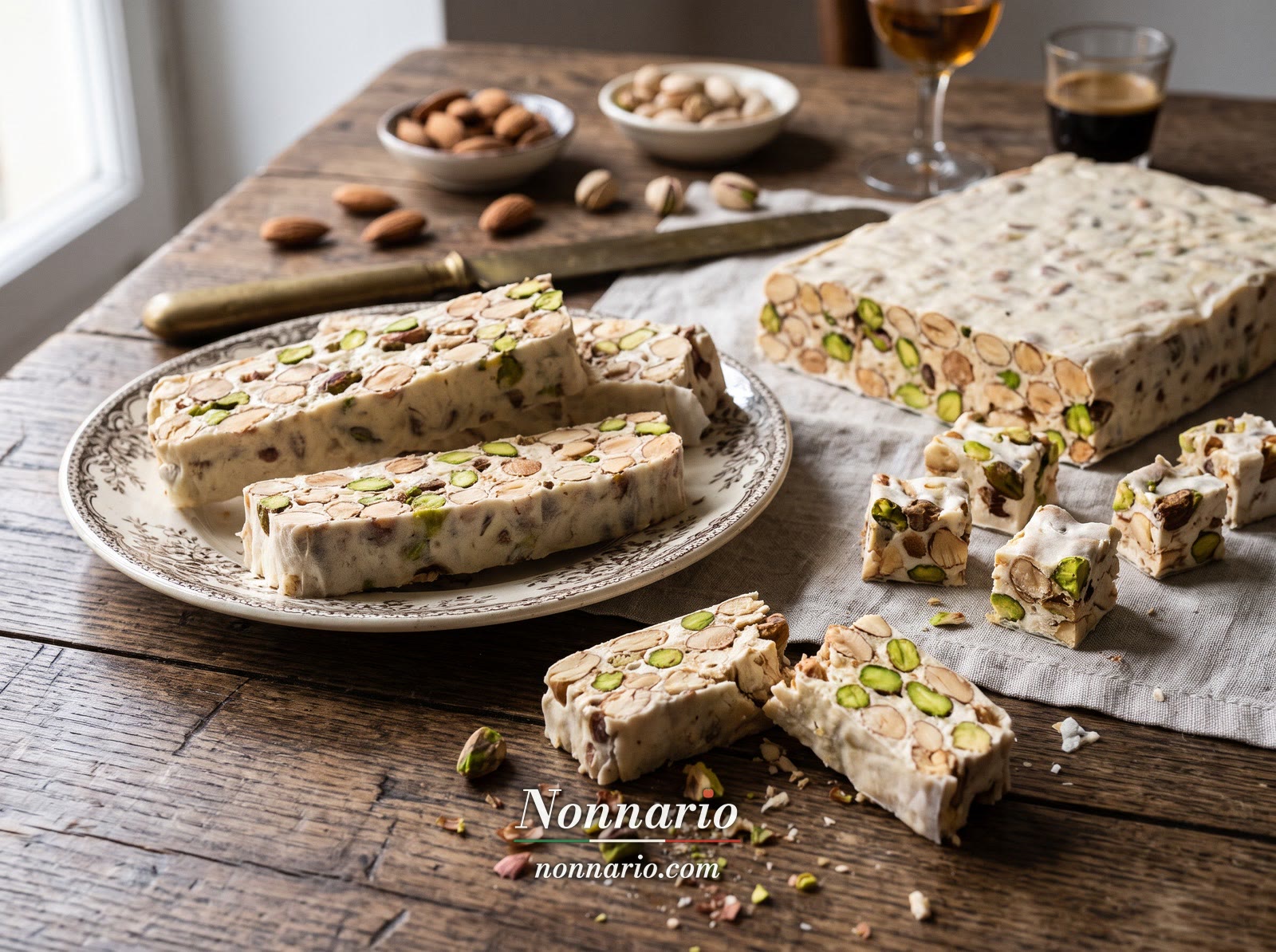
Caltanissetta's honey torrone with almonds and pistachios, cooked slowly for hours
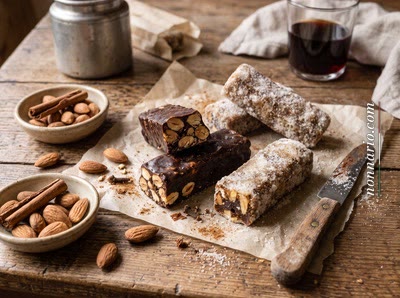
The honey torrone of Caltanissetta, applied for as a PGI in 2025: honey cooked slowly for seven to eight hours, then toasted unpeeled almonds and raw pistachios worked in, spread in a frame and cut into bars that show the nuts in section.
Applied for as an EU protected geographical indication in October 2025 and not yet granted: this page follows the proposed specification published in Italy in May 2025, which may change before the name is registered.
- Course
- DolciDesserts
- Serves
- 20
- Hands-on
- 44 min
- Cooking
- 7 h 15 min
- Resting
- 35 min+
In breve
In short
Also called Turruni, U turruni, Torrone nisseno, Torrone di Caltanissetta Bloc o Classico and Caltanissetta nougat.
- Vegetarian
- Gluten-free
- Honey (wildflower, yarrow or sulla), toasted unpeeled sweet almonds and raw dried pistachios, 45%, 45% and 10%; no colourings or preservatives.
- The honey is cooked for seven to eight hours at no more than 110 °C, over direct heat or in a bain-marie, slowly enough that it does not darken.
- The almonds and pistachios are warmed to the honey's temperature before they are stirred in.
- Spread in a frame with a rolling pin, then cut so that the nuts show in section: the ‘taglio a vista’.
- Wrapped within an hour of cutting: it takes up damp from the air and turns soft and sticky.
La provenienza
Where this recipe comes from
Caltanissetta lies in inland Sicily, among almond and pistachio trees and the hives that give its honey, and its torrone, ‘u turruni’ in dialect, is made from those three. One account traces torrone in Sicily back to the Arabs in the ninth century: a tradition, not a record. From the second half of the nineteenth century the town called itself both the world capital of sulphur and the city of torrone. Eight torrone makers were at work, a survey of the Sicilian economy at the end of that century counted thirty-four people employed by them, and their torrone was sold for Christmas, New Year and Easter in the rest of Sicily, on the mainland and abroad. At the General Italian Exhibition of 1884 in Turin, Salvatore Amico of Caltanissetta won the section for torroni and panforte, ahead of makers from Cremona, Caserta, Este and Siena; Giuseppe Infantolino, supplier to the royal house since 1837, took gold medals at Nice in 1890 and at Brussels in 1891. Eight workshops are still active, and the town holds a torrone festival every year. The honey is cooked slowly for hours in a copper-bottomed cauldron, the ‘quadara’; the finished mass, the ‘fatta’, is spread in beech frames, the ‘tulari’, and levelled with a wooden rolling pin.
‘Torrone di Caltanissetta’ has been applied for as a protected geographical indication by an association of the town's producers. The Ministry of Agriculture published the proposed specification in the Gazzetta Ufficiale on 17 May 2025, and the application reached the EU register in October 2025; the name is not yet registered. The specification covers the plain Bloc o Classico and four versions covered in dark chocolate: Umberto, Elena, Iolanda and Splendor. For the paste it requires honey (wildflower, yarrow or sulla), toasted unpeeled sweet almonds and raw dried pistachios, gives their doses per 100 kg, allows no colourings or preservatives, and sets the method: the honey cooked for seven to eight hours at low temperature, which keeps it from darkening and gives the torrone its compact, crunchy, crumbly bite. Glucose syrup and sugar are allowed in part in place of the honey, with egg white and a shorter first cooking; whether sugar and egg white belong in this torrone at all has divided the town's makers.
This page makes the Bloc o Classico with the specification's obligatory paste only, honey, almonds and pistachios, by its method for honey alone, with its doses divided by 200, for about 500 g, or 20 bars. The doses and the steps are the specification's; the home method is ours, and it has not yet been tested in a home kitchen: the bain-marie, the oven for the nuts, the test that confirms the end of the cooking (the specification names a ‘glass test’ but does not describe it), the sheets of baking paper used in place of a frame, the moment to cut and the size of the bars. The optional glucose, sugar and vanilla are left out; the version with glucose, sugar or egg white is among the variants, and vanilla, which the specification allows in either version, is noted there. Made outside Caltanissetta, it is torrone in the Caltanissetta manner: once the PGI is registered, only torrone made in the town under the specification may carry the name.
- Provenance
- An application to protect the dish in the EU (TSG, PDO or PGI) is under way; this page follows its specification as it stands, which may change before it is granted.
- Defined by
- Ministry of Agriculture (MASAF), proposed PGI specification
- Reference
- Proposed production specification of the PGI ‘Torrone di Caltanissetta’, published in the Gazzetta Ufficiale n. 113 of 17 May 2025; applied for to the EU in October 2025 (file PGI-IT-03459), not yet registered
- Sources
- Gazzetta Ufficiale n. 113 of 17 May 2025: the Ministry of Agriculture's notice of the application to register the PGI, with the proposed production specification (Italian)
- European Commission, eAmbrosia register: Torrone di Caltanissetta (PGI-IT-03459), applied for, not yet registered
- Fondazione Slow Food: the Torrone di Caltanissetta presidium, archived copy of 21 November 2025 (Italian)
- La Sicilia newspaper: the dispute over sugar and egg white in the torrone of Caltanissetta, 26 January 2023 (Italian)
- Balarm, online magazine: the torrone of Caltanissetta and where to taste it, 13 September 2020 (Italian)
- NHS, the UK's national health service: burns and scalds, what to do
- NHS, the UK's national health service: foods to avoid giving babies and young children
Ingredienti
Ingredients
Makes about 500 g, in 20 bars: 20 servings
The torrone: the specification's doses, divided by 200
Equipment
- Kitchen scale
- Oven and a baking tray
- A heatproof stainless-steel bowl about 20 cm across, and a saucepan it sits snugly on (or a double boiler)
- A kettle, to top up the bain-marie
- A sturdy wooden spoon
- Digital probe thermometer reading to at least 150 °C
- A heatproof jug, for the honey
- A glass of cold water and a teaspoon, for the test
- Two sheets of baking paper about 35 cm by 30 cm, a rolling pin and a palette knife
- A large heavy knife, a ruler and a chopping board
- Oven gloves, long sleeves and a bowl of cold water by the stove
- Cellophane or baking paper and an airtight tin, for wrapping
Preparazione
Method
About 8½–10 hours, most of it the honey's slow cooking, so start in the morning: 5 minutes to set out what you need, 15–20 to toast the almonds and 15 for them to cool, then 7–8 hours for the honey in its bain-marie, stirred every few minutes and almost without stopping in the last hour. About 20 minutes before you expect the honey to be ready, put the almonds and pistachios into a low oven to warm. From the glass test on, work without pausing: stir in the nuts, roll the mass out between sheets of baking paper, leave it 20–40 minutes, cut it into 20 bars and wrap them within the hour. Read the safety notes first: the honey stays close to 100 °C for hours and sticks to the skin, and the bain-marie gives off steam all day. By our estimate the batch makes about 500 g, 20 bars of about 5 cm by 2 cm by 2 cm; each serving here is one bar.
- 44 minhands-on
- 7 h 15 mincooking
- 35 minresting, at least
Before you start
The honey cooks for hours close to 100 °C: it clings to the skin and burns deeply, and the bain-marie gives off steam all day. Keep children and pets out of the kitchen, wear long sleeves and closed shoes, cook on a back burner with the handles turned inwards, and keep a bowl of cold water next to the stove.
-
Hands-on 5 min
Lay one sheet of baking paper on the chopping board and keep the second at hand. Weigh the honey into the jug and the pistachios onto a plate, and set out the wooden spoon, the probe, a glass of cold water with a teaspoon, the oven gloves, the rolling pin, the palette knife, the ruler and the knife.
Check The board is lined, the honey is weighed, and everything you need after the cooking is within reach of the stove.
Tip Our guide: there is no butter, oil or wafer on the specification's list; baking paper lets the set torrone go without them.
Tip Burns: if hot honey or steam touches your skin, put it at once under cool running water and keep it there for 20 minutes. Leave any honey stuck to the skin where it is. A very large or deep burn, or one on the face, needs emergency care.
The almonds
-
Cooking 15–20 minTemp 175 °CHeat oven, top and bottom heat, no fanOfficial text
Before making the torrone, give the almonds a heat treatment of 170 °C–180 °C for fifteen to twenty minutes, turning them every five to six minutes so that they toast evenly, until they take on a colour from straw yellow to light brown.
Check An almond cut in half is straw yellow to light brown right through, not white at the centre and not dark, and the almonds smell toasted.
Tip Our guide: heat the oven to 175 °C, the middle of the specification's range, spread the raw almonds on the tray in one layer and turn them with a spoon every 5–6 minutes. The colour decides, not the clock.
Tip Wear oven gloves for the tray, and cut a test almond on a board, not in your hand: a hot almond is hotter inside than it looks.
-
Rest 15 min
Tip the almonds onto a plate and leave them to cool, then weigh out 225 g.
Check Cool to the touch, crisp when bitten, and 225 g on the scale.
Tip Our guide: keep any almonds left over for another use; the specification's dose is of toasted almonds.
Tip Turn the oven off for now: you will need it again, at 100 °C, near the end of the honey's cooking.
The honey
Seven to eight hours at a gentle heat: the long, slow cooking is what makes this torrone, and it must not be hurried.
-
Cooking 7–8 hHeat low, a bare simmer under the bowlOfficial text
Put the honey in the pan, preheated to no more than 110 °C, and cook it over direct heat or in a bain-marie for seven to eight hours, the time needed to obtain, stirring, a smooth, compact, workable mixture without lumps.
Check After seven to eight hours the honey is a smooth, compact, workable mass without lumps, which turns over in one piece when you stir it, and it has stayed light in colour. The glass test in the next step confirms it.
Tip Our guide: half fill the saucepan with water, bring it to a bare simmer and set the empty bowl on it for about 5 minutes to warm, then pour in the honey from the jug. This is the specification's bain-marie and its preheated pan; in it, by our estimate, the honey stays a little under 100 °C, inside the specification's ceiling of 110 °C. A probe in the honey now and then shows where it is.
Tip Our guide: the specification stirs mechanically. At home, stir with the wooden spoon every few minutes at first, scraping the sides, then more and more often as the honey thickens, and almost without stopping in the last hour.
Tip Our guide: keep the water at a bare simmer and look at it every half hour; top it up with boiling water from the kettle, poured slowly down the side of the saucepan, never into the honey. A bain-marie left to boil dry scorches the honey.
Tip The honey must not darken: the low heat is what keeps it light, ivory to straw yellow once the torrone is finished.
Tip Our guide: about 20 minutes before you expect the honey to be ready, heat the oven to 100 °C, spread the almonds and pistachios on the tray and put them in to warm.
Tip Lift the bowl with oven gloves, and stand back from the steam when you do.
-
Hands-on 5 min
Drop half a teaspoon of the honey into the glass of cold water and leave it for a minute. Lift it out and bend it.
Check It is hard, and it snaps cleanly, like glass; it does not bend, stretch or feel tacky. With the specification's smooth, compact, workable mass, the honey is ready.
Tip Our guide: the specification names the ‘prova vitrea’, the glass test, among the skills of the town's makers, but does not describe it. This is our version, the usual cold-water test for cooked sugar.
Tip If the drop bends or is chewy before the 8 hours are up, cook on, stirring, and test again every 15 minutes.
Tip Our guide: if after 8 hours it still bends, use the specification's other way for at most one hour more: take the bowl off the water and put it over the lowest flame on a heat diffuser, stirring all the time, with the probe at no more than 110 °C, and test every 10 minutes. If it still bends after that hour, stop there and go on, as long as the mass is smooth, compact and workable: the torrone will be less crunchy, but more heat would darken it.
Tip Test with the spoon and the water, never with your fingers, and never taste the honey from the bowl.
-
Hands-on 5 minOfficial text
Add the almonds and pistachios and blend them in, having first warmed them to the same temperature as the mixture (at most 110 °C): this is the ‘fatta’. By the end, the almonds and pistachios must be evenly spread through the mixture.
Check No patches of honey without nuts are left, and the almonds and pistachios are spread right through the mass.
Tip Our guide: wearing oven gloves, take the warm nuts from the oven and tip them into the honey all at once, leaving the bowl on the bain-marie; fold them in with the wooden spoon, turning the stiff mass over from the bottom, for about 5 minutes.
Tip Cold nuts would chill the honey and stiffen it before they were mixed in.
Shaping and cutting
Work while the mass is warm: it stiffens as it cools.
-
Hands-on 2 minOfficial text
Take the mixture out of the pan.
Check All the mass is on the lined board, scraped from the bowl with the spoon.
Tip Our guide: wearing oven gloves, lift the bowl off the water, dry its base with a cloth so that no water drips onto the paper, and tip the whole mass into the middle of the lined board.
Tip The specification turns it onto the work table and divides it into blocks of 1.5 kg–4 kg; this batch, about 500 g, is one smaller block.
Tip Pour the bain-marie water away only once it has cooled, and fill the bowl with warm water to soak: the set honey dissolves.
-
Hands-on 5 minOfficial text
Spread it by hand with the help of a rolling pin.
Check An even, flat slab about 20 cm by 10 cm and 2 cm thick, with straight, square sides.
Tip Our guide: the specification spreads it inside wooden frames; at home the paper and a ruler stand in for one. Lay the second sheet of baking paper on the mass, press it out with your gloved hands into a rough rectangle, then roll the pin over the paper until it is about 2 cm thick. Lift the top sheet, push the sides in straight with the palette knife or the ruler to about 20 cm by 10 cm, cover again and roll once more to level it. The hot mass sticks to wood and skin; the paper keeps it off both.
Tip The specification allows a height of 0.5 cm–3 cm; aim for about 2 cm.
-
Rest 20–40 minOfficial text
Leave it to cool to a temperature that allows it to be cut.
Check Cool enough to cut cleanly: firm right through, so that a fingertip pressed on the paper leaves no dent.
Tip Our guide: about 20–40 minutes for a slab this thick, by our estimate.
-
Hands-on 10 minOfficial text
Cut it into pieces of the sizes given for the Bloc o Classico (3.5 cm–35 cm long, 0.5 cm–3 cm high, 1 cm–6 cm wide, 10 g–500 g in weight), so as to give it the ‘taglio a vista’: the honey, the almonds and the pistachios in full view, the nuts cut through face on.
Check Twenty bars of about 5 cm by 2 cm by 2 cm, with clean faces in which the almonds and pistachios show cut through.
Tip Our guide: the specification cuts it with a cutting machine. At home, peel off the top sheet and leave the slab on its lower sheet on the board. Cut it along its length into 5 strips 2 cm wide, then each strip into 4 bars of 5 cm, pressing a large heavy knife straight down rather than sawing.
Tip Our guide: by our estimate each bar weighs about 25 g.
-
Hands-on 10 minOfficial text
Wrap it within at most one hour of cutting, so that the torrone does not absorb moisture from the air and soften, turning sticky to the touch.
Check Every bar wrapped on its own and closed all round within the hour, and the tin shut.
Tip Our guide: wrap each bar in cellophane or baking paper, twisting or folding the ends, and keep them in an airtight tin in a cool, dry place.
-
Hands-on 2 min
Unwrap the bars and serve them.
Check A bite is compact, crunchy and crumbly, breaking into small grains, with the sweetness of the honey balanced by the almonds and pistachios.
Tip Not for babies: honey should not be given to a child under 1 year old. Whole nuts should not be given to children under 5, who can choke on them.
The essentials, for cooks who know the dish. Switch to Detailed for quantities, temperatures, times and checks at every step.
Press “I’m here” on the step you are on, and again when it is done.Tap the pin on the step you are on, and the tick when it is done. Timers keep running while you scroll.
Da sapere
Good to know
- WhenQuando
- Winter, and above all Christmas: a sweet of the winter months and the Christmas holidays, now eaten in the other months too. At the end of the nineteenth century it was sold for Christmas, New Year and Easter. Source
- KeepingConservazione
- Wrapped within an hour of cutting: in damp air it softens, turns sticky to the touch and loses its crunch and crumble. Source
- VariantsVarianti
- With glucose, sugar and egg white: The specification's other method, for a paste with glucose syrup, granulated sugar or egg white, any one of them or more: glucose (13%) and sugar (12%) may stand in for part of the honey, and the egg white is given no amount. The honey with the glucose and/or the sugar is put in the pan, preheated to no more than 110 °C, blended and cooked over direct heat or in a bain-marie for 120–180 minutes, stirring, until smooth, compact and free of lumps; then the egg white is added and the cooking goes on, stirring, for five to six hours. In either version, powdered vanilla or vanillin may be stirred in for two to five minutes once the cooking is done. Source
- Umberto, Elena, Iolanda and Splendor: The four versions covered in dark chocolate (at least 52% cocoa), tempered by melting it at 44–46 °C and cooling it to 31–31.5 °C. Umberto: the cut bars, 80–130 g, veiled in chocolate. Elena: smaller bars, 30–60 g, of the paste as it is, or ground, reheated in the oven and set again in frames, then veiled. Iolanda: thin strips of the paste set in concave frames into small half-cylinder tiles, filled with a cream of almonds and sugar and veiled. Splendor: the paste ground, reheated and shaped into small cylinders 1–2 cm across, then covered. Source
Errori comuni
Common mistakes
- Turning up the heat to save hours: the long, slow cooking at no more than 110 °C keeps the honey from darkening and gives the torrone its crunch.
- Stopping the honey early, before seven to eight hours and before it is a smooth, compact, workable mass (the glass test confirms it): the torrone stays soft and sticky.
- Letting the bain-marie boil dry: the honey scorches.
- Adding the nuts cold: the specification warms them to the honey's temperature first; cold, they stiffen the mass before they are mixed in.
- Using blanched or salted almonds, or roasted or salted pistachios: the specification asks for unpeeled sweet almonds, toasted, and raw dried pistachios.
- Leaving the bars unwrapped: they take up damp from the air and turn soft and sticky.
- Testing the honey with your fingers or tasting it from the bowl: it is close to 100 °C and clings to the skin.
Fuori dall'Italia
Cooking it outside Italy
- Millefiori honey is sold as wildflower honey; the specification allows it alone, so yarrow or sulla honey is not needed.
- Buy whole natural almonds with their brown skins, not blanched, roasted, salted, slivered or flaked ones, and toast them yourself.
- Buy whole raw shelled pistachios, unsalted, not roasted or chopped ones.
From nonnario.com/recipes/torrone-di-caltanissetta/, where you will find its sources, its story and the step photos. Sources checked in November 2026.